teisipäev, september 12, 2006

"The only post-communist Nordic country"

As you may have noticed, I have changed the subtitle of my blog to remind readers that Itching for Eestimaa is about "the world's only post-communist Nordic country." I thought about what exactly that means and why I chose to pay homage to a speech by foreign Estonian Foreign Minister Toomas Hendrik Ilves from 1999, and it came back to the dilemma that Ilves and I, both - at least at one point - Americans, have found ourselves having to do. Explaining to others what exactly Estonia is if it is not just another Slavic country in East Europe, like most of the other countries that end in "ia" - Slovenia, Slovakia, Croatia, etc. etc.

The first comparison most reach for is Finland. Most people have heard of Finland. They are aware that it is cold there and that it snows a lot and that the people like skiing and taking saunas and are quite often blonde. And that's not a bad way to get people started on understanding a peculiar mostly unknown nationality.

In the global media though, and in most International Affairs curriculi, and in Estonia as well, Estonia is known as a Baltic country or state, or sometimes even republic. This is frequently confused with Balkan - which is very different but similar sounding. Baltic means some basic things to people - formerly Soviet, small, on the border of Russia, on the Baltic sea. For the history buffs they might know something of the Teutonic knights, or the Baltic German manor houses that once dotted the land. But while this appelation helps describe geopolitical location and common history, it doesn't really say much about the Estonians as a people.

And what can be said about them? They are on the quiet side, on the blue eyed sandy haired side. They like to drink - they drink beer and vodka and both. They eat a lot of fish and potatoes and use the Internet like it was some third undiscovered side of their brain. They like berry picking and hiking through bogs and their folklore is filled with menacing woodland trolls and centers around the distressing and violent tale of an Estonian guy named Kalevipoeg. They have names like Signe and Hannes and Heiki and Tuuli and Juhan. And before you know it, you aren't discussing Estonians anymore. It seems like you are talking about Icelanders or the Faroese or Finns. You are talking about a Nordic people - and that's when they ask you.


"Are Estonians Scandinavians?" You would like to say yes, because that would be so easy to file away these people in a well-known drawer of humanity. But you can't, because the Latvians will tell you that the Estonians should get back in line and remember that Riga is the capital of the Baltics, and the Lithuanians will accuse then of thinking too high of themselves, and the Finns will look down their noses and snicker at the concept that their backward cousin wants to join the Arctic Circle club, and the Swedes - well, we won't even go there.

But regardless of what others think, you are still at a loss to describe the basic culture of Estonians. And that's where the N word comes in, Nordic, because you really can't think of a better word to describe them. It leaves enough wiggle room to make sure you won't insult Scandinavian pride, but it also allows you to easily characterize a people for those who wouldn't know Tallinn from T'bilisi.

What better way to describe the absurd and slightly disturbing cartoons of Priit Pärn, or the heavy morality of Tammsaare, or the forbidding poetry of Gustav Suits. How better can you explain why the characters in Õnne 13 rarely smile then ask someone if they've ever seen an Aki Kaurismäki film? It's just too easy to reach for the magic 'N' word and wave all the questions away.

And because this blog deals greatly with what exactly Estonia is and what is going on there, I too couldn't find a better way to sum the country up for others. I hope you don't mind.

esmaspäev, september 11, 2006

Days to Remember

I once stood in a Manhattan office building on the second floor listening to a group of music journalists discuss the plans for the coming three issues of their popular music-oriented magazine. "You're really going to hate the September issue," one of them said to the group. "It's going to be the tenth anniversary since Nevermind came out, and we are going to do a special on Nirvana."

Everyone groaned. But they knew it had to be done. This was 2001, and, yes, Nevermind would be 10 years old that autumn. But Kurt's death had been so regularly discussed and recycled and discussed again, you would of thought it was somehow connected with the assasination of President John Fitzgerald Kennedy in 1963. He had graced many a cover of many a magazine - usually when the magazine had no better news to run.

Cobain suicide-intrigue had become, sadly, the equivalent of playing A Christmas Story the weeks before Christmas on TV. It was a pop culture ritual - one we all knew the words to, but still managed to read on - hoping for another nugget we hadn't quite digested the last time.

I remember where I was when Cobain blew his brains out. I had just come home from school. And as I switched on the radio and tuned through the stations, I found it a tad eerie that every station was playing Nirvana. Then I found out that Mr. Cobain was dead. I really didn't like that feeling. In the early 90s there was something of a pop culture/rock/youth renaissance. And he and his band really made that happen. So that night I couldn't help but think to myself how shitty it was that "our" poet - the guy who always managed to make things a bit more interesting - had killed himself so brutally.

But as the years went on, I became immune to talk of his death. He was just a singer, sure. Those feelings concerning his death were dark, yes. But how many times did I have to read about it over and over again. How many times did I have to look at a newspaper stand and see his agitated blue eyes peering back at me, saying "I'm not dead yet."

And slowly all conversation about his death turned me off. I just didn't want to talk about it. Talk, in a sense, made the feelings cheap. Ordinary. Dull. Why would I want to relive the same feelings over and over and over again. What good would it do? It was 2001, right? Not 1994. I was 22. Not 15. It was the present. Not the past.

Today on my way to work I passed many magazines and newspapers that have commemorated the attacks of 9/11 on their covers. But instead of acting to memorialize the dead, they seek to help you, dear reader, for the umpteenth time, relive the horror. One paper was black and just had the times the planes hit - so you can look at your watch and think deeply about the pain and the horror those planes caused people. Others showed smouldering buildings about to fall - so you could remember an action so heinous happened right here, in our busy seaside town.

For those of you who really just want to live September 11, 2006 just like September 11, 2001, CNN is airing the full coverage of the event on its website "free, in real time." You can also rent Flight 93, the television film about the events now. It was just released on DVD.

About 3,000 people died here that day. That's a drop in the bucket compared to the people the tsunami carried off in 2004, but it's much easier to deal with an act of nature than a coordinated act by individuals. Those people that died here are still dead and always will be. Down the street from my home someone lost a son - a firefighter. His mass card is laminated and stapled to a tree. I think about that guy and how he died everytime I pass that tree. It doesn't matter if it's September 11 or May 9 or January 22, I see that guys face and I think about him and the people like him.

Maybe for some other people things like yellow newspapers peddling grief and destruction and television news programs immortalizing things we know too well ad nauseum are part of the coping process. But to me they just seem to be making a buck off people's interest in death. Deep down, it's some sick, cheap rollercoaster ride. On the surface it isn't, but deep down it tickles something in people that keeps them coming back. It's like watching the Zapruder film in the Oliver Stone film JFK. People watch it over and over again and never get tired of watching their executive get shot in the head.

Can you imagine if, in the Civil War, Americans had video cameras? And every anniversary of some horrific bloodshed, like Gettysburg, they showed footage from the battle, in real time, just so you could relive the excitement of watching armies of grown men massacre each other? Or how about if they embedded reporters at the storming of Omaha Beach in World War II, with cameras on their helmets. Just so you could relive the terror and carnage in the comfort of your home.


It sounds sick, doesn't it? It is.

pühapäev, september 10, 2006

She wants to meet 'regular Estonians'

According to a report in Postimees, when Queen Elizabeth II visits Estonia on October 19 and October 20, she won't just want to meet with the debonnaire Arnold Rüütel (should he be reelected). She'll also want to meet the people of Estonia, you know, the real nitty gritty populace.

Elizabeth only has two days in Eestimaa, but I am sure she can pack a lot into them. If she really wants to get a flavor for Estonians, I am sure that we can discuss ways to connect Her Majesty with everyday Estonians.

For the Tallinn experience, Her Highness could visit a nail salon and inhale fumes for an hour and a half, then get whisked away to the tanning salon for some rest & relaxation. Then later she can dine on dry reindeer meat at Olde Hansa. She can follow that by getting drunk and spray painting the Union Jack all over the Pronkssõdur.

For the country experience, may we suggest a date with Enn at the neighborhood pub in Võhma. They can dine on fried herringas or fried pelmeenid, and, of course, kartulisalat. I'm pretty sure the evening would conclude with a unisex nude sauna, some Gin Long Drinks, and maybe a nude swim in nice boggy Estonian lake. And maybe some berry picking/potato digging.

And that's just for starters. There's a lot of ways Elizabeth II can get to know everyday Estonians. Does anybody else have any suggestions for her itinerary?

neljapäev, september 07, 2006

Bush and the Border Treaty

Bush is coming to Tallinn:
TALLINN, Estonia U.S. President George W. Bush will visit Estonia before a NATO summit in neighboring Latvia in November, Estonian officials and the White House said Thursday.

Bush will stop by the Baltic country on Nov. 28 for talks with Estonia's Prime Minister Andrus Ansip and President Arnold Ruutel, officials said.

Ruutel's office said the 78-year-old head of state invited Bush to visit the country of 1.3 million on his way to the NATO summit in Riga, Latvia, on Nov. 28-30. Estonia joined the alliance, as well as the European Union, in 2004.

The former Soviet republic is a close U.S. ally, with troops serving in Iraq and Afghanistan.

A White House statement said the president's trip would underscore NATO's role in "fostering a Europe whole and free."

It said the visit would highlight "new allies that have successfully transitioned to free-market democracies, contribute to the war on terror and offer lessons learned and expertise to others pursuing liberty."

The United States never recognized the incorporation of Estonia, Latvia and Lithuania into the Soviet Union in 1940, and has kept close ties with the three countries since they regained their independence in 1991.


I am glad they referred to Estonia as a Baltic country rather than the dreaded "Baltic republic." Still, they managed to work "former Soviet" in there. It's also "former Swedish province of ..." too. I wonder if that was common in the eighteenth century...

Anyway, no matter what you think of him, Bush will be the first US president to visit Estonia. Clinton has been there, but not while he was in office. None of the presidents from Wilson through Roosevelt made it there the first time around.

What does it mean? The US is an important country of 300 million people. Bush is among the most high profile of world leaders. That's a lot of free publicity for a small northern European country.

BORDER TREATY BLUES

In other news, Estonia and Russia are still at an impasse over that pesky border issue.

A deputy Russian foreign minister said Thursday that Russia insists on resuming negotiations on a border agreement with Estonia to avoid any future territorial claims.

Vladimir Titov said Russia was seeking further talks to prevent a situation when Estonia could make territorial claims against Russia using a border agreement that the two sides signed. Estonia ratified the agreement but Russia refused to follow suit after Tallinn inserted some new provisions.

"The problem is that they [Estonians] included provisions in the ratification law that can be seen as legally entitling them to make some territorial claims on us," Titov said.

The two countries signed border agreements on May 18, 2005, and the Estonian parliament ratified the documents on June 20, but with additional demands linked to the 1920 peace treaty between Soviet Russia and Estonia. On September 6, Russia notified Estonia that it was revoking its signature from the treaties because the 1920 document was no longer valid.

Titov said more than a month ago Russia had proposed including a provision "that all the previously signed agreements and treaties in bilateral history outlining the border line are invalid."


Estonia's basic position is that the preamble of the border treaty does not affect the border treaty's content and therefore there is no need for further border talks. Russia though, seemingly paranoid about land claims from Tiny Estonia, won't sign it. There are some undercurrents about the Tartu Treaty of 1920 and the Occupation - Russia says that the Tartu Rahu isn't valid and that the Occupation was a liberation - but aside from that I wonder who will have the good sense to put this thing to rest.

I could see, for example, Estonia passing a document that renounced its title to the land in the Tartu Peace Treaty of 1920 not covered in the current agreements. But, as Postimees pointed out in an editorial recently, who knows what displeases and pleases the Russians. Why should Estonia have to twist and turn so that Russia will sign its name to the border treaty. And now that Estonia is in the European Union and NATO, what difference does all this make?

kolmapäev, september 06, 2006

9/11 Stories

I am now soliciting stories about individual reactions to the 9/11 attacks for a story that will appear in Postimees next week. Please free to add your stories - with knowledge that the content may be published - in the comments section.

The date was not September 11, 2001. It was July 4, 2000. And I was in lower Manhattan dragging around a video camera to chronicle Operation Sail 2000 - a big party where big boats circled the tip of Manhattan and big drunks from all over the Big Apple drank a lot of big beers. I was there from early morning to late evening and, after the big fireworks display, I proceeded to follow the masses to the nearest subway stop to get on the train home. Unfortunately, the subways were packed with people. Festering with humanity. And I had to pee. Bad.

It seemed like I oscillated from east to west as I walked up the island in search of a new subway station. I didn't know this part of Manhattan that well as I was pretty lost. Finally I found a large building that was still open. It was next to another very large building and everything in the vicinity seemed tremendously huge. I did my business in the bathroom there and came out. It was then that I looked up. And looked up some more. In fact, I couldn't really see the sky here. It was like being in one of those large fictional cities of the future you see in movies. "So this is the World Trade Center" I thought - feeling like an explorer catching his first glimpse of the Sphynx. "Wow."

***

I spent the summer of 2001 commuting between Manhattan, where I had an internship at a magazine, and Long Island, where I held a job in construction. I was in New York three days a week until August 1, when my internship abruptly ended and the department I was serving was downsized (ie. everyone I was working with got fired). I then waited for a few weeks before I was scheduled to begin my study abroad program in Copenhagen, Denmark.

At that point, I expected some things out of Denmark. I anticipated drinking a lot of beer, for example, and perhaps the ability to have relations with several nice looking Danish women. And ... I think that's about all I expected. Actually I was very happy to get away from sterile Washington, DC and out of the new George W. Bush-ruled United States. I really didn't like George W. Bush. Despised him in fact. Some people, during the Clinton years, seemed to have an irrational hatred of Clinton. I had something like that for Bush. We have a habit of electing southerners president - because southern states are even more provincial than northern states and refuse to even vote for a northerner for higher office. But Bush's Texas drawl just annoyed the ever loving shit out of me. I couldn't watch a minute of one of his speeches. I didn't need to anyway, as he rarely said anything worthy of discussion and still hadn't mastered the art of reading from a teleprompter.

So I had high hopes for Denmark, but they were shattered within a week or two. I found myself sandwiched in between preppy American students, whose conversations seemed so boring I couldn't really take part, and then when I did, I was ignored because whatever I said did not register with them, and Danish students, who looked like they worked for hours on their hair, listened to the worst music ever made, and seethed discomfort with the loud, rude American students - those students whose country sold weaponry to the Israeli Defense Forces to use on helpless Palestinian children. The immense amount of social pressure I felt weighing down on me, along with the reality that I had signed myself up for three months in a quiet Scandinavian city, brought me to go to the independent city of Christiania and buy some really good hash cookies.

I had never done a drug like that before. It was truly a psychedelic experience. A new plateau of consciousness. Not necessarily a good one - more like a rocking boat on a stormy sea. But when the ride was over I found myself content to be alone more often and not worry about those social pressures. So I sat in the computer lounge a lot. And I was sitting there in the computer lounge on September 11, 2001, when someone said ...

You know what they said. They said a plane had hit the World Trade Center. Like everyone on planet Earth, I shrugged my shoulders. We all thought it was a little plane. Not a big plane. But there were two big ones. And both buildings collapsed. The immense sickness I felt in my gut was nearly too much to bear. I went next store to the bar and drank three or four shots of vodka, hoping to numb to uneasy pile of disgustingness at the bottom of my stomach.

My brother worked in Manhattan. Not in the trade center. But who was I to know where he was at that particular moment. An image of him, lying in a pile of rubble with his chest blown open and his guts spilled out everywhere came to me. I tried to keep it away, but it was there. He was there, his eyes glassy and fish-like, gasping for air and dying. I couldn't be around people. I even walked to the administrative building at our "campus" (really just a few buildings in Central Copenhagen) and hid in the toilet there - there where I could get some peace.

I called my father. He seemed sad but calm. He kept said that "a lot of people were in the towers" and "thousands of people are probably dead." I asked about my brother and he said that he didn't know where he was. How could he not know! The event had just happened. He called me back pretty soon afterwards and told me that all of our family was safe. And in a way, that was all I needed to hear. I could live with the deaths of the faceless, but I couldn't live with the deaths of my flesh and blood. It was selfish but true.

That evening I went to my dormitory and settled down to watch Paula Zahn on CNN quote FDR and watch the towers fall over and over again. I kept waiting to find out who did it. But that wouldn't come for at least two more days. The fellow Danish students were generally concerned for us. The image that remained in my head was the people jumping from the buildings. Everything about their deaths seemed so cold and forbidding. Here they were in a cold, gray, steel high rise of a building, surrounded by gnashing metal, and jumping in the still September air to their deaths in the wreckage below. There was something so dark ... so clinical about it. That's all there was. Just a leap and a death. And it was over for them. It was over for so many people. It was - for me - a passionless death. It was someone holding a gun to your head and telling you to commit suicide.

On the wall of the train station the next day was written a new word. A word I came to know quite well. It was "jihad" written in black magic marker. It meant "holy war." I was scared. There were people that sympathized with this act in my community. People that could look at me and see right through me. Who saw my death as justifiable, just because of the country on my passport. I couldn't fathom this mentality and it frightened me. I usually thought myself open minded. I wasn't, for example, shocked that people out there hated the US. But I couldn't understand how you could just mercilessly and purposefully kill random individuals and call it acceptable.

And because I couldn't understand that, I was frightened by it. And the thing is, I never thought of my people as "Americans." To me we were - and are - just people that happen to live in the US. What did all these people really know about our policies in Israel, for example. In what way did they actually contribute to whatever it was that fueled the hatred that led to widespread massacres of innocent lives? The whole thing just didn't make sense. When I found out it was teams of young men that carried out the strikes against us - two words came to mind "useful idiots."

I wiped the word "jihad" off the wall with my hand and later boarded a bus to the north of Denmark. In a town called Aalborg my friends were busy seducing some local girl but I just couldn't put on my party face. All I could talk about was the death. Maybe it was less real for the Californians and Georgians and Tennesseans on my trip. But for me, for that week, I couldn't really do anything. I couldn't even listen to music. All I could think about was the death. Up until that time, I was on a messageboard for leftwing activists from Washington. They were busy preparing to protest the forthcoming war on Afghanistan. I was so disgusted. 9/11 had hurt so many, but it hadn't damaged the academic left's desire to organize a protest to something - whatever that was.

One of my friends, a guy who also was active in activist circles sent me a letter sympathizing with me. "Those kids are idiots," he said. "We need to find whoever did this and blow them to pieces." And I even managed to listen to all of George W. Bush's speech on September 12, or was it 13th? I can't put it all together in my head now, it's all a bit blurry.

I'll never forget the face of my friend standing on the shore near Skagen though, in Denmark. He looked up at me and said simply "I'm scared." I had images of being drafted into service and being sent to fight some Biblical war. I even thought of staying in Denmark should someone try to force me to do anything. Whatever the case was, the idea of the government taking possession of my life didn't suit me. I was an American, this much was true. But I would always be myself first, without a nationality or a loyalty. My very heartbeat and breath seemed more important that anything at that moment. It could be seen as cowardice. Sure. But that's how I felt.

****

On the Saturday after the event, I put on music again. It was a sunny day. I opened the windows in my room and, for the first time in a week, the grayness of death had escaped my mind. I could go on. Some people in my dorm avoided the topic altogether. They refused to even discuss it. It was too much for them. For example, a new TIME magazine sat on the table in the communal kitchen and one fellow student, and American, refused to to even look at it. "Look, I just can't deal with it," he said.

Others, the Europeans, played with ideas. A German student reminded me of all the people that had died in Vietnam, felled by US bullets. "No country has a clean past, not even Germany" I mustered. "What has Germany done in the past 50 years," he responded. "Nothing," I said. "But what about the past 60 years." He was silent.

The Somali in our dorm was usually friendly to me. One day he and the German both toyed with the word "jihad" again, playing on my American paranoia. I don't recall exactly what they said, but I think it has something to do with the Somali conspiring to kill me. I couldn't find it funny.

And there were lots of Muslims - or people from Muslim countries - in Denmark. You could see them down at any nightclub on a Friday night. The guys would be slick in black clothing, and they almost always had blonde Danish girlfriends. I almost never saw a Muslim woman though dancing with a Danish guy. This, to me, always seemed strange. They seemed invisible. But maybe I don't know what I am talking about. If they were there, I didn't notice them.

These kids seemed integrated. But at every falafel hut there would be men with beards reading newspapers in Arabic. Their world seemed so different. They came to live here in Denmark, but they probably only spoke enough Danish to sell you your falafel sandwich. They didn't seem like the kinds of guys who would share a beer with you. They didn't even seem to look into your eyes. I remember one guy was reading a newspaper in Arabic with the photos of the hijackers. "What did it say?" I wondered. "What is he thinking." It seemed like there was a wall between us. Something that could not be bridged. I remember cooking sausage in the communal kitchen and the Somali student covered his plate so that the smoke from my sausage wouldn't taint his food.

On a lighter note I remember sharing some food with Pakistanis at the kitchen table. They were of this subpopulation - conservative and cut off. I was a sore thumb to them, an American with bad manners who hadn't shaved that weekend. But we did share some some good food. And nobody got their head chopped off.

****

As the month rolled on we attacked Afghanistan. It took a whole month to assemble a nice coalition. And in the end we had no Osama bin Ladin. It was he I wanted. He I wanted to be taken alive, put on trial, locked in a cell with Manuel Noriega and forced to eat pork sandwiches everyday. But they couldn't find him. Later, when I returned to the US in December, the drum roll for the war in Iraq had already started. The focus went elsewhere. Public enemy number one took a backburner to Saddam Hussein. It was all quite surreal.

Back in the US, things seemed to be actually the same. I was expecting something different, but other than a lot of funerals and a lot of American flags displayed I was glad to see the whole place hadn't gone to hell. I went to visit the trade center site with my parents - to see where this big thing had actually happened. On the blocks around the trade center site there were gentlemen selling souvenirs - commemorative books and flyers and anything you can imagine that would capture that special "moment" for you and your coffee table.

A huge crowd of people were gathered around the gaping wound in the earth, and I distinctly remember a small kid asking his father if there were any "dead people in there." But being there, actually looking at the ground, reminded me even more that it was something that happened. It was something in the past. A past event. All we could do now was look at this hole in the ground and think about it. And where could our thoughts lead to? Anywhere.

***

Today, nearly five years later, Osama bin Ladin is still at large. We never caught him - can you believe that? Can you believe the most powerful country on earth lacks the political or moral or actual will to reach into the caves of Pakistan and pull that squirming, self-appointed prophet out by his beard?

The US hasn't been attacked for five years, but it doesn't mean it won't be attacked again. All we New Yorkers can do is sit and wait. Will the authorities protect us? They can't even decide on a building design for the new trade center site. I'd personally prefer that no World Trade Center-like building goes in there. But who am I? Just a little peon on the Internet.

Because of the surreal turns that have taken place since 9/11 it's hard to figure out exactly what has happened since and what has to do with 9/11 and what doesn't. Is the Iraq War part of the response? Bush says "yes" but Bush's advisors had been planning the military removal of Hussein even prior to his presidency.

There have been other attacks too - in Bali, in Madrid, and last year in London. Each time the same images come back to haunt me. The grayness of death. The finality of mortality. The purposelessness of slaughtering innocents. In December 2001 I attended a rooftop party in lower Manhattan. Standing there looking at the absence of those two buildings, I couldn't help but think of how stupid those men who killed themselves and 2,900 others were on that day.

They thought they could change the world in an action. They thought that they could provide a cause and provoke an anticipated effect. But they didn't. They didn't accomplish anything. Their efforts were worthless. Their lives, useless. And in the end nearly 3,000 people were irrationally murdered for the selfish purposes of confused and sick individuals. There was no logic. There was only chaos and then more chaos.

How could anybody be so foolish?

Historical Revisionism

The photo to your left is one of Nazi German and Soviet Russian soldiers sharing a chuckle in Brest-Livotsk in September 1939. They are sharing a moment because they have just finished dividing Poland under the terms of the Molotov-Ribbentrop Pact, signed that August. The Soviet Russians and Nazi Germans were allies under that pact. They were allies until Germany reneged on that pact when it invaded the USSR in 1941.

However, in Stalin World, the Soviets and Nazis were always enemies. Mortal foes. It was fascism versus communism and communism triumphed. This is the interpretation of this period of history as espoused by the Council of Russian Communities in Estonia, who sent a letter to Prime Minister Andrus Ansip and Jüri Ratas this week requesting that they allow people lay flowers at the memorial to the Soviet soldiers who took Tallinn in September 1944.

The context is the Estonian Presidential Election, and how any barricade could effect the outcome.

“We do not exclude that in connection with Estonian authorities’ ban of any political activity near the monument, on September 22, acts of civil disobedience to authorities and clashes with police, which can result in victims from both sides and unpredictable political consequences, may take place.”


According to the authors of the letter, "they considered monument at common grave of Soviet soldiers to be monument in honor of all people, who died in struggle against German Nazism liberating Estonia. According to them, it is a considerable part of the 20th century’s common history, which may not be changed in connection with peculiarity of the current moment. Those, who do not respect their own history, do not have future, the statement’s authors stressed, categorically opposing to revision of outcomes of WWII."

But if you read up on the history of the Holocaust, that which the Nazis are most frequently condemned for (along with the territorial invasions), you'll find that it's first real euthanasia campaign started in 1939 while the Soviets and the Nazis were allies.

The Soviets had no problem shaking hands with a Nazi Germany that euthanised its own citizens. It wasn't an issue when they carved up Europe in 1939. The issue was territory and when the Soviets got their hands on this little clump of land on the Baltic Sea it took 50 years, a Baltic Chain, a Singing Revolution, and coup for them to give it back to its rightful owners.

Under the premise of spooky Stalinist history, everything the USSR did up until the very moment that Nazi Germany invaded the USSR in 1941 was just fine, including the partitioning of Europe. Because how can you condemn the actions of your enemy when you yourself abetted that enemy, shook hands with him, signed territorial agreements with him, and worked together to destroy both foreign governments and people?

Whose historical revisionism then is less rational?

teisipäev, september 05, 2006

Danes Foil Terror Plot in Odense

The Danes did something right this week. They caught a few young suicidal gentlemen before they decided to not only blow themselves up, but kill others in the process as some sort of political statement.

Danish authorities said they foiled a serious terror plot Tuesday with the arrest of nine men accused of preparing explosives for a planned attack in Denmark.

Investigators were not sure how advanced the plans were but said they decided to launch a pre-emptive strike Tuesday after keeping the group under surveillance for some time.

"The clues police found indicate that they were very likely planning an attack somewhere in Denmark," Justice Minister Lene Espersen told The Associated Press.

"It was the most serious matter I have had in my time as justice minister," she said. "Police went in and stopped the group as it was preparing an attack."


I have to say this is a triumph for their justice ministry. There is this idea out in the ether that Danes, Swedes - whomever - can't find the 'bomb' in 'suicide bomber'. Americans ridicule their justice system with its 'open prisons' (I've actually been inside a maximum security Danish prison - as a student! - and it was quite nice, almost better than my freshman dormroom). One wonders what fate awaits the potential bombers.

But it's great they could catch the young gentlemen before they proceded to blow themselves up for Uncle Osama. Why they do it is a mystery because it accomplishes nothing and only makes things worse for Muslim countries. Palestinian suicide bombers have been blowing their guts all over the place in Israel for years, but it hasn't won them much. Not only that, it gives the Israeli military a free hand to come in and bulldoze their homes and accidentally (?) spray bullets at their children. In other words, it's counterproductive.

Anyway, while terror has washed over Western Europe, coalition partners, like Estonia, most likely see themselves as immune to these kinds of plots which usually draw on suicide bombing 'talent' from local Muslim populations. Since Muslims have yet to discover Estonia (and they are not that great a presence in neighboring Finland either) it might be significant to forecast that Estonia is not high on the hit list. However, Odense - as you can see from the photo above - is not unlike an Estonian city like Haapsalu, Pärnu, or Kuressaare. So while the threat may not hit Estonia directly, it is nevertheless a very tangible and scary reality for Estonians.

I was in Denmark on September 11. We lived in a community with a large number of Turkish and Somali residents, and shortly afterwards I remember walking to the train and seeing 'Jihad' spray painted on the wall. God, I wanted to catch whoever had written that and just kick his ass. And it wasn't a vengeful anger. It was frustration with stupidity. "How could a young person be so dumb to buy into the suicide = martyrdom equation?" I thought. "Wasn't it abundantly apparent that God isn't on anybody's side? That you only get one life to live? That killing oneself is the marriage of idiocy and irrartionality?" I guess it wasn't clear to some people.

Just because a man dresses up in a nice white dress and gets a gleam in his eye and holds an old book and tells you about the will of God, doesn't make it so. Osama bin Ladin, and those who follow him and urge young people to murder themselves and others - are frauds. If Bin Ladin really believed what he preached he would have blown himself up ages ago. But no, he hides in a cave and tells others to do his bidding. It's a sick world. Better drink your Saku Originaal (or Tuborg) while you still can.

reede, september 01, 2006

Peter the Not-So-Great

Man, I have to hand it to Andrus Ansip. He knows his history:


TALLINN, August 31 (RIA Novosti) - The prime minister of Estonia reiterated his opposition Thursday to the building of statues of Russian tsar Peter the Great in the Baltic country.

***
Commenting on the plans of Narva's municipal authorities to launch talks with the Moscow-based Dolgoruky Fund for the Support of Compatriots on financing a statue of Peter the Great in the largely Russian-speaking border city, Prime Minister Andrus Ansip said he saw no reason to be grateful for the tsar's actions in Estonia.

***

The Estonian prime minister said, "As a resident of Tartu, I do not approve of the fact that, on Peter's orders, Tartu was razed to the ground and its residents were deported to Russia. The same was done in Narva, although admittedly the city was not destroyed. But when in 1704 Narva was conquered, all old and sick people were dragged out of their beds and thrown in the river, and in 1708 all residents of Narva were deported to Vologda and Kazan. We have no reason to be grateful to Peter I for what he did in Estonia."

Ansip said Estonia should honor its own national traditions, and regretted that the government does not have the authority to ban the building of such statues, since such decisions are made by local authorities.


On one hand, a monument to Peter the Great is an improvement to any monument to Lavrenti Beria or Josef Stalin, you know, "great Soviet heroes." Peter at least has been dead for more 200 years. I have heard that Latvia has similar problems with the Peter the Great statues. On one hand the people that live in Narva are ethnic Russians and they like Peter the Great, no matter how many Chudes he managed to get rid of while he built up the city that bears his name (not enough they might concede).

But on the other hand, Peter was a malevolent imperialist prick. Just look at his sissy mustache. It's the mustache of an arrogant snob. What's an Estonian prime minister to do, welcome the statue? Besides, Peter the Great wasn't even born in Narva and Paul Keres, the famous Estonian chess player was. Doesn't Keres get priority over Peter the Great?

Anyway, I am glad we have some more monument controversies to talk about. Pronkksõdur was getting pretty stale.

kolmapäev, august 30, 2006

YouTube

This is everyone's addiction here in New York. When bored the solution is easy - just go to YouTube and watch a video from The Smiths. Anyway here's four of my picks for you ...


1. The Nomads versus The Philistines "HALA"


I went to school with Nizar (of Palestinian origins) and CJ (of Filipino origins). Toward the end of the final year, CJ said that he was working on music tracks for Nizar's rhymes and that Nizar was putting together a rap group called "The Philistines." They moved to LA and now have a music video. Enjoy...

2. Jefferson Airplane "The House at Pooneil Corners"


Before U2 did it, and before the Beatles did it, Jefferson Airplane did it. The band from San Francisco put on a live show on a roof in New York in 1968, captured on film by Jean-Luc Godard. It still seems like a cool stunt, and they sound pretty good live. Listen for singer Marty Balin's wake up "Wake up fuckers! Free music! Free love! Get some!" Their song is one of their most apocalyptic. It was written the year Robert Kennedy and Martin Luther King were assassinated, and we had the riots at the Democratic National Convention in Chicago. By all accounts a bad year.

3. France Gall "Les Sucettes"


Oh dear. This is French pop singer France Gall singing "Les Sucettes." It's a song penned by Serge Gainsbourg about lollipops, but really it's a song about fellatio. Apparently France Gall, then just about 17 years old, didn't get the innuendo. She supposedly ended her professional relationship with Gainsbourg after she found out what she was singing about.

4. Baltic Chain


And for your baltic fix, here's a video of the Baltic Chain from August 1989. Better get out your handkerchief. It's a tear jerker.

teisipäev, august 29, 2006

Ilves

Well folks, today is the day that Toomas-Hendrik Ilves, the man that sold Estonia as "the world's only post-communist Nordic country", gets his 64 votes from the Riigikogu. Like Oliver Twist, Ilves will look up and say, "Please sir, may I have some more?" But most likely there will be none.

The greatest criticisms of Ilves are that he is arrogant and he was raised in the US. He therefore does not "know" rural Estonia although he lives there with his wife and children. That very well may be. But it is also true that over the past five years, Arnold Rüütel has remained mostly invisible on an international level. When he speaks he says little, if he can be bothered to speak at all.

In reality he hasn't even campaigned for office this year. He has sat there as useful vanilla, void of any flavor. Rüütel is smarter than he comes across and I think his patient hand has been useful at times. But why should he now be chosen over someone that has actively campaigned for the position and enjoys the majority of popular support? That is baffling to anyone acquainted with reason.

Maybe some of the boys at Keskerakond will defect today. Or maybe the valimiskogu will be so disgusted with Savisaar and Reiljan that they will reject their nominee. Not to sound optimistic - we all know that in days like these it is best to suppress optimism about the future of the Estonian presidency - but this is not yet a done deal.

esmaspäev, august 28, 2006

Vastused

Answers to your excellent questions:

Kuidas läheb?

Hästi.

EPP - Why Estonia??? (Besides your lovely wife ;)

I have always been interested in the Nordic countries. When I was a small boy I used to read my brother's set of encyclopedias and I remember reading about the Lapps who used reindeer for everything. It seemed so cool. And everything is cute and quiet and in pastel colours - it's like the Japan of Europe. And underneath this cute exterior it has this menacing psychology of alcoholism and suicidal depression. Quite a combo.

EPP - Which countries would like to visit and live in?

To live? Of the places I've been I like Vancouver in Canada. I also liked Italy immensely. If I lived there for the rest of my life and was buried in an old dusty cemetery, I think I'd feel just fine. I also have strong urges to go to Brazil and Japan. In fact, I'd like to do a trip from Rio de Janeiro to Sao Paulo, then Buenos Aires in Argentina, and then to Santiago, Chile.

INGA - I have a question about Estonian language - I have heard that it's one of the most complicated languages to learn, is that so?

I haven't tried to learn many other languages so I don't know. I did take Spanish for a long time in school, but I was not particularly great at it and today I remember little. My Estonian is much better than my Spanish ever was.

Danish was hard to pronounce and I feel that Estonian pronunciation is easier, although the Scandinavian languages (aside from Icelandic) are pretty easy to read. Swedish is actually fairly easy to understand, if you have subtitles :)

The Slavic languages are very hard, in my opinion. I have learned some basic phrases, but it is so hard to remember words. Polish seems labrynthian. Russian is impenetrable and even harder because of the alphabet.

Italian doesn't seem to be so bad. I can understand that even with the subtitles switched off. Portuguese is also not so hard for me because I listen to Brazilian music all of the time. So I can understand some basic stuff in there.

The real trouble with Estonian is not the cases. The cases are only tricky when you are speaking it. It's the word order. You have to hear the whole sentence before you can digest it and understand it. In English you start from the very begining and ride the thoughts out to the end. But in Estonian the verb is often at the end. And Estonian sentences, particularly written ones, throw a lot of details into the beginning and then proceed to the action.

Another problem is all of those ü's, õ's, ä's, and ö's. I can't even make the õ sound. I sort of make it, but it's not the real õ sound.

The words are also quite tricky. Little changes in a root word can mean different things. For example, ei lähe means "don't go" while ei lähenda means "doesn't solve."

But altogether, it's not as hard as some other languages. Think about the people who have to learn Japanese or Korean or Chinese? Or how about even Finnish? have you seen Finnish lately?

Porvoon tuomikirkon sytyttämisestä syytteessä oleva askolalainen nuorukainen oli ilmoittanut aikeistaan kavereilleen hieman ennen tekoa. Sytyttäjä ja kaksi hänen seurassaan ollutta nuorta oli palaamassa toukokuun 29. päivänä aamuyöllä Porvoon keskustassa sijaitsevasta ravintolasta, kun 18-vuotias nuorukainen ilmoitti aikeistaan.

Ok, this has something to do with Porvoo's dome church ... I hear it burnt down. But still, Estonian is easier than Finnish. I'm glad I am not learning Finnish at this moment.

TATSUTAHIME - Kas sa tahaksid päriselt Eestis elada? Miks?

Eesti (praegu) on rahulik nurk maailmas. Mulle meeldib Hiuumaad, Saaremaad, ja Tartut. Me praegu elame New Yorgis. New Yorgil on palju kultuur - musik ja midagi mood - aga see linn on must. See küsimus on nii suur - mis koht elada ja miks. Aga tõde on kerge leida. Kui ühel kohal on pühas õhk ja tavaline elu - siis see on tervislik koht olla.

Millises riigis sa mingil juhul ei tahaks elada?

Kus meri ei ole.

JENS OLAF - Who cares about Estonia, who does?

I think Ukraine is the most important East European country for the North American and European foreign policy elite right now. There is this idea that the Baltics are too small and foreign for Russia to see them as a model, but that Ukraine can pave the way for Russian reform.

Estonia is a small, northern country. It is gifted with a small population and thus can distinguish itself by doing things that larger countries cannot. Estonia can have paper free government, and e-lections, and genome projects, and do many pioneering things because of its size and adaptability.

In that way it can distinguish itself.

Ergma Update

Well, it looks like Ene only got 65 votes. Period. There were not votes against her because Estonia's minority parties decided that they had no reason to come to parliament to vote - even if it was against a candidate.

I'm not sure if KESK and ERL think this move makes them appear bold, but to me it seems childish. I hear it over and over again - "the president has no power, it's not an important position, it's just ceremonial."

If so, why is it so important to KESK and ERL that they cannot even show their faces in parliament to do what they were elected to do and vote "yes" or "no."

Ene would lose if they voted anyway but the reason KESK and ERL won't vote is that their candidate hasn't been selected. And the reason he hasn't been selected is because he has refused to stand for reelection in parliament. Does that make sense to you? Pinch me. Are you sure we're not in Wonderland?

Seriously Estonia, are these the guys you want running your country? Two party leaders that refuse to let their party members vote because they are too afraid of what might happen? One fair-weather incumbent who won't stand for election in parliament because he knows that he'd lose there?

Is cowardice a virtue? If so, Estonia is thrice blessed.

Let them know how you feel:

KESKERAKOND
Phone: +372 6273 460
E-mail: keskerakond@keskerakond.ee

PRESIDENT
Phone: +372 631 6202
E-mail: sekretar@vpk.ee

ERL
Phone: +372 644 85 78
E-mail: erl@erl.ee

laupäev, august 26, 2006

Kes on see Giustino?

Kallid sõbrad, palun küsi minult mis te tahate. Täna on "Küsi midagi Giustinolt päev." Palun ...

reede, august 25, 2006

Sticking my nose in Estonia's business ...

Uh oh - it looks like I have just stuck my nose in Estonia's business.

I wrote this piece - which sort of examines the pronkssõdur controversy from an American perspective, on my own, and without the intention of having it published in an Estonian national newspaper. However, it was submitted to Postimees and they liked it enough to publish it. Since I read Postimees everyday (what I can read of it) I was honored to be party to the debate.

Anyway I decided to add my 2 EEK to the ongoing dialogue about monuments and memories and wars. The basic point is that Estonia's most uncontroversial heroes from the Second World War - the forest brothers - are being overlooked in the arguments about Nazis and Communists.

I also wanted to remind readers that Estonia isn't an island and that the United States has similar controversial issues (like the use of the Confederate flag) and that it's heroes from the American Revolution were controversial in their day. I even tried to draw a parallel between Estonia's forest brothers and the Green Mountain Boys of Vermont, who were also derided as gangsters in their time (and many were).

Well anyway, I am happy to be published and to contribute to this discussion. It is very meaningful for me.

kolmapäev, august 23, 2006

Democracy in Action Part II

Ok, since I am on vacation, let's set our sights a little lower. If you want a vote in parliament on August 28, for whatever presidential candidate, you should probably contact members of the Center Party faction in the Riigikogu. It's possible a few could show up, barring there isn't too long a line at the Söörikukohvik. Here they are:

Ain Seppik
Vladimir Velman
Lauri Laasi
Küllo Arjakas
Enn Eesmaa
Eldar Efendijev
Helle Kalda
Arnold Kimber
Tiit Kuusmik
Olev Laanjärv
Heimar Lenk
Inara Luigas
Koit Pikaro
Nelli Privalova
Kaarel Pürg
Jüri Šehovtsov
Evelyn Sepp
Toivo Tootsen
Marika Tuus

I have no favorite in this race. I can see the positives and negatives for all candidates. But I do worry about tinkering with democracy in tiny Estonia. I have seen it in the US, and every time it happens it widens the disconnect between representatives and their constituents. One thing we Americans learn from traveling in East Europe is that people actually can make a change in their lives. Don't believe me? Just ask those Germans who tore down the Berlin Wall. I'd prefer if there was at least a real vote in parliament come August 28.

teisipäev, august 22, 2006

15 Things Estonia has Given the World Since 1991

Cross Country Heroics - Andrus Veerpalu took the gold medal in men's 15km cross country skiing at Salt Lake City in 2002, followed by Jaak Mae who took the bronze. Veerpalu also took the silver in the 50km at Salt Lake, and took the gold in Turin this year in the 15km men's cross country. Kristina Šmigun (pictured) won two gold medals in Turin this year in cross county skiing.

Vanilla Ninja - The Estonian pop quartet, then trio, then quartet, then trio again scored their own kohuke, their own ice cream, made it huge in their own country and then went onto become the hottest musical act in Germany, Austria, and Switzerland since Wagner.


Carmen Kass - I am not one to be caught watching programs on models and/or modeling, but even I know who Carmen Kass is. What most Americans don't know is that she was a candidate for European Parliament and that she starred in a film with Buratino himself, Priit Võigemast called Täna Öösel Me Ei Maga (Tonight we don't sleep)in 2004.

Skype - True, Skype is based these days in Luxembourg, but its primary code was written in Tallinn, where one of its main offices is located. I didn't take Skype seriously until it seemed like just about every human being I knew was using it as a verb as in "Just Skype Me."

Mart Laar - Yeah, Isamaa may have just four seats in parliament, but Mart Laar is still a favorite global dinner guest from Chicago to T'bilisi. In the year 2006, a year he could have spent on his butt in Viljandimaa, Laar split his time between Estonia, accepting prizes and writing op-eds in the the US and UK, and advising Georgia's president on economic reform.

Flat tax - There's no photo that can describe how much credit Estonia has given to instituting a flat tax. The way right-leaning newspapers gush over Estonian economic reforms you'd think that Estonia was no longer a land of old ladies who've been wearing the same clothes (and looking at the same wallpaper) for 30+ years. Just check out the news this month. Read about Estonia in the Global Politician, Voice of America, or L'Express. From Mauritius to Manhattan they've all heard of the Estonian flat tax revolution.

Nice Beaches - That's why everyone comes. It's not the deep harbors. It's not even the attractive women. Danes, Swedes, Germans, Russians, Poles. They all came - and are still coming - for the nice beaches. Even if summer only lasts two weeks.
It seems silly, but when you consider that Sweden and Finland harbor mostly rocks and little sand, you can understand why they are more eager to go across the sea to Estonia than to take a plane to Thailand.

Markko Märtin - If you follow off-road racing, you've heard of this gentleman. Märtin sadly lost his partner, Michael Park, last year, but Estonia erected a monument to Park in his honor in Tallinn. Even the prime minister showed up to express his sympathies.


British Stag Parties - from Red Seven, the "World's Leaning Hen and Stag Company" -
What a difference the collapse of Communism has made! Some things may have stayed the same – the narrow, cobbled winding streets and medieval walls remain from centuries ago, making this capital of Estonia an undeniably beautiful city. Yet what was once a sleepy Baltic backwater is now one of the most vibrant Stag party destinations in Europe.

Free from the masses that have descended upon Prague, Tallinn is now rightly cultivating a reputation for offering those essential Stag weekend ingredients: plenty to see, plenty to do, plenty of gorgeous women, cheap food and drink, fantastic daytime activities and amazing nightlife. What more do you want?!


Wife Carrying Record Holders - Estonia has won every single Wife Carrying Championship held in Sonkajärvi, Finland since 1998.
In 2003, Margo Uusorg and Egle Soll set a world record of one minute and 0,7 seconds.


The Estonian Genome Project -
The Estonian Genome project hasn't spun out its own DeCode Genetics just yet, but it still put a very small country on the map for anyone interested in genetics/genomics.

Cheap (and skilled) Labor - From New York to London to Sydney, Estonian workers are painting ships, remodeling apartments, waiting tables, and babysitting the children of privilege.
Before 1991, they had to flee a repressive political system. These days they just have to buy some tickets ahead of time on RyanAir.


Juhan Parts - Cockheaded and cocksure, Peaminister Juhan must have felt swell when he got to run the Estonian government, shake hands with Tony Blair, join the EU, and join NATO - all before his 40th birthday.
Sure, he's out of the spotlight now, but rest assured, Juhan will be back.

Flustered Putin - There was nothing better than watching Vladimir Putin's brow wrinkle and his voice grow tighter every time the Balts mentioned the word "occupation" in the runup to his big Communist party in Moscow in 2005.

Plentiful Booze - Being a nation of functional alcoholics, Estonia has established itself as the place to get drunk. Finns come to load up and then bring some home. And most others' tales of Tallinn usually include hazy memories, finding secluded places to pee, and perhaps, even getting sick in Old Town.


And that's just fifteen things. We left out Lennart Meri, Edgar Savisaar, Kalev chocolates, and Rakvere meats. If you have anything else to add, please do!

esmaspäev, august 21, 2006

Eestlaseks jään ...

Some people think that history is irrelevant. But nerds like me like to filter through history and find interesting facts to digest for hours on end. Recently we went to Strand Bookstore in New York, and they had a world atlas from 1665. First I turned to the Italian pages to see if the villages my ancestors called home were on the map and what kind of interesting drawings - pirates, sea serpents, volcanoes - were drawn next to them.

Then I tried to find my wife's country, Estonia, and I turned to the Russian Empire. But there was no Estonia there. After long consternation, I turned to the front of the atlas to the first country represented - "Suecia". "That's right", I thought. "Estonia was once part of Sweden." As natural as it once was for people to think of Estonia as belonging to Russia, it was at one time just as easy for cartographers to think of Estonia as 100 percent Swedish.

Now, it is my hope, that after 15 years of freedom, people will continue to think of Estonia as just Estonia. Tomorrow, according to the Estonian Foreign Ministry, the prime ministers of Estonia and Iceland will mark the 15th anniversary of Iceland's re-recognition of Estonian independence with events and ceremonies in Tallinn.

The PMs will on that day inaugurate a memorial plaque to be placed on the facade of the Foreign Ministry which is also designed to explain the background of the name of the square. The granite plaque bears an inscription in Estonian, Icelandic and English: “The Republic of Iceland was the first state to recognize, on 22 August 1991, the restoration of the independence of the Republic of Estonia.” An exhibit on the history of Estonian-Icelandic relations will be opened in the Foreign Ministry lobby.


Though they are many miles apart, Estonia shares much with Iceland, which only became independent in 1944. It also shares much with other "new" republican governments in Europe, from Ireland to its neighbor Finland. At one time these countries did not exist on the map. But today nobody thinks twice about their independence. That's a good thing.

15 Aastat Tagasi

Get used to it.

neljapäev, august 17, 2006

Democracy in Action

Some people think that the Estonian Presidential election is a done deal. It's all been rigged by the minority in government - a failed parliamentary round, followed by an electoral college vote that could guarantee Arnold Rüütel another five years in government.

What is a citizen - who under the terms of the constitution is denied the ability to directly elect a president - to do in this scenario? The ideal for the Center Party and Eestmaa Rahvaliit would be that Estonians keep doing as they are doing - they'll complain about Edgar Savisaar's power grab and mock Rüütel as an old, ineffectual leader. But their opposition will stop at derision and humor and jokes. And that will have no effect on Savisaar and Reiljan at all.

But instead of taking the decision of the valimiskogu lying down, there is something Estonians can do about the presidential election: annoy the shit out of your municipal representatives.

I am not going to endorse anyone here. But the clear popular favorite is Toomas Hendrik Ilves. But if you want Ilves, or Ergma, or Rüütel, or even Edgar Savisaar - you should let your local municipal council members know. Better yet, tell them that you will be watching them. Tell them you will demand a vote for a certain candidate, and if your candidate doesn't receive the vote you want - then you will never vote for them, or their party, again.

So for the next eleven days I will be putting up the contact information for different municpalities, starting with the capital of Tallinn.

For Tallinn, you need to contact -

Elmar Sepp head of the Keskerakond faction.
Keit Pentus, head of the Reform faction.
Toomas Tõniste, head of the Isamaliit faction.
and
Erika Salumäe, head of the Social Democrats.

If you want to e-mail everyone, you can contact them here.

Again, I am not advocating a particular candidacy. But I am trying to make sure that regular Estonians have an opportunity to tell the valimiskogu what they think. If anyone wants to help, they can post more contacts in the comments section to different municipalities and I wil be glad to put them up in future posts.

UPDATE

Anyone who wants to contact representatives in Võru municipality can contact Võrulinn esimees Tõnu Anton, who also heads KESK in Võrulinn, as well as this general inbox.

UPDATE II

Anyone that wants to contact city council members in Narva can try Mihhail Stalnuhhin, chairman of the Narva city council. Here is also a list of Narva council members although, conveniently, they cannot be reached by e-mail. Try also Narva mayor Tarmo Tammiste.

kolmapäev, august 16, 2006

Tallinn Pride: Latvia Exporting Homophobia, Idiocy

Everyone knows the phrase 'loll nagu lätlane,' and according to an organizer of Tallinn Pride 2006, Latvia has expanded its exports to include both homophobia and idiocy.

Pride spokesman Lisette Kampus said there were not enough cops along the parade route. “ [ The skinheads ] attacked the middle of the march—and first, the women,” she told GayRussia.Ru. “ [ Y ] oung Estonian men attacking young Estonian woman—it is completely shocking for us. There are no words. It is something extremely shameful.”

In an e-mail, Kampus added: “We are all in ... real massive shock. Anything like this has never, never happened in Estonia during any demonstration, parade, etc. We consider ourselves to be a peaceful nation, even when it comes to gay issues.”

Indeed, Tallinn’s previous pride marches have been trouble-free, but this year has seen a rash of antigay actions directed at gay parades in the region, with marches being banned, attacked or both in Russia, Poland, Latvia, Lithuania and, now, Estonia.

“I think that we are seeing what kind of impact such situations that took place in Riga, Krakow or Warsaw can have on neighboring countries,” Kampus said. “Latvia is exporting its homophobia. Things in Riga were an encouragement for stupid people in Estonia.”


This could mesh with the story that some skinheads had actually bussed in from Riga to join in the egg bombing of gay Balts. And if it's not true, it's always nicer to blame someone else anyway.

Is Rüütel's Victory Assured?

So the consensus thought out there is that Arnold will be in office until 2011 because, although he usually polls a distant third in online presidential polls, the minority in parliament - Keskerakond and Eestimaa Rahvaliit - have decided to take their chances on an electoral college where it is supposedly common knowledge that Arnold will prevail.

I don't think Arnold Rüütel is a bad president. But I do think that the majority of Estonians would prefer Toomas Hendrik Ilves this year. He out polls everybody. He is the popular favorite. And in a democracy, don't you owe it to your constituents to give them what they want?

As I was saying about Savisaar, I've been wrong about him. I used to think he was a shrewd, calculating politician looking to build his own party. And yeah, sure Estonia needs a Center Left to balance out its young, rightwing turks. But Ilves is a social democrat. He is neither young nor rightwing. His leadership, backed by the people and the majority of parliament (save about one guaranteed vote) should be a no-brainer in this election. But in Savisaar world, the popular voice is his voice. The popular interest is his interest. It's like the rest of Estonia doesn't exist.

The Baltic Times didn't mince its words in this week's lead editorial -

Once again, “Rhino” Savisaar, who conducted parallel negotiations with leading parties to shortlist presidential candidates, has shown that he is less interested in the development of Estonia than with his own selfish, partisan interests. (Psychologically this puts him in the same odious league as Latvia’s Aivars Lembergs and Lithuania’s Viktor Uspaskich.) As always, he wanted to show himself the kingmaker, that he is the court of final appeal. But for many Estonians, and non-Estonians too, he has come off looking like the narrow-minded fool.


People are mad about it, sure. But is Rüütel's election really sealed? In 2001, Rüütel could only muster a bare majority in the Valimiskogu (the 367 member electoral college). That is, he won with 50.1 percent of the vote. I can find no link that tells me who is a member of the Valimiskogu. That in itself is why it is bad and undemocratic - it answers to nobody. They can vote for a candidate - Rüütel - that would lose badly in a popular vote, and still hang onto their jobs.

But still, if he won with only 50 percent in 2001, why does everyone think that he'll scrape by five years later?

teisipäev, august 15, 2006

Urho Kekkonen: Savisaare Eeskuju?

So I have been reading up on a very dead Finnish guy called Urho Kekkonen (1900-1986). When I was younger and more naive and reading about Finnish history in Helsinki, I noticed that Kekkonen was in power from 1956 to 1981. 25 years. "That's a long time for one president," I thought to my sunny, naive self. "Gosh, the Finns must have been in love with the guy to elect him so many times."

You can stop laughing now.

Anyway, Wikipedia has a great deal of information on Urho, including the following tidbits:


From the beginning he ruled with the assumption that the Soviet Union accepted only him; the country at the time was some times called Kekkoslovakia. Because of defectors like Oleg Gordievsky and the opening of the Soviet archives it is known that keeping Kekkonen in power was the main task of Soviet Union in its relations with Finland.

Throughout his time as president, Kekkonen did his best to keep political rivals in check. The Centre Party's rival, National Coalition Party was kept in opposition despite good performance in elections. On a few occasions, the parliament was dissolved as the political composition did not please Kekkonen. Too prominent Centre Party members often found themselves sidelined, as Kekkonen negotiated directly with the lower lever. The "Mill Letters" of Kekkonen were a continuous stream of directives to high officials, politicians, journalists etc.

***

In 1973, he was re-elected by emergency law which saw his presidency extended by four years. The elimination of any significant opposition and competition meant de facto political autocracy for Kekkonen. The year 1975 can be regarded as marking the zenith of his power, when he dissolved parliament and hosted the Conference on Security and Cooperation in Europe (CSCE) in Helsinki with the assistance of a caretaker government.

***

In 1979 Urho Kekkonen was awarded Lenin Peace Prize.


God, does that sound like anybody you know? A 56-year-old Finnic man that likes to play with democracy, who is adored by the big pushy neighbor to the East? That led a big fluffy personality-based party called ... The Center Party?

I'd just like to say that I've been wrong all along. Edgar Savisaar's historical twin is not Konstantin Pats. No, his role model is pretty obviously uncle Urho from across the Bay of Finland.

A Very Revealing Photo

Insert your own homoerotic interpretations.

esmaspäev, august 14, 2006

Reykjavik Pride

Well, it looks like it's homosexual week here at Itching for Eestimaa - what better than to kill time between now and Arnold Rüütel's reinstatement than talking about controversial topics like gays, gay marriage, and pronkssõdur (by the way, is the pronkssõdur actually gay, what are your thoughts?)

Iceland may smell like sulfur, but at least their pride rallies go off without a bunch of boneheads throwing sticks, rocks, eggs etc. And as depraved as those sons and daughters of Vikings may be, their society has not fallen for it. When I wrote up a school report about Icelanders in 1991 there were 259,742 of those gay-loving whalemeat lovers. Last year there were 296,737 of them. So much for the "gay acceptance = death of society" theory. Oh well, courtesy to Blogging Reykjavik for their pride photos.
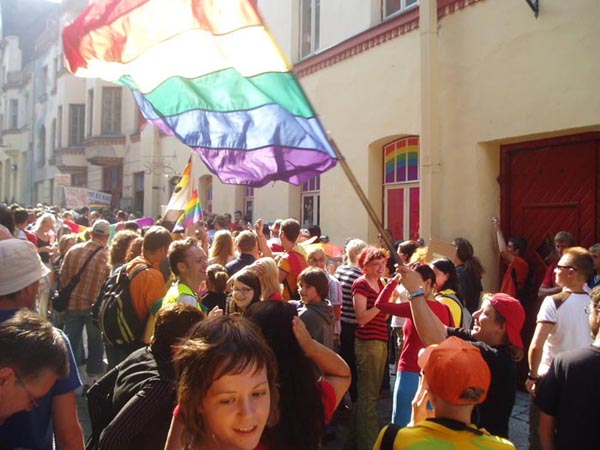
Hey it looks like Tallinn, but it's not:


Looking Forward to 2011

Imagine it's 2011. Mart Laar has gone from being the opinionated, stubborn roly poly 32 year old of 1992 to being the opinionated, stubborn, rotund 51 year old of 2011. Kristina Smigun has decided that the 2010 Olympics were her last, and has settled down to raise a family and coach skiing in Otepää. And Arnold Rüütel is still president, an 83-year-old president.

In fact Arnold Rüütel has been president so long, few people remember a time when he wasn't in office. There are whispers of a once chain-smoking intellectual president named Veri or Mari, but no one can quite remember much about him. Instead they know their president as Arnold, a man of few words and a hair line that just won't recede.

Arnold was never really elected by the Estonian people. He wasn't even elected in parliament. Instead, his backers massaged the system so that he could be elected by a favorable mysterious electoral college that had to answer to nobody about their vote.
But president he has stayed, deep into his December years.

The heyday of Rüütel's presidency has come and gone. Gone are the days of NATO membership and EU membership. Replaced are days of uncertainty as the post-Putin government of Russia has collapsed among infighting and warring factions, and even in Estonia support for Jüri Ratas' Center Party is weak following charges of electoral fraud in the 2007 elections. (Edgar Savisaar choked on a verivorst at a Christmas Party in 2009 and Villu Reiljan stepped on an unexploded mine while hiking on Naissaar in 2010).

Enter into this the government of Vladimir Zhiranovsky who has emerged as the new dictator of Russia and has assembled an army of Putin youth groups to take back what they see as Russia proper - including Estonia and Alaska. Who is there to face this crisis. Who will see Estonia through it's new twilight years? Will it be up to Estonia's octogenerian president or its 33-year party leader to combat this great challenge?

Sure, it's just a funny script for a future that hopefully won't happen. And I mean no disrespect to Edgar and Villu, but I had to write them out of the story somehow. However, real challenges do occur and in those situations it is importnat that a country have competent leadership. The US has proved so far that it can have the most incompetent leadership and still skate by. But the stakes for a small country like Estonia are higher.

When I read today that KESK and ERL indeed intend to not honor Estonia's constitution and instead will do a fake run through of the parliamentary vote to reinstall Rüütel this month, I had to wonder if they are so busy thinking about themselves, their friends, and this month, that they forgot about the big picture. Rüütel is a well-respected man, but he wouldn't even campaign because he knew he'd lose in the parliamentary round.

When running a country it is wisest to counsel the will of the people for they know what they want and they'll accept their own mistakes. But sidestepping them? That's not good for anybody.

pühapäev, august 13, 2006

Shades of Stonewall

On hot evenings in late June 1969, a cozy corner of the West Village in New York City turned into a riot zone. On the evening of June 28th a routine police raid on a bar known as a hang out for gays and lesbians turned into a violent fight between the police and the the patrons of the bar, the Stonewall Inn. In total it is estimated that 2,000 gay people did battle with 400 police officers in what became known as the Stonewall Riots.

The great "awakening" that shook the US and Western Europe - and other parts of the democratic world in the 1960s and 70s happened at a time when the economies of the communist countries - still licking their wounds of Stalinist mass murder - began to stagnate. When stronger Russification policies were introduced in the Baltics in the early- to mid-1970s, they fomented an awakening of a different kind - a nationalist reawakening, which culminated with Singing Revolution and Baltic Chain in the late 80s. Estonia didn't have a youth awakening like America's 1960s youth awakening. Estonia had its own, different nationalist awakening - not unlike the rise of Solidarnos in Poland or the 1968 uprising in Prague.

Now that Estonia is part of the "West," the movements of the the personal awakening of the 1960s and 70s are spreading their global movements into previously closed territories. Hence, Tallinn Pride 2006. It should have gone well, but it ended up with a bunch of skinheads throwing stones, rocks, and eggs at innocent people.

Coming from the epicenter of the modern gay rights movement, I can say that gay people don't march because they are soliciting new recruits into some perverted same-sex sex land. They march because they are a tiny minority, engulfed by straight people. They are horribly alone in the world. When I walk into a room filled with women, it is hypothetically possible that there is a romatic encounter lurking in every one of their jeans. I'm a heterosexual male. But for them, they must find company in special bars, and deal with the scrutiny of people that cannot understand something they probably had a hard time coming to grips with themselves. They are different and controversial. That's why they reach out in Tallinn and Riga and Warsaw. Because they know that there are young people there that need to not feel alone and not feel scared. To feel tolerated and accepted.

Enter the Skinheads. Tallinn has a skinhead problem. It's not the only country in Europe that has one. There are plenty of skinheads in Berlin and elsewhere. So it's not just an "East European problem" (sorry). Fortunately, problems in Estonia are not those of immense size. There are perhaps less than fifty active skinheads in Tallinn out of a city of 350,000 or so people. However, they are organized and they know how to stir shit up. Because their ideology is nihilistic, destruction to them is an ideal. In their perverse universe, they'd rather see the Estonian forests burn than have a 60-year-old statue to dead communist soldiers in central Tallinn. And they'd rather pelt innocent people with eggs and rocks than accept the sexuality of their fellow Estonians and allow them to walk down the street holding signs.

Estonians are cool to these marches. Tallinn is a quiet northern city. It hums, but it makes little noise. So the idea of dozens of lesbians, gays, and especially transgendered people marching down its quiet streets might not make the old ladies of Estonia particularly happy. Still, Estonia puts up with its share of bothersome intruders for the sake of welcoming tourists and their dollars. It puts up with drunk Brits - among the most vile of creatures - fondling its daughters at their Tallinn "stag" parties. It puts up with haughty Finns loading up on cases of Saku so they can go home and get drunk in the quiet of their Helsinki apartments. It puts up with some members of the Russian minority who display and honor the flag of the nation that killed their best writers, intellectuals, and plucked their family trees bare.

But gays? Holding signs? Is that too much for Estonia to bear? Give me a break. Get a life. Get over it. I understand that Stonewall did not happen in Tallinn. I understand that there was no Estonian Woodstock or No Nukes movement. But Tallinn has proven it is a tolerant town. And the only people it has to blame for this latest disturbance are about 30 to 50 shaven clowns.

Estonia is a democracy. And in Estonia you can be a skinhead. You can be a curmudgeonly bitter old communist. But you can't burn down forests. And you can't vandalize monuments to the dead. And you cannot assault your fellow Estonians just because you don't like what they stand for.

neljapäev, august 10, 2006

It's Ergma

A couple months ago when I was toying around with the idea of who could succeed Arnold Rüütel in office, I put up a photo of Ene Ergma. I didn't think that Ene was a shoe-in candidate, but I remembered photos of her welcoming Tarja Halonen to Tallinn, and I thought for some reason that she might be a candidate.

However, when Toomas Hendrik Ilves entered the race, I thought he'd surely be everyone's choice for the August 28 vote because he had the most popular support. Still, his tough statements toward Russia - which are really just honest assessments but too tough for some in Estonia to handle - probably made him too dangerous for Edgar Savisaar who is planning to become Estonia's next prime minister in 2007 (by the way, kudos to Ansip for keeping the coalition together this long).

When the parties in the roundtable had to pick two candidates to advance for the August 28 vote, Ilves was the pick of the Social Dems, Reform, Isamaa, and Res Publica. But Ergma was KESK's top choice. I have a feeling that KESK thought Ilves would (without a doubt) be the first candidate. But I think the four partners decided that Ergma had the best chance of getting elected in parliament.

Some people believe that Savisaar is gaming the system so that he will be president. But I think neither his party, nor ERL supports this. Without Savisaar, they are like sheep. Who would lead KESK in parliament without Savisaar? Kalle Laanet? Mailis Reps?
Ha.

As I have written before, KESK can do as it pleases and still expect ERL's support in forming a colaition in 2007, should they win enough to form a government.

The remaining question for KESK will be if Ene Ergma is non-controversial enough to gain their support in the August 28th vote. Ergma is 62 years old. An astrophysicist, she was educated in Moscow and speaks fluent Russian. KESK obviously feels that having someone that can speak to the Russians in their language is important for keeping their need to feel comfortable with their "near abroad" satiated while at the same time keeping their tentacles out of Tallinn. She was their first pick afterall - there must be some support for her among KESK's ranks.

Or Savisaar could have gamed it this way. Maybe KESK will find Ergma's Res Publica affiliation enough to vote her down in parliament in late August.

I believe that, in their hearts, the Ergma-backing coalition desperately wants to avoid the electoral college embarassment of 2001. Also, Estonia so far has had a tradition of electing academics president. Even Rüütel was an educator in agricultural academies before becoming president. In this way, Ergma could enjoy broad support. Perhaps even in an electoral college.

And, for my support, she can also speak English. As I have written before, it's important to have a president that can communicate with Tony Blair in his language, as well with Aleksis II when he comes to town on a mission.

kolmapäev, august 09, 2006

Why Do Chicks Dig Scraggly Dudes?

Let me preface this post by saying it has nothing to do with Estonia. It has to do with me. And I am a man. Yesterday I did not take a shower and I did not shave because it was my deadline day and I had to hurry to work. As the hours - and caffeine - took their toll, I began to resemble a character that might be at home on a show like Lost, or perhaps a buccaneer co-starring in Pirates of the Caribbean. I was greasy and dirty, and, so I thought, pretty unattractive.

But as I walked to my subway stop I noticed something funny. Women were checking me out. Now, women don't check men out the way a construction worker in the city goes "Holy shit" and will bend over half way to get a close up look at a woman's ass. Instead they sort of seem a bit startled and their eyes open a bit wider. Then they try to back out of their lengthy stare by looking elsewhere. This is different from most occasions when women just walk ahead, eyes front, as to avoid the glare of would-be stalkers, psychopaths, ex-boyfriends, and construction workers.

When I got home, my wife told me - the uncleanly unshaven male - looked handsome. This does not happen every day. But in fact her favorite character on a TV show we watch called Lost is named Sawyer (pictured above) - he's dirty and scraggly and unshaven too. I recall that many of my female friends will go to any Johnny Depp film - even Pirates of the Caribbean - just to see Johnny. And they like him best when he's all dirty and hairy and looks like he smells of cigar smoke, make-up, and rum.

This reminds me of one time when I was living in Denmark. I hadn't showered for, perhaps, three days. I was as greasy and crispy as fried mozzerell'. Even my shirt had holes in it, and, to make it better, someone had written something on it in eyeliner. I was crunchy - I was rank and foul.

But for whatever reason that night, women seemed to want to be around me. I wound up walking home with a very nice-looking Danish masseuse. If I had showered and shaved, that would have never happened. But since I was dirty and resembled Che Guevara, I became irresistable.

It's an odd contrast given how women tend to favor cleanliness. Burping, farting, picking your nose, talking about excretion - these are all obscene gestures that irritate them. They are not as obsessed - or comfortable - with the world of bodily functions, like us guys.

Yet at the same time, they seem to like us most when we smell of body odor, have a scruffy beard, and sort of look like we might be the type of guys you could buy some really good weed from.

What's up with that?

Oh well, women have always been mysterious and fickle in their tastes. And I don't mind going a few extra days without a shave.