neljapäev, november 09, 2006

A little bit about Borat

I haven't seen it yet, but I am looking forward to seeing Borat: Cultural Learnings of America for Make Benefit Glorious Nation of Kazakhstan. Sacha Baron Cohen's portrayal of the racist, sexist, and backward Kazakh reporter has won impressive movie reviews, and also, in its own way, boosted Kazakhstan's international profile in good and bad ways.

While I find Borat pretty funny - especially when he is 'disco dancing' - some, especially Kazakhs, aren't laughing. However, as Gauhar Abdygaliyeva writes this week in the Washington Post, any publicity is often good publicity:

The "moviefilm" by Sacha Baron Cohen, "Borat: Cultural Learnings of America for Make Benefit Glorious Nation of Kazakhstan," is playing well in American theaters. One can only applaud the humorist's talent, but the movie is entertaining only because the world is so unfamiliar with reality.

Perhaps that will change. The movie has already created unprecedented interest in Kazakhstan. Not only has Borat promoted our name and flag, he has also indirectly fueled a great wave of patriotism among my fellow citizens.

I think Estonians are breathing a sigh of relief that Cohen didn't decide to make his character from Estonia. But for all his pokes at post-Communist stereotypes a few things can be said.

1) Borat is funny because he's accurate.


I had a Russian cab driver in San Francisco this year that resembled Cohen's Borat character. And he spoke like him. And he listened to bad 1980s-style pop music. And his whole outfit was made of denim. I also have seen plenty of European men who prefer the lime green speedo to American-style swimming shorts. In other words, the
Borat character is an exaggeration, but he's grounded in reality. If he wasn't grounded in reality, he wouldn't be as funny.

2. Borat is funny because we're ignorant.

I am not sure why, but few have raised the idea that Borat is funny because we are laughing at our own ignorant vision of what the world is like. Borat not only makes fun of Kazakhs and post-communist countries, but he makes fun of our ideas about what Kazakhstan is like. He indulges us in our own perverted version of the world, where there are prostitution contests and women are forced to ride on the outside of buses. Of course we know that's not true, and by exaggerating our ideas about this country, we are quietly making fun of our own ignorance.

I think the latter is the most important. Our country - the US - is the kind of place where people will go see a film like Terminator 3 just to see Arnold Schwarzeneger blow something up. They don't care about plots or acting ability. They just want to be entertained. And that's my final point.


3. Borat is funny ... because he's funny.


How often do you get to see a guy bring a chicken on the subway in a suitcase?!

kolmapäev, november 08, 2006

Democrats win House, Senate

The media is being very careful in calling the senate races in Virginia and Montana, but as of now, the apparent winner in the Virginia Senate Race is Democrat Jim Webb, and the apparent winner in the Montana Senate Race is Democrat Jon Tester.

I was up until 2 am last night watching the results roll in, and it was a nail biter. At first things looked really bad in the senate for the Democrats - Claire McCaskill was down in Missouri, Webb was down by as much as 30,000 votes in Virginia, and only Tester had a commanding lead over Conrad Burns in Montana. But I stayed up late enough to see that Webb had eked out a tiny victory in Virginia over Allen, and that Tester was holding the lead over Burns. McGaskill really surprised me by trouncing Jim Talent in Missouri - I was sure that that one was over.

But what does this all mean? It means that we will have some new ideas in Washington. People talk about Harry Reid and Nancy Pelosi as being the faces of the Democratic party - both of them in their mid60s and not exactly the most charismatic people. But they have shown - and even younger senators like my senator Chuck Schumer have shown, that they are more than willing to put junior senators out there if they think it will help them improve the image of the Democratic Party. And so guys like Barack Obama - a freshman senator from Illinois - is the guy they prefer to put forward compared to John Kerry, who is so 2004.

I think that the newer senators like Jon Tester and Jim Webb (and Bob Casey and Shel Whitehouse and ...) will have greater clout than is usually assigned to Democratic freshman senators because they will be seen as the face of the expanding party. Tester and Webb represent the strong desire among the Democratic base to have "no BS" candidates representing them.

Many people think that Howard Dean was elected chairman because he's so liberal, but it wasn't his politics, it was his attitude. Hopefully we'll see a little more attitude from the incoming Senate and House that will enable this country to have a real debate on an Iraq exit strategy. Republicans and Democrats alike should be glad that Conrad Burns and George Allen - who haven't really distinguished themselves nationally - are being replaced by energetic, individualist representatives.

teisipäev, november 07, 2006

Suur Suomi

This came to us via our resident West Virginian Estonia enthusiast Jerry, who in turn found it over at Strange Maps - a very cool blog. I have been reading a book recently called Scandinavia by Tony Griffiths which has been my first real introduction to the nationalist Fennoman movement in Finland, which has, perhaps, ideological descendents in the philosophy of current parties in Finland and Estonia like the True Finns and the Isamaa half of the Isamaa-ResPublica Union.

And, so once upon a time in Finland, there were Suur Suomi advocates - nationalists who imagined a super Finnish state, perhaps both inspired by pan-Slavicism and pan-Scandinavianism. In the Suur Suomi ideal, Finnic speaking bog dwellers would rule an area from Norway's Finnmark to the Kola penninsula and then all through Karelia, Ingria, and finally Estonia.

Of course that never happened. Although one could argue these days that economically, Suur Suomi is very much a reality.

laupäev, november 04, 2006

Interesting Politics

Estonia has an interested way of electing its candidates in parliamentary elections. Parties recruit well-known names to run on the party list, poster their faces all over town, and pray to Taara for help that people who like Erki Nool will vote for Isamaaliit - the reality being that Erki will probably never see the inside of the Riigikogu to discuss such things as bilateral trade policies with Moldova. Instead, somebody else from the party that is known to be reliable and/or easily persuaded will take his place in government. I am not sure if it is done this way in other parliamentary democracies -- I have never, for example, heard of David Beckham campaigning for Labour in the UK. It will be interesting to see who manages to "run" this year.

Today the news is that Maimu Berg, a former member of Eestimaa Rahvaliit, will campaign as a Social Democrat in the March elections. Her defection to the Social Dems could be seen with in the meme of Rahvaliit's decline following its failure to reelect Rüütel in the electoral college in September, along with the resignation of party leader Villu Reiljan from his position as Minister of the Environment the following month.

Current opinion polls show the leading parties to still be Keskerakond and the Reform Party - with Reform having a slight lead. The Isamaa-Res Publica Union, despite naming Mart Laar as a common prime ministerial candidate, is the third most popular party in Estonia, with support hovering around 13 percent. The Social Democrats and ERL can count on support from around six percent of the electorate each.

While polls show a continuation of the political status quo, it's worth mentioning that this year's elections will feature two new players - the rightwing union (Isamaa and Res Publica) and possible a new party, the Rohelised (Greens), who are busy collecting signatures to run in the '07 elections.

In the case of Isamaa-Res Publica (who really need to get one name), it shows that the bickerng right-wing parties managed to at least conclude the formation of their union. Still, Laar showed himself to be a talented businessman by essentially co-opting a larger party and turning it into his own. I've seen this done numerous times in business where small, unprofitable companies swallow larger ones and become suddenly successful and profitable, but I am unfamiliar with it being done in the political world with such finesse.

In regards to the newcomer Rohelised, while the Greens lack an obvious "Big Interest" base (international business tends to favor Reform and its partners, the Center Party can similarly count on some strong support from the business community), they do have the opportunity to put a fresh spin on Estonian politics, similar to the wave Res Publica created back in 2003. But this is a new kind of party in Estonia. While it won't be openly left-wing , it obviously has connections to European movements that caucus with the left, like Heidi Hautala's Greens in Finland, or Germany's very successful Die Grünen. The Green movement in general came out of the left in the 1960s and 70s.

In Estonia, being called "left-wing" is the equivalent of political death. Even the Social Democrats are "center-right" in philosophy. But, if successful in running an election, the Greens will bring an air of European parliamentary normalcy to a political system that is dominated by the nationalist right, the euroliberal right, and the center right. Plus it will nice to see a little leafy green symbol next to Kesk's giant K and the Social Dems' red rose.

It's too early in the game to speculate on how any party will perform. But it is obvious that there is life in Estonian democracy, and that the current stagnant polls may shift in coming months as new parties and platforms are made public.

reede, november 03, 2006

Stuck in 1987

We went to Brighton Beach in Brooklyn yesterday to stock up on Russian foods that have been adopted by Estonians en masse. I am not sure at what point Estonians started eating sibeeri pelmeenid, but they do, or at least my wife does. My favorite kinds are the ones from Georgia. They have a hint of the mediterranean in them. But Slavic food - to me - seems intolerably composed of three ingredients - fried dough, meat, and cheese.

I remember we ate cheap when we went to Slovenia, and the food was the same style there. In neighboring Italy you would have pasta malfalda with big yummy slices of potent garlic cloves, lightly soaked in fine olive oil. But in Slovenia it was Tseburekk - fried dough with some cheese in it. I was told by our Slovenian friend that this was really Albanian food - imported from that mystery country with the scary red flag. But I think he was lying. Because when I was in the Czech Republic I was greeted by similar fare - smazeny sir (fried cheese). This has led me to believe that the early Slavs didn't like vegetables - unless, of course, they are mashed up and stuck inside a blintz.

In Brighton Beach though I saw a gentleman wearing a sweatshirt that looked sort of like the one up there. C C C P. Those are the cyrillic letters that represent the long-dead country called the Soviet Union. Of course today we have other ways of referring to that country. They call it the "former Soviet Union," like "the artist formerly known as Prince" - the only thing is that Prince was still Prince, and the Soviet Union broke up. The Soviet Union is as much a couple as Tom and Nicole. It's over. Yesteryear's news. Benifer. Reese and Ryan. Madonna and Sean Penn. Compleat!
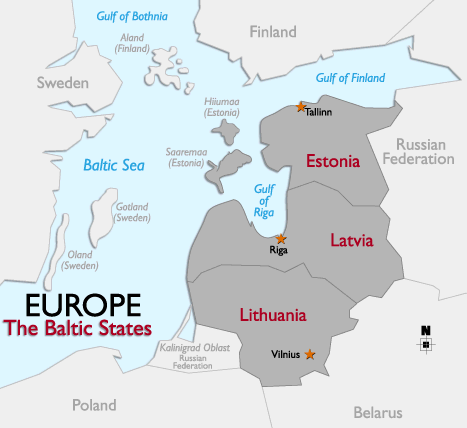
Still, the NATO summit in Riga is supposed to be a big deal because it's on territory in the "former Soviet Union." But I'm sorry to say that once you get there, you'll be let down. There'll be no hot Soviet spies with killer thighs waiting to strangle you. Brezhnev won't be there either because he's dead. Memorial rallies and sweatshirts aside, the "FSU" as it's called by people that call most of the eastern half of Europe the "CEE" is about as relevant as a sweatshirt. It's a living memory, but just a memory. And it's one memory that will die with my generation.

Sad to say, when I saw that guys sweatshirt, I was taken back to 1987 when I saw the Living Daylights starring Timothy Dalton as Bond. There were real nefarious Cold War Russians in that film and others of the genre with names like Kostov and Rostov and Bostov and Sostav. They were usually fat and had beards, but you still felt they had the mental will to break the arm of whomever pissed them off. And so you really wanted them to lose, just as much as you wanted Rocky Balboa to kick Dolph Kundgren's ass in Rocky IV.

That was a long time ago. In 1985, I played Bruce Springsteen's Born in the USA on my record player in my room. We may have still had a rotary phone. Bill Clinton was just a young punk governor in Arkansas. Schwarzenegger was an actor. Ronald Reagan was president. Paris Hilton was playing with My Little Ponies. Corey Feldman had an acting career. Do you see what I am getting at?

But I am still reacting to symbols and people are still using terminology like the last 20 years never happened. What was it about that time that has allowed us all to continue on in this Groundhog Day-like stupor where people still talk about the Soviet Union like it means something? Where I still react to clothing bearing the insignia of a dead country? There is something strange in all this, as if we have not truly accepted the New World Order in our hearts and we cannot really believe that the old Cold War is really over.

And imagine, if I still get the 1987 shakes when I see a CCCP sweatshirt, how do our foreign policy elite, most of them deep in middle age, see the world? How do they react to goosestepping Soviet war parades in Russia or the sight of Putin standing beside a hammer and sickle? If I am this far gone in backward thinking, at what year did their minds stop registering change?

kolmapäev, november 01, 2006

A European counterbalance to the US?

Let's talk honestly here - the expansion of the North Atlantic Treaty Organization has not only brought sunshine and lollipops to the countries of the old Warsaw Pact. It has also brought with it submission to a rejuvenated bi-polar interpretation of European security issues and enough anxiety for Russia to create the gas shut off to Ukraine last year, as well as the recent overreaction to the Georgian spying crisis.

Lacking significant power in numbers and euros, NATO countries are ultimately consigned to the will of the Anglo-American alliance. And so the debate over expansion of membership to Georgia and possibly Ukraine strikes analysts as a showdown between Washington and Moscow, and nothing more. It's a test of Russian and American political will, played out through the US' proxy organization NATO, which many in Russia see as "anti-Russian."

This week, however, the German defense ministry published a position paper that outlines its transition from a post-war army to one that will undertake a greater role in global security. Specifically, Defense Minister Franz Josef Jung is calling for raising troop levels by 5,000.

Germany is currently engulfed in a debate over the misadventures of some of its troops in Afghanistan, but the idea of Germany contributing more, especially within the context of NATO, was welcomed by The New York Times.

Military ties to the United States will remain at the heart of Berlin's defense policy. But larger and more robust troop contributions from the most populous European NATO country can help restore a measure of political balance to an alliance increasingly distorted by Washington's military role.


If Germany really does retool its army, it will be a positive for Estonia, because it will be easier for Estonia to cooperate in international missions - and have a say in critical decisions - if Berlin's thoughts count at least half of much as Washington's.

But I am sure our resident blog pundits have some ideas of their own.

Mr. Nice Guy

Interfax, my favorite news source, has a warm and cuddly interview with Estonian President Toomas Hendrik Ilves, where he tells the Russian interviewer that the people who say "dah" instead of "jah" in Estonia ain't their compatriots - they're his.

Ilves voiced hope that people of all ethnic backgrounds in his country regard Estonia as their home.

"Therefore I cannot agree with Russia calling not only Russians but Ukrainians, Belarussians, Kazakhs and members of other ethnic groups living in Estonia its countrymen. They are our countrymen, of course," he said.

"Estonia is a homeland for everyone who lives here. It cannot be otherwise or people would leave Estonia. It would be bad for Estonia," he said.

Ilves said he is determined "to work during the next five years for all people in Estonia to feel at home, for everyone to have work, health and love."


Awwwww. He said 'love.' Sometimes it is the most obvious things that need to be said and I think this is one of those things that perhaps, should be expressed more to the Russian side, to whatever number of them are listening. You should read the whole interview - he sounds off on the Bronze Soldier monument, the Border Treaty, and even analyzes comparing Estonian-Russian relations to being ice cold.

Commenting on a remark by an Estonian official calling his country's relations with Russia "ice-cold," Ilves said, "If you look at an ice cube, you will see that everything inside it appears to be stiff and lifeless. But if you look at Estonian-Russian relations, you can't see stiffness and lifelessness in them."


See, you can take the ambassador out of the embassy, but you can't take the ...

esmaspäev, oktoober 30, 2006

Securing Energy for the Future


There's been some evolution in how the Baltic Sea states are dealing with the Russian-German pipeline agreement, whereby Russian will provide central Europe with energy, bypassing more traditional conduits through Estonia, Latvia, Lithuania, and Poland, prompting protests from those governments, especially Poland and Lithuania.


According to the Nordic Council, increased energy cooperation was a focal point of a joint meeting of Nordic and Baltic prime ministers this week in Copenhagen:

Energy co-operation across the Baltic Sea was an important theme at the meeting of Nordic and Baltic Prime Ministers, 30 October. The Baltic countries are busy emerging from their 'energy isolation' thanks to power cables to Finland, Poland and Sweden.

***

The issue of the power cables from Estonia to Finland and from Lithuania to Poland and Sweden was also discussed at the meeting. The Baltic States want to break their isolation as far as energy is concerned - and may even build a new nuclear power plant together.


German Chancellor Angela Merkel also offered a 'European' integration solution to the 'pipeline dilemma' facing the Baltic Sea countries during a meeting with Polish PM Jaroslaw Kaczynski:

German Chancellor Angela Merkel vowed Monday she would push for Poland and the Baltic states to be linked to European Union natural gas and electricity grids in order to supply energy in case of future cut-offs from countries such as Russia.

***

"We agreed to discuss energy supply ... in the sense that we create a common European energy market in both electricity and natural gas supply and that naturally Poland and the Baltic states must have access to the European gas markets," said Merkel.

***

Merkel admitted that fully connecting Poland and the Baltic states to EU energy grids, especially the gas grid, would be "difficult" but that she expected initial decisions to be made at an EU summit hosted by Germany next March.


I am not sure how this all going to work out, but it's nice to see some solutions in the pipeline.

pühapäev, oktoober 29, 2006

Estland versus Estonia

So I went to the post office the other day to mail a letter to Estonia. Sometimes the employees of the United States Postal Service know that it's in Europe. But then there are the others who think it's another oddly named city in the State of New York, like Astoria or Fredonia. I have to tell them it's in Europe, and sometimes I wish Estonia used it's 'other' official international name - Estland - more often.

See, you can tell that 'Estland' is a country. The -ia suffix just makes it sound like a province, like Bavaria, Wallachia, Carpathia. Sure there are some provinces with the -land suffix, but over all, it could help Estonia stand out just a bit more if it wasn't just another tiny piece of land in a sea of Eastern European "ia" lands. The "land" suffix puts you in competition with Iceland, Finland, Greenland, Poland, Holland, and Switzerland. Not a bad category to be in.

Of course, there's no sense in doing something so frivolous as renaming your country for the sake of a guy at a US Post Office. But it could make my life just that much easier ...

neljapäev, oktoober 26, 2006

When Estonia was 'Eistland'


It's kind of funny to think that the best name Estonians could come up with for their people until the mid-19th century was maarahvas - the country people. Because if you look at the saga of Olaf Tryggvason, an early Norwegian king who lived in Estonia for some time, the name Eistland is clear to see. In fact, the Icelanders who use the language of the sagas today refer to Estonia by its 1,200 year old name - Eistland.

In some historical references, the term "Estonian Vikings" is used to describe the Eistlandic activities on the Baltic seas during the era of Norse invasions. But really, I think the term 'pirates' better suits the situation. Here's the text from the original Heimskringla sagas, which includes the saga of Olaf.

Þar skildist Ólafr við móður sína, ok tók við honum Klerkon, eistneskr maðr, ok þeim Þórólfi ok Þorgilsi. Klerkon þótti Þórólfr gamall til þræls, þótti ok ekki forverk í honum ok drap hann, en hafði sveinana með sér ok seldi þeim manni, er Klerkr hét, ok tók fyrir hafr einn vel góðan. Hinn þriði maðr keypti Ólaf ok gaf fyrir vesl gott eða slagning; sá hét Reas, kona hans hét Rekon, en son þeirra Rekoni. Þar var Ólafr lengi ok vel haldinn, ok unni búandi honum mikit. Ólafr var 6 vetr á Eistlandi í þessarri útlegð.


Olaf Tryggvason (c. 960 - 1,000 AD) was the great-grandson of Harald Fairhair - the first King of Norway. Due to some typical Viking blood fueding, Olaf had to escape to Novgorod where is uncle was in service to the king. However, he didn't get there on time.

The journey was not successful -- in the Baltic sea they were captured by Estonian vikings, and the people aboard were either killed or taken as slaves. Olaf became the possession of a man named Klerkon, together with his foster father Thorolf and his son Thorgils. Klerkon considered Thorolf too old to be useful as a slave and killed him, and then sold the two boys to a man named Klerk for a stout and a good ram. Olaf was then sold to a man called Reas for a fine cloak.


Reas proved to be a better host to Olaf in Eistland than Klerkon. Together with his wife Rekon and son Rekone, they lived as a family unit until six years later when Sigurd Eiriksson spotted Olaf at a market and bought him back from Reas. Olaf later met up with Klerkon at a market in Novgorod and killed him with an axe. Later they had some beer. And all was right with the world.

For you Estonian readers, there is a version of Olaf's tale available in Estonian here.

kolmapäev, oktoober 25, 2006

Interest Surrounds Bildt's Investments, EU Aspirations

Carl Bildt is the latest member of the new Swedish cabinet to become immersed in the critical eye of the media, and -- unlike the television fee scandals of two weeks ago -- it appears that he may have a genuine 'conflict of interest.' It has been reported that Bildt, who appears to have been stereotyped as a rich boy from a wealthy part of Stockholm, has some investments in the Russian energy industry. At the same time, Bildt is possibly debating whether or not he should hang onto his post of foreign minister or assume a higher ranking post in the EU.

Kommersant reports:

Bildt is naturally interested in the success of his business, which means prosperity for Russian natural resources companies. His opponents say this is the reason for the excessively lenient policy of the Swedish foreign ministry towards Moscow.

Urban Ahlin of Swedish Social Democrats believes that Carl Bildt did not give an adequately stiff reaction to the murder of the Russian journalist Anna Politkovskaya. Observers note that the new foreign minister is extremely cautious making any statements relating to Russia.


I wrote earlier that the appointment of Bildt was a good thing because he has a first hand relationship of Estonia and could be counted on to support Estonia internationally. Like many great powers, Sweden's shadow is larger than it's actual body. Here I am in New York buying IKEA furniture and driving a Volvo. Roads and plazas are named all over the US for Swedish diplomats like Raoul Wallenberg and Dag Hammarskjold - though none have been named for Hans Blix yet. It seems that Bildt might also be eyeing a similar international role, beyond Sweden.

As Sveriges Radio International reports:

There’s speculation that Sweden’s new Foreign Minister Carl Bildt may soon be moving on to a top job in the European Union.

The EU Observer says speculation is mounting that the union’s foreign policy spokesman Javier Solana may step down for health reasons. Bildt, along with the former prime ministers of Slovakia and Austria, is named as a top candidate.

According to the EU Observer, insiders say Bildt is not hiding his ambitions to obtain the top job. The foreign minister has recently come under fire here in Sweden because of his financial interests in the Russian company Gazprom, which might be a conflict of interest.


Investments aside, it could benefit Estonia - and the whole Baltic Sea region - to have someone who has personal contacts in these countries in such a post. What do you think - would Bildt as foreign policy spokesman change anything, or would it just lead to more of the same?

teisipäev, oktoober 24, 2006

Citizenship an Issue ... Again


The headline from Interfax reads: "Moscow to back Russians' struggle for rights in Baltic States - Putin." How is that news? I've been reading this stuff from Interfax and RIA Novosti for nearly two years now, and every few months they run the same headline with the same message.

President Valdimir Putin, addressing the World Congress of Compatriots in St. Petersburg, said: "I cannot fail to mention the well-known fact of mass denial of citizenship rights in Latvia and Estonia. There are about 600,000 so-called non-citizens there, who are permanent residents."


The Estonian foreign ministry has replied -- in English -- by updating its tables on citizenship in Estonia. The last update was in April, during a similar anti-Baltic citizenship laws campaign.

According to the ministry, the number of stateless persons in Estonia is down to 8.8 percent of the total population, or 120,511. So far a little more than 4,000 people have received citizenship this year. Over the past five years about 5,900 people have been naturalized per year. So perhaps Ansip was right when he said that this issue would "disappear" by 2015. I don't know - how do you think this issue will resolve itself?

esmaspäev, oktoober 23, 2006

The Honeymoon is Over

Remember September? Toomas Hendrik Ilves was elected president. Tõnis Mägi sang and it sounded good, even to American ears. News was so slow in Helsinki that they had to run Toomas' face on the cover of the Helsingi Sanomat. And the media - which was totally biased in his favor, no argument there - showered us with photos of Estonia's comparatively young president in his smart bow-tie and its attractive first lady who is, ohmygod, only 38 years old! Yeah, I remember that too. Being familiar with the Estonian media, I had a hunch they'd eat the Ilveses sooner or later for lunch, and this week the gloves, so to speak, came off.

The casus belli began with the arrival of Her Majesty, Elizabeth II, Queen of England and Vacationer of Scotland. The Queen's arrival was symbolic of the fact that Estonia has become Ilvesland, just a "boring, Nordic country" where people pay for parking with their mobile phones, listen to their electronic music in peace, and the Queen occasionally shows up.

However, it was the first lady's choice in wardrobe that got both Postimees and SL Õhtuleht to run two pieces where fashion designer Kai Saar declared Evelin's choice in clothing to be a catastrophe.

Õhtuleht has a blow-by-blow account of Evelin's fashion faux-pas, including the picture of her winter glove [seen above] with the following caption:

TALV TULI OOTAMATULT: Evelini kortsus kindad ja nendega toonilt röökivas harmoonias fuck-me tikk-kontsad.


Yeah, they said that Evelin's gloves were too wrinkled. And they didn't match her 'fuck me' boots. The article went onto generate 460 comments. Word battles also erupted over her figure. It grew so personal, one had to wonder if they were just setting the agenda for about a month's worth of discussion in a Women's Studies course.

President Ilves didn't get off without his own small dose of public scrutiny. In his case, he committed the most grievous error. He stuck his hands in his pockets again.

But that's all ok and there's no reason to be ashamed of Estonia's head of state. Everyone knows that it's nearly impossible to top the outlandish outfits Her Majesty has worn over the years. And the British press has similarly shown her no mercy. The only difference is that the Brits didn't elect her. They're stuck with her just because the House of Hanover replaced the House of Stuarts back in 1714. Their head of state is hereditary. The next British head of state will be Charles. His duchess will be Camilla. In other words, there's no reason to get too upset over some wrinkled gloves and fuck-me boots.

Western Europe Wakes Up to Putin

It looks like tiny Estonia won't be the only country feeling the Kremlin's heat from here on out. Unable to divide and conquer [ie: cite the oppression of Russian speakers in Estonia and Latvia] the Russian answer to a semi-united front from the European Union appears to be to spread the criticism, to the farthest reaches of the continent. As the Guardian reports:

Mr Putin's sarcastic anti-Spanish outburst at a dinner on Friday with EU leaders in Lahti, Finland, was accompanied by criticisms of Italy's mafia problems.

His comments, first reported in the Guardian, made the front page of Spain's El País newspaper yesterday.

Mr Putin pointed to the southern resort town of Marbella, where the mayoress and former mayor have been jailed and thousands of illegal homes face demolition, as well as other Spanish corruption cases.

El País said the Spanish prime minister, José Luis Rodríguez Zapatero, had been "perplexed" by the comments. Italy's Romano Prodi had been left "without words" when Mr Putin pointed out that his country had invented the mafia concept, the newspaper said.


In a way, Russia's new "voice" towards Western European criticism is a positive for EU-Russian relations. Despite the support of Mediterranean EU chiefs like Jose Barroso, Javier Solana, and Romano Prodi, it has been my impression that EU-wide interest in the eastern flank of the country had more to do with fears of Polish plumbers than the EU-Russian relationship. Now EU citizens from as far away as Napoli and Marbella can indulge themselves in their very own "Putin experience."

From what I gather, with Schroeder gone, Putin's last ally in the EU is septegenarian Jacques Chirac. He was the one who advocated for a 'light touch' with regards to the Georgian-Russian issue. So perhaps we should all start thinking about the French presidential elections next year. The Chirac successor seems like a key piece of the puzzle in determining how the big players in Europe will react to Putinism, as does whomever succeeds Tony in the UK. The next two years should make for splendiferous blog postings.

laupäev, oktoober 21, 2006

kolmapäev, oktoober 18, 2006

The Intriguing World of Väliseestlased

When you are a foreigner in an unknown country, things can get interesting. And things have certainly been interesting for the thousands of brave souls who have left their "isamaa" to move to places like London or New York or even neighboring Finland.

Three recent cases showcase the interesting scenarios. One involves a young woman in Finland who is at the center of a political scandal involving the former party secretary of the right-wing Kokoomus party.

Harri Jaskari [pictured] recently stepped down amidst allegations that he was involved in violent behavior against a former Estonian girlfriend and perhaps acted as a "pimp," whereby she assumed the position of "ho."

The whole thing is so messy I feel guilty dragging you into it, dear readers:

[Jaskari] also gave a detailed account of his relationship with the Estonian woman who accuses him of violence and pimping.

The two had met in Tallinn in the spring of 2003. The relationship ended in early 2005, but the woman had left some of per property in Jaskari's Helsinki apartment. Jaskari says that early this year the woman "showed up again", and he gave her the key to the apartment so that she might move her things out.

***
In August Jaskari was contacted by police who told him that the woman was accusing him of violent behaviour, and that the police suspected her of selling sex, using their former home as a base. If Jaskari allowed her to use his apartment for such activities, it could be seen as a form of procurement.

***
Suspicions of physical violence concerned the time that Jaskari and the woman were together. He says that he had defended himself "in a few situations", but would not go into detail about any actual events.


OK, that sort of made sense. But then the Estonian woman started changing her story:

A former Estonian woman friend of Harri Jaskari, who last week stepped down as party secretary of the National Coalition, was quoted as saying by Estonian daily Eesti päevalehti on Tuesday that the day after reporting Mr Jaskari to the police she had withdrawn her accusation that Mr Jaskari had procured women.

But the woman, identified only by a Christian name, continues to charge Mr Jaskari with assault.

"He throttled and beat me and chased me with a knife. The police often came round to our place because of it," she told the paper.

"He is a pathologically jealous man."


Maybe he is, may he isn't. I have a feeling this is a toxic break-up being played out in the public eye. The details all seem a bit fuzzy to me.

Anyway, "Eva Roosmaa" - as she is identified in the Finnish press - isn't the only at the center of an interesting situation. Here's another young Estonian drawing attention to himself.


ESTONIAN MAVERICK TAKES THE U.K. POKER OPEN

Just over a hundred players entered for this year's U.K. Poker Open, sponsored by 888.com - Pacific Poker with a prize pool of almost GBP 300 000.

The grand prize of $134 000 was taken by Talinn, Estonia player Marek Kolk aka "The Maverick," who has previously been "in the money" at a number of major world tournaments including the last WSOP.

It was a tough tournament - Kolk had to defeat a final table that included five other professional players of the calibre of Roland De Wolfe, Theo Dalton, Dave Clayton and Simon Zack, as well as online qualifier Alan Parkinson. Other notable players who competed include England rugby stars Matt Dawson and Austin Healy, Graeme Dott, Ray Parlour, and Eastenders star Billy Murray.


Finally, and this is my favorite case, Estonian Olympian Kaido Kreen was recently sentenced to three years in prison for stealing mobile phone parts from Nokia. He's the gentleman to the left in the picture on your right. Luckily, no mobile phone parts fell out of his pocket during the game.


Kaido Kreen was a member of the Estonian beach volleyball team who competed in the 1996 Atlanta Olympics. Beside the 41-year-old Kreen, the court in Vantaa in the Helsinki metropolitan area handed down jail sentences to two more Estonians for the same offense, STT news agency said. Kaido Tamme, 36, has to spend two years in prison, while the third man whose name was not disclosed got one year.

According to the sentence, Kreen stole more than 600,000 euros' worth of mobile telephone components from the plant in Salo between 2004-2005. Tamme and the third individual took the stolen components from the plant to Estonia. The court did not bring charges against the five other defendants.


How do you steal 600,000 euros worth of telephone components? How is that possible? I have to hand it to Kreen, he may be a criminal. He may be devious. But he must have some kind of skill set to rip Nokia off that bad. I have images of him loading up his car with spare batteries and next-generation Nokia telephone faces. But I am sure he devised a much more ingenious scheme involving espionage tactics and underground tunnels.

Someone should collect these modern day Estonian folk tales. I think younger generations will treasure them someday.

teisipäev, oktoober 17, 2006

They *do* look like cousins ...

Setting aside the height, weight, hair color thing ...

esmaspäev, oktoober 16, 2006

More Bad News from the East

Somebody in Russia is killing journalists.

MOSCOW (Reuters) - The business chief of Russian state news agency Itar-Tass was found knifed to death at his flat in central Moscow on Monday, Itar-Tass said.

Anatoly Voronin, 55, Tass's business manager, died "as a result of multiple knife wounds," a source in Moscow's Prosecutor General told Tass.

Tass sources told Reuters that Voronin was supposed to return to work on Monday from holiday and his driver waited 3 hours for him outside his block of flats in Moscow this morning before returning to Tass to report him missing.

With Tass officials, the driver went up to his flat and found the door open with all of his things scattered all over the flat and saw Voronin's body, the sources told Reuters.

"It is a colossal loss for Tass," said Ludmila Perkina, an editorial official at Tass's main news center.

"He did so much for Tass. He tried to do everything so that we -- the journalists -- could work. Our hearts are very heavy today."

Voronin had worked at Tass for 23 years.

Is Resignation Really the Answer?

As EuroNews reports, a second minister in Sweden's new government has resigned amidst scandal. The big scandal? Not paying taxes on her nanny or television license fees.

Sweden's culture minister has resigned, the second cabinet member to leave the Swedish government in two days. Cecilia Stego Chilo [pictured] said her failure to pay her television licence fee for 16 years and the fact that she had not paid employer taxes when taking on a nanny "was not acceptable". On Saturday, Sweden's Trade Minister, Maria Borelius, resigned, after newspaper reports accused her also of employing a nanny without paying taxes or social contribution fees.

The new Swedish government's first week in power has been one of mounting embarrassment. After winning elections in September, Prime Minister Fredrik Reinfeldt only named his cabinet just ten days ago. Another cabinet member has also admitted not paying television fees.


In the United States, Don Rumsfeld has held on to his post as Secretary of Defense despite being challenged from within the Republican Party and the military establishment over his handling of the invasion and occupation of Iraq. Rummy has refused to step down. But in Sweden if you don't pay your television license fee, you are unfit to hold office?

This reminds me of another northern country, Estonia, where other aspiring 'corruption-free' governments have seen resignation after resignation over matters that do not even explicitly taint the government official.

For example, Jaak Jõerüüt stepped down as defense minister in 2005, not because he himself had done anything wrong, but because some ministerial employees had worn controversial t-shirts. And the Parts government fell just because the Riigikogu wouldn't endorse an anti-corruption bill.

What is accomplished by ceremonial resignation? Does it leave the state stronger or weaker in the end when ministers prefer to step down than take the heat of critical media? Is resignation really the answer?

Putin Heads to Lahti to Bully Meek Eurocrats

This week, Russian President Vladimir Putin will sit down with European Union members in Russia's former Grand Duchy of Finland to talk about things like dead journalists, natural gas, and Georgia. Putin is feeling tough after deporting all of those people with Georgian names back to Georgia, and now he's up for a dessert - some appetizing disunity, plus the obligatory Estonia bashing, in Finland - the fourteenth republic. As the Financial Times reports:

Vladimir Chizhov, Russia’s ambassador to the EU, said he hoped the meeting would be positive and pave the way for talks on a new partnership across the board.

But he told the Financial Times Mr Putin would not take criticisms of Russia lying down, and claimed the EU should stop trying to turn countries such as Ukraine away from Moscow by presenting them with an “artificial dilemma”.

Mr Chizhov added that Mr Putin would not take lectures on human rights while ethnic Russians in Estonia and Latvia, two new EU members, were treated as “non-citizens”.

***

He also claimed that Estonia was being turned into “an SS hall of fame”, with memorials being erected to local soldiers who fought with the Germans against Soviet forces in the second world war. An Estonian government spokeswoman denied the allegation.

“The EU is doing nothing,” Mr Chizhov said. “We supported the accession of these countries to the EU and we hoped the ‘big brothers’ inside the EU would provide them with a certain calming – even educational – influence,” he said.

“So far this hasn’t produced the changes we were hoping for.”


Notes to Chizhov:

1. Russians were the largest minority in the Republic of Estonia prior to its occupation by Soviet forces. According to the census of 1934, Russians made up nearly 9 percent of the population of Estonia. And every one of the descendents of those inhabitants was eligible for citizenship when Estonia regained its independence.

2. The Estonian government has been more willing to remove monuments to Estonian 20th Waffen SS than to do anything about the memorials to the Red Army soldiers that took Tallinn in 1944. Because the Soviets killed more Estonians than the Nazis did, the Estonian people have the right to make their own moral judgements about the actors of World War II.

Still, I've been to many Estonian towns. I've been to Kärdla, Kuressaare, Paide, Pärnu, Viljandi, Tartu, Põlva, Tallinn, Käsmu - I've spent a lot of time in Suure-Jaani, but I've never seen anything that would lead me to believe that Estonia is an 'SS Hall of Fame.'

Both of these facts lead me to think that the EU knows that Russia is grasping at straws when it tries to play the "Estonia" card. The only trouble I see ahead is putting together a common EU policy towards Russia [no way!, really?]

But seriously, folks. What does the EU really need to tell Russia? Or better yet, what advice can the EU give Russia that Russia will actually consider? On Belarus? On gas pipelines? On Georgia? On Iran?

Does the EU have any leverage over Russia? Does Russia have any need to listen to its concerns? Does anybody trust Russia enough to believe it will do anything it says it will do?

If Chizhov's observations of Estonia can be so false and untrue AND the EU obviously knows them to be false and untrue then what exactly is the point of this summit? Is it just a PR show for Finland? Maybe not even that.

kolmapäev, oktoober 11, 2006

Well Look Who Came to the Party

How did I miss this? Carl Bildt, whose blog I read pretty regularly, was recently appointed foreign minister of Sweden. He comments:

Well, things do happen in life, as we know.

On Friday I was appointed Foreign Minister of Sweden in a move that was widely seen as somewhat surprising.

And in many ways it was. But when asked, while it wasn't entirely easy to say yes, it would have been impossible to say no.


Estonia is lucky to have Bildt as the foreign minister of one of its largest economic partners, not to mention political allies. Bildt recently congratulated Estonia on its election of Toomas Hendrik Ilves as president and wrote one of the more moving tributes to Lennart Meri when he died in March. Along with Tarja Halonen, Bildt gave a speech at a memorial on the day of Meri's funeral in Tallinn.

In other words, he's a staunch ally. I wonder if he'll keep up blogging.

Remember Our Old Friend, Pronkssõdur?

From everything I read there is still a police presence around the most controversial monument in Estonia. There has been one since May. I know that the Estonian government didn't want to spend its huge surplus on redistributing some of the state wealth back to the have-nots, but, how long exactly is this going to go on?

September 22 came and went and here we are still. Prime Minister Ansip wants it gone and I understand him. It seems like a very big hassle to live in fear of dueling crowds of Slavs shouting "fascist" and rightist Fenno-Ugers vowing to blow the whole place up. Wouldn't make sense to bury the issue in a faraway cemetery on the edge of town?

But then there are those that are afraid of Lihula on steroids. Because it was ok to unleash the riot police to hold of crowds of natives hurling sticks and stones in Lihula when they took their war monument away. They could get away with that. But do they really want to revisit Lihula in Tallinn? That idea gives me the creeps.

And so the compromise has been to try and "change the meaning" of the monument. What exactly does that mean. How will the somber laying of national symbols in commemoration of the dead of the first Estonian republic manage to peacefully coexist with Soviet anthem singing and unveiling of the hammer & sickle?

None of these solutions seems to solve anything. And so the watch goes on. and on. and on. Maybe if we wait long enough, it will go away?

pühapäev, oktoober 08, 2006

Anna Politkovskaya 1958-2006

When you become a journalist, you are made aware that there are some situations in which it is possible your profession can turn fatal. Usually though you imagine that death only strikes those reporting in war zones that are hit by stray bullet or mortar. But in modern Russia, a land where bodyguards are a status symbol, the absence of overt war does not guarantee your safety.

Investigative journalist Anna Politkovskaya, who chronicled military abuses against Chechen civilians and garnered accolades and awards from around the world, was killed in her apartment building Saturday in an apparent contract murder possibly tied to her reporting.

Politkovskaya, 48, was found dead with a gunshot wound to the head in an elevator in her apartment building at 8/12 Lesnaya Ulitsa near Belorussky Station in central Moscow.


Politkovskaya was not the first journalist to die an execution-style death in Russia, and she probably won't be the last. But in a country that lacks the will to bring the murderers of journalists to justice, one has to wonder if it is really worth the trouble for those behind these assasinations to kill their critics. The logic follows that if you are free to kill reporters, what they write shouldn't bother you much anyway - unless of course you are more worried about appearances then any kind of threat to your political economic livelihood. Hence, the murder of journalists is not only deplorable, it's also ... illogical. But Russia was never much one for logic.

Anyway, looks like a mob hit.

Footage from a security camera in the apartment building foyer showed the presumed killer, a tall young man wearing dark clothing and a black baseball cap.

Prosecutor General Yury Chaika will personally oversee the investigation, his office announced Sunday.


However, people are being quick to lay the blame at Putin's feet because it fits into the "Russia is sliding back into authoritarianism meme."

Her killing sent shock waves across Russia and raised fresh doubts about media freedom under President Vladimir Putin. She was the 12th reporter murdered in contract-style killings since Putin came to power, according to the Committee to Protect Journalists.


What's ironic about Putin's Russia is the close resemblance to Mussolini's Italy. Instead of communism in Russia, we now have fascism - a state-centered around the fused ganglea of big business and political power where xenophobia is fashionable and a strong arm is preferred to any hint of chaos. The irony is stronger because Russia's post-war identity was built on being the country that defeated fascism. Yet what do we have today in modern Russia?

I hope Anna's murderers are caught, but I do not believe they will be.

neljapäev, oktoober 05, 2006

Aaviksoo

The Baltic Times has an interesting piece on Jaak Aaviksoo, the current rector of Tartu University who is stepping down to enter politics as a potential prime ministerial candidate for the Isamaa-Res Publica Union, better known as the guys in the smart suits with the glasses.

As his lack of hair attests, Aaviksoo is a very smart man. And his interview is revealing about his thoughts on the future of Estonia:


What, in your mind, is wrong with the country?

There are a lot of worrying trends, including an increased concentration of power in both formal and informal structures. The transparency of society is also decreasing. There are serious trends of politicizing non-political posts, and politicizing investment decisions. This includes within the field of education. One of the most dangerous trends, which I want to change, is the allocation of investments according to party leaders’ affiliations.
What are your views on Estonia’s economic outlook?
Estonia has been very successful, but problems are on the horizon. Most of our success has been due to low labor costs. Once wages start to rise, things will change. If we don’t invest in building a true knowledge society, with vocational as well as higher learning research and innovation, we will face very serious problems.


BT is subscription only online, so I won't give the rest away, but I am glad somebody is thinking about what will happen after Estonia stops being the most awesome capital of the world.

teisipäev, oktoober 03, 2006

Old Money

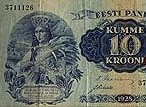
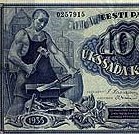
Did you know that before Estonia had the kroon, it had the mark? It's true. Up until 1928, things were in marka, not krooni. I came upon this interesting site that has images of money from different countries during different periods.

My guess is that from 1918 to 1928, business was done in marka and penni. Here is an example of a 5 penni note:

You can also glimpse some more scenes of daily Estonian life from the newly founded 'peasant nation.' These appear to be fishermen:


Here are some interesting images from the currency when it switched to krooni, which I guess depict Estonian national values in the 1930s. There are some like this farmer:


And then there is this woman, who has appears to be holding some kind of harvested vegetable or grain in her hands:


Then finally this industrious gentleman, perhaps representing Estonia's fondness for workoholic behavior:

esmaspäev, oktoober 02, 2006

A Plebiscite for Georgia?

I know this is an Estonia blog, but the situation in Georgia is important in the context of demonstrating how much support allies of the United States can actually depend on when Russia makes its "interests" known. From a historical perspective, it's hard not to see the Russian empire in a long slow process of devolution - akin perhaps to the long, slow death of the UK, which played out into the 1960s and 70s as former imperial possessions (like Jamaica) attained independence. But as the empire unravels, the powers that be hold onto symbolic clumps of Earth to show that they aren't out of the game just yet (like the Falkland Islands).

And so Russia, vanquished by the expansion of NATO and the EU to its western borders, must now show its response to NATO encroachment in the south. There are signals that the US is serious about expanding the alliance to Georgia and the Saakashivili government maintains its wishes to join the ranks of organization (although Georgia isn't exactly close to the North Atlantic - but who are we to be fixated on names?!).
This conflicts with Russia's interests, which are having Lukashenko-like allies in all territories of the Former Soviet Union (at least) and the Russian Empire of 1914 (the most desirable option).

How this conflict plays out - Zhiranovsky is already calling for occupation and war - could have a lot of impact on how Russia and the US deliberate in future conflicts. Will the US symbolically protest military actions by Russia? Does Russia really feel that fighting a war in Georgia is in its best interests, given its inability to fully subdue the Chechen uprising, more than a decade after the first Chechen war? And what will be the premise for that conflict? ALmost forgotten is that this is about two renegade provinces of Georgia - Abkhazia and South Ossetia. Any conflict would most likely revolve around the actions of Georgia's military in the context of Russia defending its compatriots abroad.

The easy solution for Western democracies would be to take the NATO card out of the conflict, and to instead insist on the bureaucratic "EU" solution - plebiscites to determine the future of Abkhazia and South Ossetia - therefore ending the situation peacefully. They would be held at the same time, and would be administered by a non-aligned international force (would the UN do?). Voters in those territories would then be able to decide for themselves whether or not those provinces remained in Georgia or joined the Russian Federation. And all would be right and merry in the world and there would be no war and John Lennon would rise from the dead proclaiming Peace on Earth.

No seriously, I think it's an option. I doubt, however, the willingness of either side to agree to such plebiscites. In the meantime, the conflict will carry on . . .

pühapäev, oktoober 01, 2006

Only Ilves Can Reach Out to Moscow

In my parents' garage, there sits a LIFE magazine issue from 1953. On the cover is a photo of Richard Milhous Nixon, the man who would become our 37th president and whose name would become synonymous with untrustworthiness, the way the name "Clinton" has epitomized the oversexed male and "Bush" seems destined to become a metaphor for "aloofness" or "incompetance" [which is kind of funny considering that the first President Bush was also considered aloof from the reality of American life.] But in 1953, Nixon was one of the good guys. In fact, the title of the magazine article was, "Nixon, a Vice President Who is Making Good."

This was at the height of the Cold War, and before he resigned in 1974, the feather in Nixon's cap was that he was a staunch anti-Communist, who came from a generation of men who had perhaps tinkered with left-wing ideas in the 1930s when the nation's economic system crumbled and many were intrigued by the promises of socialist ideology in response to that problem. Nixon, in other words, was clean when the Cold War started. And therefore the statement "Only Nixon Could Go to China" was circulated to mean that only a staunch anti-Communist could visit the heart of Asian communism. Only Nixon could shake hands with Mao Tse Tung and not have to aggressively scrub his hands clean later. Meeting Mao in 1972 was not a great political liability for Nixon. You can imagine that if Hubert Humphrey or George McGovern had done the same, Nixon's peers would have been the first to criticize them as being "cozy with communism." Nixon's critics did not successfully mount that kind of campaign.

With that in mind, I propose the following successor statement - only Ilves can go to Moscow. Ilves has a communism-free biography. Not only that, his life story reads like a history of post-war Estonia in brief. He was born in exile in Sweden and returned with the restoration of the republic. He is the anti-Communist embodied, because in the Soviet mindset those who left their country supposedly betrayed it. But here he is serving in its highest post. In Soviet history, the thousands of Baltic refugees were scantly mentioned, because they were living evidence that the USSR did not liberate the Baltic countries. Ilves existence, especially now that he is president-elect, does much to undermine the perspective that is cherished in the east.

There are a number of issues that are affecting Estonian-Russian relations right now that need to be dealt with promptly. One is the border treaty issue. While the Estonian-Russian border has functioned as a regular border for 15 years, the lack of an actual agreement is symbolic as the incapability of Estonia to normalize relations with the Russian Federation. It also gives the RF one remaining tool in its diplomatic arsenal to use against Estonia.

The second, and greatest issue, is the undefined citizenship of the Russian-speaking minority. Without seeking to minimize the importance of the ethnic Russian minority, Estonia also has a number of other minority groups of significant size - namely Ukrainians (2 percent), Belarussians (1 percent), and Finns (1 percent). However, none of the states that represent those ethnic groups seem concerned about their status in Estonia. The Russian government is concerned with the legal status of the 26 percent of Estonian residents that are ethnic Russians. But still, non-citizenship doesn't affect all of them, it affects about 9 percent of them.

Something tells me that this remaining 9 percent of the population is going to be exceedingly difficult to "digest" into the Estonian citizenship. But Estonia's program to naturalize these 120,000 - 130,000 people is not happening in a vacuum. The Russian government has also recently authorized a program to aid foreign compatriots in repatriating to Russia. Would it be too much of a stretch to think that these programs could work symbiotically? That there could be a joint Estonian-Russian "citizenship campaign" that will work to end the citizenship issue by presenting non-citizens with three funded options - 1) naturalize in Estonia, 2) naturalize in Russia, and 3) repatriate to Russia. The last option may be appealing to both young persons looking for opportunities where they don't have to learn Estonian and old pensioners who simply do not have the capacity to relocate without state assistance.

While working with Russia could have a negative connotation for many Estonian politicians - Savisaar comes to mind - having an Estonian president like Ilves, who cannot even speak Russian take interest in solving the problems with Russia might be acceptable to all parties and safe for Estonia politically. Though Ilves himself doesn't have the power to launch such a campaign, he does have the ability to influence policy and public opinion.

On the other hand, recent Russian foreign policy has been characterized as "sowing instability." Russia perhaps would ignore such a move by Estonia because solving these problems might not be seen as being in its interest. However, by showing an effort to improve ties, Estonia might win more confidence in the international arena. And that kind of confidence is valuable when the shit hits the fan.

What do you think?

laupäev, september 30, 2006

Calling All Experts and Academics

Are any of you more than just armchair Baltic and Nordic thought leaders? Do any of you teach or regularly comment on Northern affairs? If so please privately e-mail me. I am working on a personal project that requires your assistance.

reede, september 29, 2006

Did Mart Laar Sell Guns to Georgia?

Things are heating up over in Georgia. It's hard to know when the Russians are playing hardball and when they are just screwing around with their neighbors. It's also difficult to fully grasp the issues the Georgians are addressing - Georgia is a little known entity in the US and Europe. We have a hard enough time finding Estonia on the map, let alone South Ossetia and Abkhazia.

Russian Defence Minister Sergei Ivanov on Friday accused Georgia of seeking a military solution to end frozen conflicts in its breakaway provinces of Abkhazia aand South Ossetia.

Ivanov also said several new members of NATO were fueling current tensions by supplying Soviet-bought arms to the Georgian government.


Remember to take this all in the context of possible NATO expansion to Georgia and the big meeting in Latvia in November. Also, I have heard that Ivanov is a contender for the Russian presidency in 2008. Funny how he is the one doing most of the talking here.

But don't worry, there's more, lots more:

The Russian defence chief also lashed out at the "younger generation" of NATO nations which he said were delivering Soviet-era weapons to Tblisi.

Some new NATO nations had violated an international system of end-user certificates by supplying old Soviet-produced arms and ammunitions to Georgia, he said.

These young NATO nations were in breach of "world practice" on arms deliveries, said Ivanov, adding that "serious members of NATO" agreed with his analysis.

Ivanov refused to name the countries involved in the arms trade, saying people could "come to their own conclusion."


Hmm. Former communist country, new to NATO, selling arms to Georgia, who could it be???

Mart Laar, 45, a former Estonian prime minister credited with turning around his country's fortunes after the collapse of the Soviet Union, has been working since May this year as a special adviser to Georgian President Mikheil Saakashvili. Laar was hired for a year to coordinate economic reforms and offer wider transition advice.


It seems almost too perfect to put Laar, guns, and Gruusia together, though. I also wonder if Estonia a) has the leftover Soviet weaponry to sell, b) has the capacity to transport arms shipments to Georgia in the first place, c) sees it in its interest to sell off its own vital military resources when it has so little to begin with.

Given that Russia enjoys singling out the Baltics as the archvillains of the universe, something tells me that the arms didn't come out of Tallinn or Riga, and came from a more sensitive and formidable new NATO member, perhaps Poland or Hungary. Russia wouldn't be able to resist publicly shaming Estonia.

I'd place my bets on whomever has the secret CIA prisons in Europe. Because whoever had the resources to transport people to and from southwest Asia, certainly has the ability to transport weaponry.

teisipäev, september 26, 2006

Mõnus Pilt

Yeah, now that that's over it's probably high-time we got back to learning some Estonian.

Let's try out some new words I learned this summer.

1. Rauk - translation "geezer" - Marguse isa on üks tõeline rauk. Ta on nelikümmend aastat vana!

2. Kaitsema - translation "to defend" - Keskerakond kaitseb teie õigusi.

3. Nõudma - translation "to claim/to call into question" - Mõned eesti poliitikud nõuab hüvitist venemaalt.

4. Väitma - translation "to argue/to allege" - Tarmo väidas et Pauli uus pruut on tegelikult mees.

5. Ametniku - translation "clerk" - Elo töötab linnaametnikuna.

and finally

6. Ilves - translation "lynx" - Kas sina oled kuulnud? Üks hirmus ja vihane ilves sõi Villu hobust ära.

pühapäev, september 24, 2006

Latvia is Just Alright with Me

The woman who cuts my hair is a Latvian. She's really nice, and, I have to say - her country gets a raw deal. For starters, Latvia consistently polls as the greatest enemy of the Russian Federation. Estonia came in fourth after Georgia. We've been lucky to have things work out ok here at my blog, but things can get downright dirty at Aleks' place - www.allaboutlatvia.com.

And if sneering former colonial masters weren't enough, Latvia gets broadsided by its Baltic brothers on a frequent basis. The Latvians are often the butt of jokes. In Estonia, if you are stupid, you are loll nagu lätlane (as stupid as a Latvian). I have also sensed that Lithuanians regard their northern neighbor as sort of a foolish country.

But compared to Estonians, all the Latvians - not that many, but how many do you need for a big, fat American-style generalization? - I have met have been softer, more pleasant people. Estonians are so puzzling that its hard to tell what emotion they are having, if they are having an emotion at that moment. They are like a nation of poker players, if you get what I mean.

Plus, if things have been hard for Estonia, Latvia's always gotten it just a little bit shittier. For some reason, even though most countries in the world could care less about some boggy land of Lettish people, Russia and Germany both have been so enthused about occupying and colonizing said land that they were willing to expend thousands of lives and considerable amounts of hard currency - not to mention effort - to try and do so. And yet Latvia survives, limping along here and there, but still running.

So to all Latvians, today I'd like to say Prieka!

laupäev, september 23, 2006

Welcome to Kadriorg

I would like to think I am a reasonable man. I may not be, but that still doesn't help me from trying to be as unbiased as I can. Call it my nervous journalist's tick.

But before I was a journalist, I had a love of politics. And, let me tell you, the last ten years have not been the best in the US. If you grew up supporting the Democratic Party in the US, it's been ten long years of disappointment since Clinton won the second time - and even that wasn't that thrilling. So, let me just say that I am used to being very disappointed with the outcome of elections.

I therefore awoke this morning early believing in my gut that Villu Reiljan and Edgar Savisaar's political effort to get Rüütel reinstated another five years had paid off. That everything had gone according to their plan, and that even though most Estonians favored one candidate, the valimiskogu would do as their party leaders told them and choose another.

Today, though I was pleasantly surprised to see that the members of the valimiskogu made the decision as individuals and not as party loyalists, and that the kind of democratic freakshow that played out on August 28 - where parliamentarians refused to even vote on a presidential nominee - was not repeated.

I have heard bad things about Toomas Ilves and good things too. But whatever some may think of him, I do think that he really cares about his country and I do think that he really wants to be president.

Now he has that opportunity.

reede, september 22, 2006

One Future, Like it Or Not

This is my official election eve post, and I'll try to sum up a lot of big thoughts in a few modest paragraphs. Such is the Estonian way.

When I think of Arnold Rüütel, the first word that comes to mind is not 'president', and it's not 'ex-communist', and it's not 'old' - it's 'midwife'. The presidency of Lennart Meri - though I was not paying attention at the time - seemed to prevent a clear break with the past. But coupled with NATO accession, EU accession, and citizenship and language reform, the years since 2001 have necessitated a figure like Rüütel, that is popular among the havenots and - to an extent - accepted by the haves. Rüütel has, in this way, played the part of a mediator in society, cooling the passions of warring factions with the finesse of the ex-communist bureaucrat.

The question before the valimiskogu is now whether Estonia needs five more years of that, or if it needs a bold, new, more European direction. In Toomas Hendrik Ilves they will no longer have a president that knows Russia in any personal capacity. Ilves does not speak Russian, and is unique among Estonians of his generation in this way. It seems trivial, but considering that an increasing number of young Estonians - the post-Soviet generation now entering the workforce - are in Ilves camp, Russia is as foreign to them as it is to him, he may ultimately wind up making - sooner or later - a better figurehead for independent Estonia than Rüütel could.

As the metaphor implies, Rüütel is the midwife, coaxing the new Estonia into existence. The questions is whether or not Ilves' direction is the baby everybody wants.

Opinion polls suggest that they do, and the fact that a political majority echoes those polls - uniting the far right of Isamaa with the Euroliberals of Reform and the Social Democrats - plus the fact that the Center Party and People's Party forbid their own electors to vote in parliament - reveals that this emerging direction is not the Soviet-style top-down, do-as-I-say model. Instead, it has genuine grassroots support, and a diversity of economic support - The Economist basically endorsed Ilves in its recent issue.

The central figure in this is the party unity of Keskerakond and the personal aspirations of Edgar Savisaar. Savisaar has shown himself as someone who is capable of speaking to Russia in a language they understand, of well-known political acumen (some call it trickery), and most of all of uniting Estonia's large and diverse Russian-speaking minority under an Estonian party led by one of the leaders of the reinstatement of independence, rather than separatist Russian people's parties.

While it can be said that Savisaar represents some Russian business interests, I think it would be wise to accept that he is not the enemy of the Estonian republic. In any fight, he is a man who you would want on your side. And his patriotic rhetoric shows that even though he coddles Russian interests, he acknowledges that none of his efforts will bear fruit unless he speaks to the national Estonian interest.

So Estonians who despise Savikas and Reiljan must know this - in any new Estonian order that emerges from the election, Savisaar will be present, no matter what.

Still, the problem with his model is that it is top-down, rather than bottom-up. What that means is that eventually his model will breakdown, because political movements in a democratic society - or any society - cannot be sustainable if they are top-down.

From that viewpoint, those who support Rüütel, and by association Savisaar, must accept that the coalition backing Ilves would find another point man if he wasn't there, because their coalition is one of ideas, not just based around a personality. The polls and parties show that Estonia is a Northern European state that looks West. That's where its capital comes from, that's where its TV shows come from, that's where its intellectual ideas come from (the modern tax system is based on ideas promoted by Americans, for example).

Like it or not, these two movements in Estonia must eventually embrace one another. While they duke it out in the political arena, the reality is that Estonians have consistently chosen their direction since they were given the choice in the mid-80s. They chose independence, they chose Mart Laar's government in 1992, they chose the EU and NATO in 2004, and it is likely that, whether tomorrow or in 2011, they will choose Ilves, or someone like him to lead them.

Estonia clearly has shown it has one future, like it or not.

Learning about the Baltics

I recently borrowed three books through interlibrary loan about our beloved Baltic countries and I am have been tucking into them on my rides to and fro NYC via the Subway system. It's a nice change from the previous books I read this summer, which is sadly over. Over the summer I read a lot of Stephen King books - Bag of Bones, From a Buick 8, The Gunslinger, and (the most eerie) 'Salem's Lot. I also managed to finish a book by Sir Ernest Shackleton called South! about a group of Britisher explorers trapped on an ice flow in Antarctica.

But now it's back to the real books. Most were written in the post-1991 period and, I have to say, it's sad to see how few books have been published since on the Baltics. They seem trapped, in the Western reader's mind, in 1991, unless of course you are familiar with NATO and EU accession. The best books by far deal with the formation of the Baltics. What's cute is that even when the definition is narrowed to Estonia, Latvia, and Lithuania, they can't manage to neatly clump these three countries together into a common narrative.

Despite the intentions to promote a common pan-Baltic history, Lithuania is nevertheless fished out of the mix from the start. Latvia and Estonia were both fiefdoms of the Teutonic Knights, and so it's easier to deal with their individual responses to common conditions in chapters, while separate sections must be devoted to explaining the Polish-Lithuanian commonwealth and the great king of all Lithuanians Mindaugus. Lithuania really does seem like it is a central European country, not just because of its Polish connections, but because of the interest that France had in the region via the Franco-Polish alliance of 1918. In Lithuania, unlike Latvia and Estonia, the elite were Jewish, Polish, and Russians - not Germans.

The formation of Latvia is really interesting because it was more industrialized so there was a greater connection to Bolshevism. They also seemed to have more of an anti-German edge following the 1905 revolution- I guess the Baltic German elite was especially harsh towards the Latvian people during their rule. There are also documents supporting the grotesque plans of the Reich to colonize Latvia with Germans. And this was in the 1910s, when Hitler was an art student! It has echoes of Stalinist population transfer, especially in Kaliningrad.

At the same time Latvia was also the most important for the Bolshevik Russians and their Soviet government. From what I have read, it was their hope to retain Latvia as a Soviet country in 1918 so they could set it up as a model Western Soviet country and then export their ideology to Germany and Scandinavia. Lenin doesn't come across as an arch villain in the formation of the Baltic either, when compared to the Germans. He seems to have viewed them as a way of exporting Bolshevik ideals through Western conduits - a sort of ideological electrical adapter, before they had such things.

From this, you can see why Latvia is still seen as somehow "betraying" Russia in its current independence and Western orientation. [In current opinion polls, Latvia is seen as the greatest enemy of modern Russia]. Because there was genuine support for Bolshevism in Latvia and the Latvian Red Riflemen played a prominent role in the October Revolution, Latvia was seen in Moscow as a kindred nation. Latvia's current Western reorientation then, in the eyes of current Russia, is a total rebuff to their great civilization. It shows that they are suffering from intellectually bankruptcy. Ouch. You can see why the Russians are bitter about Latvia these days.

The big player that these books omit is Finland, which should be included as much as Lithuania should be included. So many Estonian decisions were based on Finnish decisions - the decision, for example, to pursue full independence rather than national autonomy - is attributed to the Finnish decisions to do the same.

So the books wind up discussing Finnish internal politics at length even though they categorically try to separate them for the sake of it being a "Baltic"-focused history. The biggest douche bag in the history books though is Konstantin Päts. Unlike some would claim he wasn't your garden variety fascist. He was more of a presidential despot. And he made some huge mistakes which cost Estonians their independence in 1940. He foolishly attempted to deny the Vaps - the paramilitary force active in the 30s - a seat at the table. He actively suppressed strong Estonian nationalists, like Jaan Tõnisson. And the Constitution of 1938 only prolongued the denial of democratic forces in the country.

If Päts had been wise enough to include his political adversaries in government, even at his own personal expense, then Estonia may have been strong enough to stand against Stalinist Russia. It just goes to show you that many heads are always better than one.

Kind of interesting.

neljapäev, september 21, 2006

Four Days of Freedom

There is a reason the memory of World War II is so alive in these first years of the 21st Century. And that reason is that very soon, the adult memory of that era will be wiped from the planet by mortality. Soldiers of age 20 in 1945 are 81 years old today. Every day more and more disappear. What we are left with are the memories of children who suffered across the globe through an adult world in complete chaos. When people look back at the Second World War, all adults - from Michigan to Moscow - should feel shame. We are charged with protecting our children from danger and ensuring our children a peaceful and safe upbringing. But the promise of a happy and sane life was not enough to keep Germans from marching on Paris, Japanese from marching on China, or Russians from marching on Tallinn. It's perhaps one of the most embarassing moments in humanity.

In those terrifying moments though, there were the attempts of men to do the right thing. And on September 18 in Estonia, one such attempt was made by Jüri Uluots to save his country and preserve the rule of law before Stalinist Russia took it back four days later. As www.okupatsioon.ee explains -

On September 18, 1944, as Nazi occupation forces started to evacuate the remaining Estonian territory that they held, and Red Army troops were closing on Tallinn, Jüri Uluots, as the Prime Minister acting as provisional President, appointed a new Government headed by Otto Tief [pictured], the Deputy Prime Minister acting as Prime Minister, who was also Minister of the Interior.

The Government also included Johan Holberg (Minister of Defense), Hugo Pärtelpoeg (Finance Minister), Johannes Pikkov (Minister of Transportation), Rudolf Penno (Minister of Commerce and Industry), August Rei (Foreign Minister), Juhan Kaarlimäe (Minister without portfolio), Arnold Susi (Minister of Education), Kaarel Liidak (Minister of Agriculture), Voldemar Sumberg (Social Minister) and Johannes Klesment (Minister of Justice). In addition, Oskar Gustavson was named State Comptroller; Helmut Maandi, Secretary of State (Head of the Chancellery); Endel Inglist, Deputy Secretary of State; Jaan Maide, Commander in Chief of the Armed Forces; and Juhan Reigo, Head of Internal Defense. Two issues of the State Gazette and a governmental declaration were issued in the name of the Government of Otto Tief. Soviet troops conquered Tallinn on September 22, 1944.


And what happened to Estonia's government after it had been 'liberated' on Sept 22, 1944 by The Soviets?

Rudolf Penno and August Rei had left Estonia by the time they were appointed to the Tief Government. Johan Holberg, Johannes Klesment and Helmut Maandi succeeded in escaping from Estonia. Kaarel Liidak went underground in southern Estonia in April 1944, managed to evade detection by both the SD as well as the NKGB, and died in 1945. The NKGB and counterintelligence operatives of the Leningrad Front of the Red Army imprisoned the rest of the members of the Tief Government. Jaan Maide, Juhan Reigo and Endel Inglist were sentenced to death and executed in 1945; Oskar Gustavson was killed while trying to escape from interrogation in 1945; in most cases the rest were sentenced to prison for 10 year terms. Otto Tief (died 1976), Arnold Susi (died 1968), Juhan Kaarlimäe (died 1977) and Richard Övel managed to return to Estonia; but the others all died in Russia. Voldemar Sumberg was freed from prison camp in 1960 and remained in the Kemerovo oblast in Russia, where he died. In 1969, Juhan Kaarlimäe was arrested again for some time. The other government members who returned to Estonian were kept under surveillance by the Soviet secret police.


Tomorrow, there may be some commotion over these events. Some individuals, residents and citizens of Estonia, will attempt to lay flowers in commemoration of the fall of the Estonian government on September 22. Others may carry around an Estonian flag and beat their chests to remind people that Estonia was occupied in 1944. What may be forgotten during these events is what actually happened for four days in Estonia in 1944. The Estonian flag flew from Pikk Hermann, just as it does now, and a few grown-ups tried to restore some type of normality to their country before it was overrun by deportations, executions, and terror.

Humanity doesn't have the greatest track record, but it's nice to know that once in awhile we try.