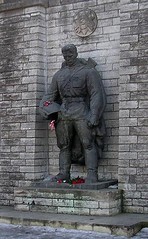
I know all of you are sick of reading about World War II memorials. It's sort of played out, but it seems like the Bronze Soldier disease has spread from Tallinn to Moscow, where officials and analysts are now weighing in on the issue like it would make a big difference in their life whether the Bronze Soldier was there or not.
As Interfax reports today, Moscow Theological Academy professor and deacon Andrey Kurayev thinks the Estonian authorities should ‘go all the way and pull down not only monuments, but everything that the ‘occupant’ empires built in their country.’
He thinks they should start with the buildings of the Teutonic Order dominion time, proceed to the time of the Swedish rule, then to that of the Russian Empire, and finish with the Soviet period buildings.
‘As a result, Estonia will get rid of everything the foreign ‘occupant’ powers befouled its holy soil, thus setting up a unique European landscape reserve. The separate Estonian state would be able to develop its absolutely new life on this open field,’ Kurayev remarked.
Let's be clear here - Andrey Kurayev is a jerk. He's inferring that there is no organic Estonian civilization, which I think is a buried chauvanistic psychological complex of some in Russia today - that the "Baltics aren't real countries, anyway." Although Russian "culture" seems to be perpetually stuck in the 19th century - ballet, thousand-page novels, the Russian Orthodox church - there is still some belief that it is superior to the nordic pagan culture of the Estonians. They've got Swan Lake, and Estonia has Runo songs - that's the crux of this attitude.
But that aside, Kurayev has a point. The "occupation" argument holds no water in the debate over the monument. You might as well pull down the huge "Stalin house" across from Stockmann. That building scares the crap out of me - it looks like a fossilized dump from a Soviet dinosaur - but people preferred to tear down the older house across the street for the sake of traffic. They think, despite Stalin's indulgence in genocidal mania, that the house looks pretty cool and there's a nice furniture shop and casino in the first floor anyway.
One argument that does stand up is that there are soldiers buried at the site. While one could argue that that impedes any attempt for removal, it can be rationally argued the opposite way. That if "radical nationalists" like Jüri Liim and Tiit Madisson really do managed to tunnel under Tõnismägi through the basement of the national library and blow up the memorial, sending Red Army femurs and skulls blasting through the windows of the Kaarli Church, who will be to blame then? Will the same "glorifiers of fascism" then have "failed in their civic duty" to protect the graves of the dead?
See, that's why I like this topic so much. There is no right answer to any question. However, I do have some words of hope. I've been reading a pretty good book by Robert McNamara, the former secretary of defense under Kennedy and Johnson, and he notes that one of the key steps to ending interethnic conflict between warring peoples is common mourning for all dead - no matter what "side" they fought on. This is a shift in an outlook of revenge - ie. "your grandfather did this to my grandfather" - to one of common mourning for tragedy.
I think that if we apply this principle to the monument controversy, that the wisest course of action would be for both sides to jointly mourn the dead. What that means is that, if the statue is torn down, it is done so in a dignified manner with only the protection of the site in its interest. If it is left standing, then it should be used as a memorial to mourn the dead, instead of a victory celebration of one side over another side. The same should be applied to all war graves in Estonia, be they of German Nazis, Russian Soviets, or Estonian partisans. The term for this common honoring is "reconciliation" and it is a key step in securing a lasting piece between ethnicities.
But reconciliation doesn't just call on Estonians to mourn the Red Army dead - the brothers, fathers, uncles, and grandfathers of many Estonians. It also calls on newcomers to Estonia to mourn the Estonian dead, including its political leaders who were murdered by the Soviet state. Sadly, it usually resorts to name calling. People use the words fascist and communist as if they still had some meaning in an era where
Russia is as drunk on capitalism as Estonia is. Obviously, both sides have to make some concessions to reconcile their differences. But the supreme question is - "Are those concessions worth it?" I think they are.