laupäev, juuni 17, 2006

The most annoying habit of Estonians

No, it's not their habit of winning the International Wife Carrying Competition every year since the dawn of the Millennium.

The most annoying habit of Estonians is answering all questions in English (or Russian, Finnish, German, Swedish, whatever) when they are asked a question in Estonian. Today I had such a dialogue. My half of the conversation was in Estonian, the other party's was in English. I could have understood most of what he said correctly in the language I am trying to learn (which most Estonians would like everybody that lives in their country to know, by the way), but instead I had to converse with another Estonian unwilling to speak in his language with someone enthusiastic enough to try and speak it with him.

I know others who have had similar problems, including Russian-speaking Estonians who said it took a LONG time for Estonians to respond to them in Estonian, even though they are fluent in the language.

So what's the deal here? Why does everybody encourage you to learn, and then snatch victory from your hands when you muster a correct sentence and wish to have a conversation? Why are Estonians so willing to bend over and introduce another language in a conversation? Why is it that when you go into a R-Kiosk in Tallinn, and two people speak Estonian and the third person speaks Russian, that everybody will talk to the Russian-speaker in Russian rather than have to deal with some bad grammar or some mispronounced words from the non-native speaker?

Is it really so hard to humor us?

reede, juuni 16, 2006

Spanish Girls Speaking Estonian

You've got to see this!!!!!! Here's a video of some Spanish girls living in Estonia speaking in Estonian.


It's C U T E ... A R M A S ... L I S T A ...

kolmapäev, juuni 14, 2006

Laisk Poiss

Kahjuks, mina olen olnud nii laisk et ma ei osknud uued sõnad. Siis ma pean hakkama jälle.

Täna meil on see huvitav sõna - mõjutama. Tegelikult, Edgar Savisaar on minu suur õpetaja, ja ma märkas 'mõjutama' üks artikelis kus ta räägis. Jah, ta on vist rikutud ja Benny Hill on kindlasti Savikasile sarnane. Aga, mina olen õpinud palju sõnad temalt. Ma ei tea miks. Nii - mõjutama - see tähendab "to affect" inglise keeles.

Siis, las leiutame midagi -

Suur inflatsioon mõjutab Eesti võime saada Euro valuuta järgimsel aastal.

Järgime sõna täna on eraldi. See tähendab 'apart' või 'individually' inglise keeles. Ma proovin -

Margus ja Maarju on abielus, aga nad eraldi elavad.

Numero kolm on nautima. See tähendab 'to enjoy'või 'to revel in' inglise keeles. Mu lause on -

Airi naudib kui piltid temast ilmub Kroonikas.

Neljaks on lidistama. See tähendab 'to tape' või 'to record.' Ma proovin -

Martini band lindistas oma uus albumit keldris.


Oi oi oi. Kui palju teil on õppida. Viimane sõna täna on 'meeles pidama' - ma veel ei saa äru kuidas seda lauses kirjutada -

Mats, pane meeles et su hobune on õues!

reede, juuni 09, 2006

More on the Glaubitz Affair

Well, this is an op-ed that might get read by some 'important' Europeans, and it's in English, by Martin Helme (pictured), the editor for world news at Delfi.ee, and published in today's Brussels Journal.

In his interesting op-ed, Helme discusses two main topics - first, the willingness of the Estonian civil service to scold the Estonian public over the affair rather than defend itself in the wake of Glaubitz's very public accusations.

But the second sheds more light on the things we know and the things we don't know:

Just when Estonian society was bracing itself for endless lectures about “true Western values” and the need to train our capacity for tolerance, the entire matter became a farce. On the same day the Estonian media reported that there had never been any harassing of the ambassador’s husband.

The papers wrote that the real reason for the ambassador’s early departure was the fact that his Cuban husband did not like the Estonian weather nor the local night life. Hence he was threatening to leave the ambassador unless the latter moved to somewhere warmer and livelier.

The Estonian authorities confirmed that not a single notification of racial or homophobic incidents had been reported by Ambassador Glaubitz, neither to the Estonian police nor the Estonian or Dutch ministries of Foreign Affairs.

Accusations of harassment that are not reported are hard to discuss. Are they perceived, real, did anything really happen? Who knows. And Glaubitz and his partner did spend the least fun time of the year in Estonia (autumn and fall) before deciding to leave Tallinn for balmy Montreal.

On the other hand, getting painted as a nation of SS-worshipping homophobes from the other side of Europe might make an offended person react by not taking Glaubitz's accusations at face value, and instead respond by insinuating that this is nothing more than the very personal becoming very private.

The best thing that can be said about these matters, is that all the individuals involved are human. From that fact alone, we can come to many simple conclusions.

neljapäev, juuni 08, 2006

Okei Õpetajad

Nii, mina olen lugenud viis uued imelikud sõnad.

Esimene oli rõhutama. See tähendab 'to underscore/to emphasize' inglise keeles. Mu lause -

Mats ütles et Arnold Oskmaa uus avaldus rõhutab et tema on üks näljakas huul.

Teine imelik sõna oli tõetama. See tähendab 'to back' inglise keeles. Leiutame midagi -

Taavi Veskimägi ütles eile, et Isamaa ja Res Publica Liit ei tõeta Arnold Rüütel presidentiks.

Järgmine sõna oli juht. 'Juht' tähendab 'conductor' või 'party leader' või 'leader.' Okei.

Lembitu oli vana eestis suur juht.

Neljaks meil on ammu teada - I have no friggin' idea what this means exactly. But Veskimägi said yesterday -

Rüütli kandideerimine oli ammu teada

Viimane on äpu. Ma arvan et see tähendab 'fool' või 'idiot' inglise keeles. Mu lause on -

Palju inimesi maailmas arvad et George W. Bush on tõeline äpu.

Presidential Update

Well, it appears that Keskerakond and Eesti Rahvaliit have been reading Eesti Päevaleht.

On May 23, Päevaleht published a story indicating that up against Edgar Savisaar or Arnold Rüütel, Toomas Hendrik Ilves would still win the presidency. One should keep in mind that at that time, neither Rüütel nor Savisaar had been publicly selected by either of their parties

Yesterday, Arnold Rüütel, Rahvaliit's strongest candidate and the 78-year-old sitting president, announced that he would represent Estonia in a second term if no other candidate could be agreed upon. Savisaar said that he would not seek the presidency if Rüütel was in the running.

Villu Reiljan, the Minister of the Environment, put on his poliical face this morning on ETV's Terevision program by saying that Rahvaliit could not support Ilves - who was born in Stockholm to Estonian refugees in 1953 and grew up in North America - because Ilves doesn't know Estonia.

However, Päevaleht released a poll showing that even up against Arnold Rüütel, who is still quite popular in Estonia, Ilves had more support among the public - be he born in Viljandi or Stockholm.

Toomas Hendrik Ilves is the preferred contender for Estonia’s highest office, according to a poll by Turu-uuringute published in Eesti Paevaleht. 36 per cent of respondents would like the Social Democratic Party (SDE) member to become president.

Current president Arnold Rüütel of the Estonian People’s Union (ERL) is second with 24 per cent, followed by Edgar Savisaar of the Estonian Centre Party (KESK) with 11 per cent.


Hmm. Savisaar's 11 percent plus Rüütel's 24 percent equals a combined 35 percent. That means that Ilves could face a tough battle against Rüütel. It also means that 30 percent of the Estonian public didn't know who to vote for.

The two sides seem locked in their positions. Interestingly, it is the two most right wing parties in Estonia - Isamaa ja Res Publica Liit and Reformierakond - that have pledged their support for Ilves - a social democrat.

Yesterday, Taavi Veskimägi (who is nearly 50 years younger than Rüütel) of the Isamaa-Res Publica union said that a vote for Rüütel would move Estonia backwards.

"Meie arvates Rahvaliidu presidendikandidaat Arnold Rüütel neid väärtusi ei esinda ning pigem sümboliseerib Eesti minevikku kui tulevikku," ütles Veskimägi. "Tema tagasivalimine presidendiks on Eesti jaoks halb valik."


"In our opinion, Rahvaliit's presidential candidate Arnold Rüütel...is more a symbol of Estonia's past than future," Veskimägi said (approximately). "To choose him to go back to the presidency would be a bad choice."

kolmapäev, juuni 07, 2006

Is the Tartu Rahu Still Valid?

Oh, this is a question to be sure. But such are the questions when you ink deals with rogue states. And what could be a better epitomy of a rogue state than Russian Soviet Federative Socialist Republic - the Russia that existed between 1917 and the establishment of the Soviet Union in 1922?

It was on the second of February of 1920 that Jaan Poska (1866-1920), Ants Piip (1884-1942) (pictured), Mait Püüman, Julius Seljamaa (1883-1936), and Jaan Soots (d.1942) sat down with their Russian counterparts Adolf Joffe (1883-1927) and Isidor Gukovsky and signed the Treaty of Tartu, also known as the Tartu Preace Treaty, or Tartu Rahu in Estonian, in which the Russian RSFSR renounced its rights to Estonia in perpetuity.

The two most important people at that signing were Piip and Joffe. Piip reached the peak of his political career in the early 1920s when he was Riigivanem, or state elder, the highest position in Estonia before the establishment of the office of president. However, by the end of the 1930s he was just a rank-and-file member of the parliament. Still, when the Soviet Union occupied Estonia in July 1940, Piip was arrested by the NKVD. He died in a prison camp in Perm oblast in Russia in January 1942.

Joffe is also an interesting character. He was one of the RSFSR's top diplomats until Lenin died in 1924. He was also a close friend and ally of Leon Trotsky, and after falling ill, he took his own life in 1927. Trotsky gave the eulogy at Joffe's funeral. It was the last speech that Trotsky gave in the Soviet Union. Trotsky was eventually assasinated in Mexico in 1940 with an ice axe. For his efforts, Ramon Mercader, the Spanish-born NKVD assassin, was awarded the 'Hero of the Soviet Union' medal, and split the rest of his life between Havana and Moscow. He has a place of honor in the KGB museum, and when he died in 1978, he was buried as a hero in Kuntsevo Cemetery in Moscow.

But what do all these dead men and the documents their once active hands signed have to do with us with our iPods, cellphones, Wifi connections, and blogs in the 21st century?

Plenty, as the Russian Foreign Ministry attests. For today, the seventh day of June, in the year of our Lord 2006, 66 years after Trotsky's skull was shattered with an ice axe, 64 years after Ants Piip died in a prison camp in Siberia, and 86 years after the RSFSR signed its treaty with Estonia, the Treaty of Tartu is declared 'no longer valid.'

MOSCOW, June 7 (RIA Novosti) - Russia will resume border negotiations with Latvia and Estonia only after the two Baltic states withdraw political demands on Russia, the foreign minister said Wednesday.

Talks on border treaties between Russia and the two countries have stalled over territorial issues inserted into new versions of agreements by Estonia and Latvia, and the two countries' claims for compensation over what they term Soviet occupation.

Sergei Lavrov said Russia would only rejoin negotiations if the Baltic states returned to the original documents and remove the political subtexts.

"But as long as these political links are there, returning to the negotiating table is out of the question," he said.

...

The Russian and Estonian foreign ministers signed treaties on common borders on May 18, 2005, and the Estonian parliament ratified the documents on June 20, but with additional demands linked to the 1920 peace treaty between Soviet Russia and Estonia. On September 6, Russia notified Estonia that it was revoking its signature from the treaties because the 1920 document was no longer valid.


The preamble of Estonia's border agreement claims a) the legal continuity of the Republic of Estonia proclaimed on 24 February 1918 b) that the treaty partially amends the state border line established by Art. III section I of the Tartu Peace Treaty of 2 February 1920, c) the agreement shall not influence the rest of the treaty and shall not determine the treatment of bilateral issues not connected with border treaties.

At what moment did this document become no longer valid? Estonia signed a military alignment pact with the Soviet Union in September 1939, yet even at that point, the Treaty was apparently still in effect. For example, The Republic of Iceland has been recognized by the United States since 1944 and has had a base located there since 1951. However, the existence of American military presence in Iceland has not interfered with Icelandic sovereignty.

In 1940, after a new communist puppet government was created, the Republic of Estonia ceased to exist as far as Moscow was concerned, and was now a member state of the USSR, as established in 1922. The Tartu Rahu was no longer valid. It's living signers were now enemies of the Soviet state (Jaan Soots, who accompanied the delegation in 1920 and a former defense minister of Estonia, also died in a prison camp in Russia in 1942).

But, the current Estonian Republic considers itself the same republic that was founded in 1918 and signed the Tartu Peace Treaty. The Russian Federation considers itself the successor state to the USSR. For example, last year, Putin said that Russia owed Estonia no apology for occupation due to a resolution passed by the Soviet Supreme Council in 1989.

So what is afoot here? The Russian government does not recognize the Estonians as who they claim to be. The Russian foreign ministry, at the same time, is not exactly sure who it is. Sometimes - ie. when it comes to claims to the Kurile Island in the Pacific Ocean - the RF is definitely the successor state to the Soviet Union.

But when it comes to bilateral relations with Estonia, Russia is not so sure if it actually had anything to do with the Tartu Peace Treaty or not. Instead, it just wants to not discuss the past and move forward.

I guess this is an example of Russia's oft-discussed post-1991 identity crisis.

The sad irony here is that Estonia's preamble references resolutions already passed by the Riigikogu. Therefore, there is little need to reference those resolutions in this document. So if Estonia revoked the original document and passed a second one without the preamble - the legal effect would be exactly the same.

teisipäev, juuni 06, 2006

Dutch Ambassador to Leave 'Homophobic' Tallinn

Dutch Ambassador Hans Glaubitz (pictured, left) is leaving Estonia because his male partner, a black Cuban, has been the victim of homophobia and racism, according to several news reports.

The Ambassador's partner was subjected to verbal harassment and threats in the street and threats. These began after a local magazine wrote that the appointment of a gay Ambassador with a black partner had to be seen as a Dutch provocation.

The Dutch Ministry of Foreign Affairs had hoped that Estonia, like its neighbour Finland, would be able to accept a relationship between two men. According to a report by the US Embassy in the capital Tallinn there have been nine cases of threats made to non-white embassy staff, mostly by Neo-Nazis or skinheads.

In a personal statement, quoted by the NRC, Glaubitz indicated the behaviour of the Estonian government was beyond reproach as his partner was treated well on an official level.

The treatment by members of the Estonian public was another matter. "[Estonian] society is far from ready for two men, particularly if one of them is black," Glaubitz said.

The Ambassador and his partner are being transferred to a two-year assignment at the Consulate General in Montréal, Canada.


First, does anybody know which local magazine was the first to discuss this man's private life? I doubt it was Kroonika, but could it have been the SL Õ? Pray tell to whom we all owe the honor of bad publicity for oma isamaa meie õnn ja rõõm...

Second - I actually heard - second hand - of an African-American individual affiliated with the American embassy that had to put up with a few 'Heil Hitlers' from some enthusiastic self-defoliating skinheads in Tallinn. I too was pressured for money from a leather-clad skinhead in the Old Town at an Internet Cafe. He actually asked me for money in Estonian, then Russian, then Finnish, and finally English. So you can't say they've lost all of their mental faculties :)

The idea that Estonia is any different from Finland though in its attitudes towards blacks, is a bit off mark though. Throughout my travels in Northern Europe I was privy to racist jokes a plenty. I don't think it is necessarily because people there are malevolently racist - I think it is because they just don't live near a lot of black people. When I lived in a very caucasian neighborhood as a child, I too had some funny ideas about people who didn't look like me. Now that I live in New York though, I have a lot of funny ideas about people that DO look like me.

A interesting tidbit is that the word for black man in Estonian is 'neeger' which is an insulting term in English, but Estonians insist that 'must' the word for 'black' also means 'dirty' and is a far more derogatory thing to call someone.

Estonian attitudes towards homosexuality though are a separate issue. I am currently unaware of any openly gay celebrities or high profile individuals in Estonia. I am aware they exist - and I am sure most people could point them out - but it just doesn't seem like something which is openly discussed in society.

Yet, sexuality isn't really openly discussed in public either. It is in magazines, sometimes on TV, but in a public setting? I rarely saw straight couples 'making out' or embracing in Old Town - and if they were, they were usually foreigners, or it was warm out and they were drunk.

I welcome all comments on Estonia's attitudes towards homosexuality though. I am NO expert.

I do think it's important though to view this from a European perspective. As any Dutchman will tell you, Holland, with the recent assasination of Pim Fortuyn and the murder of Theo Van Gogh, not to mention the effort to strip the citizenship of Ayaan Hirsi Ali is struggling with similar issues of bigotry and tolerance.

Three Years of Marital Bliss


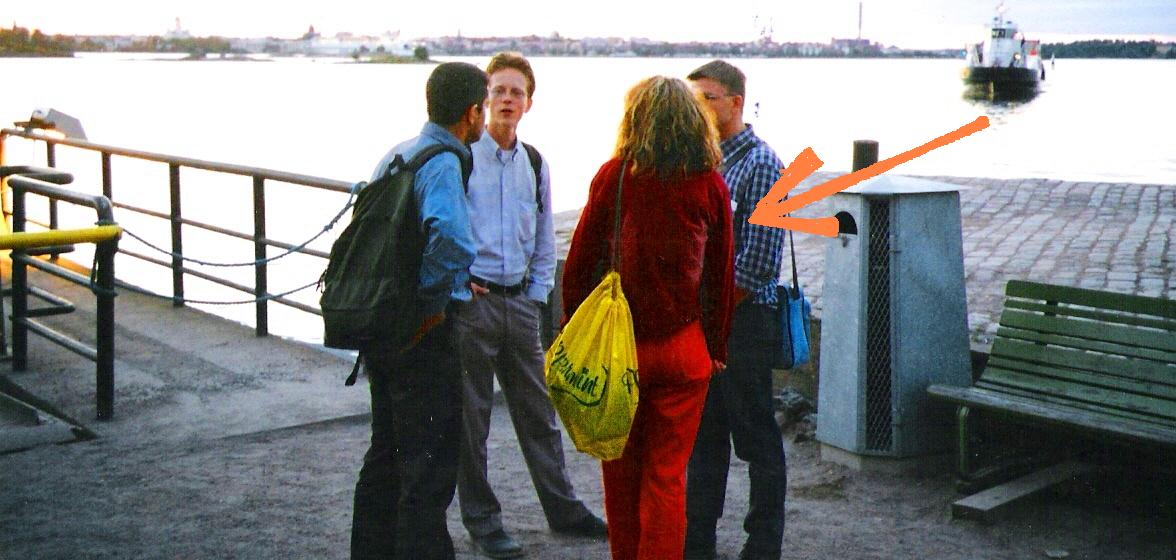
This photo was taken on or about the 5th of August in 2002. The young woman in the red pants and red jacket is Epp - then just one of the many fuzzy foreigners in my company in Helsinki - now my wife and the mother of our child.

The clean (well cleaner than New York Harbor) waters of the Gulf of Finland are at play in the distance, and, according to my memory, I most likely was intoxicated by the time I took this photo of what was to become a familiar backside.

As of today - 6/6/06 - the number of the beast - we are officially married for three years. Many marriages don't last that long. For example, Lisa Marie Presley's marriage to Michael Jackson only lasted about 19 months. Frank Sinatra and Mia Farrow on the other hand duked it out for a full two years. So we have something to be proud of - a true achievement in today's society!

When we got married, my romantic cousin asked if it meant that I wanted to "spend the rest of my life, forever and ever" with Epp. I have never been comfortable with the idea of the "rest of my life, forever and ever" because I am a bit of a fatalist and I just don't like predicting the future. I enjoy more to go with the flow. But, as of today, it does appear that we are on the road to spending the "rest of our lives, forever and ever" together.

We were married in Tallinn on June 6, and then took a sweaty bus south to Viljandi where we honeymooned (the most unlikely honeymoon spot on Earth). We had a nice south Estonian dinner and retired. The next day we greeted her family and I had to give an embarrasing speech. It was overcast. I still was getting used to having this metal ring on my finger. I always hated rings (or any jewelry, body art etc.) and so it took awhile to get used to. I have to say that I was a bit uncertain about getting married. In all my predictions for the future, marriage had never seemed to manifest itself in my dreams. I didn't know what to expect, I wasn't sure what it meant, I wasn't sure that if I was turned loose in a nightclub in Amsterdam if I'd succumb to adultery and other debacherous acts. I just was not very confident before I took the plunge.

But now, three years, later, it seems to have worked out pretty well. I like being married. In fact, I oddly am enjoying it more each year, which is the opposite of what others describe as a "long meal with dessert at the begining." The hype of marriage is long gone, and again it's just me and my kullake, living together, watching bad movies on the Lifetime network together, and, once in awhile, frequenting NYC comedy clubs together. Two peas in a pod. Two bees in a nest. Two humans in legal bondage :)

And, in a way, I am glad we did it the way we did it. Our wedding had little fanfare - limited planning, the thousands of cousins did not materialize to muster up a bon voyage. Instead, we just got married, and have lived happily since, so much so that, today, when I am on business trips, I actually have trouble sleeping without the warm human being in bed next to me.

A really good marriage necessitates the compliance of two really well-suited people. When I met Epp in Helsinki those four years ago, I knew pretty much immediately that she was creative enough, interesting enough, moody enough, and crazy enough to put up with somebody like me. It felt like I had finally found a partner that could put up with me and vice versa. And it seems that my gut instinct was right.

neljapäev, juuni 01, 2006

Toored Sõnad

OK...hakkame jälle.

Esimene on paras. Paras tähendab "fitting" või "appropriate" inglise keeles. Mu lause on:

Ma arvan et sul on parasid riided pülmale.

Teine on hälgima. 'Hälgimaä' tähendab "to starve" inglise keeles. Mu lause on:


Kui te ei söö mitte midagi, siis te kindlasti hälgite.


Kolmaks on ilmuma. 'Ilmuma' tähendab 'to appear' inglise keeles. Mu lause on:

Veevana ilmus jõepeal.

Neljaks on toores. 'Toores' tähendab 'raw' inglise keeles. Mu lause on:

Tõitsi lemmik toit on toored porgandid.


Okei, viimane sõna on segema. 'Segema' tähendab 'to disturb' inglise keeles. Mu lause on:

Need inimesed kes jööb kohvi sukru ja piimata alati segeb mind!

teisipäev, mai 30, 2006

Nordic? Defense? Mwahahahahahah.

Remember the Winter War where Finns young and old bound skiis to their feet and defeated Stalin's invasion of Finland? Ok, so maybe you don't, but that was the highlight of Nordic military prowess in the 20th century.

Other Nordic countries, like Sweden, just decided to let Hitler do as he pleased. Denmark surrendered, Norway had to endure Quisling's Vichy-like regime, Iceland went fishing, and Estonia? Well, Estonia didn't listen to Laidoner.

But now, the Nordic defense ministers are cooperating, and the EU's Nordic battalion, which includes troops from Estonia, Finland, Norway, and Sweden this week opened its headquarters in the Swedish city of Enköping.

Meanwhile Jürgen Ligi, Estonia's defense minister is also in Enköping to dream up scenarios where they could possible use the Nordic Battalion Group - perhaps defending Lake Peipsus from drunken Russian fishermen, or defending the Faroe Islands from drunken Faroese fishermen or...

Defence Ministers from Sweden, Norway, Estonia, and Finland are taking part in a workshop Tuesday here on coordinating activities.

The four countries are members of the Nordic Battle Group, a rapid reaction force, which is to be ready to work with the European Union during the first half of 2008.

Tuesday’s workshop, at the home of the Uppland regiment in Enköping, includes a series of fictitious scenarios where the defence ministers will discuss cooperation and decision-making on the national, joint, and EU level.

Eesti Mayor of Mälmo to be Tried for Junket

From The Local, Sweden's News in English:

A senior Social Democrat politician in Malmö will go on trial this August charged with taking bribes.

Municipal commissioner Ilmar Reepalu is accused of accepting a free trip to Africa from businessman Dan Olofsson. He is being charged together with former governor of Skåne Bengt Holgersson. Olofsson is being charged with bribery.

"I think that this will be over with before the election," Reepalu told Swedish Radio.

Sweden goes to the polls on September 17th


According to Swedish Wikipedia, Reepalu was born in Estland in 1943 but found some very important reason to relocate to Sweden as a youngster.

Las õpime jälle!

OK, I have a limited amount of time so here are my five new words -


Lahkuma - see tähendab "to depart" inglise keeles. Mu lause on -

"Järgmine Silja laev lahkub kell 17:00."

Teine sõna on kuumutama. See tähendab "to simmer." Ma proovin -

"Las riisi kuumutab pottis pool tunneks."

Ja järgmine on äädikas. Äädikas tähendab "vinegar" inglise keeles. Proovime -

"Inglismaal söövad nad kala ja krõpsud äädikasiga."

Tegilukult mina olen lugenud menuud eesti keeles, sest et mu järgmine sõna on purustama. See tähendab "to crush" inglise keeles. Nii -

"Kui te tahaks teha veini, siis te peaks purustama viinamarjad."

Viimane sõna on libu. Libu tähendab "harlot" inglise keeles. Nii -

"Kui sa tahaks leida üks odav naine, siis mine Molly Malone'sse laupäeval õhtul, sest et palju libusid hangivad seal."

Ja see on kõik (ja tore)!

pühapäev, mai 28, 2006

The Politics of Pronks

First, dear readers, I would like to apologize for writing another post about the most controversial monument in Tallinn. However, I was thinking, and thinking, and then thinking some more about how this will play politically, and I came up with a few basic thoughts. Being an American and an Atlanticist who believes that World War II was more about power and geography and less about ideology, I am perhaps biased in the eyes of some readers. Well - whatever - here are a few main political observations on this controversy.

1. This is bad for Tallinn mayor Jüri Ratas. Ratas, as mayor of Tallinn and a member of what appears to be the most popular party in Estonia, Keskerakond, should have been front and center in this debate. Instead he's been invisible, wondering what all the fuss is about. His nonchalant attitude about the memorial shows him catering to his "nostalgic for Communism" base - funny considering that the USSR died when he was a spotty 13 year-old. He might preserve KESK's hold on the "nostalgic for Soviet times" crowd, but his lukewarm defense of the controversial soldier will cost him big in the "character" category.

2. This is also bad for Isamaaliit AND the future Isamaaliit-Res Publica Union. With its smart ties and Eurospectacles, Res Publica seemed like Isamaaliit for the 2000s. Isamaaliit - it's name translates as "fatherland union" was the more old fashioned, genuinely patriotic party, with roots going back to 1987. Most of its members probably are nothing but Estonian patriots. But the high profile media attention given to certain Isamaaliit members like Kalev Rebane, and other skin heads, leaves a bad taste in anybody's mouth.

3. This is actually a win for the Reform Party. Andrus Ansip's commitment to moving the soldier to a cemetery - where most war monuments are located - and out of central Tallinn speaks less about what the monument stands for, than the fact that there is a Soviet memorial in central Tallinn that is a lighting rod for conflict. The Soviet nostalgia parties every May 9 don't help. With Isamaaliit and Res Publica voters pondering their future following the merger of the two parties, many could jump ship and move to Reformierakond.

4. This hurts Edgar Savisaar's presidential ambitions. Savisaar's belief that the monument should stay there reinforces the attitudes of his opponents that he is nothing but a Soviet-style yes man, an Estonian slave with a Russian master. Just read the comments on Postimees and you can see how deeply in hate some people are with the guy.

5. This helps the presidential ambitions of Toomas-Hendrik Ilves. Because where is Ilves these days? He's in Brussels. Far away from skin heads, spray paint, red flowers, and the bronze soldier in central Tallinn. He has said little if nothing on the matter, and he shouldn't have to - he's in the European parliament, it is wholly out of his jurisdiction. So as the mud flies, none of it lands on him.

laupäev, mai 27, 2006

An interview with Aili Jõgi

We were discussing the two girls that destroyed the first monument to Red Army soldiers in Tallinn - a wooden one - before the occupation authorities decided bronze would be more fitting, and less easy to destroy. Well if you ever wondered what happened to the two girls that blew up the first Soviet memorial in downtown Tallinn 60 years ago, now's your chance.

Aili Jõgi was less than 15 years old when she, and her neighber Ageeda got rid of the first memorial there. She spent her 15th birthday in an NKVD prison. She was allowed to leave Siberia in 1970.

A key moment in her interview:


"Ja mis tehti meie presidendiga? Ma mõtlen siis, kui Lennart Meri kirst toodi Kaarli kirikust välja ja kirstuga auto läks sellesama punasõduri eest läbi. Kas nad tõesti ei saanud teiselt poolt minna?! Kas matuse korraldajail üldse aru peas ei ole?!"


"And what did they do with our president? I think that, when Lennart Meri's coffin came out of Kaarki Kirik, the car coffin went right in front of and past the Bronze Soldier. Couldn't they really have gone the other way? Didn't the organizers have any common sense?"

Jõgi says she took up the discussion of the memorial with Tallinn mayor Jüri Ratas, but he decided, after a lot of thought, that it didn't bother him.

Uskumatult loll avaldus... Poisslinnapead ei häiri, kui tema linnas on pisuke maalapp, kus Eesti riigi lipp ei tohi lehvida, aga punalipp tohib.


"This was an incredibly stupid statement...it doesn't disturb the boy mayor [she refers to him as poisslinnapea throughout the piece, Ratas is 28 years old.] that his city used to be a little chunk of land where it was prohibited to wave the Estonian Republic's flag, but it was permitted to wave the Red flag."

reede, mai 26, 2006

Laanet Bans Pronkssõdur Protests

Estonian Interior Minister Kalle Laanets is your typical Estonian public servant - young and faced with difficult decisions. At age 41, he is of the same generation of post-Soviet leadership as Finance Minister Aivar Sõerd and Education Minister Mailis Reps - people born long after WWII yet somehow caught up in the historical melee.

Can you believe that? Fighting over history? So angry that you are willing to become agitated and violent for something that has actually little bearing over your life here and now, in the present? It happens everywhere. It's some kind of human disease.

Well anyway, as of today rallies for and against the bronze soldier in central Tallinn have been banned. That means that neither Tiit Madisson from Isamaalit nor Vladimir Lebedov - a founder of Intermovement and an opponent of independence from the 80s - can hold rallies and argue about who killed who in World War II in front of the controversial memorial and May 9 party zone.

While the move seems undemocratic, banning sounds scary, it's actually not. It's fairly common to not allow protests in certain municipal areas in this zion of democracy known as the United States of America. And it is a safety issue.

But it has attracted the attention of international media.

Karvased Päevasõnad

Ok, several of today's words come from Mõmmi Aabits, a song to which my daughter knows all of the words.


Täna esimene päevasõna on sarnane. See tahendab "alike" inglise keeles. Siin on minu lause -

Tõnis Kasemets on Markko Märtini sarnane.

Nümber 2. Küpsetama. See tahendab "to bake" inglise keeles. Minu lause -

Kaur praegu küpsetab küpsid köögis.

Kolmaks sõnaks meil on arendama. See tahendab "to develop." -

Anstile meeldib oma auto arendama.

Järgmine päevasõna on abiratas. See tahendab "training wheel" inglise keeles.

Mõned blogijad oli kirjatanud, et Tallinna linnapea on Jüri Abiratas, mitte Jüri Ratas.

Ja me lõpetame sellega, Karvane. See tahendab "furry" või "hairy" inglise keeles.

Ruhnu karu on kindlasti karvane!

neljapäev, mai 25, 2006

...Ja Veel

OK, I think I have found some more words to learn for today. Täna hommikul ma sõitsin rongiga tööle. Need on minu päevasõnad.


Lurr - ma õppisin seda sõnat eile õhtul Epuga. Me lugasime 'Laps ja Toit' - üks ajakiri Eestist. Siis, see on minu lause lurrile.

Liisu isa ütles et Linnaleht on mingi lurr.

Järgime sõnad on 'meeles pidama,' mis tahendab 'to remember.' Ma tõesti ei tea kuidas õelda seda veel. Tavaliselt ma ütlen 'maletama.' Aga las ma leiutan midagi -

Sina pead meeles oma telefoni numbrit!

Okei. Järgine asi on Uskuma. Lihtne,jah? Ei.See on minu vale lause. Palun api!

Uku usub maausk.

Järgmine sõna on stereotüpiline imelik Eesti sõna. See sõna on 'Iialgi,' ja ma mõtlen et see tahendab 'never.' Proovime -

Inno ütles et ta on iialgi käinud Kärdlas.

Viimane päevasõna on 'Valdama,' ja see tahendab 'to be fluent.' Minu viimane lause on see -

Vambola valdab vabalt Võru keeles.

kolmapäev, mai 24, 2006

Õpime Sõbrad!

OK, so I have two main missions in life - Mission 1 - make music. Mission 2 - õppida eesti keelt. The missions are not exactly in that order.

In order to increase my Estonian skills I have decided to put together vocabulary lists. Today's words/phrases to be learned are the following -
Lasema Õhku
Plehku Panema
Suurepärane
Lööma/Lüüa
Kunagi


Knowing the basic meanings is the easy part. 'Lasema õhku' means to 'blast away.' I learned this from Jüri Liim in Postimees. The phrase can be used like so, I believe:

"Jüri Liim tana hommikul ütles et ta tahaks laseda pronkssõduri õhku."

'Plehku panema' I learned from E Nagu Eesti. I think you can use this one like so:

"Epp proovis püüdma Martat, aga Marta panes plehku."

'Suurepärane' is an adjective. I think it should be easy to incorporate. It seems like a synonym of 'täiuslik' and 'imehea.' So it can be used like this:

"Oi oi oi, vanaema. Sinu klimpisüpp on tõesti suurpärane!"

'Lööma/Lüüa' looks less promising. Let's try this one in the past tense.

Eesti löös Taani üleeile jälgpallis.

Bear with me. I know this is frustrating to watch...Ok, here's our final term, 'kunagi.' Oh, it would be nice to know how 'mitte kunagi' and 'nähagi' are different. But let's try 'kunagi.'

Mart söi pitsat ühest restoranist Tallinnas, aga ta oli häige sellel õhtul. Ta ütles mulle et ta ei viitsi süüa seal samal kohal mitte kunagi.

I await your many corrections...

teisipäev, mai 23, 2006

At Postimees, It's All Pronkssõdur, All the Time!

What do you see when you look into the eyes of the Pronkssõdur ('bronze soldier') near the Estonian National Library in Tallinn?

Do you see the defiant look of the Red Army soldiers that drove Hitler's troops out of Pribaltika? Or do you see the manical laugh of the men who loaded your grandmother into a cattle car bound for Siberia? Or do you just see an ugly, bronze dude in a cape (how many soldiers back then wore capes? Come on!)

I regularly read Postimees, one of Estonia's daily national newspapers, and today has been Pronkssõdur day - the day where every leading news story is about what different important - and not so important - people in Estonia think about this guy.

One really important person who made his opinion clear today was Prime Minister Andrus Ansip, who told Eesti Radio that:

Kõige enam sümboliseerib see pronkssõdur seal okupatsiooni ja sellist ausammast okupatsioonile me Tallinna südalinnas Kaarli kiriku kõrval taluma ei peaks.


Basically, "the bronze soldier is a symbol of occupation that doesn't belong next to the Kaarli Church in the heart of Tallinn."

Ever the cautious public servant, Villu Reiljan told the newspaper that it wouldn't solve the problem to move the Bronze Soldier, which Ansip has recommended relocating to a cemetery.

Not one to miss an opportunity to get a few more votes from his base, Edgar Savisaar chimed in saying that the bronze soldier should stay where it is. But I had a hard time translating him without using a dictionary so we'll leave it at that.

Finally, President Arnold Rüütel decided that the best way to scuttle the controversy would be to bury it in red, or blue, black, and white tape. He believes that a commission should be set up to address the matter.

Other than Savisaar, Postimees found two organizations to disagree with Ansip - Vene Erakond Eestis and the Anti-Fascism Committee. VEE said that the Bronze Soldier memorial is a great place to come and put down flowers and honor ones grandfathers who won the war against fascism in World War II.

Sadly, in 2003, VEE only got 0.20 percent of the vote, or 990 votes in total. However, a spokesperson for the group said on ETV that removing the statue would not bode well for Ansip. One can only guess that VEE hopes to double its turn out in the 2007 election.

I think this debate will go on for a long time and never really cease in Estonian society. I mean look at the US. It's 2006 and we are still arguing about the Civil War!