neljapäev, aprill 30, 2009

gospel of liberalism

I watched Finance Minister Ivari Padar last night on ETV and I was surprised by how bad he looked. Maybe it's the hellish job of being a social democrat in a center-right government, or just the fact that rumors are circulating that Prime Minister Andrus Ansip would like to dismiss him.

Padar's sin was making the argument that, rather than cut anymore at Estonia's already bare public sector, perhaps Estonians themselves could sustain a tax increase to pay for some of the services they enjoy.

This of course was not music to SDE's coalition partners' ears. Taxes, from the standpoint of liberals, always go down. They never go up. Given the choice between paying your teachers and nurses and sanitation workers a decent wage and lowering taxes, the choice is obvious: you lower taxes.

This is the philosophy of those who see the state as inefficient and intrinsically evil, though they don't mind running it themselves when given the opportunity. And if you really need money, the Swedes are always there to bail you out.

Except why is Sweden so sturdy and its satellite Estonia in such shit shape? Both nations should share the blame. The Swedes offered free money to the Estonians, and the Estonians took it, even though they couldn't pay it back. Now the relationship between the two countries has become even closer. Russia may own Estonia's past, but Sweden owns its future.

Estonian reliance on Sweden and Finland has created a narrowly structured economy heavily reliant on investments in financial intermediation, real estate, and the domestic consumption fed by both. Now that the money has dried up, Estonia has few places to turn. It keeps waiting for its shiny Nokia to appear, but it doesn't spend the same amount on R&D that Finland or Sweden do to produce those Nokias and Volvos and Ikeas.

Besides, investing the same amount of money in R&D to get to that point would necessitate capital, and perhaps even some tax increases. But such a scenario should never come to pass, because tax increases are not what Estonia is about. Here taxes are only supposed to go down, they never go up. If you need money, go ask the socialists in Brussels for it.

The problem with this philosophy is that, up until last September, the private sector was considered to be far more sophisticated than the public sector. Liberals could make their arguments based on the assumption that the financial managers knew best. Maybe they still do. Maybe Padar is wrong and Ansip is right. But how would we ever know. We are all tied to the theory of how things are supposed to work. But just a few years ago, these same characters were forecasting eternal growth and lighter tax burdens. Now, that appears to have been a fantasy.

So, on these days, I am happy I am not the social democrat Padar. But I am really glad that I'm not the liberal Ansip either.

esmaspäev, aprill 27, 2009

seto maffia

We only spent eight hours at our new place in Setomaa yesterday, but my entire body is exhausted. It's not like I took on particularly arduous tasks. It's just the constant movement: chasing children, carrying items, opening dysfunctional barn doors.

My wife's grandmother Laine did not approve of us finding a maamaja -- country house -- in Setomaa. She recommended Tõstamaa, the coastal area of Estonia north of Pärnu where she was raised.

I really like water too, Laine, but Tõstamaa is expensive. One might pay more more a rundown outhouse on the coast of Estonia than for what we dropped on a little house with a barn, sauna, and rundown outhouse in Setomaa.

There's something else you should know. Laine's husband Karl was born in Setomaa, though he is not himself a Seto, whatever that means. Seto people are basically Orthodox Estonians from the border region with Russia that speak a funky dialect that is very close to Võru, the main differentiator probably being faith, as most Võru speakers are Lutherans.

But the reality is that our nextdoor neighbors in Setomaa are like Karl in that they aren't Setos. They don't appear to be Orthodox. And they definitely didn't speak any special Finnic dialect with us. As far as I could tell from the conversation, these people moved to Setomaa for the fresh air and country life. They were sort of like us, we of the Italian family name.

Our friends Helen and Mart who live near Obinitsa aren't Setos per se either, though Mart has deep roots in Petseri, on the other side of the border, which makes him sort of like an exile Seto who has returned, I guess. Mart seems to know so much about Seto culture, that I cannot accurately represent his wealth of knowledge. One day in a parking lot in Värska, I told him it was hästi libe -- "very slippery" -- in Estonian. "Ah, but do you know what the word "slippery" is in Seto?" he asked, as if I might now. "It's %&#%." Or something like that.

All properties in our parish have names. Our farm, built in the 1920s, originally had a Russian name, like "Nikolaikova," that was shortened to a cute Estonian name, like "Niku." The farm was later bisected into two farms, and we were encouraged to choose a new farm name, while the other property owner maintained the old name, "Niku," for their farm.

This is actually a good example of how things can become Russified or Estonianized. If it is Russified, it becomes Orthodox and is written in the Cyrillic alphabet. If it is Estonianized, it is rendered with a few extra vowels, some with diacritical marks, in the Roman alphabet. On the Estonian side of the border, there are villages with adorable names like "Lüübnitsa" and "Võmmorski."

I didn't like the existing name of our farm anyway, so Epp and I went back and forth trying to think of a new name. Epp suggested Leelo Talu, after the famous seto folk song form, but she later decided that it might seem obnoxious for some guy from New York and a lady from Viljandimaa to name their farm after the most sacred word in the seto vocabulary.

We played with other names, trying to remember the few seto words we knew. How about Ubina Talu -- "Apple Farm" -- because ubina is "apple" in seto language? No matter how hard we tried, these seto names didn't work for me. Why? Maybe because it's just a cosmetic way of appreciating the local culture. So we settled on Sassi Talu, after Epp's great-grandfather, who lived in Setomaa. I was told that this worked well because "Sass" is also a Seto name.

Then there is the discussion of what to do with the house. Most Seto interiors are spare and wooden, save for a ornate "Icon Corner" for the Virgin Mary. The Estonians I know seem to exotify the Orthodox Church. They have grown up as dull secular Lutherans, and anything with a splash of color and some incense is instantly more appealing. To me, though, these trappings of Orthodox life remind me of my own Catholic upbringing. Do I really need a mystical Orthodox portrait of the Virgin Mary on my wall? Really? Do I?

Maybe Seto folk patterns and colors would be a better route to show our appreciation for local tradition. As he is familiar with Seto architecture, Mart advises foresty greens or sky blues for the exterior trim on the house, and I am not opposed to green. I think it's a good choice. Still, I feel like a blind man, feeling his way around the southeast Estonian landscape. With some advise, the house might look great. Without it, it might look garish and out of place.

One bonus for me is that there are people in Setomaa who do speak the dialect, and in Tartu there is also a subset of people who belong to a category I call, "I have no idea what the heck this guy is saying," most of them either from Võru or Setomaa. One of them works at the place where I get my car fixed. Whenever he picks up the phone, it sounds something like, "%&%&? #%¤&! #¤#¤?" So, I figure that if I can break the Seto dialect, then I will hold the key to understanding all varieties of the Estonian language in my hand.

neljapäev, aprill 23, 2009

maamess

Our refrigerator now contains four round küüslaugujuustud -- garlic cheeses. It's mahe toit -- natural food, bought directly from this year's maamess.

We bought four of them, because if we had bought only two, they'd be gone in two days. With this investment, we managed to secure enough of our favorite cheese to last possibly a week.

The word mess in Estonian means something like "fair." Maa is "land," but it's also "earth," and it's also "ground" and it's also "country," so a maamess is a "landearthgroundcountry fair."

What does that mean? It means tractors and animal feed and forestry equipment and local cheeses and meats and vegetables and robotic masseurs and women's magazines and insurance companies and folksy newspapers and even political parties.

The patron political party of this year's maamess, as well as the countless other öko festivals and gatherings we have attended in recent years, is Erakond Eestimaa Rohelised -- the Estonian Green Party.

Founded prior to the 2007 parliamentary elections, the party used to seem like the brainchild of leader Marek Strandberg. Our well-meaning friends in the Estonian Social Democratic Party (SDE) advised us that the Greens would quickly implode following the elections; they were supposed to be the new "Res Publica" -- the ill-fated vehicle of Juhan Parts & Co. that merged with the smaller but more tenacious Isamaa Liit in 2006.

But the Rohelised did not implode. They still poll rather well. They have followers too -- men and women, young and old, estophones and russophones -- who don snazzy green t-shirts and stand in booths at gatherings like maamess to talk with possible voters. And I have to say that I like them, even if I am not sure what they stand for, other than eating organic cheeses and scoping out new tractors, because "greenness" is very appealing to Estonians.

Case and point, when we went to deliver two boxes of Roheliseks Kasvamine - "Growing Green" - a book authored by mu kallis naine, the guard at the gate waved us through: "You don't have to pay!" he smiled. "I am green, like you. We are on the same side!" I can imagine this social movement catching on because the devout brand of liberalism sold by the Reform Party doesn't look as appealing during a global recession, and the left-leaning populism of the Center Party isn't convincing because their leader is rather unattractive, yet thinks he can win votes by plastering his face all over Tallinn.

Estonia's two biggest parties are both money parties. They buy billboards and revolving signs and new brands of kohuke snacks. This kind of advertising does not convince me. Beyond Reform and Center though I am pretty content with the choices. The conservatives in IRL are an obstinate, history-obsessed bunch of professional Estonians, but I do not doubt that they love their country. The social democrats can be eurofriendly poseurs, but I share their concern for their fellow impoverished, drunken maarahvas. There are a lot of people living in squalor in Estonia. This is the truth.

Finally, there are the Greens, whose soothing öko colors strike me as the most Estonian of all. The Greens are not as well-financed as Reform or Center, so they actually have to do grassroots work to capture some votes. This kind of grassroots work is an essential component of a healthy parliamentary democracy. It is ideal that you go to a country fair to talk with politicians, rather than choose between the slogan printed on every Tallinn city garbage can and the promises displayed at every Tartu bus stop.

My only question is, if the Greens hang out at country fairs, where do the social democrats and conservatives hang out? Are there young co-eds in red SDE t-shirts canvassing at the local Taara punkt bottle return to reach the down-on-their-luck losers of neoliberalism? Do the representatives of IRL adorn folk costumes and hang out in the history sections of Rahva Raamat and Apollo bookstores next to the latest works of their party elders?

In some ways, I hope they do, because Estonian political parties are among the least trusted institutions in the country. A little more face-to-face time could go a long way; much longer than any kohuke, bus stop promise, or revolving sign.

esmaspäev, aprill 20, 2009

mongolian people's republic

My research into Estonia's June communists has yielded some interesting results.

The June communists were the armchair social revolutionaries and left-wing MPs drawn up by the Soviet legation in Tallinn in June 1940.

This government was installed following an ultimatum from Moscow to form a friendly government capable of carrying out the terms of the September 1939 mutual assistance pact. They were called "June communists" because they weren't actually communists. They just happened to find their communist souls after being instructed by the Soviet legation to do so.

Most had some connection with Moscow. They were brought into its web of deceit and blackmail via Soviet cultural diplomacy programs. They had been invited to present their poetry for example, by their Soviet "counterparts" in the USSR.

The head of this puppet government was Johannes Vares, a Pärnu physician and modernist poet. His deputy was Hans Kruus, a university historian. The foreign minister was Nigol Andresen, a school master with leftwing views.

According to the declaration of the government upon its installation, Estonia's new leaders would adopt a pro-Soviet position to enhance their country's independence and security. Between June 21 and the faux elections held July 14 and 15 -- which were not only unconstitutional, but closed to opposition and rigged by the Soviets -- the government continued to assuage the people that life would continue as it had before.

The elections would be free and fair, said Foreign Minister Andresen. Social Minister Neeme Ruus said that there would be no collectivization; that Estonia did not need collective farms. And at no point did anybody mention applying for membership in the Soviet Union.

The discussion of joining the USSR began on July 17 -- after the new parliament composed of handpicked Soviet stooges and leftwing intellectuals had already been "elected." Spontaneous demonstrations coincided with the outcome of a meeting between the Soviet emissaries in Estonia, Latvia, and Lithuania, that decided on the course of events that would see the occupied countries into the Soviet Union.

According to several sources, the June communists were actually surprised by this. They didn't mind the new found status of going from marginal politicians to national leaders, with the aid of Soviet tanks of course. Still, giving up Estonian sovereignty was not what they had in mind. Why, on July 17, the same day of the "spontaneous demonstrations," they had even welcomed the new Soviet envoy to Tallinn, who toasted Estonian independence and pledged to uphold the Treaty of Tartu.

Hoping to secure some other future for their country, the Estonian leadership proposed a different outcome to Andrei Zhdanov and Vyacheslav Molotov: Estonia would have the same status as the Mongolian People's Republic, not the Ukrainian SSR, as the draft of Estonia's resolution to incorporate with the Soviets had read.

The Mongolian People's Republic? It existed from 1924 to 1992 as a nominally independent Soviet puppet state, wedged between two ideologically similar, but geopolitically rival communist regimes. While they remained free to be Mongolians, rather than Soviets, life in the Mongolian People's Republic was no picnic. About 35,000 people were killed during purges in the late 1930s. Its national leaders and intelligentsia fell prey to the same orgy of bloodletting that took place next door in the USSR. Yet, in the perverted logic of 1940, the year that Hitler took Paris, this was a preferable fate to gaining the same status as Ukraine for an Estonian poet-physician, a historian, and a school master with leftwing views.

Zhdanov's response to Vares' Mongolian suggestion was to point a loaded revolver at him and threaten him with either death or detainment (sources differ) should he not fulfill the Soviet legations orders to vote Estonia into the USSR. The Lithuanian "foreign minister" Vincas Mickevičius had a similar idea. He actually visited Molotov in Moscow, and was told that in the future, Finland, Estonia, Latvia, and Lithuania, would vanish as independent states, and that all of these diverse nationalities would be absorbed into the great Soviet people.

So there would be no special Mongolian status for Estonia, Latvia, or Lithuania in 1940. But the idea is another to throw on the pile of big "what ifs" for Estonia, next to all the others.

neljapäev, aprill 16, 2009

talsinki

We missed our flight to Helsinki by two minutes last week. We arrived at the check-in desk at 7.47 am, to be told by the clerk, a human devoid of all empathy, that two minutes is a long time in aviation. She had closed the flight at 7.45 am.

With our two children, one of whom was fairly sick, we explored other options. Despite the apparent unfairness of the situation, we decided to take a fast ferry to Helsinki and rejoin our journey to New York there.

But there was another problem. The 10 am fast ferry was cancelled due to ice in Helsinki harbor. At this point, I summoned my inner Sonny Corleone. I imagined throwing garbage cans at the Finnair customer service agents, three of whom hung up on me while they went to run my query past their supervisor.

Finally, a compassionate Finnish person arrived at a solution: they would inform the gate at Helsinki that four New York-bound passengers would be arriving a few minutes late. We then boarded a slow ferry to Helsinki that was scheduled to dock at 1 pm. If we took a cab, we could make it to the gate by 1.40 -- just enough time to board. So we relaxed on the ferry and listened to instrumental piano versions of "Garota de Ipanema" while I downed several more coffees -- necessary for supervising my children, as the wife was also under the weather (hence our early morning tardiness).

But there was a problem. A technical problem. The ferry did not dock until 1.20 pm. This allowed us 20 minutes for running the 250 meter long ramp off the ferry, hailing a taxi, speeding through the thickest Helsinki traffic, and getting to the international terminal at Vantaa. Of course we didn't make it. My lungs heavy with fluid from dragging a gigantic suitcase down a ramp at frantic speed, I was almost relieved when they told us that, at 1.53 when we arrived, we could not board the plane.

After going to the transfer desk, hat in hand, children in tow, my breath still heavy, a God of a customer service agent named Lindström decided to book us on a flight the next day. And we would have a full 24 hours to recuperate in the silence of Finnish suburbia. For reasons barely understood by me, I love Finland. Maybe it's because it's the place where I met my wife, or maybe the sky is so blue and trees so green, or maybe even because the people are helpful and unintrusive. Whatever it is, I was glad we were there.

The problem is that I wish it was easier to get there. It is an important place. And to get to this very important place, you either have to take one of two daily small planes or a ferry, that may or may not be running due to the weather. Wouldn't it be great if the politicians who constantly tease us with big ideas about a chunnel-like undersea connection to Helsinki would make good on their word and get to work digging it? Then I wouldn't have to nearly suffer cardiac arrest just to get between two points that are only 80 kilometers (55 miles) apart.

laupäev, aprill 11, 2009

... and even more rasmussen

As nations, the Danes and the Estonians have some things in common.

The males of these small Baltic Sea countries tend to subscribe to the lifestyle of perfunctory denim wearing, sausage grilling, and beer for breakfast, while the females play catch with mobile communication devices and obsess over ways to make their naturally blonde hair more interesting.

There are other similarities. Both Denmark and Estonia have three lions on their national coat of arms and like most northern Europeans, each country harbors the inner pride that their nationality is superior to all others, even if the national passtime includes complaining about the vanity and egomania of their civil servants.

But in terms of asserting this private sense of worthiness, the Danes and the Estonians are different. For Estonians, it is good enough to feel better than their eastern and southern neighbors. And even if the northern neighbors are better off and more secure, they're still inbred, inebriated, overweight, and speaking some archaic form of Estonian.

But for Danes, the Baltic Sea region is not enough. They once had Iceland and they still have Greenland, which, by definition, extends to a role in the Arctic. And they did keep Saaremaa until the mid-17th century. Why, they're a former great power, aren't they? Yes, a former imperial power that might still have by some fantastic stretch of the nationalist imagination a claim to Estonia. The Danes envision themselves as unsung leaders of the world, waiting for the opportunity to seize power so that they can make their Scandinavian righteousness and love of all that is just and good truly universal.

The recent decision to make current Prime Minister Anders Fogh Rasmussen the next head of NATO therefore is a step in the direction of eventual global submission to the wonders of the Danish way.

There were some issues with his appointment. Rasmussen is said to be unloved by the Russians, to which I ask in response, who is? Sometimes I doubt the Russians even love themselves. Next there were the Turks, unhappy about his free speech posturing during the cartoon scandal. No problem. Anders Fogh will have a Turkish deputy to keep him in line. Finally, there was the trouble of finding a replacement for Copenhagen's most toothy smile. The solution? Finance Minister Lars Løkke Rasmussen, aged 44. By having the prestiged surname alone, he qualifies for the job. And did you know that Løkke sounds a lot like the Estonian word for 'bonfire'? How pagan.

I have never met Rasmussen, but I once sat next to a guy on a bus who had. It was at the Lennart Meri Conference in 2007. We were headed to the Old Town, where Mart Laar was going to show us all the places Peter "the Great" passed out after long nights of debauchery. All the seats were occupied, except one next to an older gentleman with a moustache.

"Where are you from?" I asked out of politeness.

"Denmark," he sighed.

"Does Tallinn remind you at all of home?"

"Well, the weather certainly does."

"I used to live in Copenhagen. It was a fun city, though I heard they closed down Pusher Street in Christiania."

"Yes they did," he smiled. "Rasmussen's been trying to rein in some of the excesses there."

"Now that was an interesting place. Some of the drug dealers were very professional looking middle-aged women."

"Oh, I am sure it was just like a proper farmers' market," he snickered.

"What do you think of Rasmussen?"

"Well, I think he's done quite well. He's very talented; he always has been, for as long as I've known him."

"You know Rasmussen?" I asked in astonishment.

"Know him? I trained him."

I soon found out that my busmate was Uffe Ellemann-Jensen, the former foreign minister from Denmark from 1982 to 1993, and head of Rasmussen's Venstre Party from 1984 to 1998. Uffe is head of the Baltic Development Forum and a friend of Estonia. I hope his Venstre successor will continue in that tradition.

esmaspäev, aprill 06, 2009

dr. vares

I've been doing a little research on the so-called "June communists" -- the puppet government of Estonian literary men and ne'er-do-wells that was assembled in the Soviet legation in Tallinn in June 1940.

The sitting Estonian government had been given an ultimatum to form a pro-Soviet government on June 15. President Konstantin Päts first put forward August Rei, a Social Democrat and Estonia's ambassador to Moscow, as a candidate for prime minister of this "pro-Soviet" government.

The Soviets rejected Rei's candidacy. Instead, they chose a prime minister for the government themselves. It would be Johannes Vares, a 50 year-old, wealthy Pärnu doctor and radical poet who dabbled in cubism and anarchism. In modern American parlance, Vares would be considered a "limousine liberal" -- a person of wealth who expressed compassion for the plight of the working people of Estonia.

At first, Vares seemed like the perfect man for Moscow's plans. He was a genuine national cultural figure who could assuage the masses that Estonian independence would remain intact, and that their indepedence was secure, until the Soviets fulfilled their plans of annexing the country.

For the Soviets, though, there would be one problem with Dr. Vares, according to the memoirs I am reading. The main issue was that he was a naive dope who proved incapable of carrying out their basic orders. Most of the June communists were men who had no political background at all. Vares had none. Nor did his "foreign minister," Nigol Andresen, a school master. Vares' personally selected deputy prime minister, Hans Kruus, a professor of history in Tartu, similarly had no political experience.

According to the memoir of Ants Oras, a professor of English who knew most of the "June communists" personally, none of these men were even communists. He describes Vares as an "anarchist by temperament," whose grasp of political problems was "uncertain." Vares was "a type destined to remain opposed to any regime, pouring forth magniloquent dreams and vituperations in verse."

During the month between Vares' installment as prime minister and Estonia's request to join the USSR, Vares, Andresen, and others made daily radio broadcasts assuring the Estonian people of Estonia's intentions to remain an independent country that would now, thanks to its Soviet protector, have more freedom and equality than ever before. Vares himself was kept under 24-hour supervision by the NKVD and complied with all the requests of the Soviet legation.

An issue though was that he himself did not understand what to do as prime minister. According to Oras, Vares visited Soviet emissary Andrei Zhdanov several times a day for instruction. Sometimes the government itself did not understand the Soviet legation's orders. Vares was "in a state of miserable confusion" as to how his statements on air were contradicted by the actions that he was ordered to take, Oras writes.

Zhdanov himself had assured Vares that Estonia would not be incorporated into the USSR. When Vares was told that Estonia would be annexed he was "horrified." The June government made a last ditch effort to negotiate for "Outer Mongolia" status -- then a Soviet-dependency but not part of the USSR. According to Oras, Zhdanov threatened to shoot Vares if he did not comply with the order to vote for joining the USSR.

Vares, who called the vote a "fiction," himself did not speak in Moscow in favor of joining the USSR. He had written his own speech and was not permitted to speak by his handlers. Instead, Johannes Lauristin, deputy foreign minister, read the prepared speech in the presence of Stalin. The Soviets deliberated, and unsurprisingly accepted Estonia as the 16th republic on August 6, 1940.

Vares was evacuated from Estonia in 1941 after the German advance. He returned to fulfill his duties as a puppet political figure in 1945, but committed suicide in Kadriorg Palace in November 1946, though some speculate he was killed by the Soviet secret police.

Several other June communists were eliminated by the Soviets after they had outlived their usefulness. Maksim Unit, minister of the interior in Vares' government, was executed by the NKVD in July 1941. Economy Minister Juhan Nihtig-Narma was deported by the NKVD to Siberia where he died in 1942. Boris Sepp, the minister of justice, simply disappeared. War minister Tõnis Rotberg was also deported by the NKVD in 1944. He died in a Soviet prison camp in 1953. Similarly, Nigol Andresen, the foreign minister, was purged as a "bourgeois nationalist" in 1950. He was sentenced to 25+5 years in Siberia, but was allowed to return home after Stalin's death.

The central question of my research was whether the June government were willing collaborators who gave up Estonia's independence or whether they were useful idiots who were manipulated by their Soviet handlers and then discarded. Right now, I am leaning towards the latter.

neljapäev, aprill 02, 2009

hüvasti, lenin?

Aprill aprill on torupill! St. Petersburg - April 1, 2009

[For some reason, [some] Estonians [who have seen Bullerby Lapsed] say, "April, April is a bagpipe" when they make April Fool's Day jokes. I don't get it, but, I don't mind it either. I don't think the St. Petersburg vandals that made it look like Lenin ate some explosive chili were Estonians though. Most likely Georgians.]

esmaspäev, märts 30, 2009

meri veri

One Meri cousin, Lennart, just had an airport named after him to coincide with the annual foreign policy conference that bears his name. He's been away for three years already, but newspaper headlines still celebrate his anniversaries and ask, "What did he eat that made him so smart?"

The other Meri cousin, Arnold, spent his twilight years on trial for the deportation of the men, women, and children of Hiiumaa while being defended to the bitter end by the Kremlin and its media. This week, he even received an award from President Dmitri Medvedev for his WWII heroics.

Yet there is something you should know about each of these Meri cousins. They are now both dead.

Lennart Meri is an important man for Estonians for many reasons. But perhaps the biggest reason is that there have been far too few great Estonian political leaders. Needless to say, only after Lennart's death would they rename something as consequential as an airport. They didn't name it after Konstantin Päts. They wouldn't name it after Arnold Rüütel.

Nobody buys the collected speeches of Päts or Rüütel at the supermarket. But their bookcases shine with intelligence when they carry the words of Lennart Meri. Indeed, if there is one Estonian that the state would like you to grow up to be, it is the whimsical, swashbuckling polyglot Lennart, followed distantly by Estonia's plethora of Olympic champions.

But if there is one Estonian the state would like you not to grow up to be, it was cousin Arnold. The Russian media portrayed him as a kindly old grandfather who proudly served in the Red Army and -- most importantly -- willingly abandoned the national interests of the Estonian state to Soviet state interests when the Soviets deemed necessary. The political gods of the 20th century had decided that Estonia would not survive, said Meri, so he chose the lesser evil. This is the kind of Estonian that the Kremlin, through the ages, has preferred.

Still, when cousin Arnold would make his rounds on May 9th, speaking to fellow veterans in the language of the Soviet state, a lot of Estonians probably saw him as one thing: a sell out.

Estonians don't click their heels and say "sbasiba" do they? They aren't really happy that the Soviets came back in 1944 to stay and sit on the Estonian soul for 46 more years, are they? They don't justify their role in deporting their own people to die in Siberian camps with the response, "I was just following orders," do they?

No, there was something really distressing about cousin Arnold, and the most distressing thing was that he and Lennart were flesh and blood. One was just as Estonian as the other.

The Estonian discourse on dealing with the Soviet period, especially the crimes of the Soviet state, is quite deep -- a far cry from the sort of Russophobic village hysteria that has been used by the Kremlin-supported media to describe the Estonian dialog. How would they know anyway? How many Kremlin sycophants are functional in the Estonian language?

It feels though that the discussion has moved away from, "How could they do that to us?," to "How could we do this to ourselves?" It's true that even some of the June Communists, including puppet Prime Minister Johannes Vares, did not want Estonia to join the USSR in 1940. But they voted for it anyway. It is true that some Estonians did not want to deport their fellow citizens to Soviet concentration camps. But they did it anyway. Like cousin Arnold, they were "just following orders."

The most painful legacy of the Nazi occupation is Estonians' participation in the crimes perpetrated by that state. But equally as painful is the collaboration of Estonians with the Soviet occupation authorities. It is one thing to blame all ones suffering on an external enemy. It is another thing when the person who held the keys to your survival or ruin lived right next door, attended family parties with you, and sprang from common roots.

Perhaps this is one of the reasons that Estonians are notoriously distrustful of one another and why they still say that an Estonians' favorite food is another Estonian.

pühapäev, märts 22, 2009

kevadväsimus

It is now March 22, and there has been snow on the ground for four, full months.

Winter arrived around my birthday in November, and I am not really sure when it will leave. Allegedly, spring has sprung and, yes, I hear birds chirping in the trees. At 5.30 am this morning, I saw the kind of translucent gray light pouring in through the windows that one could expect at 9.30 am in December. And yet, I do not believe it could be over.

This morning, blinded by the sunlight, I walked to our compost heap to deposit some orange peels and spaghetti our youngest daughter had dumped on the floor, only to spy my neighbor sunbathing in his backyard. He was sitting in a chair, lounging in the sun like an Estonian lion, wearing a short-sleeved shirt and rolled-up trousers. "Is it that warm?" I thought to myself as I stood on the crunchy snow. "Is my neighbor a mirage? Am I going crazy?"

Could be. I am told that it's the kevadväsimus -- spring fatigue -- that's been setting in, a crisscross between cabin fever and winter exhaustion. It is the yearning for sunlight and all of the earthly pleasures that you know must be right around the corner coupled with the grim knowledge that nature will find a way to delay your satisfaction for as long as possible.

It seemed like it snowed almost every day last week. Even my stoic Estonian abikassa was reduced to emotional rubble by the kevadväsimus. "I just can't take it anymore," she opined, her face in her hands. "I need to get away." "Honey," I console her. "You grew up here. How did your 15 year old self deal with kevadväsimus?" She looks at me like I am crazy and that she has never been 15 before.

For some reason I felt the strong need to bleed out my fatigue with some punk rock. I brought out a live Clash album and put it on while I made breakfast. To my surprise, my two young daughters loved it. [London's burning with boredom now, London's burning to na na na na night.] I turned it off, but they begged for more. "Keep playing it," the older one yells. "Play more of that crumply music." Could they be suffering from the kevadväsimus too?

I remember my first spring in Estonia. It had been black and icy and unforgiving as the North Pole. My rear was black and blue from all the spills I had taken on the ice. Inside, I felt petrified. Then a hot silvery beam of sunlight touched me on my neck outside of the Hotel Olümpia in Tallinn. I felt like sobbing inside, I was so overcome by the change of the season. The women around me were suddenly more beautiful, the budding greenery more luscious, the chocolate heavenly. Yes, the Estonian climate is some kind of physical embodiment of a mood disorder. And now it is the end of March. Here we go again.

laupäev, märts 14, 2009

knee deep

Is politics sport or comedy? If it's Estonian politics, I would have to vote for the latter.

It all started when Russian Ambassador Nikolai Uspenski, who bears an uncanny resemblence to Dr. Seus' Grinch Who Stole Christmas and who I suppose is only capable of smiling from behind the reflective windows of his country's embassy in Tallinn's old town, criticized the Estonian state's treatment of its linguistic Russophone minority.

His words were criticized in turn by Sergei Metlev, a 17-year old student in Tallinn who, according to the article before me, asked in response if teachers in Mari-El, a Finno-Ugric republic within the Russian Federation, could fulfill their duties without knowledge of the Russian language. Metlev is described as the head secretary of the Students Representative Assembly (Õpilasesinduse Assamblee) in the article.

Unsurprisingly, the story of the articulate teenage Estonian Russian versus the cranky Russian ambassador got people all fired up on the Internets. The Postimees story that carried Metlev's original comments drew 148 comments, but after Metlev's school controversially disciplined their outspoken student, 227 more commenters chimed in. Of course, the readers of Postimees' Russian edition also went bananas, registering 134 comments in one story concerning a statement from Tõnis Lukas, the Estonian Minister of Education. Another story about the affair drew 189 comments. And where there are fiery comments, dear readers, there is always more coverage of the controversy!!!

Because of this most recent flare up in the ongoing comedy show called Estonian-Russian relations, Uspenski had to dress his cute little dog Maksim up like a reindeer and sled over to Islandi Väljak for a little chat with his Estonian counterpart. I wonder what they talked about. Language Inspectorate? Treaty of Tartu? Päts' medals? Eurovision? Chelsea FC? For all of you who ever wonder about the integration debate in Estonia, the case of Metlev vs. Uspenski is exemplary. Attempt to discuss integration, wind up knee deep in media-fueled nonsense.

pühapäev, märts 08, 2009

capo di tutti i capi

The Estonian Social Democratic Party selected a new party leader over the weekend, Jüri Pihl, the sitting Minister of the Interior.

Curious about this development, I decided to read through the comments on Postimees and Eesti Päevaleht about what the average Estonian thinks of Pihl.

In summary, they think his 15-year career in police surveillance in Eesti NSV plus his post-independence role in building up Estonia's Security Police board, Kaitsepolitseiamet or "KAPO" for short, would make him a more fitting head of a politseiriik [police state] party, than the party of Padar and Palo, not that they particularly like those two sotsid either. (Commenters tend to be pretty conservative in their views).

I personally thought Pihl would have suffered politically from the Hermann Simm case, if only because any association with pre-independence Soviet structures, particularly in the police or military, renders one suspicious in Estonian political discourse.

However, I noticed that the issue of Eesti Ekpsress prior to Pihl's ascent to party chair had a lovely story about the 55-year-old Pihl and his wife, 33-year-old prosecutor Lavly Lepp. I have a gut instinct that, for many of Estonia's winning generation, this relationship is reassuring. To them, Pihl is no longer an old mustachioed KAPO director from Kuressaare -- he's a nice guy with a cool wife who, according to some sources, enjoys grilling and talking with friends. They've got it all, in the words of Ekspress, just like Bogart and Bacall.

Pihl also is, for an Estonian, somewhat charismatic and, most importantly, he seems to know what he is doing. The "I know what I am doing" factor goes a long way in politics in any country, and is worth more politically than ideological commitments to a party platform. Even though many Estonian voters perhaps do not think Prime Minister Andrus Ansip knows what he's doing, he has stayed in office since 2005 largely due to his ability to project that he is in charge. Liberalism? Social Democracy? 'Tis but garnish for decisive leadership, sõprad.

I have a feeling the Sotsid who agreed to elevate Pihl to the leadership position felt a similar way. Sure, Pihl's kind of new and he has a shadowy law enforcement past. But nobody wants to mess with him, and he looks like he can win. And what good is a political party with no votes?

neljapäev, märts 05, 2009

face it, she's madonna

Did you hear that Madonna is coming to Estonia? She's going to give a performance at the Song Festival Grounds in Tallinn on August 4 as part of her incredibly lame sounding Sticky & Sweet Tour.

How do I know this? Because the event is being hypermarketed in Estonia. The front page of Postimees yesterday was an advertisement promoting the concert. The commentators in all media outlets are weighing in on what Madonna's stop in Estonia means for the country and, most importantly, how it will reflect on the nation's image.

When it comes to high profile visits, Estonians are sort of like the poor country girl from Võrumaa who moved to Tallinn and made it big. There is a "realness" to Madonna's concert. Estonia suddenly isn't a nobody from the middle of nowhere. Estonia is somebody, somebody important, somebody who hangs out with Madonna and the Japanese Royal Couple.

Estonia now really exists, according to this train of thought. That Finnair connection you took at Helsinki did not deliver you through a black hole to the fifth dimension. Estonia exists, and the Sticky & Sweet Tour is proof of its existence. It's no fluke. Estonia is a real country.

Sure, there's the in Soviet times factor too -- Madonna didn't make it to Tallinn during The Virgin Tour in '85. But, let's face it, most of Madonna's Estonian audience probably doesn't even remember the Soviet times. They have come to expect events like these. If Robert Plant could schedule a gig in Tallinn, surely Madonna Ciccone couldn't be far behind.

And so we wait for Madge and her cast of nubile dancers and her new 22-year old Brazilian boyfriend to arrive in Tallinn and bring the pages of Kroonika to life. Estonian mothers, lock up your teenage sons! The Sticky & Sweet Tour is nigh!

teisipäev, märts 03, 2009

stuff i am reading

Guns from Finland -- Eesti will pay Suomi €2 million (31.3 million Estonian kroons) to acquire to acquire forty-two 122 mm 122H63 howitzers.

Money from Sweden -- An agreement with the Riksbank would allow Estonia to borrow up to 10 billion kronor ($ 1.12 billion).

[Maybe they could throw in an IKEA while they are at it? I find it curious that two of the Western European lender countries, Sweden and Austria, have invested heavily in their former imperial possessions (Estonia, Latvia, Hungary, Slovenia) but nobody ever seems to point this out]

Where's Misha? -- "Two highly-respected erstwhile allies, former Parliament Speaker Nino Burjanadze and ex-ambassador to the United Nations Irakli Alasania — have broken ranks and are now calling for the president’s removal."

Mexico, 1970 -- The real danger to the Putin-Medvedev regime is a "coup by the captains and majors who do the grunt work of running the state and don’t have enough hard currency to go into exile. This was the pattern of Latin American regime change circa 1970 and stands as the best historical analogy to present-day Russia."

Master of the game? -- "President Obama has sent a letter to his Russian counterpart that raises the prospect of the United States halting development of its missile defense program in Eastern Europe if Russia helps resolve the threat posed by Iran's nuclear program."

[Was this part of the plan all along? Freak the Russians out over a missile shield that didn't even work and then press them for assistance on Iran in return for its removal from the agenda?]

pühapäev, märts 01, 2009

the choice of a new generation

The European parliamentary election season has already begun, and so I am increasingly bombarded with signs and newspapers advertising various candidates.

Isamaa and Res Publica Liit has been the first to begin advertising in a bold way. One of their candidates is Karoli Hindriks, a 25-year-old entrepreneur, perhaps best known for running MTV Eesti.

If Hindriks is any kind of example, then Estonian political advertising has come a long way from the "plats puhtaks" campaigns of the 1990s, or even the juicy economic populism of 2007. Because seeing Hindriks' advertisements, one would not know exactly why you should vote for her other than that she seems like a charismatic personality.

Perhaps this is the legacy of Barack Obama's 2008 presidential campaign. Who really wanted to say, "no, I can't" to Obama's "yes, we can"? Even if you had your doubts, the way in which the candidate was marketed to you made you put them aside. Resumes suddenly did not count as much. What counted was that the candidate had "it." Hillary didn't have "it"; John McCain certainly lacked "it", but Obama was the "it" candidate extraordinaire.

To date, most Estonian politicians follow a few tracks to public life. There are the academics and the journalists and the career politicians and the business leaders that went to Tallinn to work things from the other side. But, increasingly, you see Estonian politicians coming out of the business community, where many held roles in sales and marketing. And their approach to politics does not differ much from their approach to their former jobs. They sell their candidacies the same way they might sell a perfume or a car or a TV channel.

I was struck recently by an editorial in which a representative for the Ministry of Population and Ethnic Affairs wrote that they now viewed Estonian citizenship as a "commodity" that had to be "advertised" and "sold" to the country's remaining 105,000 stateless persons on the grounds that it would somehow enhance their lifestyle: it would give them access to opportunities they wouldn't have otherwise.

And the truth is that the Minister of Population and Ethnic Affairs' prior gig to going to work in government was running Saint-Gobain's Estonian office. Her specialties are in advertising, marketing, and international business administration. The contacts of these younger politicians from the private sector also find their way into government and they think the same way. They will work in the public sector the same way they did in the private sector because that is what they know how to do.

Estonia's Swedish-bankrolled economic boom of the last decade may have come to an end during the past year, but the perspective acquired by its young people who came of age during that era will remain and is now increasingly manifesting itself in politics. And so in a few years time, the Estonian state may come to be run in a way that is not significantly different from how Swedbank or MTV Eesti has been run. I am not sure if that is a good or bad thing.

teisipäev, veebruar 24, 2009

paraad narvas

"Why are they having the Independence Day parade in Narva?" asked a friend. "Are they just trying to get up in Russia's face?"

"No, I think it's more of a territorial thing," I said. "You know how the dog makes sure to pee on the bush on the corner of his owner's property? Well, the parade in Narva is sort of similar."

I watched the hosts on ETV ask the same question. "Why are they having it in Narva?" asked one. "Why not?" responded the other. Besides, Narva is kind of an out-of-the-way place in Estonia. Few Estonians I know ever go there and, if they do, it's to see the castle, the border, and to turn around and go home. You can understand why people ask these questions.

A lot of Estonians are also country folk. They are scared of big cities, where they assume drug dealers and prostitutes lurk on every corner. "Don't go to Tallinn!" my niece once warned. 'There are a lot of baddies there!" Having the parade in this piirilinn therefore makes Narva safe for the people watching at home. I mean, if Estonia's leaders don't mind to parade around in the snow in Narva, then it can't be half bad.

Kindralleitnant Ants Laaneots's speech was chock full of symbolism. What's interesting is that Laaneots spent a lot of time in Russia, and mu naine detected a slight accent when he spoke. President Ilves too has a slight accent, though it is getting better all the time. I think the time spent in Mulgimaa is paying off. So, if you ever think that Estonia is a stodgy, homogenous place, just remember that its president and its highest-ranking military commander have accents from all the time they spent abroad.

But back to Laaneots' speech. Some major points: 1) lots of nationalities fought in the War of Independence on the Estonian side, including Russians, Finns, British, Germans, Swedes, Latvians, Ingrians, and Danes; 2) one of them was Tallinn-born Lieutenant General Nikolai Bazõkov (who later changed his family name to Reek and was executed by the Soviets in 1942); 3) NATO has a plan to defend Estonia; 4) the NATO mission in Afghanistan is important; 5) the Estonian army today is as diverse as it was in 1918 and it's great.

Still, why Narva? As Laaneots pointed out, there have been a lot of battles here, stretching back to the Livonian War of the 16th century. But I think there is another reason. Following the war in Georgia, the Estonian foreign policy elite has had to fend off anxious warnings from lazy analysts who conclude that, after South Ossetia, Narva must be next. By holding a military parade in Narva, Estonia shows these lazy analysts that it is capable of holding an independence day parade in its eastern-most city without any problems.

That's just one hypothesis. Another is that the government increasingly likes to get out of Tallinn. They are hungry for a change of scenery. Last year's parade was held in Pärnu. This year's independence day gala will be held in Jõhvi of all places. Maybe next year, they'll have it some place really boring, like Viljandi. You never know.

esmaspäev, veebruar 23, 2009

tagaq

"So how was it?" asked a friend. "Orgasmic," I replied. Then I toned down my description. "Or primitive."

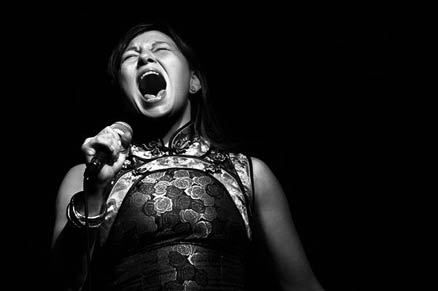
The truth is that Tagaq's performance reminded me of child birth. When an Inuit woman is on her hands and knees violently sucking air in with her throat and howling like a wolf, then the delivery room comes to mind. I should know, I have been there twice.

At the same time, fellows tend to lose their lunch at any reference to child birth or even the female body. But during the concert, a woman seated beside me whispered in my ear, see on nii erootiline! So my arrow did not miss its mark.

Tagaq is a solo performance artist who specializes in Inuit throat singing. She is unique in that she has married a folk tradition with a new means of expression -- throat singers typically sing in pairs, she sings alone; and with modern technology -- she was accompanied by a percussionist (Kenton Loewen) and a "DJ," that is, to say, a guy (Michael Edwards) standing in front of a laptop.

She performed two dates in Estonia over the weekend: the first at the MTÜ Eesti Pärimusmuusika Keskus in Viljandi and the second at the Kumu Art Museum in Tallinn. I chose to see her in Viljandi because it's closer and I had a feeling the audience would be a bit more down to Earth. I mean, who wants to sit next to Edgar Savisaar at a throat-singing concert?

Tagaq is small but fiery. When she began to warm up, I wondered if I could stomach an hour plus of throat singing. There were no words I could understand, except when she knelt in the spotlight like a demon and began grunting, "aitäh, aitäh, aitäh." Interestingly, her two releases have Estonian names. The first, Sinaa (2004), means "the edge" in Inuktitut, but could mean "you" in some Estonian dialect. The second, Auk (2008), means "hole" in Estonian, but "blood" in Inuktitut.

Which leads us to a big question: what the heck was Tagaq doing in Viljandi on a Friday night saying "aitäh" to people? My Estonian companions assured me it was because of Viljandi's place in the pantheon of folk music centers, but I proposed a more personal hypothesis.

Simply put, Tagaq worked with Björk on Medulla (2004). Björk worked with Michael 'Arvopoeg' Pärt, born in Tallinn, on Volta (2007). Arvo Pärt, born in Paide, is respected in all avant-garde circles and is a "friend" on the pages of many a MySpace musician. Estonia thus is one of the places where cool people who dig throat singing might hang out. Case closed.

"I'm not sure," said my friend. "I mean, I don't even like Arvo Pärt." She caught herself saying it and cupped her hand over her mouth. "I'm sorry," she blushed. "You're not allowed to say that in Estonia."

"It's not just his music," I said. "He looks awesome. He looks like a mad monk or a science fiction character. People want to come and play in the country of his birth, hoping that his essence will rub off on them."

And so our conversation drifted into the night fed by glasses of wine. But Tagaq? She was a no show at the performance center cafe. She had probably gone home to rest her throat.

reede, veebruar 20, 2009

judenfrei

The Holocaust is still an extremely sensitive topic in Eastern Europe. In Estonia, which was under Nazi Soviet occupation from June 1941 to September 1944, it is also sensitive, though perhaps less discussed than in Poland or Lithuania.

Estonia was the only country designated as "judenfrei" -- free of Jews -- at the Wannsee Conference in 1942, a terrible category to be put in, indeed, and one that continues to haunt the country in the discussion of its past.

At the same time, it is perhaps worth noting that by the time the Germans arrived in Estonia in 1941, Estonia's prewar Jewish community, which numbered around 4,500, had been reduced to around 1,000 persons, thanks to Soviet deportations, executions, and Red Army mobilization. In comparison, there were around 34,000 Jews in Lithuania and up to 420,000 in occupied Poland at the time.

So the "final solution" was carried out in Estonia even before Wannsee, indeed even before Hitler himself decided to eliminate the rest of the European Jewry. Some interesting things I learned in my class on WWII and Stalinism in the Baltic States this week about this nauseating chapter in Estonian history:

* The Germans staged the Holocaust on the Eastern Front as a mass, spontaneous pogrom carried out by locals. This is why so much photographic "evidence" exists of Baltic partisans taking part in atrocities: that's how the German propaganda masters wanted it. They did not want to take responsibility for it themselves.

* The Soviet authorities later used this photographic "evidence" of Baltic war crimes to discredit Baltic emigre leaders in the West who opposed the Soviet occupation and annexation of Estonia, Latvia, and Lithuania. In this way, they recycled Nazi propaganda for their own purposes.

* It was not the Estonian and Latvian SS Divisions that were central to Nazi war crimes in the occupied Baltic region. The German-led operation instead used local police battalions to guard the camps and, at times, carry out the mass executions. Sadly, many of the local police battalions were comprised of Estonian or Latvian Russians who were considered too much of a security threat to send to the front.

* Incentives to join a killing squad? Believe it or not, they were voluntary. Members of killing squads got better pay and considered it a dirty job that would advance their careers after the war. It was also safer than being sent to the front. Finally, most of the executioners were inebriated while doing their "work." Alcohol was consumed prior to mass executions.

* There were no gas chambers in Estonia. Mass executions were carried out by police battalions and killing squads using shooting as a means to accomplish their hideous task.

* According to German documents, the Estonians in German civil administration were not considered anti-Semitic enough. The local population did not support Nazi racial theories and it was difficult for the Nazis to enlist locals in their efforts.

* The Germans and Estonians were more culturally similar. They had seen the same Western films and knew the same popular songs. In comparison, the Soviet troops had lived under socialism already for 20 years. This is one of the reasons why German rule was seen as milder by many Estonians, and the Soviets were seen as alien.

* Most Estonian men who served in the German and Soviet armies were conscripted during a military occupation. The conscription of men from an occupied territory is considered a war crime in itself.

* After the war, Western military intelligence integrated existing German networks into their own. German military methods were also studied as the conquered army was still considered to be a well-run and efficient operation. Hence, many officers and officials connected to war crimes were never prosecuted and some continue to live on in the West without threat of prosecution.


And so concludes our history lesson. While I admit the topic is intense and, at times, quite sickening, I felt that these new nuggets of knowledge needed to be shared.

neljapäev, veebruar 19, 2009

eestlane ei karda tööd

I spent two hours yesterday in the presence of Marju Lauristin, and I am still tired from the experience. This is a human being who, even in her late 60s, is tireless and engaging.

At times, as she paced in front of the desk, her arms waving about as she explained the differences between the Popular Front and the Congress of Estonia in the late 1980s, I began to wonder if she really was an Estonian. Estonians don't move their arms around like that, do they? Estonians aren't charismatic, are they? Estonians aren't ... friendly?

It seems that some Estonian thought leaders -- be they academics, politicians, or in betweens -- have some special gravitational pull that makes you believe everything they are saying. I have noticed this with regards to people who have encountered Mart Laar. At first, they might seem skeptical, but once exposed to Laar's unique charisma, they turn into Laarbots. I am almost afraid to meet him for fear that it might happen to me too.

I asked a Laar supporter once if they thought it might be time for the current generation of Estonian leaders to pass the torch to a younger brigade, perhaps less shaped by the collapse of the USSR. "Could you imagine," I said, "that we take a time machine to the year 2030, and Laar is prime minister for the sixth time?!" The supporter smiled and said that she would be very happy with that result, as Papa Mart knows what's best for Eestimaa.

Almost all of my professors are down on the current Estonian government. There are a number of Danes who have infiltrated the halls of Tartu Ülikool along with some Germans (yes, they're baaack) and they can't figure out why the government is cutting away at the public sector, reducing their salaries to a point that even regular Estonians start to cry.

In Denmark, a significant percentage of the population of the country feeds in one way or another on the teat of the state. This is the Scandinavian welfare model: the people work for the state and, typically, vote for parties who will increase their benefits and paychecks, or at least won't reduce them. From their perspective, the public sector must be protected, as it is the backbone of civil society.

If the Danish government started making public employees cry, there would be hell to pay, I am told. In Estonia, they'll shut up and take it for the sake of liberalism. The speck of light at the end of the tunnel is a pot of shiny coins, the leaders tell the maarahvas, and in that pot the money is in the European currency. The Gods in Estonia are not teachers or nurses or trade unionists, you see; they are foreign entrepreneurs. And forget about the poor drunks living in shanties in the Estonian global south. They might not be dead yet, but they will be soon enough!

Ai, ai ai. Estonian politics. It's everywhere; in the classroom, at the bus station, even in my sister-in-law's place where Laar and Lauri Vahtre's most recent works fill the bookcase. Now, with the European parliamentary elections coming up, I even got a free Eesti Eest! newspaper in this morning's Postimees. IRL has some good candidates: Tunne Kelam (the wiseman), Marko Mihkelson (the bold loyalist), and Karoli Hindriks (the slick choice of a new generation).

I can't wait to see who the other parties put forward. Really.

teisipäev, veebruar 17, 2009

suur-pakri

The Estonian government appears to be in support of building a nuclear power plant somewhere on the territory of Eestimaa.

A decision in principle is soon expected, though a definitive parliamentary decision could be five years off, and the power plant itself is unlikely to become functional before 2025.

A representative for Eesti Energia with the unfortunate name of Andres Tropp told Helsingin Sanomat that the government is already in the fields and bays of north Estonia scouting up locations. Its favorite site is Suur-Pakri, an island near Paldiski.

Suur-Pakri is known as Stora Rå in Swedish and is one of the few locations in Estonia that is officially labeled in my Estonian road atlas in a language other than Estonian. These coastal islands were inhabited by the Estonian Swedes prior to the Second World War. During reprivatization, many of the former owners reclaimed their property, though only a handful returned to live there. I am unsure of what kind of conflict the erection of a nuclear power plant there would create with the local landowners.

More likely, the idea to place the plant close to Paldiski, which is now home to a farm of wind turbines, made sense to the government. The area could become a small power generating corridor within the country, far away from the troublesome border with Russia, where several hydroelectric plants are already located.

As for the option of connecting the Estonian grid to the future replacement for Ignalina in Lithuania, here is a demonstration of Baltic unity for you in a nutshell:

Originally the Baltic States were planning to set up a joint nuclear power station in Lithuania. Estonia and Latvia, however, grew weary after Lithuania decided to include Poland in the project the year before last. The project has advanced sluggishly.

pühapäev, veebruar 15, 2009

kristjan jaak

And so our Estonian Literature class turned its attention to the curious case of Kristjan Jaak Peterson, an Estonian born in Riga in 1801 who, by virtue of his linguistic genius and well-kept journals and homespun poetry, made a lasting contribution to Estonian national consciousness before his untimely, TB-caused death in 1822.

During his student days in Tartu, Kristjan Jaak would parade around in Estonian folk costume much to the consternation of his more conservative friends. Indeed, Kristjan Jaak was ahead of his time; a hip gentleman who would have been more at home in the Estonian national awakening of the 1860s than the tsarist winter of the Napoleonic era.

And there is something else you should know about Kristjan Jaak: he dedicated much of his work to some person or thing named 'Alo.' Alo is a male Estonian name -- a derivative of Aleksander. The fact that the flamboyant dresser and poet was pouring his heart out to some guy named Alo raised eyebrows in our class. Could Kristjan Jaak have ... been playing for the other team?!

"No, no, no!" says the Estonian Lit teacher. As tempting as it is to expand gay iconography to include any possible historical hint of same-sex affection, we have no evidence of kreeka armastus on Kristjan Jaak's part.

Besides, guys back then loved nothing more than writing letters laced with erudite homoeroticism. The correspondence of many well-known men from the 18th and 19th centuries could be used to subtitle foreign softcore pornography films these days, argue the experts. And isn't President Ilves another foreign-born Estonian who likes to parade around Eesti in folk costume? He seems pretty straightlaced. Why, I even saw him kiss Proua Evelin on TV.

All too quickly, our ultramodern mosaic of Kristjan Jaak the gay icon falls to pieces. Just as Queen Christina of Sweden had her ladies in waiting, she had her Cardinal Azzolino. Sure, David Bowie dithered with Lou Reed, but he also dallied with Iman. Human sexuality, like humans themselves, is a complex thing. I am sure Alo would agree.

reede, veebruar 13, 2009

vastuvõtt

Much has been made of Estonian customer service skills or lack thereof. My encounter with the receptionist at the polyclinic the other day could be seen as a typical one of my daily adventures.

To set the stage, I am a bit of an odd bird. I am a foreigner who is mostly functional in the Estonian language. That doesn't mean I understand every word tossed in my direction; it means that I understand about 80 percent of what people are talking about, depending on the speaker.

So I made it up the five flights of stairs to the office of my doctor to be informed that my chart, which is typically ordered to the office from a lower reception and archival area when an appointment is made, was not there. I would have to go get it myself.

I bounced down the five flights of stairs again, took my number, and waited patiently for #527 to be called. I was a bit mentally tired when they finally called my number but, fortunately, you can be aloof in Estonia and nobody cares.

"My chart, please," I said, pushing my identity card through the window.

"Why do you need you chart?" the woman behind the desk responded.

"Because I have an appointment with my doctor," I answered.

"What doctor?"

"Kõrvits."

She typed furiously at her PC with her manicured fingernails. I noticed that parts of her hair were dyed purple. She was a very fashionable receptionist, in my opinion.

"But you have no appointment with Dr. Kõrvits today," she said.

"Yes, I do," I responded. "I just came back from the office." I stuttered when I said the word for office. The receptionists eyes lit up, understanding that I was not a native Estonian speaker.

"But the computer says that you don't." She clicked a few more times with her long fingernails.

"But I just came from the doctor's office and his assistant said that I should get my chart from here."

She looked at me as if I was crazy.

"If you have an appointment, then how come it is not in the system?"

"I don't know," I answered.

"So, you don't know," the receptionist sighed. She did not like this answer. I guess I was supposed to know why I wasn't in the system.

"Look, I made the appointment yesterday," I said. "Maybe the system hasn't been updated."

After this she decided to discuss the matter with her colleague in the next booth. The two of them went back and forth as our purple-haired, well-manicured receptionist explained the conundrum: some weird guy wants his chart, but his appointment isn't in the system. Following this lengthy discussion, a solution was found. She would call Kõrvits' assistant and ask her if I had an appointment!

"Yes, yes, certainly, certainly," she said on the phone. She asked them why I wasn't in the system and received a satisfactory answer. Finally, the receptionist stood up, walked ten feet away, pulled my chart from the wall, and pushed it under the window to me. She said nothing.

"Thank you," I said, holding my chart. The receptionist quickly sucked air in and said a breezy "jah" at the same time. I then turned to bound up the five flights of stairs to see my doctor.

esmaspäev, veebruar 09, 2009

belated obit

Samuel Huntington, the highly influential thinker who authored The Clash of Civilizations and the Remaking of World Order, died on Dec. 24 on Martha's Vineyard -- of all places, not a bad place to go.

One of the first books I read about Estonia was Marju Lauristin and Peeter Vihalemm's Return to the Western World: Cultural and Political Perspectives on the Estonian Post-Communist Transition (1997).

Return to the West lays out Estonia's historical narrative for inclusion in the nordic and European community. The book heavily references Huntington's theory, and the authors are quite pleased to reprint his map with a thick border running through the middle of Lake Peipsi separating Orthodox Russia from Western Estonia. The differences are not merely about interpretations of history; these two countries sit on different civilizational tectonic plates.

Is this just smart geopolitical repositioning? Partially. Estonia's political leaders at that time passionately used such civilizational rhetoric. To President Lennart Meri, for example, Estonia was not "FSU" but "FSE" -- former Swedish empire. But even in the Soviet era, Estonia was a different kind of Soviet country. Magazine articles from the 1950s and 60s talk of a similar kind of limboland, where Soviet power was apparent but eastern civilization was not.

The genius of Huntington's work, like the best theories, was that it confirmed something we already intrinsically knew. What is interesting is how it continues to drive Western policies. At the Lennart Meri Conference in Tallinn last year, I listened late at night as an older British diplomat explained his country's support for Baltic EU and NATO inclusion. "Tallinn could be Copenhagen," he said. "Riga could be Lübeck, Vilnius could be Krakow. This is the West!"

But Kiev? Tbilisi? The Western thinkers know not what to do. The strength of their convictions atrophies in the civilizational confusion that ensues whenever big questions over the future of Ukraine and Georgia are raised. As Peter Millar wrote in the Times in August. "For [David] Cameron to equate Estonia and Ukraine, as he did last week, is stupidity. Estonia’s history, language and culture are markedly separate."

That was a civilizational argument underpinning a contemporary foreign policy. And here you can begin to see why Huntington is still controversial and his theory is not loved in certain quarters.

pühapäev, veebruar 08, 2009

palmisaarel - 5. osa

Before Vello Vedelik began to wander the Earth, he became skilled in animal husbandry, with an area of concentration in fish breeding. He is said to know how to pair the right animals to produce a new generation of fish that is better than its predecessor generation.

Vedelik believes that Epp has strong genes. In 1999, when young men would flock to Vedelik's booth to chat up his lovely assistant Epp, Vedelik would tell her to pay them no mind on account of their average genetic potential. They were not worthy of her time. Vedelik knows fish; he seems to know humans too, as the Persian episode demonstrated.

But the last night on the island, Epp asked Vello for his expert opinion on me as a breeding specimen. Since we have two children, it's after the fact but, still, when you are in the presence of an expert who can identify a person's ancestral lineage by eye, you take advantage of your opportunities.

Vedelik pointed out that the fact that our two daughters are lighter than I am confirms his original assessment of Epp's strong genetic make-up. However, because they are incredibly cute and talented -- Anna, aged 1.5, has started saying "Hola" -- it indicates that I am no slouch myself.

"He seems intelligent and well balanced," Vedelik affirms. "He is definitely above average." I feel embarrassed and at the same time proud. There is nothing like having your genetic constitution judged by a fish breeder.

Vedelik also knows that we have been writing about him on the Internet. He does not use the Internet, but one of his accomplices has sent him telepathic messages about it. "You have been writing about me and you haven't even asked my permission," he accosted us.

"It's ok," Epp said, soothing him. 'I was just trying to find my bag, and Giustino? Well, he calls you 'Vedelik.'" "Vedelik?!" he smiles, approving of the strange moniker. "Well, you can write what you want about my theories," he said, "but, whatever you do, don't give away my trade secrets." He is afraid that other Estonians will copy him and try to capitalize on his ideas.

We left Vedelik at the bus station. We all waved to him from the bus windows as it pulled away into the night. He shook my hand, looked me in the eye, and said, väga meeldiv. He even smiled. I began to suspect that he might like me as a person. I saw him once more from the bus window, standing below a lamp on a street corner. A small halo hovered above his gray hair. Then he was gone.

Poor Manuel meantime had tried to link up with us on the last day, but, in true Spaniard style, did not call before hand. While we were on our bus, he and his old pal Gallo stopped by to see "Epah" one last time. He left us a present instead at the front desk. I thought it could be the bag, but it was the idola de tara -- a statue of the Canarian God who shares her name with Estonia's Taara.

At 4 am, we huddled to board our buses. The Finns were on their flight back to Vaasa. Marta hugged Jennifer, and I wished them hyvää matkaa, to which they replied jo and nii and kiitos -- all three of their favorite words. I loaded our overstuffed bag, now filled with t-shirts and bags of gofio and a little idola de tara, and helped my family on board. Our bus then slowly stole away into the early morning. Our vacation was over.

neljapäev, veebruar 05, 2009

palmisaarel - 4. osa

Nude beaches and regular beaches in Gran Canaria are ruled by their own, unspoken codes of conduct.

In the Zona Nudista, nakedness is normal. You are surprised to learn that all of those masses of similarly clothed people you pass on the street day after day also look homogenous without their bathing suits on, give or take stages of sun tan, extra pounds, and gray hairs.

When a clothed person walks by, they look hilarious in their baggy shorts, polo shirts, and caps. They also seem foreign and a bit rude. "Where is your nakedness?" The nude sun bathers glare. "What are you doing on our beach?!"

On the regular beach, it is the opposite. The sight of a topless sunbather draws similar stares. Couples look at each other, wondering whether or not the woman in question knows she has strayed from the Zona Nudista. No male dare remove his trunks on the regular beach, lest he be hauled away by the police for scaring little children. Here, it is the nudists who are unwelcome and suspicious.

The most interesting place is where the two beaches meet, the brackish water between the salty clothed bathers and the fresh-water nudists. Here the two tribes mix freely, quietly acknowledging that their borders are porous. In this No Man’s Land, bathers of both stripes tolerate the others’ differences.

I lay here in the golden dune sands oppressed by visions of the past. They swoop down on me like vultures, plucking at me. What are these sandstorms of feelings that harass me? Do they have names? Alienation? Vulnerability? I ask Epp, and she says that it's normal to feel vulnerable when thinking about one's past.

Our trip to recollect Epp’s bag from 1999 has dredged up the memories of a past that, on its face, seems more freewheeling and carefree. At the same time, some kind of melancholia lurks behind the nostalgic glow of not so distant history. It has been 10 years since Epp left the island. There are reasons for these things.

Part of the reason for this onset of Canarian blues is that Epp is such a good story teller. The characters – their names, faces, and situations -- come alive. People I have never met and will likely never meet become characters with whom it is easy to empathize. I can see the different sets and watch the actors block their scenes. The zestful yet absent minded young traveler. The sea captain turned supermercado padrone. The Estonian prophet. Many others. Why, it’s as if I am there, except I was not, nor am I.

Who are these people? What are their stories? If only we had Epp's journal, I could tell you more clearly. She tells me she can't recall one line of it. Such is the conundrum of our lost youth. If only Henry Miller were here to fill the rest in.

Last night, Vedelik indulged us one last time in his theories of the connection between the Estonian and Canarian peoples. “The Estonians worship Taara,“ he pointed out, “while the Guanche Canarian idol was called Tara.” Vedelik believes that Estonia is a juhtriik, like ancient Greece or Rome that all countries will eventually follow. “It would be better for Russia,” he argues, “if they readopt their lost Finno-Ugric languages and reconnect with their kin peoples in Suomi and Eesti.

"Forget about Ukraine," advises Vedelik. Once these latent Finno-Ugrics reconnect with their past, the cultural confusion that has driven their country through the preceeding neverending chaos will cease. At that moment, all will be one. Om.

On Gran Canaria, the promenades are home to slick marketers trying to sell naive tourists time shares. "Just come to our beach," they smile. "It's the best beach on the island." They always start hitting on you by asking where you come from. The time share sellers in Maspalomas are quite talented in this regard: I have heard them switch freely from Spanish to English to ... Swedish.

They asked us where we lived. "Estonia?" the Spanish time seller announced from behind his cool dark shades. He then began speaking to us in Russian. "Nyet!" I protested. "But didn't you learn it as a little boy in school?" he said. "Nyet!" I said again. Finally, Epp decided to tell them that we already had a place on the island.

Yesterday, we took a glass-bottomed boat from Mogan to Puerto Rico. No, it was not a nude, glass bottomed boat. I was waiting for Jaws to rear its great white head in the underwater window, but we only saw a few small schools of hungry fish. Over head, a plane flew by advertising a Boney M concert on the island.

Boney M’s disco-pop career peaked in the late 1970s, probably around the time that most of Gran Canaria’s middle-aged tourists were enjoying the swinging, single life. In our hotel restaurant, they indulged us in Boney M’s greatest hits, including “Rasputin.”

'There lived a certain man in Russia long ago
He was big and strong, in his eyes a flaming glow
Most people looked at him with terror and with fear
But to Moscow chicks he was such a lovely dear'


One of the only things I really look forward to, as we headed back from this sandy paradise to Eesti Vabariik, where the temperature is -5 C today, is that I will get these Boney M songs out of my head.

teisipäev, veebruar 03, 2009

palmisaarel - 3. osa

My high school girlfriend's father was a man of the 1970s. This meant that he could stroll around town wearing platform shoes without fear of having his masculinity questioned. It also meant that he imbibed various substances during many long, lost weekends.

One of his maxims was "when it doubt, it is best to puke." I thought about this as I circled our WC and regurgitated the several bowls full of gofio and lechera I had consumed only hours before.

The cause of this sudden illness? Perhaps the gray weather that set in on Sunday, or, even more compelling, our family's visit to the Faro Maspalomas shopping center where we were treated to the overcommercialized underbelly of Gran Canaria tourist civilization. If you are in Spain and they are advertising bratwurst mit sempf, you may find yourself stricken with nausea.

All Sunday night I floated on a sea of post-vomitory relief as my aching stomach soothed itself. My children have also been afflicted. We actually think it's the local water, consumed accidentally while brushing teeth, that is the culprit. Why is it that wherever Spanish is spoken the local water gives outsiders the shits?

Monday was better. The glowing orb of the sun returned, prompting expeditions to Arguineguin and Puerto Rico. In Arguineguin, a salty port dominated by a mix of locals and Norwegian pensioners, the captain Manuel returned to talk with Epp. I let them reminisce by themselves as I scarfed down my first post-gofio meal, spaghetti aglio e oglio. According to Manuel, he really gave the bag and its prized journal to Vello, who is refered to by Spaniards as "Vejo". Epp returned with a look of confusion on her face: who to believe, the Canarian sea captain or the Estonian prophet?

We walked the promenade and bathed in the salty, clear ocean waters. Here too, I was surrounded by the occassionaly nude bather and bratwurst peddler, but I retained my constitution. I began to secretly hope that my illness had passed.

Later, we returned to Rico to find Vello. Again, I let Epp conduct her interrogations without me near. Vello insists that Manuel offered the bag to him, but he said no, and that Manuel threw it away. Epp is even more confused. I began to wish that the bag had a secret tracking devices sewn into its seams. Who knows where it is? Lost in Vello's secret Puerto Rico stash? Buried in Manuel's basement? Degrading in the local dump?

After market hours, we sat with Vedelik as he expounded on possible solutions for the crisis in the Middle East. Vedelik is a strong supporter of Israel and is irritated about how Hamas fighters fire rockets into Israel and then take refuge among the civilian population of Gaza. I asked him for his opinion of Prime Minister Andrus Ansip, but he said he had none. "Ma ei tea mitte midagi eestist!" he said, pushing the thoughts away. "Mitte midagi!"

Vedelik then launched into his theories about how the ancient Estonians were kin to the Etruscans and local Guanche people who settled the Canary Islands. He supposedly is able to tell the tribal origin of a person merely by looking at their face. "But what about him?" said Epp, gesturing at me. "What does he look like?" Vedelik paused to think. "This is a hard one," he said, studying me. Finally, it came to him. "Jah, jah, nüüd ma tean!" Vedelik exclaimed. "Tema on pärslane!"

"Pärslane?" I said to Epp. I had never heard the term. "He said you look Persian," she said. "I do?" I said, trying to imagine Mahmoud Ahmadinejad as a relative. "Well, he has been to Iran," shrugged Epp. "So maybe he knows what he's talking about."

pühapäev, veebruar 01, 2009

palmisaarel - 2. osa

I had never before intended to see the bare breasts of a 70-year-old Swedish woman, but on the beaches of Gran Canaria, such occasions are inevitable.

The atmosphere here is eclectic, to say the least. Frightening cliffside roads stretch down into hotel-marred coves and tourist-thronged playas. We ate churros with our coffee in the coastal town of Puerto Rico and contemplated our search for Epp's distant past.

We were in Puerto Rico to find Vello Vedelik. Epp described him as an old hippie who never cut his hair or beard, and after strolling past a few kiosks, I saw an old man in Indonesian attire seated in a chair. Epp walked up to him, peaked under his broad hat, and in a few minutes I had come face to face with the man with no phone and no e-mail address.

"Kott? Kott? Mis kott?" he said, when asked of the missing bag. Vello spoke in clean, crisp Estonian. This was not a man from Mulgimaa. I watched Vello's body language for evidence of lying, but could find none. According to Vello, Manuel the hotel owner did indeed offer him the bag, but Vello said no, and Manuel threw it all away. It seemed unbelievable, but Epp looked Vello in the eye and said, ma usun sind -- I believe you.

Then somehow Vello went off on a diatribe about how Russians are not really Slavs but are Finno-Ugric peoples who have adopted a Slavic language and about how the economic crisis is bringing the world to the edge of catastrophe and how one of the few safe places in Estonia is Suure-Jaani and how he came up with all the ideas for Star Wars. And I believed him, because he is very believable.

Well, good old Manuel decided to face the music and came down into Puerto Rico to acknowledge that, yes, after waiting for Epp to return for seven years the bag went in the trash when he renovated his supermarket. Epp forgave him, and he said he would drive us home. He then loaded us into his jeep and we made for the Canarian hills. Manuel used to be a captain of a ship and lived in Gambia for awhile. He's a native Canario, and he owns multiple properties and seems to have many relatives on the island.

The interior of Gran Canaria resembles the American Southwest, at least to me, a person who has never visited the American Southwest. Ranches overlook huge canyons; dogs chase each other on the floors of endless, treeless ravines. The natives dislike visiting the touristed parts of the island, and, if Manuel is exemplary, they have no time to do so, because they are always driving around, visiting their friends, visiting their cousin, stopping the car in the middle of a road to chat with a friend in another car. Such is Spanish life.

For example, Manuel took us to visit the ranch of a friend he called "Gordo" -- fatso. Gordo also is known to Manuel as "maricón." Gordo acts as a local sherrif and drinks too much whiskey. He grows pigeons that he sells to local Cuban migrant workers for use in shamanistic sacrifices. My children were very impressed with the animals. Anna said "owf owf" many times in response to the tough looking guard dog. Gordo was sober, and I still don't know his real name, even though we shook hands. He said that beer is for poor people; whiskey is the only real drink.

We may see both Vello and Manuel before we leave. Vello has no new fangled communication devices (he says he uses telepathy to communicate), but he said that he can be found in that one spot, always in that one spot, until April when he heads east. Though Epp has lost her journal for good, life is at least repaying her with new tales to tell.