esmaspäev, juuli 31, 2006

The Center Party's Unique Predicament

Did you ever have a friend in high school or camp that you weren't too happy to be friends with, but you hung out with anyway because you yourself had few friends and you sort of felt bad for the guy? That's sort of how I interpret the relationship between Edgar Savisaar's Center Party (KESK) and Villu Reiljan's Estonian People's Union (ERL).

Now, let me clue you into my biases. My wife's family is from Viljandimaa - Mart Laar country - and so when I was introduced to Estonian politics Isamaa Liit came across favorably. These were the Estonian nationalists - but nationalists in a good way. They were into folk dancing and sült and promoting the Estonian language. But while I lived in Estonia, I witnessed the rise of Res Publica - an army of smart-looking youths barely out of their master's studies that looked poised to fuse Reform's emphasis on liberal economic policies with Isamaa's focus on the Estonian people.

Most people I met in Estonia were of my age, educated, fairly successful (ie. were not pensioners or alcoholics, or, if they were drunks, they were functional drunks as the definition of alcoholic in Estonia is not quite clear), and thus supported one of these parties, although there were some that liked the Social Democrats, who I sort of liked because I have a soft spot for social democratic philosophy (for all of you libetarians reading this from Finland for Thought, that's NOT an invitation to hate).

Anyway, the bogeyman in this scenario was Edgar Savisaar, who in the midst of Juhan Parts' "vali kord" (choose order) campaign was smugly thrusting the Nixonian victory sign into the air. Savisaar was the dreaded "populist" - a very nasty term in Estonian politics which summons the image of a nippernaadi-like character that promises you peace, land, bread, free Internet and all the Vana Tallinn you can drink in exchange for your vote. Parts won in the short term, but Savisaar has won since then, tacking up a pretty sizeable victory in 2005, especially in Tallinn where the Centrists control the city council. So while he may stink of the kohuke scandal, and the signing of the pact with the Russians, and, before that, the taping scandal, Savisaar is on the rebound. KESK may only have 28 votes in the Riigikogu, but he has a certain sense of momentum.

Now, small parties in a parliamentary system cannot win enough votes to assemble a ruling coalition. So they are, by nature, parasitic. Among right wing parties in Estonia, there is the hope that one of them - these days the Reform party - will be the breadwinner and take home enough votes to set up the next government. And similarly, for ERL Edgar Savisaar's party represents a ticket to power - ERL relies on KESK for its power.

Now, usually that big guy-little guy partnership favors KESK because KESK, being the bogeyman of the Estonian right wing, has few parties it can form coalitions with. But these days, because of the presidential election, KESK is facing some big decisions about its future.

That's because ERL, which can't muster a positive vote for sitting president Arnold Rüütel in parliament with its paltry number of votes, even with KESK's support, wants the election to go to the electoral college where it can get Rüütel reinstated for another five years. The president appoints the prime minister following elections. You can see why ERL would like Rüütel to stay. He also keeps them more relevant, especially when their government presence is not big (they have 13 seats - as much as Isamaa and the Social Dems put together). Plus he's weak. That favors KESK because it will have little interference from the head of state, should it head the next coalition.

But KESK is looking at the 2007 elections as the big year when it sweeps the right wing parties from power and Edgar Savisaar gets to be peaminister once more - and this time one that was actually elected. Factor that into that the public's support for Toomas Hendrik Ilves, a social democrat that grew up in exile in Sweden, the US, and Canada, and who, no doubt, will not help Savisaar's attempts to build up business between Estonia and Russia. Ilves, however, consistently polls above all other challengers in opinion polls. He is the clear popular favorite. And there lies the big dilemma for KESK.

If KESK supports Ilves, they'll seem reasonable - they'll be able to expand that large umbrella they are building because people will see the Centrists as honoring the will of the people. Right now, their strength is strongest amongst pensioners and the Russian minority (where they actively campaign). If it supported Ilves, it could buy off even more of the Reform and Social Dem's base. It could be a true electoral power house. However, if KESK does that - which is in its own best interest - it may alienate the only real political ally it has - ERL.

The way ERL is talking these days, it seems like they are the ones running the show.

The presidential candidates of Estonia may be known as early as this week, as the Center Party and the People’s Union enter another day of negotiations over the topic.
Also this week, the five major political parties are expected to narrow their shortlist of preferred candidates from two to one.

The chairman of the People's Union Villu Reiljan believes that the party will sign a cooperation agreement with the Center Party even before Thursday, when the presidential candidate of five parliamentary parties would be picked.

***

Kadri Must, secretary-general of the Center Party, did not share Reiljan's optimism concerning the speed of signing the agreement. She said that the parties had only met once on the issue and the talks were still in a too early stage to start looking for pens.


Watching the two negotiate you get the impression of how desperate ERL is for KESK's support and how much of a political animal KESK is. You get the sense that KESK would gladly sell their little brother ERL to install Savisaar as king of Estonia.

And that's sort of the predicament they find themselves in. Personally, I think that KESK owes ERL nothing. Because as badly as they want Rüütel to be president in the winter of his years, they owe KESK more, at this moment, than KESK will ever owe them, especially if they clean house in 2007. KESK could annoint Ilves president and ERL would still want to ride its coattails to coalition government next year.

The political world is defined by self-interest. And KESK now has to decide, where exactly its interest lies. Will it shut out the popular favorite as a favor to the smaller party clinging to its side, or will it take ERL's support for granted, and widen its big tent.

laupäev, juuli 29, 2006

What happens in Estonia ...

I don't know about you, but I was really glad to read the following story. Hillary Clinton (my senator) has been to Estonia on several occasions. I remember that in the hall of Tallinn Central Hospital there was a photo of her. While some people in the US dislike her, I have to say I was happy to know that Hillary had been in the same hospital where I was awaiting the birth of our first-born.

Today, I read that Hillary and John McCain (the Republican senator from Arizona)had a drinking competition while in Eestimaa:

NEW YORK Jul 28, 2006 (AP)— If Hillary Clinton ends up running against John McCain for the presidency in 2008, the two might vaguely remember competing against each other once before.

That would have been in the summer of 2004 in Estonia where, according to The New York Times, the margin of victory was not votes, but shots of vodka.

The instigator of the after-dinner contest, the Times reported for its Saturday editions, was Clinton, D-N.Y. McCain, R-Ariz., readily agreed.

Aides to McCain did not return messages seeking comment Friday. Philippe Reines, Clinton's spokesman, played coy.

"What happens in Estonia stays in Estonia," he said Friday evening.

reede, juuli 28, 2006

Mis Giustino ei õpi ...

Sometimes I have the odd feeling that I am doing things that are actually quite difficult, but achieving them just by being oblivious to the obstacles they present.

Fatherhood is one of these things. Everybody tells you that, "it's so hard" and "you'll never be the same." Yes, it is pretty demanding sometimes, and yes, I am different, but high school was demanding sometimes too, and I was definitely a different person at the end of high school from the fellow who entered high school three years prior.

And, in a way, isn't life one big challenge that never leaves you the same? One time I went to Cancun, Mexico. I drank lots of tequila, ate lots of quesadillas, kissed dangerous and borderline psychotic women (most fall into this category), and imagined that I could lead my life like this - one big party. I'd get wasted everyday, live in my hotel room with its barely functional toilet, and write novels with short punchy words, just like - that's right - just like Ernest Hemingway. Papa. I'd be he and he'd be me. Together we'd tango in the night enjoying life as one big party free of responsibilities.

But even when you are trying to circumvent the things in life that are "so hard" and trying not to be "changed forever" you still succumb to the reality of life. It is hard and it does change you. Imagine that I had stayed in Cancun. It would have been great until a) I ran out of money; b) I got my Mexican girlfriend Esmeralda pregnant and was beaten nearly to death by her traditionalist brothers; c) I drowned in a puddle of my own vomit. See what I mean? Life is always full of surprises. You just can't avoid the great ones, no matter how hard you try to skirt responsibility and inevitability.

And so it is with the Estonian language and it's many cases. It's supposedly hard. Some sort of "cave language." An ancient language of slanty-eyed reindeer herders and berry picking peasants who - despite thousands of years of separation - still have some common words with their distant Hungarian cousins - important words like "ver/veri" (blood) "sarv" (horn) and "kutsu" (dog). These are the words that Conan the Barbarian needed in his daily life. This is the base of Finno-Ugric languages.

Estonian is the language I am learning, despite the fact that most of its speakers have poor diction and prefer to mumble their sentiments rather than pronounce them loud and clear. This is why many Estonians have a hard time with English because they are not used to opening their mouth enough to make the American 'r' sound or to negotiate their 'th' sounds with an agilen tongue. The Estonian mouth is about this --> ( ) <-- big. That's how big my mouth has to be to master these words.

And I have been making progress. I made it through a whole comic strip of "Bertli Päevik" in the TV Ekspress magazine with limited questions. Some of my new words are - limpsima, which means 'to lick,' eeskuju, which means 'role model,' and jagama - which is what Sting was doing recently in Tallinn as he signed autographs.

The sentences come - Epp limpsis jäätist, Oleg oli halb eeskuju, and Sting jagas autogrammi Tallinnas.

Then there are the ones that don't immediately come to mind, like esitama, which means a whole bunch of things, including to 'bring forth' and eelistama which means 'to prefer.' So we can try something like Joonas esitas asja kohtus and Endel eelistab oad. Isn't the word for 'bean' great? One bean is uba but many beans are oad. I have no idea where this word comes from. The Finnish word for 'bean' is papu which is the Estonian child's word for 'shoe'.

Another word that has popped up recently is hoopis, which Epp says means 'suddenly' but the online dictionary says means 'quite.' This comes directly from Nuktisamees. Võib-olla pahed on hoopis hea!

Võib kull.

teisipäev, juuli 25, 2006

Tartu Rules, and Tallinn ...

When we lived in Estonia, we used to be awakened every morning by TV hosts Marko and Anu of Eesti Terevision telling us about all the amazing things happening in Estonia, like car accidents and Juhan Parts' pet kitten. They'd also play music videos, some of which were totally NOT appropriate for morning television, like Missy Elliot's "One Minute Man" (break me off/show me what you got/cos I don't want/no one minute man). Good thing I only understood that one. Now I liked waking up to Marko and Anu, but what I really hated was when the Tartu crew took over on Fridays. From a misty tower somewhere in South Estonia two not so nice looking kids that looked like they'd both just smoked a fat spliff, yawned out the morning news in their flat south Estonian accents.

"How boring," I thought. "Glad I'm up here in Tallinn where everyone is so rich and beautiful, and I can go to Stockmann whenever I want, and I can go peruse the cake section at Kaubamaja and get some meekook, and maybe I'll see someone famous, like Alex Lepaja at the Söörikukohvik on Kentmanni Street or Meelis Atonen getting out of his shiny, black car." To me, at that time, Tallinn was where everything was happening. Tartu was just some college town. But these days I am not so sure. Things have been changing in me. My tastes have grown. I no longer want sweet lemonade. I want iced tea. And maybe, if we returned, I wouldn't want to live in the city of Kroonika, where all the girls get their nails done and then shimmy straight over to the tanning salon for the Scandinavian golden brown. Maybe I'd prefer that college town with its dreadlocked kids and snoozy mornings.

I'm an ocean boy. I've always lived near it, and most of my ancestors lived near it too. As far as I know, only one of my ancestors came from a place that was not near an ocean or sea (Sebnitz, on the German-Czech border). But everybody else comes from the water, and I've got it in my veins. I can't stand being away from the sea. My mind needs mental barriers. It NEEDS to know that just out there, a few kilometers down the road, is a big salty continent-defining mass of sogginess. So I would expect that Tartu, with it's meandering little river would not cut it. But somehow, it does.

For one, Tartu has some nasty Soviet leftovers, but it's not like Tallinn, where parts of the city still look like Beirut circa 2006. But actually, in some ways it's prettier than most of Tallinn, aside from the Old Town. And Vanalinn is filled with girls selling nuts and postcards, and Italian tourists with babies crying for gelato, and 24-hour prõnkssodur watches. Not so in Tartu. Tartu is like a confectioners paradise compared to Tallinn. It's colorful buildings look so good, you could strip them of their sugary icicles and snack on their creamy moldings. Plus in Tartu they have Tsink Pekk Pang - or however you spell it. The food there is GOOD.

Another good thing about Tartu is the fact that all the major heads make it a point to stop there. When famous DJs like LTJ Bukem come to Estonia, they stop in Tartu. And in a way, I feel they are appreciated more. It's not the biggest city (about 100,000 people) but you can do things there. Even if you read poetry by Michael McClure, it's possible you could generate a sizeable crowd. You've got to appreciate an Estonian city with two reputable Chinese restaurants within 300 yards of one another.

Plus Tartlased, for whatever reason, seem more genuinely international than Tallinnlased. In my mind this is distinguished between the people from Tartu looking 'normal' while the kids from Tallinn look like they are going to a party 24-7. You know exactly what I am talking about. The untrustworthy group posturing. The bleached out hair. The suave earring. The fondness for A. Le Coq. The anxious text messaging thumb. Tallinn teens are so trendy, I even feel intimidated. And I am a 26-year-old geezer.

Now, I'm not totally dissing Tallinn. I'm just saying that as I move from lemonade to iced tea, and from chocolate cookies to bowls of fruit, and from rock to the boss nova, maybe my heart is setting a bit on Tallinn and moving on to Tartu.

And maybe those hungover kids with the dreadlocks weren't so bad afterall.

reede, juuli 21, 2006

Yo, Blair!

By now I am sure you have all heard of the "shit" heard 'round the world. First let me put that very American saying "heard 'round the world" in context for you. When British troops fired on America militiamen on Lexington Green in Massachusetts in April 1775, begining the conflict that would lead to American independence, it was called the "shot heard round the world" in colonial media. But that is a fitting way to juxtapose the office of American president as conceived by our heroic "Founding Fathers" and the the office as occupied by its current tenant, one buttered-roll slurping George Walker Bush.

When Bush ran for office in 2000, most of us on the left (or middle) side of things denounced him for what we saw him as - a dumb college frat boy with an influential daddy (Bush I), military industrial complex backers (Cheney), and friends who claim to speak for God (DeLay). But Bush supporters - not unlike Clinton supporters in the early 1990s who looked the other way at his sexual indiscretions - swore their leader was fit for office. To him they ascribed great character traits - especially after 9/11. Sure he wasn't the most eloquent leader, but neither was Disney's version of Davey Crockett or Forrest Gump. And that's what they saw in him - a guy who was plainspoken but spoke from his gut. A guy who wasn't brilliant, but still would do good.

As the audiotape from the G-8 summit clearly shows, Bush speaks from his gut alright. Perhaps too much from his gut. When the word "yo" first appeared in American dialogue (roughly around the time hip hop emerged as a commercial artform) it was a hip hop slang word. It was used outside of that of course, but it is not a word my grandmother would use. Rather, it's the kind of word your high school English teacher would take you to task for uttering.

So the transcript of Bush's dialogue with Tony Blair at the summit in St. Petersburg is truly interesting. Because Bush not only said the dreaded 's' word, but because of his whole demeanor - starting with the word 'yo'

Bush: Yo, Blair. What are you doing? Are you leaving?

Blair: No, not yet. On this trade thing…

Bush: Yeah, I told that to (inaudible). If you want me to. I just want some movement. Yesterday I didn't see much movement. The desire to move.

Bush heard swearing about Syria

Blair: It may be that it’s impossible.

Bush: I'll be glad to say. Who's introducing me?

Blair: Angela

Bush:
Well tell her to call on it. Well, tell her to put me on the spot.

Thanks for the sweater; it was awfully thoughtful of you. I know you picked it out yourself.

Blair:
Oh, absolutely!

What about Kofi Annan? I don't like the sequence of it. His attitude is basically cease-fire and everything else happens.

I think the thing that is really difficult is you can’t stop this unless you get this international presence agreed. Now, I know what you guys have talked about but it's the same thing.

The next remarks are i naudible, but the conversation turns to U.S. Secretary of State Condoleeza Rice.

Blair: . . . see how reliable that is. But you need that done quickly.

Bush: Yeah, she's going. I think Condi's going to go pretty soon.

Blair: Right. Well, that's, that's, that's all that matters. If you -- see, it'll take some time to get out there. But at least it gives people a --

Bush: A process, I agree. I told her your offer too.

It's unclear what offer he means, but apparently Blair offered to make some sort of public statement.

Blair: Well, it's only if it's -- I mean, you know, if she's gotta -- or if she needs the ground prepared, as it were. Obviously, if she goes out, she's got to succeed, as it were, whereas I can just go out and talk.

Bush: See, the irony is what they need to do is get Syria to get Hezbollah to stop doing this shit, and it's over.


I don't know, but the the "shit" thing seems the least of what makes reading this transcript funny over and over again. Earlier in the dialogue, there's this gem.

Bush: It takes him eight hours to fly home. Eight hours. Russia's big and so is China.


Russia's big. And so is China. Wow. Apparently people are already printing up "Yo, Blair" t-shirts and making a fortune. But personally, I'd prefer a shirt that just said "Russia's big and so is China." That one was my personal favorite. I used to hate Bush, but now I don't hate him anymore. I don't even feel sorry for him. I am just sort of - puzzled by him. He is our president. He sits in the same office as James Madison, Abraham Lincoln, Teddy Roosevelt, and JFK once did. It's sort of like listening to a heady Jefferson Airplane record from 1968 where they are singing "up against the wall, motherfucker" and then hearing Starship sing "We Built This City" 16 years later. What the hell happened? Is that was has happened to the US? Are we past our peak? Are we in the middle of, for lack of better terms, a midlife crises/sophomore slump?

And you Estonians are worried about whether your next president will be the septegenarian from Saaremaa with the impeccably combed white hair (Rüütel), the bachelorette astrophysicist (Ergma), or the europarliamentarian with the bow tie (Ilves). Maybe we can take some of your presidential rejects and use them here in Washington.

esmaspäev, juuli 17, 2006

Who do you believe?

We get two newspapers every day here in our office in downtown Manhattan - one is the New York Times and the other is the Wall Street Journal. Though its editorial teams inhabit the same New York space of gorgeous, nighttime skylines and exhaust-filled dirty air, the opinions of how to deal with the Russian Federation, as well as most international situations, varies greatly.

However, both the Journal and the Times have been pretty much on the same page concerning Putin and promoting democratic reform in Russia. But that doesn't mean people are of one mind on Russia. On the contrary there's a heated debate going on in foreign policy circles concerning the RF. For example, there are those out there in the conservative media, like John Hall in this recent Washington Dateline piece, that say that Estonia could be in growing danger of losing its sovereignty.

Rather than deal with the EU as an entity, Tunne Kelam fears, the Russians have decided to pick off individual nations and dictate terms for energy needs.

As for Estonia, Russians have begun to put this country's small, privately owned railroad in a squeeze, working with left-wing politicians in the Estonia's government to either de-privatize it or sell it off to a coalition of Russian-owned firms backed by its oil industries. The effort apparently is aimed at getting more favorable rail rates for oil shipments to the Baltic.

So far, the American manager of the property is holding his own. But Kelam said Russia policy is "officially hostile to the Baltic states" and he is even hearing rumors that the Putin government has discussed ways to begin moving Russia's border back, roughly, to the boundaries of the old Soviet Union.


That's some scary stuff, right? I can see it now. Edgar Savisaar standing in Tallinn like Johannes Vares-Barbarus before him, holding out his hand to the new boss, allowing Vladimir Putin to kiss as many Estonian boys on the belly as he wishes, making a Russian language exam the ticket to gaining Estonian citizenship, and tearing down all of Estonia's bogs and forests to make way for oil pipelines....Oh God, what a nightmare...

Some, like the Wall Street Journal last weekend, say we should be tough on Moscow to prevent that from happening...

Throughout President Putin's six years in power, a conceit indulged by Western leaders has been that the Russia of strong growth and the Russia of creeping authoritarianism are different places. Russians themselves are told to sacrifice freedom for stability and prosperity. Both are dangerous illusions. For Mr. Putin's governing approach undercuts the very gains he will advertise this weekend. As the world stood by, Russia has become a danger to the West, to its neighbors and not least to itself.
...
Now would be a good time to recommit resources to election monitoring and democracy building. Awakened by January's gas war, the Western Europeans can lend a hand for a change. The new Russian middle class will appreciate and, one day, may take advantage of this engagement. Now would also be an ideal moment to prop up the fledgling democracies in Georgia and Ukraine that are feeling the heat from Russia and put those countries on a track to joining NATO.


At the very same time The Nation warns that the Russia of today is far more preferential to the possible Russian bogeyman of tomorrow, a genuine enemy:

Washington has to abandon the triumphalist conceits primarily responsible for the revived cold war and its growing dangers. It means respecting Russia's sovereign right to determine its course at home (including disposal of its energy resources). As the record plainly shows, interfering in Moscow's internal affairs, whether on-site or from afar, only harms the chances for political liberties and economic prosperity that still exist in that tormented nation.

It also means acknowledging Russia's legitimate security interests, especially in its own "near abroad." In particular, the planned third expansion of NATO, intended to include Ukraine, must not take place. Extending NATO to Russia's doorsteps has already brought relations near the breaking point (without actually benefiting any nation's security); absorbing Ukraine, which Moscow regards as essential to its Slavic identity and its military defense, may be the point of no return, as even pro-US Russians anxiously warn.


That sounds similar to what Putin said last night. Christ, the guy goes to bed thinking about Estonia.
Russian President Vladimir Putin has urged Estonia to solve the existing problems with Russia calmly and “without hysteria”.

“Only then we will be able to begin interaction and gain benefits, especially [with] such a small country like Estonia,” he said.

“I wish that some complicated issues which we have inherited from the past were not politicised and that agreements were being implemented,” Putin told reporters shortly before midnight on Sunday.

By saying this, the president meant, among other things, the border agreement with Estonia.


The problem with many "big stick" policies is that they often backfire. One can even look now to Israel's strikes on southern Lebanon with the fear that instead of inspiring the Lebanese to root out Hezbollah, they will instead - by virtue of Lebanese casualties - provoke the Lebanese to aid Hezbollah in retaliation to Israel's strong line.

But then there is the tragedy of appeasement - the duped confidence of Neville Chamberlain and the Munich agreement of 1938. "Peace in Our Time"? Yeah, right.

So which will it be? Which op-ed head knows what's going on? Is it Isamaa's Tunne Kelam and the rumors of a reformed USSR controlled by the one man in Moscow? Or is that just a political ploy to score more votes and outside support for conservatives in Estonia?

Will the "leftists" in Estonia - KESK and ERL - wisely smooth things out with a resurgent Russia or will they just bow to their former masters like loyal canines?

And is there a logic of the middle in all of this, or is this just another annoying dilemma of "for" versus "against"? This is the torture of the present. Trying to plan for a future where all sources of information have multiple interests - most prominently, their own.

Takso Tere!

Thank God.

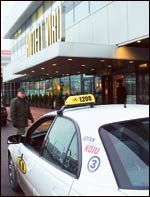
Taxis in Tallinn will be forced to display fares and information in both English and Estonian after new regulations came into effect last week.

The dual language requirements are part of an overhaul of the city’s taxi licensing system designed to crack down on profiteering cab drivers. Tallinn’s taxi service has suffered from a poor reputation amongst both tourists and locals.

Under the new rules, all cabs must have a certified taximeter, together with a compatible printer. If the taximeter or printer is out of order the passenger will be within their rights to refuse to pay the fare.


The Tallinn taxi drivers are disreputable thieves. I was told to engage them in Estonian only, so they would be less apt to rip me off, but what happened was - you guessed it - they responded in English. I guess I did something that gave my nationality away. Maybe I was too friendly, or I forgot to suck in air when I said "jah."

I had whole conversations with taxi drivers like that like: "Tere hommikust, Liivalaia kakskümmend kolm, palun." And at the end: "Kui palju maksab?" And they would respond in English - or they wouldn't respond at all - and at the end I'd pay much more than if someone else had ordered the cab for me in Estonian.

Good to see they are doing something about that!

Estonian Jogger Missing in London

Bad news. UK authorities searching for Egeli Rasta, a 27-year-old woman from Estonia, have found a body on the Mitchum Common in South London.

Sadly, they may need dental records from Estonia to determine whether or not the body belongs to Rasta:

Egeli Rasta, a 27-year-old Estonian shop assistant, was reported as missing on July 4th after failing to return from a run on Mitcham common in south-west London.

Now the Metropolitan Police have confirmed that a search conducted on Saturday evening has revealed a body, which forensic experts are now seeking to establish as the missing Ms Rasta.

'Officers investigating the disappearance of Egeli Rasta… discovered a body on Mitcham Common at approx 20:30 BST [on Saturday] ,' the Met said in a statement.

'We are unable at this early stage to confirm if the body is that of a male or female… a post-mortem will be arranged in due course.'

Media reports describe an extremely thorough search by police of Mitcham common, with divers scouring ponds, teams searching the ground and officers approaching members of the public with her photograph.

Police established that Ms Rasta had gone jogging after only one of her two pairs of trainers was found in the flat at Mitcham where she lived.

A man in his 20s, who the Met said 'remains in custody at a south London police station,' is not thought to be the man whom Ms Rasta was in a relationship with at the time of her disappearance.

reede, juuli 14, 2006

Tita Beebid!

June was a prolific month for young Estonian mothers, according to the Estonian Ministry of the Interior.

Altogether 1,305 children were born, 65 more than during the same month last year. There were 670 boys and 635 girls, including 21 pairs of twins (!) Fitting for the month of Gemini.

The most popular boys names in June were Aleksandr/ Aleksander/Alexander, Marten/ Martin, Artjom, Rasmus, Nikita, Kaspar/Kasper and Mathias/Mattias.

The most popular girls names in June were Lisete/ Lisette/ Liset, Sandra, Liis/ Liisa/ Lisa/Liza, Maria/Marie, Diana, Greete/Grete/Kreete, Meribel and Mia.

Tallinn led the pack of new babies with 499 babies, followed by Tartumaa with 158, then Harjumaa with 152. Ida-Virumaa reported 113 births, followed by Pärnumaa with 78, Lääne-Virumaa with 50, Viljandimaa with 41, Saaremaa with 39, Jõgevamaa with 35, Võrumaa with 30, Valgamaa with 28, Järvamaa with 27, Raplamaa with 22, Läänemaa with 18, Põlvamaa with 13 and Hiiumaa where 2 little Hiidlased were born.

kolmapäev, juuli 12, 2006

Why It Pays to Have a President Who Speaks English

Latvian President Vaira Vike-Freiberga is George W. Bush's favorite Baltic President. That reason alone - according to a state department source I spoke with, that was familiar with the decision to go to Riga last year - sealed the deal for which Baltic country Bush would visit before going to Moscow.

Likewise, when Vaira visited London this week, she was treated to a loving embrace by Tony Blair (see photo) in front of 10 Downing Street.

"I think this will be truly an historical year in the relations between our two countries," the Latvian leader told a joint press conference with her British counterpart Tony Blair after the two held talks.

Blair, for his part, welcomed his guest to Britain and said they discussed a range of issues such as the European Union, NATO, the upcoming Group of Eight (G8) summit in Russia and Latvia's military deployment to Afghanistan.

"The bilateral relations between Latvia and Briain are very strong," the British prime minister said.


I have read that Estonian President Arnold Rüütel got to meet with a British head of state - Queen Elizabeth II herself, earlier this month. But one could wager that Arnold, with his interpreter, and the Queen, with her very, very blue blood, didn't hit it off as well Tony and Vaira did. I doubt there were any cordial embraces at their meeting in Scotland.

And there lies the question - why is Vaira the fav., and not Estonia's president? What does she have, other than spell-binding administrative hair, that Rüütel doesn't.

Well, for starters, she's younger (69). She also is fluent in English, indeed she lived much of her life in Canada. I think it's the second attribute that is her strongest. Vaira can speak to Tony and W. in a way that Rüütel, who speaks Russian fluently, can probably speak to Putin and Alexis II when he goes on a sojourn to Moscow. In other words, Vaira talks for the Balts the way Estonian President Lennart Meri once did.

Latvia is very lucky to have a president like Vike-Freiberga. While Latvia routinely produces some minimal headaches for Western Europe and the US (the minority issue, the border issue, the SS marches issue, the gay rights issue), it also has a person that is able to talk to the greatest power brokers in a language that they understand.

But the power brokers see beyond those issues because, like business, it appears that politics really is all about personal relationships. Tony and W. will stand by Latvia because they like its president. US presidents have been to both Latvia and Lithuania on official visits. But no US president has ever (and I mean since 1920) stepped foot in Eestimaa on official business.

So, in a world where communication is quick, painless, efficient, and EVERYTHING, it might behoove Estonia to select in the future a president that can better represent their interests.

Just saying.

esmaspäev, juuli 10, 2006

Ütle seda eesti keeles!

OK. I only have a few minutes for this -

Sageli tähendab 'often.'

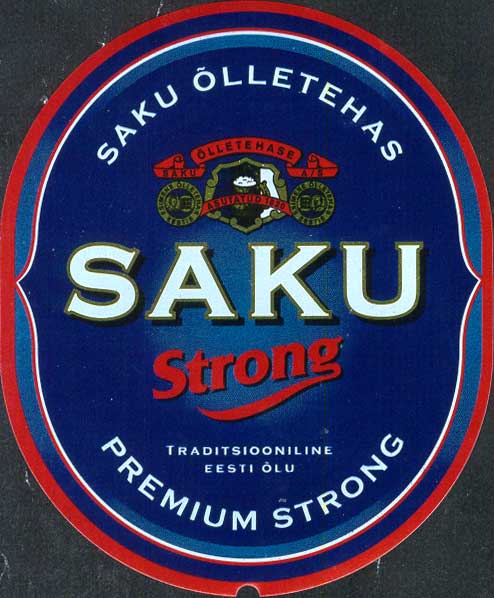
Siim sageli jööb Saku Originaali, aga mõnekord ta jööb Rockit ka.

Mõru tähendab 'bitter.'

Tanel on mõru, sest et tema ja tema vana naine abielu lahutavad.

Nüüd meil on eesti kaksikud varastama ja varustama. Varastama tähendab 'to steal,' aga varustama tähendab 'to supply.'

Toivo varastas sularaha oma isa taskust!

ja...

Saku varustab maailmi hea õllega.

Ja viimane sõna on inetu. See tähendab 'ugly' inglise keeles.

Ott lõi Reinit, sest et Rein ütles et Otti ema on inetu paks lehm.

reede, juuli 07, 2006

Abiratas goes to Annapolis


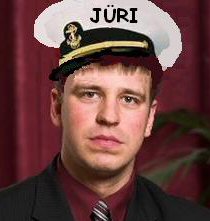
Tallinn's boy mayor gets around. After surveying the widespread use of bicycles in Grenoble, France, Jüri Ratas, the 28-year-old mayor of Tallinn affectionately known as 'abiratas' or 'training wheel' decided that Tallinn needed more bikes. Now after a stop over in Annapolis, the capital of Maryland and home to the US naval academy and lots of places that specialize in crab dishes, Jüri was treated to a good old fashioned Marylander birthday party:

Juri Ratas, mayor of Annapolis sister city Tallinn, Estonia, and a few of his staff members made a stop in Annapolis last night, one of 10 stops on their coastal cities tour of the United States.

The point of the trip was to gain information on how to better secure harbors and work with local police and fire on crisis situations. The tour also includes stops in other cities like Tampa, Fla., but turned out more like a belated birthday party than anything else.

And after meeting with city officials, like administrator Bob Agee and of course, our own Mayor Ellen O. Moyer, Mr. Ratas was treated to an ice cream social with about 30 people at Reynolds Tavern and his first root beer float.

Root beer floats and four different flavors made by Annapolis Ice Cream Co. included apple pie, chocolate raspberry, Oreo and especially for the Estonian delegation, oatmeal raisin cookie ice cream, yummy.

"Very interesting, very good," Mr. Ratas said, in between slurps of his float.

Annapolis officials even went so far as to wish the 28-year-old mayor a belated birthday (July 2), singing the birthday song at the conclusion of the social.

Unfortunately, there were no pony rides or clowns making balloon animals.


Too bad about the lack of pony rides or clowns. Maybe another one of Tallinn's sister cities, like Los Gatos, California, can pick up the slack.

neljapäev, juuli 06, 2006

Jõudu!

Noh, hakkame jälle.

Kuus uued sõnad.

Puru tähendab 'litter' inglise keeles.

Peeter paneb purru pruugikastisse.

Jahmuma tähendab 'to be startled' inglise keeles.

Priit oli jahmunud Chalice valju hiphop-ist.

Nüüd meil on viga ja vigane. Viga tähendab 'mistake' ja vigane tähendeb 'defective.'

Nokia tegi viga. Mu uus mobiiltelefon on vigane.

Järgmine on looja. See tähendab 'maker' või 'creator' inglise keeles.

Minu naine on suur looja. Ta tahab kirjutada kokku aeg.

Viimane päevasõna on hiljuti. See tähendab 'lately' või 'recently.'

S L Õhutleht kirjutas hiljuti et Arnold Rüütlil on vallaslaps venemaal.

kolmapäev, juuli 05, 2006

Invite Putin to Estonia

North Korea just test fired a missile, Iran needs a few more persuasive phone calls, but Russian President Vladimir Putin has his sights on addressing a more urgent issue - fighting Neo-Nazism.


Russian President Vladimir Putin said Wednesday that all countries were obliged to combat neo-Nazism and urged European prosecutors to observe objective standards in these efforts.

Russia has repeatedly criticized marches staged by former members of the SS in the former Soviet republics of Latvia and Estonia, which are members of the European Union.

"For instance, it is hard for us [Russia] to understand why some countries close their eyes to human rights violations and why they break up anti-fascist demonstrations but do not notice rallies of former Nazis," Putin told a conference of European prosecutors.

For starters, I'll point out that the Nazis weren't fascists. They were Nationalist Socialists. Although the party was hijacked by Hitler's leadership, which was more concerned with nationalism than socialism, the Nazis started out as a working people's party. His social engineering of culture had more in common with Stalinism than Mussolini's fascism.

But that's beside the point. I get the feeling that Putin is not unlike our Bush. Bush only watches FOX News - a right-wing media outlet in the US that favors his worldview. Putin probably only gets his news from the state-controlled media, which, in turn, tells him everything he wants to hear.

As far as he knows, Estonia is a place where Nazi concentration camp guards are honored as heroes and Russian-speakers are slaves, forced to learn this strange bog language with its ä's, ü's, ö's and õ's.

It shouldn't be that way. In the 15 years since the reassertion of Estonia's independence, there has been no official visit of a sitting Russian president to Estonia. There hasn't even been an official visit by a prime minister to Estonia. It would make sense to open the eyes and ears of Vladimir Putin and invite him to come and see Estonia for himself. And don't just meet him in Tallinn. Meet him in Tartu or Kuressaare.

This government, and perhaps the next one has the unique ability to do that. No one questions the allegiance of the Reform Party of Ansip. And if Rüütel stays, or if Rüütel is replaced by Ilves or Aaviksoo, or whomever, they will have a unique opportunity to invite Putin to Estonia before he is supposed to retire from public office in 2008.

esmaspäev, juuli 03, 2006

When does a Hyphenated Estonian Become "Just Estonian"?

Most of the news coming out of Estonia over the past few weeks has been largely financial - the acquisition of Silja Line by Tallink, or about Metallica - James Hetfield's interview in Tallinn about the band's next album has been widely circulated around Internet by metal-lovers.

But the other day we were talking in the car about a different kind of issue - the Estonian identity one - because we went to college and like to talk about such crap. We were trained to dig into murky 20th century topics like identity and nationality and, like what does it all mean, man? Zoinks!

One portion of the conversation touched upon something of increasing relevance in Estonian society - when does a non-Estonian (ie. someone who has ancestors that didn't live on the territory of Estonia for 2,000 years) become "just Estonian." Kristina Šmigun - the Olympic skiier - is prime example of this. Kristina is from Otepää, but her father, Anatoli Šmigun, is an ethnic Russian. But no Estonian will tell you Kristina is Russian. She is "just Estonian" - and there seems to be some nuanced way that Estonians can determine who is one of "us" and who is one of "them."

There are lots of mixed families in Estonia - Finns that married Estonians, Ukrainians that married Estonians, Russians that married Estonians, Belarussians that married Estonians, and more frequently, Americans that married Estonians, Germans, Swedes, what have you. They go both ways. The stereotype though is that it is the Estonian women who are more willing to have a "foreign" husband, though this is not always the case.

Unfortunately for the children of Slavic fathers, they have inherited extremely long surnames in a short, punctual language. But if Estonia has room for Jaan Kaplinski, Jaan Manitski, and Julius Kuperjanov, I am sure it will have room for Helle Retsetnikova, Aivar Balanovski, and Pille Pokeshkova. I've even met an Estonian family with the last name Pushkin!

I recall standing in Tallinn Central Hospital looking at the list of maternity doctors on the wall, and seeing either Russian surnames with Estonian last names (Olga Sepp) or Estonian first names with Russian lastnames (Pille Ivanova). I had to wonder, at what point will the established caste of non-mixed Estonians determine that these people - most of whom are bilingual - have become "just Estonian?"

What makes one "just Estonian"? - well, people will say that the number one thing is fluency in the lovely, vowel-laden Estonian language. That's a good start. But even people that were born in Estonia and can speak Estonian, but speak Russian at home and are named Sergei don't seem to qualify as "just Estonian."

It seems that "just Estonians" need to also act Estonian. For example, the lady at the Tartu playground with the colorful paisley dress and fluorescent blonde hair that smiled at my daughter and told me she was an "ilus tudruk" with a bit of a Slavic touch didn't strike me as "just Estonian." She was just too friendly.

So, in order to be "just Estonian" you must also obey rule #2. No smiling. Unless you're drunk. Plus no talking about bullshit of any kind. You want to talk about Colin Farrell's new movie? Go to Ireland. In Estonia the only proper conversation can be:

1) Do you want something to drink? Ok.
2) I think our prime minister is an idiot. Me too.
3) What's with all these Russians living in Lasnamae?
4) What time does the bus leave? 4 pm.
5) Estonians are the most beautiful, most intelligent people in the world. I agree.

Another detail is that Estonians love to drink, but they are more discreet about it. So when a cadre of young males piles on the bus with beer in hand and it's not even noon, I have a hunch that these gents still have a while to go before they become "just Estonian." Ditto for those old guys who sit outside the apartment houses in Tallinn passing around a bottle of vodka. "Just Estonians" don't do that. They go to the designated place to destroy their livers, like the local pub - not the back of the bus.

People think that Estonia is a weak country because it is small and it's people all look the same so you can imagine there are actually only about 35 Estonians and they are all just playing the roles of all the other Estonians you meet. This is untrue. Estonians are actually pretty tough when it comes to integration. Being a non-Estonian speaker in Estonia is like feeling the weight of a fat, honey-loving Estonian-speaking bear sitting on your face. You've just GOT TO LEARN.

This is misconstrued as German Nationalist Socialist-like xenophobic tendencies, coupled with Nordic, Saga-like revenge for that whole USSR thing. But it goes on in every country, even these United States, where every white guy named Smith with a beer is hammering his fist on the table next to his swimming pool and yelling about "those damn Mexicans' whose worst offense is that they "don't speak English."

The fact is, that, after three generations, even Mexicans (!) start speaking English. And Spanish is a big ass friggin' language. It's not some lightweight next to the mighty English tongue. Mexicans could survive speaking Spanish ONLY in the US indefinitely. But for some reason, they switch from "los sandwiches de jamon y queso" to "ham and cheese sandwiches" within three generations. It's because Americans, like Estonians, and like most nationalities, put immense social pressure on those that aren't fluent in the national language and force them into the mainstream. It's some sort of national survival mechanism.

The only question is when that happens - and it is happening in Estonia as I type away - will the non-mixed Estonian community see the Signe Ivanovs and Triinu Pushkins of the world as "just Estonian"?

Ma arvan jah.

neljapäev, juuni 29, 2006

KESK, ERL are you listening?


From Postimees today. With more than 4,500 votes. Interestingly the poll on the Russian version of Postimees shows similar results. Ilves is doing even better there - with 61 percent of those surveyed, versus 13 percent for Ergma and 13 percent for Savisaar. Poor Jaan Manitski only got 0 percent of the Slavic-Estonian vote. Maybe his name sounds too Polish...

1 9 9 5

1995 seems like a while ago these days. That's what happens after seven or eight years. Things turn into "a while ago." Eddie, our dog, was born in July 1995. He was a Cancer - and he really was - sort of emotionally clingy, obviously sensitive, a bit modest, a bit moody. I didn't meet him as a newborn puppy though. I met him as a five month old in December or so, when I was informed we were getting another dog. I still wasn't "ready" for having another dog. Our older dog - Leroy - had died four years before and he was a genuine pal of mine. I had known him as a baby, ridden him as a toddler. He followed me everywhere when I was eight years old. I fed him during his last days. I didn't feel like starting another one of those relationships.

During this time things were changing in my life. As a teenager, I felt that culture was stagnating. Kurt Cobain and 'alternative' was dead. My friendships were unraveling. I just didn't feel that inspired anymore. Instead, I felt mostly confused and a bit depressed. Enter Eddie. I - as I said - didn't want another dog. But my mother insisted. The first time I met Eddie he scratched me in the face. So I really didn't like him. Then he moved in - to the chagrine of our cats. I remember them looking at him like, "Oh shit, we're in trouble now." They were.

Eddie started to grow on me as I took him for walks in the snows of 1996. 1996 was a very snowy winter on Long Island. The snow came up to my chest alongside the road. I could literally rest my breakfast on the snowbank like it were a kitchen table it was so high. And this is how I became friends with the sturdy little West Highland Terrier as he burrowed into the snow banks to leave a nice warm dump or lifted his leg every 15 feets to sprinkle some territorial pissings.

My Mom adored Eddie. He went everywhere with her in the car. That was a period of change for her too as she started working in real estate. God, I think she even bought him sweaters. Our home was soon decorated with 'Westie' pillows, pictures - she even had a little leather Eddie-look alike dog on her key chain.

As Eddie got older he got fat and lethargic though. I made a film about him in 2000. It was called "Dawg Daze" - it was a video of him literally lying on the couch - eating food - lying on the couch - eating food - sleeping. He also got depressed. So to make him MORE depressed my folks got another dog - Hannah - to keep him company later that year.

Eddie also soon developed diabetes. He had to get a shot once a day, and I had to use these little litmus strips to test the level of sugar in his blood. But for some odd reason he stayed healthy through the years. It was pretty amazing.

Recently though he had been slowing down. The last time I was at my parents' place I caught him napping on the cold bathroom floor. He would never do that in his heyday. He would curl up on the couch. I had been nudging him too, on these past visits, just to check that he was still breathing.

Unfortunately, he stopped breathing last night. He died next to the new pool my parents put in.

Right around the time we got Eddie, my grandfather died. He too had been sick for awhile, so it was sort of expected. But, try as a might, I couldn't shed a tear for the old man. My father did, and my uncle did. But I couldn't find my pocket of sorrow and weep. People were around me at all times. It just seemed hard to do. Instead, I got a headache.

Today when I found out Eddie died - I also sort of wanted to cry. But I had to get on a train and didn't want people to think there was something seriously wrong with me. So I let a bit out but kept most in. And, oh man, how my head hurts.

teisipäev, juuni 27, 2006

pühapäev, juuni 25, 2006

Pole häda midagi Eesti Naisega

When I took statistics in college, my professor was a quirky Cantonese woman from Hong Kong who told us she learned most of her English from watching Seinfeld. Someday somebody might ask where I learned Estonian, and I'll have to admit, I have learned many of my words from reading Eesti Naine. Last night I learned a few more words.

Hüüa tähendab 'to shout' või 'to call.' Las leiutame midagi.

"Romeo, Romeo, kus sa oled, minu kallis Romeo," Juliet hüüdis akenist.

Toppida tähendab 'to stuff,' as in stuffing a turkey or stuffing mushrooms or stuffing stuff into a bag full of stuff.

Mart topib kommi taskusse.

Süst tähendab 'injection.' How about something like this -

Fredi on nii õnnelik sest, et tema uus firm sai jälle värske raha süst.

One interesting word is häda. Häda tähendab 'distress' või 'trouble' inglise keeles. Nii -

Oi oi oi, Tanelil on suur häda. Tema naine tahaks lahutada!

But that's not all for häda. This is one of these words that joins with other words to make phrases that are a bit different from the original meaning. So pole häda midagi means 'there's nothing wrong' as does häda kedagi.

On häda kedagi Eurovisioniga, sõbrad. See on üks äge asi!

Finally we have puudutama. See tähendab 'to touch' inglise keeles. Nii - ma proovin -

Veegi! Ära puuduta need pudukad!

laupäev, juuni 24, 2006

Remembering the Generation of 1918

On June 3, Montenegro became the world's newest nation, just weeks after the residents of the country voted in a referendum to secede from the union of Serbia and Montenegro. The following week, Estonia became the first country in the world to establish diplomatic relations with Montenegro. The action mirrored the good will of the Icelandic people, who were the first people to recognize an independent Estonia in 1991, and for whom Islandi Valjak is named - the square in front of the Estonian foreign ministry in Tallinn.

This week though, even while Estonia celebrated Võidupüha and Jaanipäev with a naval parade in Kuressaare, people are still groveling to celebrate the day some World War II hero blew his nose in the fight between the Russian communists and the German nationalist socialists. Meanwhile Postimees has a nice map of the front between the German nationalist socialists and Russian communists that looks like a set of peculiar of dance instructions.

But of these two world conflicts, it is the former, more forgotten, less celebrated with films and protests and angry diplomatic charades, that is ultimately more important in Europe today. The peaceful declaration of independence of Montenegro from the union with Serbia attests that - no matter who is paying attention - the world order created out of the end of the first world war has had the most lasting impact in global politics, more so even than the great WWII. One can only look at Montenegro's independence and see the spirit of former President Woodrow Wilson's fourteen points.

Sure, World War #2 was horrific, big, terrible, and intriguing. But it ultimately has had less of an impact on the world - save perhaps the establishment of Israel (which probably would have been established anyway) than World War #1.

But why is it that we are so ready to forget those who fought in #1? Why are they strangers to us when men who died in another war are treated with closeness and are fiercely debated among young people who have no personal connection to either conflict? Even when they were alive, the generation of 1918 were like the walking dead. When the Vaps (rightwing Estonian veterans of the war of independence) were organized in Estonia in the 1930s, they were treated with disdain by the Estonian government. In fact, though they warned about the incraesing Soviet threat, most spent the mid-1930s in jail. Similarly, when the Bonus Army - American World War I veterans - went to Washington to demand their bonus pay in the 1930s, the government had them forcefully removed from the spot.

Why is it the very people who were most important in setting up the current world order are overlooked, disregarded, and just not that interesting, while memorials to the Red Army, which defeated the German nationalist socialists and then stayed for 50 years, are so fervently looked after and controversial. Why is it that even in America people today are still arguing over Franklin Delano Roosevelt, but Woodrow Wilson barely musters an interesting word?

Is it because that generation was the last to grow up without radios, automobiles, and indoor plumbing is just too foreign for us to understand. My great-grandparents wre of this generation and they had a rough life - a life of flu epidemics, great wars, great depressions, and economic hardship. But today we live in the world the peers of Hemingway created. Yet they are lost and forgotten. Why?

For whatever the reason, it just doesn't seem fair.

kolmapäev, juuni 21, 2006

Jussikese Seitse Sõpra

Have you ever read this book? My daughter has it and it's g-r-r-reat. It's called Jussikese Seitse Sõpra, and it's about a little blonde Estonian boy named Jussike who enjoys Sundays SO much he travels through the woods to find Pühapäevamaa - Sundayland - where it is Sunday every day, ja kõik on tore ja päike paistab kokku aeg.

But, thanks to this Finno-Ugric bog language, I wasn't able to get three pages into Jussikese Seitse Sõpra without meeting some new words.

One of the first words I came upon was kaduma, which means 'to disappear' in English. Las proovime midagi -

Hansel ja Gretel kadusid metsas.

Another interesting word was tarbima. This means 'to consume.' Leiutame midagi -

Juha tarvis meie jäätis ära.

The third word I met was tihane. This is a kind of bird that doesn't exist in great quantity in North America. After much searching, we discovered that the English word for tihane is 'tit' and there are birds out there called 'great tits.' Wow! What a cool name for a bird.

Palju tihased elab metsas, ja me nägisime kaks tihaset eile õhtul maja ees.

Also, I recently was reading Eesti Naine (these are the kinds of magazines lying around my house) and found some more words I didn't understand. One of them was 'keerlema.' This means 'to spiral' in English.

I can't think of a good way to use it in a sentence in Estonian. Maybe something like -

Toomas Liivi probleemid on kleerenud kontrolli alt välja.

Finally, I have been reading some comments on SL Õhtuleht. So two of my new words now are pask and okse. They mean 'shit' and 'vomit,' respectively.

Need pelmeenid maitsevad nagu pask! Mul on nüüd vaja oksendada!

laupäev, juuni 17, 2006

The most annoying habit of Estonians

No, it's not their habit of winning the International Wife Carrying Competition every year since the dawn of the Millennium.

The most annoying habit of Estonians is answering all questions in English (or Russian, Finnish, German, Swedish, whatever) when they are asked a question in Estonian. Today I had such a dialogue. My half of the conversation was in Estonian, the other party's was in English. I could have understood most of what he said correctly in the language I am trying to learn (which most Estonians would like everybody that lives in their country to know, by the way), but instead I had to converse with another Estonian unwilling to speak in his language with someone enthusiastic enough to try and speak it with him.

I know others who have had similar problems, including Russian-speaking Estonians who said it took a LONG time for Estonians to respond to them in Estonian, even though they are fluent in the language.

So what's the deal here? Why does everybody encourage you to learn, and then snatch victory from your hands when you muster a correct sentence and wish to have a conversation? Why are Estonians so willing to bend over and introduce another language in a conversation? Why is it that when you go into a R-Kiosk in Tallinn, and two people speak Estonian and the third person speaks Russian, that everybody will talk to the Russian-speaker in Russian rather than have to deal with some bad grammar or some mispronounced words from the non-native speaker?

Is it really so hard to humor us?

reede, juuni 16, 2006

Spanish Girls Speaking Estonian

You've got to see this!!!!!! Here's a video of some Spanish girls living in Estonia speaking in Estonian.


It's C U T E ... A R M A S ... L I S T A ...

kolmapäev, juuni 14, 2006

Laisk Poiss

Kahjuks, mina olen olnud nii laisk et ma ei osknud uued sõnad. Siis ma pean hakkama jälle.

Täna meil on see huvitav sõna - mõjutama. Tegelikult, Edgar Savisaar on minu suur õpetaja, ja ma märkas 'mõjutama' üks artikelis kus ta räägis. Jah, ta on vist rikutud ja Benny Hill on kindlasti Savikasile sarnane. Aga, mina olen õpinud palju sõnad temalt. Ma ei tea miks. Nii - mõjutama - see tähendab "to affect" inglise keeles.

Siis, las leiutame midagi -

Suur inflatsioon mõjutab Eesti võime saada Euro valuuta järgimsel aastal.

Järgime sõna täna on eraldi. See tähendab 'apart' või 'individually' inglise keeles. Ma proovin -

Margus ja Maarju on abielus, aga nad eraldi elavad.

Numero kolm on nautima. See tähendab 'to enjoy'või 'to revel in' inglise keeles. Mu lause on -

Airi naudib kui piltid temast ilmub Kroonikas.

Neljaks on lidistama. See tähendab 'to tape' või 'to record.' Ma proovin -

Martini band lindistas oma uus albumit keldris.


Oi oi oi. Kui palju teil on õppida. Viimane sõna täna on 'meeles pidama' - ma veel ei saa äru kuidas seda lauses kirjutada -

Mats, pane meeles et su hobune on õues!

reede, juuni 09, 2006

More on the Glaubitz Affair

Well, this is an op-ed that might get read by some 'important' Europeans, and it's in English, by Martin Helme (pictured), the editor for world news at Delfi.ee, and published in today's Brussels Journal.

In his interesting op-ed, Helme discusses two main topics - first, the willingness of the Estonian civil service to scold the Estonian public over the affair rather than defend itself in the wake of Glaubitz's very public accusations.

But the second sheds more light on the things we know and the things we don't know:

Just when Estonian society was bracing itself for endless lectures about “true Western values” and the need to train our capacity for tolerance, the entire matter became a farce. On the same day the Estonian media reported that there had never been any harassing of the ambassador’s husband.

The papers wrote that the real reason for the ambassador’s early departure was the fact that his Cuban husband did not like the Estonian weather nor the local night life. Hence he was threatening to leave the ambassador unless the latter moved to somewhere warmer and livelier.

The Estonian authorities confirmed that not a single notification of racial or homophobic incidents had been reported by Ambassador Glaubitz, neither to the Estonian police nor the Estonian or Dutch ministries of Foreign Affairs.

Accusations of harassment that are not reported are hard to discuss. Are they perceived, real, did anything really happen? Who knows. And Glaubitz and his partner did spend the least fun time of the year in Estonia (autumn and fall) before deciding to leave Tallinn for balmy Montreal.

On the other hand, getting painted as a nation of SS-worshipping homophobes from the other side of Europe might make an offended person react by not taking Glaubitz's accusations at face value, and instead respond by insinuating that this is nothing more than the very personal becoming very private.

The best thing that can be said about these matters, is that all the individuals involved are human. From that fact alone, we can come to many simple conclusions.

neljapäev, juuni 08, 2006

Okei Õpetajad

Nii, mina olen lugenud viis uued imelikud sõnad.

Esimene oli rõhutama. See tähendab 'to underscore/to emphasize' inglise keeles. Mu lause -

Mats ütles et Arnold Oskmaa uus avaldus rõhutab et tema on üks näljakas huul.

Teine imelik sõna oli tõetama. See tähendab 'to back' inglise keeles. Leiutame midagi -

Taavi Veskimägi ütles eile, et Isamaa ja Res Publica Liit ei tõeta Arnold Rüütel presidentiks.

Järgmine sõna oli juht. 'Juht' tähendab 'conductor' või 'party leader' või 'leader.' Okei.

Lembitu oli vana eestis suur juht.

Neljaks meil on ammu teada - I have no friggin' idea what this means exactly. But Veskimägi said yesterday -

Rüütli kandideerimine oli ammu teada

Viimane on äpu. Ma arvan et see tähendab 'fool' või 'idiot' inglise keeles. Mu lause on -

Palju inimesi maailmas arvad et George W. Bush on tõeline äpu.

Presidential Update

Well, it appears that Keskerakond and Eesti Rahvaliit have been reading Eesti Päevaleht.

On May 23, Päevaleht published a story indicating that up against Edgar Savisaar or Arnold Rüütel, Toomas Hendrik Ilves would still win the presidency. One should keep in mind that at that time, neither Rüütel nor Savisaar had been publicly selected by either of their parties

Yesterday, Arnold Rüütel, Rahvaliit's strongest candidate and the 78-year-old sitting president, announced that he would represent Estonia in a second term if no other candidate could be agreed upon. Savisaar said that he would not seek the presidency if Rüütel was in the running.

Villu Reiljan, the Minister of the Environment, put on his poliical face this morning on ETV's Terevision program by saying that Rahvaliit could not support Ilves - who was born in Stockholm to Estonian refugees in 1953 and grew up in North America - because Ilves doesn't know Estonia.

However, Päevaleht released a poll showing that even up against Arnold Rüütel, who is still quite popular in Estonia, Ilves had more support among the public - be he born in Viljandi or Stockholm.

Toomas Hendrik Ilves is the preferred contender for Estonia’s highest office, according to a poll by Turu-uuringute published in Eesti Paevaleht. 36 per cent of respondents would like the Social Democratic Party (SDE) member to become president.

Current president Arnold Rüütel of the Estonian People’s Union (ERL) is second with 24 per cent, followed by Edgar Savisaar of the Estonian Centre Party (KESK) with 11 per cent.


Hmm. Savisaar's 11 percent plus Rüütel's 24 percent equals a combined 35 percent. That means that Ilves could face a tough battle against Rüütel. It also means that 30 percent of the Estonian public didn't know who to vote for.

The two sides seem locked in their positions. Interestingly, it is the two most right wing parties in Estonia - Isamaa ja Res Publica Liit and Reformierakond - that have pledged their support for Ilves - a social democrat.

Yesterday, Taavi Veskimägi (who is nearly 50 years younger than Rüütel) of the Isamaa-Res Publica union said that a vote for Rüütel would move Estonia backwards.

"Meie arvates Rahvaliidu presidendikandidaat Arnold Rüütel neid väärtusi ei esinda ning pigem sümboliseerib Eesti minevikku kui tulevikku," ütles Veskimägi. "Tema tagasivalimine presidendiks on Eesti jaoks halb valik."


"In our opinion, Rahvaliit's presidential candidate Arnold Rüütel...is more a symbol of Estonia's past than future," Veskimägi said (approximately). "To choose him to go back to the presidency would be a bad choice."

kolmapäev, juuni 07, 2006

Is the Tartu Rahu Still Valid?

Oh, this is a question to be sure. But such are the questions when you ink deals with rogue states. And what could be a better epitomy of a rogue state than Russian Soviet Federative Socialist Republic - the Russia that existed between 1917 and the establishment of the Soviet Union in 1922?

It was on the second of February of 1920 that Jaan Poska (1866-1920), Ants Piip (1884-1942) (pictured), Mait Püüman, Julius Seljamaa (1883-1936), and Jaan Soots (d.1942) sat down with their Russian counterparts Adolf Joffe (1883-1927) and Isidor Gukovsky and signed the Treaty of Tartu, also known as the Tartu Preace Treaty, or Tartu Rahu in Estonian, in which the Russian RSFSR renounced its rights to Estonia in perpetuity.

The two most important people at that signing were Piip and Joffe. Piip reached the peak of his political career in the early 1920s when he was Riigivanem, or state elder, the highest position in Estonia before the establishment of the office of president. However, by the end of the 1930s he was just a rank-and-file member of the parliament. Still, when the Soviet Union occupied Estonia in July 1940, Piip was arrested by the NKVD. He died in a prison camp in Perm oblast in Russia in January 1942.

Joffe is also an interesting character. He was one of the RSFSR's top diplomats until Lenin died in 1924. He was also a close friend and ally of Leon Trotsky, and after falling ill, he took his own life in 1927. Trotsky gave the eulogy at Joffe's funeral. It was the last speech that Trotsky gave in the Soviet Union. Trotsky was eventually assasinated in Mexico in 1940 with an ice axe. For his efforts, Ramon Mercader, the Spanish-born NKVD assassin, was awarded the 'Hero of the Soviet Union' medal, and split the rest of his life between Havana and Moscow. He has a place of honor in the KGB museum, and when he died in 1978, he was buried as a hero in Kuntsevo Cemetery in Moscow.

But what do all these dead men and the documents their once active hands signed have to do with us with our iPods, cellphones, Wifi connections, and blogs in the 21st century?

Plenty, as the Russian Foreign Ministry attests. For today, the seventh day of June, in the year of our Lord 2006, 66 years after Trotsky's skull was shattered with an ice axe, 64 years after Ants Piip died in a prison camp in Siberia, and 86 years after the RSFSR signed its treaty with Estonia, the Treaty of Tartu is declared 'no longer valid.'

MOSCOW, June 7 (RIA Novosti) - Russia will resume border negotiations with Latvia and Estonia only after the two Baltic states withdraw political demands on Russia, the foreign minister said Wednesday.

Talks on border treaties between Russia and the two countries have stalled over territorial issues inserted into new versions of agreements by Estonia and Latvia, and the two countries' claims for compensation over what they term Soviet occupation.

Sergei Lavrov said Russia would only rejoin negotiations if the Baltic states returned to the original documents and remove the political subtexts.

"But as long as these political links are there, returning to the negotiating table is out of the question," he said.

...

The Russian and Estonian foreign ministers signed treaties on common borders on May 18, 2005, and the Estonian parliament ratified the documents on June 20, but with additional demands linked to the 1920 peace treaty between Soviet Russia and Estonia. On September 6, Russia notified Estonia that it was revoking its signature from the treaties because the 1920 document was no longer valid.


The preamble of Estonia's border agreement claims a) the legal continuity of the Republic of Estonia proclaimed on 24 February 1918 b) that the treaty partially amends the state border line established by Art. III section I of the Tartu Peace Treaty of 2 February 1920, c) the agreement shall not influence the rest of the treaty and shall not determine the treatment of bilateral issues not connected with border treaties.

At what moment did this document become no longer valid? Estonia signed a military alignment pact with the Soviet Union in September 1939, yet even at that point, the Treaty was apparently still in effect. For example, The Republic of Iceland has been recognized by the United States since 1944 and has had a base located there since 1951. However, the existence of American military presence in Iceland has not interfered with Icelandic sovereignty.

In 1940, after a new communist puppet government was created, the Republic of Estonia ceased to exist as far as Moscow was concerned, and was now a member state of the USSR, as established in 1922. The Tartu Rahu was no longer valid. It's living signers were now enemies of the Soviet state (Jaan Soots, who accompanied the delegation in 1920 and a former defense minister of Estonia, also died in a prison camp in Russia in 1942).

But, the current Estonian Republic considers itself the same republic that was founded in 1918 and signed the Tartu Peace Treaty. The Russian Federation considers itself the successor state to the USSR. For example, last year, Putin said that Russia owed Estonia no apology for occupation due to a resolution passed by the Soviet Supreme Council in 1989.

So what is afoot here? The Russian government does not recognize the Estonians as who they claim to be. The Russian foreign ministry, at the same time, is not exactly sure who it is. Sometimes - ie. when it comes to claims to the Kurile Island in the Pacific Ocean - the RF is definitely the successor state to the Soviet Union.

But when it comes to bilateral relations with Estonia, Russia is not so sure if it actually had anything to do with the Tartu Peace Treaty or not. Instead, it just wants to not discuss the past and move forward.

I guess this is an example of Russia's oft-discussed post-1991 identity crisis.

The sad irony here is that Estonia's preamble references resolutions already passed by the Riigikogu. Therefore, there is little need to reference those resolutions in this document. So if Estonia revoked the original document and passed a second one without the preamble - the legal effect would be exactly the same.

teisipäev, juuni 06, 2006

Dutch Ambassador to Leave 'Homophobic' Tallinn

Dutch Ambassador Hans Glaubitz (pictured, left) is leaving Estonia because his male partner, a black Cuban, has been the victim of homophobia and racism, according to several news reports.

The Ambassador's partner was subjected to verbal harassment and threats in the street and threats. These began after a local magazine wrote that the appointment of a gay Ambassador with a black partner had to be seen as a Dutch provocation.

The Dutch Ministry of Foreign Affairs had hoped that Estonia, like its neighbour Finland, would be able to accept a relationship between two men. According to a report by the US Embassy in the capital Tallinn there have been nine cases of threats made to non-white embassy staff, mostly by Neo-Nazis or skinheads.

In a personal statement, quoted by the NRC, Glaubitz indicated the behaviour of the Estonian government was beyond reproach as his partner was treated well on an official level.

The treatment by members of the Estonian public was another matter. "[Estonian] society is far from ready for two men, particularly if one of them is black," Glaubitz said.

The Ambassador and his partner are being transferred to a two-year assignment at the Consulate General in Montréal, Canada.


First, does anybody know which local magazine was the first to discuss this man's private life? I doubt it was Kroonika, but could it have been the SL Õ? Pray tell to whom we all owe the honor of bad publicity for oma isamaa meie õnn ja rõõm...

Second - I actually heard - second hand - of an African-American individual affiliated with the American embassy that had to put up with a few 'Heil Hitlers' from some enthusiastic self-defoliating skinheads in Tallinn. I too was pressured for money from a leather-clad skinhead in the Old Town at an Internet Cafe. He actually asked me for money in Estonian, then Russian, then Finnish, and finally English. So you can't say they've lost all of their mental faculties :)

The idea that Estonia is any different from Finland though in its attitudes towards blacks, is a bit off mark though. Throughout my travels in Northern Europe I was privy to racist jokes a plenty. I don't think it is necessarily because people there are malevolently racist - I think it is because they just don't live near a lot of black people. When I lived in a very caucasian neighborhood as a child, I too had some funny ideas about people who didn't look like me. Now that I live in New York though, I have a lot of funny ideas about people that DO look like me.

A interesting tidbit is that the word for black man in Estonian is 'neeger' which is an insulting term in English, but Estonians insist that 'must' the word for 'black' also means 'dirty' and is a far more derogatory thing to call someone.

Estonian attitudes towards homosexuality though are a separate issue. I am currently unaware of any openly gay celebrities or high profile individuals in Estonia. I am aware they exist - and I am sure most people could point them out - but it just doesn't seem like something which is openly discussed in society.

Yet, sexuality isn't really openly discussed in public either. It is in magazines, sometimes on TV, but in a public setting? I rarely saw straight couples 'making out' or embracing in Old Town - and if they were, they were usually foreigners, or it was warm out and they were drunk.

I welcome all comments on Estonia's attitudes towards homosexuality though. I am NO expert.

I do think it's important though to view this from a European perspective. As any Dutchman will tell you, Holland, with the recent assasination of Pim Fortuyn and the murder of Theo Van Gogh, not to mention the effort to strip the citizenship of Ayaan Hirsi Ali is struggling with similar issues of bigotry and tolerance.

Three Years of Marital Bliss


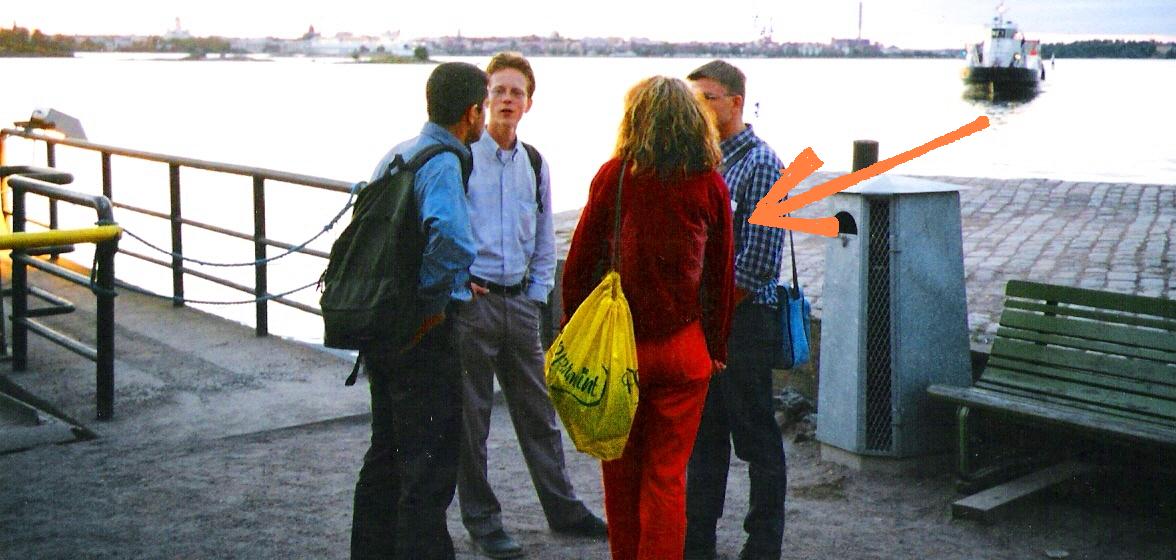
This photo was taken on or about the 5th of August in 2002. The young woman in the red pants and red jacket is Epp - then just one of the many fuzzy foreigners in my company in Helsinki - now my wife and the mother of our child.

The clean (well cleaner than New York Harbor) waters of the Gulf of Finland are at play in the distance, and, according to my memory, I most likely was intoxicated by the time I took this photo of what was to become a familiar backside.

As of today - 6/6/06 - the number of the beast - we are officially married for three years. Many marriages don't last that long. For example, Lisa Marie Presley's marriage to Michael Jackson only lasted about 19 months. Frank Sinatra and Mia Farrow on the other hand duked it out for a full two years. So we have something to be proud of - a true achievement in today's society!

When we got married, my romantic cousin asked if it meant that I wanted to "spend the rest of my life, forever and ever" with Epp. I have never been comfortable with the idea of the "rest of my life, forever and ever" because I am a bit of a fatalist and I just don't like predicting the future. I enjoy more to go with the flow. But, as of today, it does appear that we are on the road to spending the "rest of our lives, forever and ever" together.

We were married in Tallinn on June 6, and then took a sweaty bus south to Viljandi where we honeymooned (the most unlikely honeymoon spot on Earth). We had a nice south Estonian dinner and retired. The next day we greeted her family and I had to give an embarrasing speech. It was overcast. I still was getting used to having this metal ring on my finger. I always hated rings (or any jewelry, body art etc.) and so it took awhile to get used to. I have to say that I was a bit uncertain about getting married. In all my predictions for the future, marriage had never seemed to manifest itself in my dreams. I didn't know what to expect, I wasn't sure what it meant, I wasn't sure that if I was turned loose in a nightclub in Amsterdam if I'd succumb to adultery and other debacherous acts. I just was not very confident before I took the plunge.

But now, three years, later, it seems to have worked out pretty well. I like being married. In fact, I oddly am enjoying it more each year, which is the opposite of what others describe as a "long meal with dessert at the begining." The hype of marriage is long gone, and again it's just me and my kullake, living together, watching bad movies on the Lifetime network together, and, once in awhile, frequenting NYC comedy clubs together. Two peas in a pod. Two bees in a nest. Two humans in legal bondage :)

And, in a way, I am glad we did it the way we did it. Our wedding had little fanfare - limited planning, the thousands of cousins did not materialize to muster up a bon voyage. Instead, we just got married, and have lived happily since, so much so that, today, when I am on business trips, I actually have trouble sleeping without the warm human being in bed next to me.

A really good marriage necessitates the compliance of two really well-suited people. When I met Epp in Helsinki those four years ago, I knew pretty much immediately that she was creative enough, interesting enough, moody enough, and crazy enough to put up with somebody like me. It felt like I had finally found a partner that could put up with me and vice versa. And it seems that my gut instinct was right.

neljapäev, juuni 01, 2006

Toored Sõnad

OK...hakkame jälle.

Esimene on paras. Paras tähendab "fitting" või "appropriate" inglise keeles. Mu lause on:

Ma arvan et sul on parasid riided pülmale.

Teine on hälgima. 'Hälgimaä' tähendab "to starve" inglise keeles. Mu lause on:


Kui te ei söö mitte midagi, siis te kindlasti hälgite.


Kolmaks on ilmuma. 'Ilmuma' tähendab 'to appear' inglise keeles. Mu lause on:

Veevana ilmus jõepeal.

Neljaks on toores. 'Toores' tähendab 'raw' inglise keeles. Mu lause on:

Tõitsi lemmik toit on toored porgandid.


Okei, viimane sõna on segema. 'Segema' tähendab 'to disturb' inglise keeles. Mu lause on:

Need inimesed kes jööb kohvi sukru ja piimata alati segeb mind!