reede, september 18, 2009

kes siis veel

Politics, politics, politics, politics. You can't get away from it. Like a wizened old drunk on a Tallinn street corner it pesters you for attention.

"Hey buddy, spare a few extra krooni, I'm awfully thirsty."

What to do? Everywhere I go in Tallinn's capital, I'm assaulted by posters for the Estonian Centre Party. Kes siis veel! Kes siis veel! The slogans are laughable and yet work. The Reform Party will cut your pensions. The Reform Party will increase unemployment. The Reform Party cuts money for kindergartens. The Reform Party practices human sacrifice.

"It's a demonstration of power," says a colleague. "Centre wants to show they have the most money. So they have to put a sign on every garbage bin in the city."

You can't take a leak in Tallinn without coming face to face with Edgar or one of his apprentices. Trust me, I've tried.

Where does Centre get its money? Who knows? Estonian parties aren't ones for transparency. But I have a suspicion that Centre's strategic partners in Moscow, United Russia, might be lubricating their Tallinn counterparts' local election campaign with petrodollars.

I know that Centre leader and Tallinn Mayor Edgar Savisaar recently returned from meeting United Russia leaders Boris Gryzlov and Konstantin Kosachev in Moscow. Boris and Kostja have even given Centre their blessing. Edgar & Co. are the only ones, in Moscow's minds, who can heal the riff between these two proud states. Even if I am not Estonian, I found it embarrassing to watch the Centre's delegation to Russia. How could they ever say no to their benefactors? If they were to get into power, what would it mean for Estonian sovereignty?

In light of my disgust, you'd think I'd find my natural home with the right-wing parties. We could sit around, and dance to the day when Laidoner is king. Except, in many cases, they are just as annoying. This constant battle over the interpretation of history, the obsession with the wounds of the Soviet era, the nearly religious genuflection to economic liberalism. I hear about 1940 so much, you'd think it was 1940. I get it already, my Estonian brothers. I get it. But what's next?

There is this odd rift in Estonian political life. Neither of the political forces can truly unify the country. It's either Ansip or Savisaar. 'Pragmatic' relations with Moscow or ardent Atlanticism. Sorry Jaan Kaplinski but, right now, there is no third way.

Which is a shame. I listened to a young woman from Jõhvi last night become emotional as she described her relationship with the state.

"My father is an engineer in a mining company. He's lived in Jõhvi almost all his life. And the Estonians tell him it's not his home. How can it not be his home?"

My question is, what Estonians told her that? Didn't President Ilves go to Narva as soon as he took office and tell a classroom of Estonian Russian students that they were Estonia's compatriots and the country couldn't make it with out them? Didn't he go to Kohtla-Järve and tell the miners that they were the backbone of Ida Virumaa? Wasn't Population Affairs Minister Urve Palo out there, before Andrus Ansip canned her, scarf on head, making nice with MEIE venelased?

From what pungent sewer does Estonia's ethnic strife spring?

"Everyone knows that you can't be the boss unless you are Estonian," she opines.

"It's not true!" I protest. "Savisaar is half Russian. It's literally his mother tongue."

"But this is Estonia," she waves me away. "Everyone has a Russian in their family tree."

The Estonian Russian hates Ansip. She's like a cartoon character, almost as bad as those rural Estonians who haven't seen a Russian in years and keep complaining about kuradi tiblad. Except she's human. And friendly.

"We didn't think he was so bad. Then he took that statue down."

"He had to do it. There were two-right wing parties running, and he wanted to win. Once he won, of course, he had to do it."

She pauses for a second to contemplate how all that nonsense two years ago might have been just about politics. Not history. Not principles. Just politics.

"But he was stupid. He lost the support of all Estonian Russian voters."

"Maybe it was a short-term gain," I shrug. "Long-term loss."

***

Politics, politics, politics, politics. It's the foulest thing in this town. Tallinn looks great. I don't think it's ever looked better. When I came here for the first time in 2002, Tallinn did not look like this. Where there now stand shiny hotels and business centers once stood vacant lots and ruined buildings. Nearly every street in the center has benefited from a face lift.

I'm proud of how well this city looks. I am proud that international conferences can be held here, and people are surprised by how well things function. "You can get Internet everywhere," says a colleague from San Diego. "Even in a public park!"

A public park? You can get wireless outside the metalworks in Obinitsa on the border with Russia. I've sent mails from there, crouched down in the dirt with my laptop on my, well, my lap. One time the wireless was down in the restaurant where I was eating and I was waiting for an important mail. So I went out to the parking lot and linked up to another signal instead. Sure it was in the middle of a January snowstorm, but, impressive, no?

It feels good because a lot of people think Estonia is stuck in some 1991 vortex. They think that they might have to wait on a breadline to get a bite to eat, or get stuck up by thieves in the street. Dastardly eastern Europeans who prey on naive Western tourists. And the people who think these things come from places like London or San Francisco, where there really are aggressive street people, although, I'll admit, some of those thieves do probably come from Estonia. But that's a hidden benefit of EU enlargement -- eastern Europeans got to export their most successful criminals to Frankfurt or London or Paris.

So Tallinn looks good. The people do too. They are so fashionable with their scarves and sunglasses and exotic dogs. Maybe too fashionable for a city of 400,000 perched on the Baltic Sea. The Swedes expect another post-commie bottle depository and they go away thinking that it might be time to give Stockholm an upgrade. And during the conference they all got to watch the masses jog by for the sügisjooks -- the fall marathon. It was sunny the whole weekend. Everything was perfect. The city glowed with goodness. Tallinn to them must have seemed ideal.

It feels great to be in a situation like that because you have no idea how often I have dreaded sharing my biography with strangers. I would tense up when I let slip in front of strangers that I had a relationship with a place called 'Estonia.' There were times when I would just say Finland, or the all-encompassing 'Scandinavia' instead. Anything to avert the horrid line of questioning ('Do they have indoor plumbing there?') As the conference attendees discovered after serial cocktail hours, indeed, they do.

***

Politics, politics, politics, politics. Obama's decided to scuttle the planned missile defense installations in the Czech Republic and Poland. It's always been controversial, partially because this part of the continent, like most parts of it, actually, have been gutted by war for centuries, and the idea of any change in the 'balance of power' makes people uneasy. It's also been controversial because of the Russians' incessant whining about, well, everything. And wouldn't you know that after Obama and his advisors dropped the plan, Russia said it didn't owe America anything and continued to wag it's finger at the Western allies like a certain Austrian.

The Russians. They keep playing the same old song. It's irritating. But even the most irritating songs disappear from the radio for awhile to be replaced by other irritating songs. With a Putin return to the presidency possible, we could be hearing his tune for decades to come. It would be as if Brit singer James Blunt's detour in sappiness "You're Beautiful" (I saw your face/in a crowded place/and I don't know what to do) stayed at the top of the pops forever. If that's not a reason to jump out a window, I don't know what is.

"Things have never been good between Estonia and Russia," a friend shakes her head. "Why do you think we have our guys in Afghanistan? It's the best training they can get. Because they know it's not a matter of 'if', it's a matter of 'when'."

Her father's in the army. So's her brother. Maybe she knows what she's talking about. Or maybe she's just indulging us in the invasion myth. It stretches back through the generations. It's replayed itself over and over again, from the Northern Crusades to the Second World War. It's in every Estonian. "They're coming." Pack your bags. Hoist the sails. Run to the hills. "THEY'RE COMING!"'

Every Estonian has nightmares about the hordes of evil ransacking the country, raping and burning and murdering and torturing their way back and forth across the soil of Eestimaa, like a fine comb, back and forth, until every tree is charred black with the agony of death, every field flooded with blood and the anguish of geopolitics.

You watch Savisaar seated with Boris and Kostja and it looks like a tunafish supping tea with a pair of great white sharks. You wonder how terrible Russia's leadership is inside. I mean Stalin and Molotov also played nice with their Estonian colleagues before they sucked the country like an egg through a straw and informed the hostages that their nationality was destined to vanish and blend into the great Soviet people.

But those were evil men. They were different. Look what happened to Comrades Zinoviev and Kamenev and Trotsky. And Mihhail Khodorkovsky is only in jail indefinitely. Why, that's like a slap on the wrist. Putin and Medvedev are different. They're pussy cats. As Finnish President Tarja Halonen says, 'we've never had it so good.' Putin and Medvedev want to look respectable at the G20 summit. So we would like to believe.

teisipäev, september 08, 2009

teel

How to get between points A and B in Estonia? If you are going from Tartu to Tallinn or vice versa, it's easy; just take the Tallinna-Tartu maantee, that heavy-traffic ridden, accident-inviting highway to hell. But if you are traveling from Tartu to, say, Haapsalu, you must be more creative.

As driver and lead navigator for the family, finding a relatively straight route from one of these locations to the other was not easy. Tartu, the home of Estonia's oldest university and city of good thoughts, sits almost 200 kilometers (120 miles) directly southeast from Haapsalu, the whimsical seaside retreat of Ilon Wikland and Peter Tchaikovsky.

But there's no Tartu-Haapsalu road. And I refused to do something so counterintuitive as to make the L-shaped drive west to Pärnu and then north to Haapsalu. No, I was going to drive that damn diagonal straight up to Põhjamaade Veneetsia ("the Nordic Venice" as Haapsalu is called) even if I had to plow through fields or burst through buildings, like Burt Reynolds and Dom DeLuise in Cannonball Run.

The course I plotted went north past Poltsamaa, southwest at Imavere (pop. 501) to Kabala, then north to Türi. Not like one could tell the difference between any of these places; they were covered by the same seas of fields and dense forests. At Türi, we headed northwest to Rapla, then southwest to Märjamaa, before turning northwest to Koluvere (pop. 404), where we encountered the first sign for Haapsalu. From Koluvere, we headed north to Risti, where we made a final turn west and burned the last 33 km to Haapsalu.

Later when we were having dinner with the film producer who my wife was dispatched to interview, she asked which way we came.

"We took an unusual route," Epp told her. "We didn't use any of the main highways."

"Let me guess," said the producer. "You took the Tartu-Imavere-Kabala-Türi-Rapla-Märjamaa-Koluvere-Risti-Haapsalu route."

We looked at each other and realized we weren't the only creative navigators in Estonia. It was comforting to know that other Estonians who tackled the difficult issue of getting from point A to point B in a country routinely describes as "tiny" had settled on a similar course.

***

I was happy to zigzag across Estonia because, aside from the elusive Narva, Rapla and Märjamaa were two of the few places in Estonia I had yet to visit. Rapla and Märjamaa. What to expect from this duo? More of the same.

After you've visited most of Estonia, you come to understand what an Estonian town or city is made of. Most of them are centered around some body of water -- be it a silty river or manicured lake or a broad harbor. The rest invariably grew up like shantytowns around a castle or a railroad stop. Most city streets in Eesti are woven around one heavenly object: a sober-white Lutheran Church that either dates back to or is built on top of the ruins of a place of worship established shortly after the Teutonic conquest in the 13th century.

Beyond the church are main commercial streets dotted with a variety of dwellings. The oldest date back to the 18th century as most of Estonia was trashed during the Great Northern War between Sweden and Russia, while the youngest are postmodern erector sets of metal and glass that would be at home in any city in northern Europe where they sell stuff you really need, like designer jeans.

Outside the city center, you'll find the brightly-lit evidence of Estonia's love of consumer goods: supermarkets with names like Säästumarket, Konsum, and Selver; home-improvement oases dubbed Bauhof and Ehitus ABC. Beyond them lie the big box apartment blocks of the Soviet era, the valley of the average Estonian. These Khruschevka pueblos may have once beamed with modernity upon move-in day back in '62, but today they look worn, and, when you have that many owners living in the same residence, most of them uppity individualistic Estonians who will go to war over whether to paint the front door red or green, then it takes time to settle on a scheme for renovations.

And that's Estonia. That's Rapla. That's Märjamaa, though I admit I was attracted to Märjamaa's colorful main street with its wooden homes styled in orange and red and blue. It seemed like a special, secret place. A good setting for a great Estonian novel in the vein of Anton Hansen Tammsaare, Oskar Luts, or Andrus Kivirähk.

What can you tell about the Estonian people from a car window? Preciously little, other than they go about their business as if nobody was watching. You forget that most people on Earth remain true to the communities into which they were born. The Raplakad and Märjamaalased are no exceptions. Remember that Maria Tomson, the oldest Estonian on record, spent all of her 112 years between 1853 and 1965 in a small parish in Viljandi county. Century in and century out in, for many Estonians, life is still centered on the Kinder, Kirche, Küche, and Konsum.

***

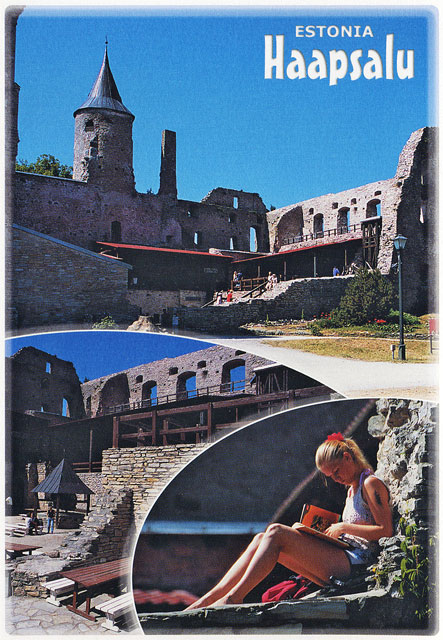
Haapsalu, though, is the jewel of them all. It was only my second time there, and already the city moves with me like an old pair of pants. Imagine, ornately decorated, candy-colored homes built around a charming old castle with a face to the islands and the sea. When writers and musicians and handicraft merchants need to get the hell out of the figurative Dodge City, wherever it may be, they pack their bags and head to Haapsalu for a little R&R.


The producers' house shines as much as a home meant to revive the styles of the 1930s can. With its soft wooden floors, rolling couches, and grand maritime views, one hesitates to even disturb a book from one of the sturdy shelves, nevermind throw a wild house party where half of Estonia and a quarter of Finland docks in the front yard, gets smashed, and then violates the place.


All Estonian conversations flow to the question of languages. "Estonian is difficult." "It is." "Do you know any Russian?" "Izvenitsa. Zat knies." Then there's that moment when you tell them you've been studying Swedish. Speakers of all big European languages turn their heads when you confess that your German is nonexistent, but Jonas bakar bröd, Emil spelar musik, och Anna pratar i telefon.


In the '30s, Haapsalu used to be known as the 'capital of the Estonian Swedes.' Most of them have joined the 9 million Swedes in the mother country, and and most of those Swedes prefer not to speak their tongue in the company of foreigners. But I like svensk anyway. In my dreams, I am getting into arguments with Swedish Foreign Minister Carl Bildt on his blog. I'm not there yet, but it could happen. It's true. The 'Languages' section of my CV renders me entirely useless. Except for the English, of course.


The producer, a slender former model in her early 40s, is part Russian, part Estonian. She still has a big toe permanently in Moscow. But she fits in here. It comes naturally. Haapsalu, for all its Scandinavian ambiance, has a distinct tsarist touch. You can walk by the house where Peter "the Great" stayed in 1715. Alexander Gorchakov, state chancellor of Russia from 1867 to 1883, was born here in 1798. It's a shame the Russians' leaders are such shitheads, I think to myself as I make my way up a verdant lane in the old city center. They would really enjoy this place.


Could you imagine? Dmitri Medvedev takes an armored train to the old tsarist-era Haapsalu train station where he is met by Toomas Hendrik Ilves in full mulgi regalia. The duo are transported via horse-draw carriage to a local bakery where they are served delicious moskva sai pastries fresh from the oven. From there, the lynx and the bear don old-fashioned swimming trunks for a photo-op and dip at Aafrika Beach before embarking on a public tour of Gorkachov's birthplace, Peter's cottage, and Tchaikovsky's bench. Medvedev compliments the Estonians on their tidy streets and hospitality, while Ilves emulates Halonen and manages to construct some random historical fact into a symbol of good neighborly relations, spicing it up with a Mihhail Veller quote.


But it doesn't happen. Some of the Russians still haven't figured out that, though Peter slept there, Haapsalu isn't 'ancient Russian land.' Some of the Estonians are still walking around with their fists in their pockets like an oppressed imperial minority, rather than the overwhelming majority and political masters of the land that bears their name. What a shame, I shake my head and pass an orchard. There are apples on the ground and autumn is in the air. A shame.


***


Where is eternity? Some people seem to have found it. But my spirit is restless. It won't let me be. After just a week and a half in Tartu, I had to get out. The same streets, the same river, the same baskets on sale at Jysk. Do you know what song they were playing there in Eedeni Keskus? "More than a Woman," the Bee Gees' 1978 hit. That song has been following me all through my life. Even when I was a little loaf of bread in nappies, they were playing that song at the supermarket. I can't get away from it. Some things are fixed. It's just the Bee Gees and me, from here until the end of time.

But Tartu. It's endearing, but I'm restless. I've got to keep moving. I feel like that wherever I go. When I lived in Washington, DC, years ago, I might sojourn through Foggy Bottom over the bridge to Arlington and back, greeting the black squirrels and fitness freaks along the way. But the itch, the itch, the itch. It could not be scratched. You can't tell your professors these things.

"How come you didn't complete the assignment?"

"I'm sorry, sir. I had another existential crisis."

Not like the film producers are any less itchy. They split their time between the Hap', Tallinn, and Moscow. They keep things interesting. Interesting. That's how things should be. And then I feel that other little itch: the desire to say inappropriate things. The desire to make things interesting. Maybe because there's nothing else really to say. With priests, there's that overwhelming yearning to crack a George Carlin joke (The invisible man has a special list of ten things he does not want you to do. But He loves you and He needs money.) With film producers, you must overcome the desire to swing your feet up on the table and pitch them your movie, a movie that's going to be big, big, BIG.

"I've got a a great idea for a picture," you say, munching an imaginary cigar. "It takes place in Tallinn at the American embassy. It's like Ferris Bueller's Day Off meets The Hunt for Red October."

But you won't do that. That would be impolite. You wonder if film producers lives really are like that. If they can't go to the local R-Kiosk without the seller trying to pitch them a movie about a woman who works in an R-Kiosk. It will be big, she tells them and hands them a candy bar. HUGE.

But Haapsalu. Haapsalu could be an eternity. I couldn't design a more perfect city: centered on a castle, face to the sea, candy-colored homes. When Estonia's restless writers need to get away, they come here. If take a walk down along the promenade, be careful not disturb a soul. They're wrestling with a plot twist. It's best to let them be.

Still, I'd like to jet the world into Estonia just to show them this place, show them the castle, show them the buildings, show them the sea, envelope them in the spirit of Haapsalu, the Haapsalu vaim. It's one of the best places I've found. I get scared though. I am afraid that if I linger too long, my shoe will begin to itch. It could be more of the same, same castle, same sea, same vaim. It's best not to spoil the mood. And so we pile back in the car, and prepare for the long, zigzagging journey home.

pühapäev, august 30, 2009

teeme juurde

Thick gray clouds, fat and fluffy. Like migrating birds, they always seem to find their way to the Gulf of Finland at certain times of the year. I could feel the grayness of northern life consume me as soon as we got into Helsinki.

At first, it was sunny, but then the clouds began covering Vantaa as we waited for our plane. The shiny Moomin souvenirs and reindeer cold cuts and Marimekko plates; all were suddenly calmed by the serene clouds. The Finns are such stylish people, even if they are oppressed by the gray, even if they can't help but crack a perverted grin when they serve you at a café. Their mouths say "kiitos," but their translucent eyes hint at something more sinister. It's their subtle way of letting you know that everybody in that country is secretly nuts.

The gray followed us to Tallinn, but here other details caught my attention. While the Finns are stylish, many Estonians are garish. Supposedly, an Estonian man's kroons go first to the car, then the house. I would venture that an Estonian woman's most cherished bling is her expensive manicure. First the nails, then the hair.

I spoke to the cab driver in Estonian — the best way not to get ripped off, I'm told. His name was Sergei. I noticed his name when I saw his ID card in the car. He helped us with our bags, crammed with less- expensive clothing procured during a spree in the US, and was mostly polite, but he didn't say a word, even when I paid him or thanked him. Not a word. Not a 'How was your trip?' or 'You're Estonian's pretty good. Some people have been living here for 50 years and not one word.' Not a smile or even a grimace. Nothing. Sergei gave us nothing except a silent and efficient ride to our address. After a few weeks of warming up in the US, Sergei to me signaled that it was time to cool down. I was back in Tallinn and summer was coming to an end.

***

And then there were blondes. This subgroup of humanity walks the sidewalks of Estonia, totally unaware of how strange it looks to outsiders. We have words for these odd flaxen-headed creatures. We call them Vikings or Nordics or Scandinavians or Germans or even Aryans, but to me, these towheads are just different. Blondes. They make everything better. They look good. When Estonians need to print up travel brochures or postcards and they don't know what to do, they usually put a blonde on the cover. Come to Põlvamaa, they entice would-be tourists, we have blondes! And the people come.

Still, negative stereotypes do belong to groups of people, even the blondes. And even in Estonia, some people think the fair-haired are dumb. For example, the Estonian term sinisilmne – literally 'blue-eyed' – is a metaphor for 'naïve.' Blue-eyed Estonians use it regularly and don't get the irony. Once on Taarapuiestee, a minor boulevard in Tartu, we almost got in an accident with an erratic driver who ran a STOP sign. By the way the car blew through the intersection, I thought it was driven by a big drunk man, but when I saw the person through the windshield, I noticed it was a small, seemingly sober woman.

"Did you see what I saw?" I asked my wife.

"Yep," she answered. "She was blonde."

And we both knew what 'blonde' meant. In this scenario, it referred to a group of people that is unable to operate heavy machinery. No wonder there are so many traffic accidents in Estonia. It has one of the highest 'blonde rates' in the world.

***

"Teeme juurde, teeme juurde." When I first went to the local Säästumarket to buy some bags of milk, I accidentally said 'thanks' to the cashier before I corrected myself and said aitäh instead. I knew then that it was time to adjust again, to slip back into Estonian life and speak the local language.

And so here we were in a used furniture store on the outskirts of town, haggling with the proprietor who promised to build us a set of bookshelves for our growing library. Epp did 90 percent of the talking. I rifled through a Soviet-era book on Finland. Did you know that the 'ultra patriotic' right-wing Lapua movement got the Finns into a war with the Soviet Union twice, in 1939 and again in 1941? According to that book, published in the late 1960s, that's how it all went down. I'm keen to read about the rest of world history as the Soviets wrote it. Maybe it should be compiled into a single book, perhaps a new Russian history book for high school students?

But teeme juurde – that's what the shop owner said. Teeme means 'let's make it' and juurde, well, that means literally 'to the root.' 'Let's make it to the root?' No, that can't be right. It makes no sense. "It means 'let's make more,'" Epp explained. I struggle to grasp how the word for 'to the root' turned into 'more,' but who can figure out the etymology of phrases in this language where somebody's place is their 'root' -- Ma olen Jaani juures is 'I am at John's place.'

I close my eyes and try to imagine roots. What do they look like? Some are big and others small, but most are underground and twisted into terrifying shapes. Only the tree-minded Estonians would be able to fully understand how they've managed to give the word for 'roots' so many other meanings, but, whatever, teeme juurde, let's make some new shelves.

***

When I left to go the Konsum today, it was sunny. On the way there, it got cloudy. While in the Konsum, it began to rain. I asked the girl at the Apteek for some rubbing alcohol. Or at least I tried. This is what transpired:

Kas teil on alkohol mida ma saaks mu näole panna? (Do you have alcohol that I could put on my face?)

Puhastamiseks? (For cleansing?) She gives me a puzzled look.

Juust. (Exactly)

Jah, üks hetk palun. (Yes, one moment please) She pulls out a key and begins filing through a drawer.

Asi on see, et putukas hammastas minu tutre ja ma tahaks, et see amps läheb kiiresti ära -- (The thing is that a bug bit my daughter and I would like that the bite goes quickly away)

Ah, nüüd ma saan aru. (Ah, now I understand) The clerk looks delighted and hands me a bottle of Mentool Piiritus.

'Mentool Piiritus'! See on täpselt mida ma tahtsin osta. Teate, et ma just tulin tagasi Eestisse ja -- .
(This is exactly what I wanted to buy. You know, I just came back to Estonia and --)

Pole hullu. (No worries) The clerk smiles and rings me up. I guess it's obvious that I am a foreigner, but I was understood.

On the way home from the Konsum, it stopped raining. When I pulled in the driveway, it was sunny again.

teisipäev, august 25, 2009

noormees ja meri

"Kaka." It's a universal word. French babies say it. Estonian babies say it. American babies say it. My daughters say it. The younger one said it on Friday on the beach.

She was following me out of Provincetown harbor, her legs still in the water, when she cried out in surprise: "Issi, kaka!" I turned and saw the stripe of brown sloping down her leg towards the sea. She stared at her leg in panic too.

"Oh shit," I looked around at the other beach goers to see if they had noticed my daughter's 'surprise.' "What do you do when your kid shits on the beach?"

I decided that I had no choice but to give her a good rinse in the Atlantic-fed bay. I was ashamed to pollute in public, but there didn't seem to be any other option. I grabbed her by the arms and dragged her through the tide. To my horror, clouds of brown plumed in the still harbor waters, only to dissipate into nothingness. Within seconds, all was clear again. It was as if nothing had ever happened. As if there had been no "kaka" incident. The water looked fit to drink. Standing there with two legs in the mix, I had to ask myself: How much shit is actually in here?

I rolled her up in my t-shirt and made for my wife who was at a beachfront café. She was lost in verse when I approached her bearing our bundle of joy, now oblivious to her condition, who was pleased to see her mother. 'Tsau, emme,' she chirped. 'Tsau!' her mother responded, her hand gracefully finishing the last line of a well-thought out sentence.

"Kaka," I explained. We hurried to the public restrooms. After some emergency surgery, mother and daughter emerged clean, with a plastic bag bearing her unfortunate swimsuit and my unfortunate t-shirt. And there I stood in nothing but a bathing suit in downtown Provincetown surrounded by tourists and locals, many of whom also have nothing on but swimwear. My wife was soon joined by two Estonian friends, who were sympathetic to our 'kaka' incident. They have kids too. They understood.

I stood waiting in the hot August sun with our stroller and the ill-fated plastic bag while the Estonians discussed our agenda for the rest of the day. After awhile, I noticed them glancing at me.

"What do you think? Could he be one of them?" my wife gestured at the half-naked guy with the mysterious plastic bag. The trio of eesti naised turned and looked me up and down.

"No, his shoulders are too broad," concluded one.

"And he's too hairy to be gay," the other offered her expert opinion. "If he was one of them, he would have had that stuff waxed."

***

We came to Provincetown at the end of Massachusetts' Cape Cod for a carnival. Epp found out about it and put it on our list of things to do. It was advertised everywhere, a real local event. Carnival! It sounded so quaint. I imagined there would be cotton candy and a Ferris wheel, live music and lobster rolls. It would be a child-friendly happening. Maybe there would be pony rides too, face-painting, and funnel cakes. But this was Carnival Week in Ptown. Instead there were rainbow flags and gangs of roving mostly-nude males holding hands and discussing European fashion trends. Yes, there was a touch of Europe on the main walking street of Ptown that day; I hadn't seen that many guys wearing thongs since my last trip to the Aura Keskus water park in Tartu.

The first shops I saw as I parked our car on Commercial Street were of the European persuasion. 'Simply Danish' hosted a inventory of Scandinavian designs: futuristic vases and metallic ashtrays. Across from the Danes was 'Red Square,' which employed crimson motifs. I stopped to look at Danish vases as gaggles of bare-chested, hairless males passed by on the street.

"I'm going to go have dinner," said one to his friends.

"Ok, we'll meet you at the café later," a friend responded. "Just remember: no carbs after 6 pm!"

"It's 5.50," the first one chuckled. "I've still got 10 minutes!"

As we waded through the masses down this walking street, I noticed that, other than a few curious couples with kids and perhaps family members of the carnival attendees, Ptown was overwhelmingly gay and lesbian. Instead of people staring in confusion at two men holding hands, they shot odd looks at my wife and me as we pushed our daughter in a stroller down the street, as if to say, Wait, you're married? To a person of the opposite sex? Why would you go and do a silly thing like that?

This is what the world would be like if gays ran it. There would only be elegant shops purveying the finest in interior design and men's apparel or wild discotheques playing the best of the 1970s. There would only be well-manicured gardens and trendy cafes serving the yummiest of treats and tastiest of drinks with a pinch of this and a hint of that. And, most of all, couples with young children would be kept to a bare minimum: at least couples comprised of one male and one female.

This is how they must feel in straight society, I deduced as I watched a guy with pierced nipples sorting trash from a cafe into a variety of recycling bins. A world where everything is its opposite. We walked down to an ATM in a parking garage. The wall was covered with posters for different local events. Someone was screening a film called Two Boys in a Bed on a Cold Winter Night. On the other side of the garage, I spied a deck on the water and a swimming pool filled exclusively with dudes in fluorescent-colored thongs. Somewhere a radio was blasting Patrick Hernandez' 1979 hit, "Born to Be Alive." For me, all stereotypes about gay culture were justified in that one moment.

In Estonia, there are two takes on how to handle this phenomenon of the West. Persons to whom I am tangentially connected sit at opposite sides of the debate. There are passionate social activists like Lisette Kampus who would be happy if Estonia was a bit more like Ptown. Then there are conservative newspapermen like Priit Pullerits who would prefer if carnival took place at some place in the woods, rather than on Main Street. Most of us probably sit somewhere in between, turned off by the moral absolutism of the gay community and the social conservatives. Curmudgeonly misanthropic writers like me just want to be left alone, thanks.

It was this yearning for isolation that drove me to Ptown in the first place. It sits at the end of an eastern extremity of America. To get there, you have to drive through miles of mountainous sand dunes that shift with the winds of the sea. I see dunes like that when I go to sleep in Tartu. The sands of the Atlantic coast may be the one thing I miss about the place where I grew up. In Tartu, the nearest body of water is the Emajõgi – the 'mother river.' That meandering vein through southeast Estonia is persuasive in its own way, but it's no substitute for the ocean.

It's probably this longing for lonesomeness that's drawn so many strange characters to Ptown. "The gays wind up here because this is a place you have to decide to come to," Epp told me as we rolled along. "You can't just pass on through. You have to have this place as your destination." Before it was a gay haven, Ptown was home first to pirates and Colonial ne'er-do-wells and then Portuguese fisherman before the homosexuals seized cultural power, starting in the 1940s, and later political power, starting in the late 1970s. Indeed, in Ptown, gay political power was apparent. As we strolled through, a gentleman dressed in a one-piece pink body thong ala Borat alerted me to the reality of politics in Ptown while soliciting signatures for some particular local cause. In any other town, the gentleman in the pink body thong would be an oddball. Here, he just might wind up as a town councilman.

***

While Carnival Week in Provincetown was not exactly what I expected, it was fun. I'm not the type to go skydiving and I loathe roller coasters, but there's nothing more exhilarating than the masochistic shattering of one's own homophobia. Homophobia – the fear of gays. It's not easy to walk past a row of half-naked males in your swimming trunks and pretend you don't notice them eyeballing you. It's harder still when you are carrying a thick book entitled Gay Lives, Straight Jobs. My spouse bought it, along with other treatises on Ptown life for use in some future essay or book chapter. She must have bought a dozen books in Ptown's used book shops. I bought one: The Colossus of Maroussi by Henry Miller.

I kept Miller's travel book on Greece on top of Straight Jobs, Gay Lives in one hand so no one would get the wrong idea as I pushed the stroller down the street. Epp had left me to go feed the parking meter. I got tired of the one-handed pushing and put the books on top of the stroller. Then, as I neared a group of guys at the entrance to the Prince Albert Hotel, we rolled over a bump and the books went flying. Straight Jobs, Gay Lives landed front-cover up for all to see. Humiliated, I bent over and picked up it up along with the only book I had bought. It's not what it looks like. I'm like Miller, I wanted to shake my fist at them. I desire women!

Some women at least. Later that night, the Estonian ladies quizzed each other as to Estonia's sexiest politician. "Margus Tsakhna," one ventured. "Or maybe Silver Meikar."

"How about Savisaar?" I asked. "Some ladies think he's sexy."

The Estonians looked nauseous. "How about our president?" one changed the subject. "He's looking better these days."

"Who do you think is Estonia's sexiest politician?" they asked me.

I couldn't decide on who was Estonia's sexiest female politician because there seems to be something inherently unsexy about politicians, like they'd only sleep with you if you'd vote for them. I decided to keep my mouth shut.

But there in front of the Prince Albert Hotel, I was ready to endorse just about any Estonian female for sexiest politician to prove that Straight Jobs, Gay Lives was not my book. Even if I had done so, those guys probably wouldn't have cared. After all, it was my phobia I was dealing with, not theirs.

Why are people scared of gays or any particular group of people? When I lived in Tallinn years ago, I was intimidated by the Russian kids who hung out near the Säästumarket in Kalamaja. They were big and loud and usually drinking something alcoholic outdoors, even in January temperatures. They wore puffy black jackets and were boiling with machismo: if they were ever with women, their arms were draped protectively around their females' shoulders. When I passed them, I looked straight ahead as not to arouse their attention. That was Russophobic me. But what about homophobic me?

Maybe fear isn't just drilled into us by our family and friends or by films and books. Maybe there are certain instances in our lives that lead us to adjust our instincts a certain way. Nobody on Commercial Street in Ptown tried to touch me or said something suggestive. But when I was 15, I had a friend who had just come out of the closet that did so several times. Each time, I pushed him away. But he came back three or four times. To him, maybe it was funny, but to me it seemed like sexual harassment – that thing they were always talking about on TV. It was harder to determine how harsh my 'no' should be because he was my friend, or at least he had been. Such is the painful confusion of human sexuality.

Probably because of that one guy, I felt intimidated in Ptown. It's not something I intended. It was just a natural response, one that said, Please, whatever you do, don't invade my personal space. This was the fear I faced. It felt good to deal with it because nobody there bothered me in any way. I understood then that it's wrong to link one individual's behavior to a whole group of people. These guys meant no harm. They just wanted to wear thongs and listen to Patrick Hernandez in peace. Once I had identified the root of my fear, I was able to let it all roll off my back. I could walk down the street with my head held high holding a copy of Straight Jobs, Gay Lives.

Epp's response to the scene seemed different. She's a kind of cultural bon vivant. She learns about gay culture the same way if we were in Japan she might develop an acute interest in Shintoism. She's hungry and the world's her buffet. She fears no one. She savors it all. While I enjoyed the shock therapy of carnival in Ptown, she loved its vibrant colors and exotic characters. She fell in love with the place at once. It was a respite from the banality of American consumer life. For me, it was looked like a lot of fun, but not designed for my personal enjoyment. Instead it took time and a trip to the Portuguese Bakery for Provincetown to win me over.

***

I am not Portuguese. I only know a handful of phrases I learned from listening to João Gilberto records. But in Ptown, I felt like the Portuguese community was my life preserver, keeping me afloat in a storm not only of a gay vibrancy, but also in the icy terrain of Yankeedom. Remember, this was still New England -- a place where people's surnames often mean things – Bush, Ford, Starbuck.

Even if it was Carnival Week, I could escape to the Portuguese Bakery. I knew that there they would understand. They would have rich, delicious Mediterranean pastries, made with the love of people who appreciate the sweet life by guys with names like Fernandinho or Gilberto and women with names like Carolina or Teresa. If Epp fantasized about blending into Ptown's dissident culture, I imagined getting on a first-name basis with its Portuguese fishermen and bakerwomen. Maybe they would even one day take me as their own: Justino.

The woman behind the counter didn't wear a name tag. Instead she had on a t-shirt that read The Crazy Portuguese One. I took a sample of the best-looking treats, giant frosted malassadas, cream-colored pastéis de nata. They were all good, but one stole my heart. It wasn't the crazy Portuguese one. It was called trutas: a fried, sweet-potato turnover shaped in a crescent and covered in sugar. I bought and ate one. Then two. Then I had to have three. I bought one for my youngest daughter, but she got frustrated with the sweet potato filling and threw part of it on the ground. I've spoiled her. She doesn't yet appreciate that her father keeps her supplied with cannolis and trutas. One day she'll learn.

In a nearby bookstore, I Told You So by Kate Clinton, political commentary from a gay/lesbian point of view, was on display. I flipped through the essays on gay marriage, the Bush White House, Hillary Clinton, and Ptown, but felt bored. It looked like another artifact from America's never-ending culture wars. But who wanted to think about Karl Rove on a hot August day? I wanted to read about something delicious. I made for the more captivating Provincetown Portuguese Cookbook to find out how to make my beloved trutas.

Dough made with whiskey and orange juice, filled with sweet potatoes, sugar, and cinnamon. Why didn't Estonians make things like this? In every bakery in Estonia, they'll give you moskva sai and dallase sai and mooni sai and kohupiimakorpid. But nobody cares enough up north to mix whiskey and orange juice with their dough or fill their pastries with sweet potatoes. Only the Portuguese are crazy enough to do something like that.

What Tartu really needs, I decided, is a really good Portuguese bakery. Maybe I could start it. Sure, I would be a fraud, but if the 19th century Estonian writer Viidri Välma could take a German as his wife and be known to the world as 'Friedrich Robert Faehlmann,' then maybe I could pass as a Portuguese baker in south Estonia.

Sometimes I wonder what I will be like when I am an old man. I imagine there may be sand dunes. I can hear the Estonian being spoken around me. And now, after Ptown, I can see myself standing over a counter, kneading in the whiskey and orange juice, mixing up the cinnamon, sugar, and sweet potatoes. You have to do things that make you happy. It's like they sing out in Provincetown: You were born to be alive.

neljapäev, august 13, 2009

naistest lihtsalt

"Are you the one who ordered the blowjob?" The sultry eyed Asian hostess ran her hands over my shoulders as I shimmied into a seat besides my comrades. I was late for dinner. The restaurant was thronged with humanity. I could see why they picked the place.

"I'm too jetlagged for a blowjob," I told her. "Better just bring me the menu instead."

If I had been 15 years old, I might have blushed. But I am cruising in on 30. The word 'blowjob' to me sounds like 'pretzel' or 'anchor.' It's as desirable as a chocolate chip cookie, and I usually don't blush when someone offers me chocolate chip cookies, even if that person is a transsexual. That's what she was. A man with mascara and implants. This was a transvestite-themed restaurant in San Francisco's Mission district.

"So glad you could make it," my British comrade holds out his hand and then fills my glass with white wine. "We were beginning to worry about you."

The Britisher loves this restaurant. He comes here every time he's in town. Why, the transsexual help even know him. This married father of three gladly lets them unbutton his shirt and massage his pectoral muscles. Later on, they escort him up to the bar to do a shot out of one of their bikinis as the crowd cheers him on. By that time, we're all liquored up.

"You know, if I were really drunk, more than I am now," slurs another Britisher, "I wouldn't be able to tell that she's, you know, not really a she." He points at the cute Filipino tranny with the chocolate-colored ponytail who just gave up the shot. Now she's feeding a banana from her mocha-hued 'bosom' to a genuinely female guest at a nearby table. This guest is special: not only is she just about to turn 30, but she's also about to get married. Two bananas!

She's accompanied by genuinely female friends. It's a bachelorette party. They are real women with real boobs and rotund backsides. They are real women with master's degrees in linguistics and area studies. They'll tell you about the plight of the Peruvian sweatshop workers, or their work to create clean energy jobs. They drink fair trade coffee. Yes, real American women. Not men with mascara and implants.

"Those are real women," I tell the Brits. "These trannies have no cushion. It's like what that British group Spinal Tap sang about in 'Big Bottoms.'"

"Those girls are ugly," my comrade declares. "And Spinal Tap were not real Englishmen," his lips shrivel. "They were Americans."

Some American ladies of my generation like to celebrate their impending marriages in the company of transsexuals. I've been to places like this in New York before. They are always chocked full of bachelorettes. They seem to be ridiculing gender stereotypes of the 1950s. The problem is that nobody in the audience was actually alive in the Eisenhower era. We must familiarize ourselves with the old stereotypes in order to mock them. This is the mindfuck of the liberal arts.

"Do they turn you on?" I remember one of the New Yorkers asking me about the men in mascara.

"No," I told her. I remember she was big all around, a real woman shaped like the Liberty Bell.

"Are you sure? You can tell me." She was puzzled. How could it be? I mean, the 'waitresses' did look like Barbie.

If instead I had confessed to her that I really did like transsexuals, maybe she would have let me crawl up in her lap and given me comfort. "I can't help it," I would sob, "they look so real." "That's ok, sweety," she would stroke my head like a wounded animal, "you're not alone."

But if I had confessed that I was secretly attracted to her, her Liberty Bell shape, all that estrogen swimming around, if I had pulled the curtain back and revealed all that ugly biology to her, she would have made quickly for the door, her face contorted, mouthing, "the horror, the horror," like Marlon Brando in Apocalypse Now.

This is the mystery of American sexuality. These are the issues with which we grapple, the incomplete feminist upheaval, the aborted sexual revolution, the poorly defined notion of desirability, fed by a Hollywood that tells you that if one puts some makeup on a man and give him implants, he's attractive. Like us stupid American guys can't smell the difference. And they wonder why we run away in droves to Europe to rejoice in post-feminist bliss, to bathe ourselves in the blue lagoon of nature, where a man is attracted to a woman because ... she's a woman.

"A Swedish woman expects her mate to do 50 percent of the work," my friend Ingmar once told me. "If you only do 49 percent one day, then you're on your own."

See, clearly defined rules. I may be American, but I can follow rules. I am frequently asked why, why do so many foreign guys wind up with Estonian women? Is it because they look like Barbie? No, it's because they abide by stated rules. These American Odysseuses were lost on the jagged postmodernist seas of transvestite pirates and college-educated harpies. Then one day they washed up in the soothingly geometric cities of Northern Europe. Like a well-played game of the videogame Tetris, the shapes fit. At last, everything fell into place.

"How was the shot?" I ask my British friend as he returns to the table from his conquest.

"Frothy," he grins. I think I know why he's so happy. They just don't do it like this out in the Midlands. He's like Walter Raleigh or Francis Drake: an intrepid explorer. He speaks the local languages, can tell a breadfruit from a pineapple. He's worldly. This Britisher speaks San Franciscan.


***
According to Jüri Estam, Estonia is "bleeding brides to the West." Inga is one of them. She calls the San Francisco Bay home, but she grew up in Ida Virumaa. She says she's from Jõhvi, but, according to Inga, most people in that area claim to be from Jõhvi, even if they only go to school there or pass through on their way to work. Nobody wants to be from Kohtla-Järve. Jõhvi it is.

Inga's pinginaaber at one point was Kristiina Ojuland. For Estonians, the pinginaaber – your bench mate in school – is an institution of intimacy. The pinginaaber knows everything about you, your fashion catastrophes and high school crushes. If you fall anywhere on Earth at any time, your pinginaaber will be there to catch you. And so it is between Inga and Estonia's new representative in Brussels.

"Ojuland?" I say. "Didn't I see her on Dancing with the Stars?"

"Kristiina doesn't take shit from anybody," says Inga of her friend's relationship with fame. We're crawling across San Francisco. It's the night after my encounter with the transsexuals. "I don't care what anybody says about her. She's successful and she deserves it."

Sometimes it seems in Estonia that Ojuland is everywhere. I once shared a plane with her. Another time I bumped into her at Abakhan Fabrics. Then there was that encounter at the foreign ministry. You can't go berry picking in north Estonia, without coming home with a bucket full of Kristiina.

"I remember some of the local journalists liked to run her photo," I say. "They had a thing for her."

Inga looks away in disgust. "The reason you saw her at Abakhan is because she makes her own clothes," she pivots. "She's always been her own boss. The teachers in school gave up on her. They punished others for trying to act the same way she did. There was no use in trying to tame Kristiina."

Ida Viru ladies like Inga and Kristiina walk the tightrope between east and west. They grew up in a soup of population transfer and multilingualism. Many of them come from mixed families. Who is an Estonian? Who is a 'Russian'? And where, perchance, are the elusive 'Soviet people'?

I personally don't care who you are. If you claim to be Estonian, then I'll vouch for your self-diagnosis. I'm fine, so long as you don't soak me with 'great Soviet Union' nostalgia, with sepia-toned yearning for the years of the Politburo gerontocracy and the wild parties and ice cream orgies at Jurmala. Like an old hombre down on his luck, the Soviet dreamers still slip a wrinkled dollar into a Saloon jukebox and request Bryan Adams' "Summer of '69." You told me it would last forever, they tell Brezhnev's ghost as their tears drip into their beer foam, those were the best days of my life.

Brezhev's ghost was not to be found at the North Beach Saloon later that night, just old sinewy gray ladies who looked as if they had been high every day since that first Country Joe and the Fish concert back in '66. They've been living the 'style so long, they've become Hippie incarnate. Their brains are made of hemp. Patchouli oil flows in their veins. Their eyes tear LSD. The San Francisco grannies have come to see a co-ed blues band, one with a female guitarist and bassist, or at least, musicians that appear to be female — you can never be sure in this city.

The horn player starts bearing his soul, the girlie rhythm section kicks in, and I am overcome by Delta blues melancholia. I am saturated with guilt. Poor Inga, poor Kristiina, I rub my face. Poor Ida Viru girls growing up at Fast Times at Lenin High, contending with male pig dogs everywhere, male pig dogs that only know them for their dance moves or put them on the cover of their newspaper because they look nice.

But it doesn't matter, because they are Estonian soul sisters, pinginaabrid. They stand back to back, pistols out, like Butch Cassidy and the Sundance Kid. One of them lines the haters up, and the other one mows them down. Never mess with an Estonian woman, these northern birds caution, or you'll wind up with her pinginaaber's mushrooming knife in your back.

***

The night before, we left the cross-dressers at the Asian restaurant and ensconced at a trendy bar down the street, one with soft red lighting and gurgling electronic music. We were served by a real woman this time. There were no offers of blowjobs or pectoral massages; no bananas or frothy shots. I ordered club soda though, lest I pass out in the Brits' laps.

"Did you see the photos of Putin in Siberia?" asks one. He's not really English but Scottish. And not really Scottish but Glaswegian. He's from Glasgow.

"You mean Genghis Putin?" I remark. "Vladimir Khan?"

"He just can't keep his shirt on," he says. "Is that some kind of Russian thing?"

"The Russian ladies adore him. He's in good shape and he's not a drunk. He's their ideal man."

"Are there a lot of drunks in Russia or something?" he asks.

Are there drunks in Russia? Are there stars in the sky? I want to tell him. Though I have never been to Russia, I have heard the screams of the hungover from across the border. Hell, the Estonian drunks even built a pipe across the Narva River to funnel moonshine from our neighboring Putinate.

"Are there a lot of drunks in Scotland?" I counter.

He shakes his head. "No drunks," he says. "None at all. We all get on just fine."

"Functional alcoholics then."

"Aye, functional alcoholics," he nods. "That better describes us. I have done some business with Estonians. They seem a bit like Russians, but they make it very clear that they are not. Just a wee bit different."

"It's like the Irish and the Brits," I tell him. "Would you dare call U2 a British rock band?"

"No," he shudders. "Never."

"Besides, they are different," I pull out my identity card, my isikutunnistus. "Here, try and read this."

He holds it up to the candle light. "What's that say?"

"Ameerika Ühendriigid," I tell him. "The Unites States of America."

"I've never seen a language like this."

I'm pleased. Never again will this one soul mistake Estonians for Russians again; only several billion more souls to go. "It's like Finnish. Know any Finnish?"

He shakes his head in the swirl of red lights and electronic music. Frothy shots from transvestites? Genghis Putin? Ameerika Ühendriigid? It's more than he bargained for on a Thursday night. I feel like a guy with an odd hobby, an insidious stamp collector, a bird-watching savant, or reclusive spelunker. Then I realize I am in the company of British molecular biologists.

I stagger back to my French hotel and take the lift up to the sixth floor. Each floor is decorated with the artwork of one artist. Chagall's on four. Toulouse-Latrec is on two. Mine's Modigliani. Sprawled across every wall are nude French women from 1918. 1918! The year one. Nude after nude after nude after nude. Breasts and blank stares. Women thrown across beds or seated stoically in chairs. That's all Modigliani could paint. Give a Parisian a paint brush, and he'll give you a naked woman.

"This Modigliani's on to something," I think as I tuck myself into bed. "Maybe I should get myself one of his coffee table books."

esmaspäev, august 10, 2009

vähi pöörijoon

When my cousin flew from Las Vegas to New York last year, airport security was waiting for him at the arrival gate. He was stoned out of his mind and had been watching a boxing match on his personal TV on the airline JetBlue. So invigorated by the stunning camera work and liquid human motion was he, that my cousin began to box the seat in front of him with his fists, annoying his fellow passengers, and he was eventually escorted out of JFK by security and banned from JetBlue for life.

I thought about my cousin as our plane glided across the country this week. The two passengers seated beside me -- a man and a woman, both middle aged -- were following a New York Yankees - Boston Red Sox game with passion. As I tried to traverse one of Tropic of Cancer's thick interior chapters, they yelled at the miniature umpire on the screen or clapped their hands when someone scored. Yes, there was a loud little baseball game going on in row 6. The flight attendants were passing out concessions. The crowd smelled blood. As our plane approached our destination I wondered, if you can get banned from an airline for being a boxing enthusiast, can they also ban you for being a baseball fan?

***

It took a long time for our luggage to snake through the organs of the airport. I was hungry and thought of the mouthwatering cafeteria I passed upstairs before descending to the baggage claim. Here there were limited opportunities to find nourishment, unless sustenance meant donuts or candy bars. Up there one could eat passable Mediterranean or Asian food. When I approached the door to the escalators I met a security guard.

"Can I go back upstairs to the cafeteria? I am really hungry."

"What does the sign say?" she swallowed once, wrinkled her nose, and looked at her shoes.

"What sign?"

She pointed to a small red sign on the glass door. No Entry.

"Oh, I'm sorry, I didn't see it," I said.

She said nothing and looked away again. I felt so sorry to trouble her. Terribly sorry. If only I had seen that little red sign and not bothered her. Ashamed, I found relief at a nearby bookstore, tinkering with a new book on how childhood memories define who we are. According to some of the useful charts, older siblings are more responsible and ambitious, while younger siblings like me are more entertaining and carefree. For every Bill Clinton, there's a Roger Clinton, according to the author, or, for you Estonian readers, for every Rein Raud, there's a Mihkel Raud.

The night before started at a German restaurant called Suppenküche in San Francisco where I ate schnitzels and slammed beers with Mike and Inga, an Estonian-American couple. I was desperate to talk about the Second World War in a Teutonic joint like that, but somehow I felt like if you mentioned totaler krieg in such a boisterous establishment, you deserved a swift kick in the pants.

"Nobody ever changes," Inga opined after a few beers. "My son, he's 20 years old, but he's the same as he was when he was two." She sipped her beer again. "The girls at work think their boyfriends will change. They say, 'He'll mature.' But he's never going to mature, honey. He's always going to be that way because nobody ever changes."

Everybody dumps their personal problems on Inga. She says she's like a greasy goose, the water just slides right off her back. It's all just water, and Inga never gets wet. We got another round of beers and I raised my glass.

"Elagu eesti!" I proclaimed.

"You're more Estonian than you know," Inga said. "You're like half Estonian and your wife is half American."

I don't even know who or what I am anymore. Not an American. Not a European. Not a New Yorker nor a Tartlane. It's all just water. It rolls off my back. Later that night we are joined by some old college friends in North Beach. I haven't seen them since I left university. Now they work for the unions, though none of them are steel workers or carpenters. But they love unions. In fact, one of them is doing his master's on Brazilian steel worker unions. Lula is his God. He's from Missouri but now speaks Portuguese and has lived in São Paulo. I order cannollis and limoncellos, talking about a Noor Eesti poet.

"I can't help it, I love crazy writers," I explained my selection in mate. "In class, we were shown a photo of Marie Hedberg. I saw her face and I felt that I knew her. I thought, 'What is it about this woman? Why do I feel drawn to her?' Then the professor told us she had schizophrenia and died in a mental institution. And I said, 'Ah, now that explains everything!'"

I've been to this restaurant before. The manager's name is Giovanni. He sings along to Andrea Bocelli or Renato Carosone tunes. I am the only one at the table who knows "Tu Vuo' Fa' L'Americano." I am pleased because Giovanni's limoncello tastes only a little better than mine. I fantasize about becoming a limoncello magnate. I would use Estonian vodka, of course, because it's the best in the world. Typically, I use Saaremaa. It's accessible; not for snobs.

Inga's husband Mike is a chameleon. With a big bushy mustache and broad smile, he could be anything. If he told me he was a German, I could picture him in leiderhosen. A Frenchman? Just add a beret. A Mexican? Give him a sombrero and he's the boss at the hacienda. Japanese? Well, he does belong to a San Franciscan sake club. Mike's older. He knows things. He's been places.

"I saw Van Halen, before and after," he informs us.

"Before what?" I ask.

"I mean with David Lee Roth and with Sammy Hagar."

"What did you think?"

"They were both good," he meditates. "In their own ways."

David Lee versus Sammy. Estonia versus America. West Coast versus East Coast. From JFK, I traveled to Penn Station. With a half hour to kill I tried to find dinner. My trick in locating suitable food is to look at who is standing in line. The problem in Penn Station is that all the people are enormous. I spied a woolly mammoth in front of the hot dog stand, a pack of polar bears buying pizza. And then there were the blue whales with their buckets of Kentucky Fried Chicken. At last I saw a cafe that looked vaguely European: Au Bon Pain.

I picked out a chicken asiago salad wrap and cranberry juice. I handed it to the cashier who was talking to her friend. After a few moments I noticed that the cash register had a number on it: $9.83.

"So does my food cost $9.83?" I interrupted the cashier and her friend.

"What?" she looked at me.

"Does my food cost $9.83?"

"Oh, yeah," with an absent stare she checked the register.

I handed her my card, she swiped it, and handed me the receipt, all while continuing her conversation with her friend. They were talking about boys. I felt as if we had traded places, as if I somehow for a second had become the cashier at Au Bon Pain, informing myself how much my food cost. I could have stamped my own drink card. Thanked myself for shopping. Maybe if I had some useful relationship advice, I figured, I might have been a more attractive customer.

In Estonia, it's different. Paying at a cash register is a high-intensity affair. There's the frenetic ringing up of items, the question of whether or not you have a discount card, the queries on how much change you may or may not have in your wallet to make the transaction as efficient as possible, and, finally, the rabbit-quick deposits in and out of the clinical plastic dish, the pressure from the drunks behind you to hurry it up so that they can pay for their liquid breakfast, lunch, and dinner.

In New York, its best not to trouble the security guards or cashiers with your queries. Read the signs. Read the registers. Do it yourself.

***

"So I was like and she was like and we were like and like and like and like like like ..."

They were American girls on a train in Secaucus, New Jersey. The final leg of my journey was nearly over. I couldn't understand what they were talking about, but I knew it was infectious. If I stayed on that train with them, it could happen to me, and soon I would be like and they would be like, and we would all be like like like like.

On the train before, I had a riveting dialog with a Nigerian about music and weather and life and stuff. I felt like Femi was my African brother. We could talk all night about West Africa, about the Anglophone and Francophone countries, and, if things got more personal, broach the topic of religious strife. He's a Nigerian San Franciscan. It's always all cool. I wasn't worried about his laid back African attitude seeping into my soul. But the Jersey like girls? They were dangerous. I could enjoy Nigeria. I didn't want to become Secaucus. Have I become Estonia already? Is it in my Elagu eesti?

People ask me funny questions about Estonia. "I'm afraid of going to Eastern Europe," a colleague confessed in Silicon Valley. She's going to Tallinn for a conference next month. "I'm afraid of the crime."

"The only criminals you have to watch out for there in Tallinn are Brits attending stag parties," I told her.

"I resent that," said a third colleague from London.

"That's how it is," I tell him. Maybe he believes me. He said its hard to be English in America. Everyone either thinks you're a villain or gay, like Morrissey or Andy Bell or Boy George or George Michael or Neil Tennant or.

"Gay?" I believe him. Americans are a bit hung up on sexuality. They smolder about health care reform. They erupt over gay marriage. Everyone has to have a well-refined opinion on these topics. You must consume and consume information, then offer up some witty insight to the never-ending math equations of the day. One simply cannot avoid it. You must participate.

"Is Estonia developed?" asks another colleague. I tell him yes and no. The kids all have wireless. They can take digital photos with their eyes and upload them to Flickr telepathically. But vanaema and vanaisa are still out in the outhouse, partying like its 1939. I've become the bearer of the Two Estonias. I tell the people what Ivari Padar wants them to hear. I'm a sots.
I hate the street people and desperately want them to stop bugging me for change. They call government handouts entitlement, but aren't I entitled to not being stuck up for a quarter everytime I use public transportation? Mayor Bloomberg, I adopt the same tone with which Reagan told Gorbachev to tear down that wall, give these people some frigging quarters.

It's getting late as our train winds north. I let all the water roll off my back and shut up and eat my sandwich. Who am I? Just a writer. A greasy goose. It's just me, the night, my jetlag, and Tropic of Cancer. To me, it's the last book, the coup de grâce. It's colossally pretentious and yet I feel as if I wrote it. It shatters me.

reede, august 07, 2009

ameerikas

Plastic utensils, plastic drink containers, paper napkins sealed in plastic; every meal is disposable, you can only hope that someone somewhere sorts this junk, because there is no other place where to put it other than in the trash.

Not that I am angry about those vanilla frappuccinos or falafel salads or spinach-feta wraps I consumed en masse upon arrival to the United States this week; they were all quite tasty, a welcome respite from the ubiquitous saiakesed of Eestimaa. But my revulsion to clinical plastic ware confirms the diagnosis: I've become a filthy European.

I had the misfortune of catching a glimpse of FOX News' Sean Hannity on TV while I was in search of child-friendly cartoons at the hotel. All it took was that brief exposure and the poison of the cable news channels consumed me, a rush of shit to the head.

To balance a nanosecond of FOX's Hannity, I had to watch 10 minutes of MSNBC's Keith Olbermann. Hannity's casus belli is liberal hypocrisy. Olbermann's is conservatives – the worst people in the world. My brain's gone soft on Estonian political discourse. America's cable news blood sport is too much. I hold the cool plastic of an iced frappuccino to my temples to soothe the pain.

Today's shouting match is about health care reform. For me, the idea that we still don't insure all our people is a stain on our American nationality, nay, our Westernness. Most other Western democracies do it. We don't. Why? Is it because we are exceptional? Just like we don't buy into the metric system or learn second languages, we don't guarantee you the right to a bed if you get sick?

Maybe we're still Anglos deep down. In the same way that our British cousins can extricate themselves from being Europeans, Americans can convince themselves that everything is fine with a system where a sizable chunk of the population isn't covered. It's your own damn fault is a resilient strain of American thought. Maybe we have not yet come to see ourselves as a country because there's always more where we came from. If we run out of healthy people, there are always more over the border. We're disposable. Use us once. Throw us away.

pühapäev, juuli 26, 2009

midagi inglise keeles

The entire news staff of the Baltic Times quit recently, according to various news reports.

Vello Vikerkaar's got a stirring piece up on the issue right now: his Postimees piece inspired this venture into "me too" blogging.

I am not surprised, having seen editors come and go through the years. Several tried to reform the newspaper for the better but failed. At one point, one even told me, "If you want the job, it's yours for the taking." For some reason, I declined and decided to remain in my auxiliary capacity.

When I used to freelance for BT, I would fantasize about how I would remake it. First, I would kill all the cosmetic "Baltic" crap, whereby any creature living within the territory of Estonia, Latvia, and Lithuania was a "Balt" -- a term originally used for Baltic Germans. Go into an Estonian supermarket and ask the cashier if she's seen any Balts lately. See what she tells you.

After the death of "the Balt," I would add an office in Helsinki to make it a full-fledged "eastern rim" newspaper. That might irritate people in that post-tsarist nordic country, but they deserve it.

Finally, I'd set up stringers in major Baltic Sea cities: Stockholm, Gdansk, St. Petersburg. The Baltic Times would have daily online content, and suddenly make other local English-language news sources in the region look provincial. It would be a sea-sized publication. We would keep a pensioner at a desk in Riga, the natural center of the region, and call it our headquarters.

That was a fantasy. Accomplishing it would have been impossible. I suggested the "Finnish office" idea to an editor once, but was told that Finland was labyrinthine and "you have to have a cousin up there to get anything done." From there, one could guess that an expansion to Stockholm or St. Petersburg was not really an option. BT would march on, publishing on such topics as "Baltic fashion," "Baltic music," and "Baltic fiction."

Nowadays, if you want something in English on the region, you've got to search the blogs, decipher the news stories on BBN, or wait patiently for The Economist's Edward Lucas to write something, when he's not in Ruthenia or Moldova.

Or you could just learn Estonian.

reede, juuli 17, 2009

kaitsemisest

There has been a lot of talk in recent weeks about defense.

Most recently, Atlanticist thought leaders from central and eastern Europe sent the American president a letter to voice some disappointment with NATO, reaffirm their belief in the benefits of transatlantic relations, and stress the need for the same contingency planning that older NATO members enjoy.

Signing on behalf of Estonia were Mart Laar and Kadri Liik, head of the International Center for Defense Studies in Tallinn. Other notable signatories were Vaclav Havel, Lech Walesa, and Vaira Vike-Freiberga.

It is right that Estonians would like to know exactly how NATO would fulfill its Article 5 duties to come to its aid in the event of a conflict. At the same time, I would personally like to know what kinds of security guarantees other small northern European NATO members like Norway, Denmark, and Iceland enjoy.

What would NATO do if the Russian Northern Fleet would anchor off Kirkenes and annex the city? How would NATO respond should the Baltic Fleet leave port at Kaliningrad and launch a blockade and invasion of Copenhagen? We treat such ideas as preposterous but, other than the nuclear option, what would be the response?

Lost in the shuffle here when talking about the CEE is that Estonia is the last stop on the central and eastern European highway (or lack thereof). There are two very large nations in our neighborhood, Sweden and Finland, both of which play significant roles in our economic, not to mention cultural lives. While we use their banks, buy their products, and talk on their telecommunication networks, it seems our security has been outsourced to Washington.

I have no doubt that there are strong links between the defense ministries in Tallinn, Stockholm, and Helsinki. A Nordic Battle Group has even been created under the auspisces of the EU. But I keep feeling that, if we are talking about Estonian security, it would be helpful to clarify what roles two of its largest and wealthiest neighbors would play in a given crisis. Until then, we will have an incomplete picture of how Estonia fits into the puzzle of northern European security.

reede, juuli 10, 2009

nagu kaks tilka vett

Estonian author Friedebert Tuglas, author of "Meri" (1908) and Väike Illimar (1937) and ...


Sen. Al Franken (D-Minn.), author of Lies and the Lying Liars Who Tell Them (2003) and The Truth (With Jokes) (2005)


-------------------------------------------------------------------------------------------------
By the way, we are selling or renting out an apartment in the homey Tartu neighborhood of Karlova. You can find information on this housing opportunity here.


teisipäev, juuli 07, 2009

hammer of the gods

They took an Estonian Cross of Liberty from 1919 and stuck it on a pedestal in Tallinn. The monument was officially opened June 22 to coincide with Võidupüha -- "Victory Day" -- which commemorates the victory of Estonian troops over the German freikorps at Võnnu (Cesis, Latvia) 90 years ago.

I like that they built a monument to the veterans of the Estonian War of Independence. I enjoy how Estonian nationalism is focused on 1918 rather than 1945. The First World War lacks the Biblical narrative of postwar Allied history. The narrative of the Great War, the assassination that led to thousands of more deaths, the collapse of empires, the shifts in alliance, the chaotic emergence of new states, seems more representative of the nature of human conflict. Estonia at that time produced heroes, heroes who actually won and made a state from a territory that was only several years prior two Baltic provinces that had been traded by neighboring empires for hundreds of years.

So the victory deserves commemoration. But how? The erection of the võidusammas -- victory monument -- was your typical Estonian production, filled with backbiting and intrigue, allegations of misused resources, aesthetical battles pro and con, and worries over whether it was just too "anachronistic" and "aggressive," in the words of one German-born Tallinn academic, for a modern city center.

I went there Sunday morning. There was no one around. Like most commentators, I was pleased that it was not completely revolting, but -- a Cross of Liberty on a pedestal? That's the best you could do? In Suure-Jaani they have a statue of Lembitu of Lehola on his back, sword in the air, fighting to the death for his freedom. I always liked Suure-Jaani Lembitu. He was fearless man holding a weapon. But the new monument? It looks like a weapon itself.

I could imagine some science fiction film where the buildings of Tallinn come alive. The Stalini maja -- an imposing multistory Stalin-era building across from Stockmann kept intact for historical purposes -- begins to breath fire. From its perch on Liivalaia and Tartu maantee, Stalini maja uproots itself and starts moving towards the Riigikogu on Toompea. It's slicing the air with its hammer and sickle star. It could be the end of the Estonian republic.

The Riigikogu is defenseless -- the Russian Orthodox Church won't allow him to hook up with his stalwart ally Vana Toomas on Tallinn's Townhall Square. But, suddenly, the Riigikogu reaches around the Orthodox priest and grabs a hold of the võidusammas, a ready-made battle axe, a hammer of the gods. A couple swift blows from the võidusammas brings the Stalini maja to its knees. Its remains are jackhammered and used to make new parking places. The Riigikogu dusts off its battle axe and returns it to its place, where little girls in national costumes bring it flowers.

It would make a great film but, in reality, the monument looks kind of out of place. Tallinn's vibe is a Hansa one. It's the air of thrifty merchants of various backgrounds making a living backdropped by picture perfect cobblestone lanes. It was the hometown of Jakob de la Gardie, a statesman of French extraction turned nobleman of a German-speaking city in the imperial Swedish center of its Estland province. There's a shopping center named after his family now, across from the McDonalds near the Viru gate. That's Tallinn right there. That's what the city is about. Is it also a home for this hammer of the gods? Apparently so, but I am not yet convinced.

esmaspäev, juuli 06, 2009

hingame üheskoos

Who can describe music? The sound of thousands of people singing? It's an impossible task, but why not reach for other musical metaphors to guide the way?

When I was in Tallinn this past weekend, the music of one group kept coming to mind. It wasn't any of the hundreds of choirs that made up the singing organism of the Laulupidu, where balloons drifted by bearing the soulful words: Hingame üheskoos! -- "Let's all breathe in concert." It wasn't the sweet rock'n'roll of Rein Rannap, one of my favorite Estonian songsmiths whose works were on display at the festival, sung by rows and rows of ecstatic teenagers. It was Led Zeppelin.

Why not? They were the teachers of Norse Mythology 101 to junior high school students everywhere. And there was something deeply northern and slightly mythic about the whole event. The hordes of the blonde and blue-eyed. The noise as the crowd egged on the giant flames of the Laulupidu torch. The cool and soothing winds of the north coast, putting thousands of austere blue, black, and white flags to move. And then, the opening of the mouths, the flow of sound, the breathing in concert. I am not of this land, I sensed, but I understand what these people are saying.

One recurring thought I have when in the company of Estonians is that they are still pagans. They have modern technology and speak the language of liberalism, but when you are out in the countryside with them, seated next to a bonfire, it's not hard to imagine how their insurgent armies slayed Cistercian monks during the St. George's Uprising of 1343. Such thoughts resurface, even as I watch floats pass by bearing the young choir singers of Saaremaa -- they whose forefathers renounced Christianity in 1261 and slayed all Germans on the island.

Pop music and pop history aside, Laulipidu is an exercise in identity building. Our friends and acquaintances may make up one voice in one local singing group, but at Laulupidu, all of the chains of singers are connected. The people breathe as one. They have been doing this since 1869. Young people take the bus from, say, Sillamäe to Tallinn as local singers. They leave the Laulupidu as one of the Estonian masses.

The folk costumes that people wear at the Laulipidu though are exemplary of Estonia's ardent individualism. Sometimes it seems every local parish has its own folk costume. The men of Mulgimaa -- a band of south Estonia stretching through Pärnu, Viljandi, and Valga counties -- wear the Mulgi kuub, a long, black robe symbolic of affluence and ambition. The ladies of Setomaa -- a border region in Võru and Põlva counties, wear on their chests kilos of silver jewelry. Once upon a time, it served as their doury. Now it is purely for fun.

For our family, choosing rahvariided -- national clothes -- is a conundrum. Epp is from Mulgimaa, but her mother's family is from the West Coast and her father's family from near Rakvere. As mentioned previously, we have now shacked up with the Setos, but Epp's mother used to wear a folk costume from Muhu island, "because its the most stylish," she explained. I told her that if I have got to dress up, then I am going with the Mulgi kuub. No emasculating knickers for this writer. And the president wears one too. "Folk costumes don't have anything to do with where you are from," a friend told me during the rongkäik. "You wear what you like best."

You may think that Laulupidu is an event that can only be experienced at Lauluväljak. This is not true. In some ways, the TV coverage is better. At home or in a cafe, you can get a much clearer picture of what is going on. The crowds are invigorating, but Laulupidu can really break you as you contort your body to best use your minuscule amount of personal space. I got a taste for what the event was like for the armchair singers in the cafe at the Tallinn bus station. The waiting passengers sat mesmerized by ERR's coverage. Most sang along as the festival rolled on past the festival's scheduled set list.

pühapäev, juuli 05, 2009

elagu epu mees


Rongkäik. If I was translating it into English, it would literally mean "train way," but really it's a parade, and yesterday the parade to Tallinn's Lauluväljak (Song Festival Grounds) where Estonia's famous Laulupidu (Song Festival), held every five years, was set to take place.

Th parade started at 2 pm. We heard the drums beating, and soon it seemed all of Estonia was marching past in folk costume, city by city, parish by parish. There were even singers from Kiev, Ukraine; Stavanger, Norway; and Vancouver, Canada. Other places too. Hungarians, New Zealanders, Latvians. It took a very long time for the big Estonian counties to filter through during the rongkäik. I wasn't even aware that so many people lived in Ida Virumaa, "where the sun starts to rise over Estonia," as they declared proudly.

To show ones appreciation for a certain parish or singing group, you have to yell out Elagu ____, or "Long Live ___." For example, when Tallinn gümnaasium 34 passes by, you must salute them by crying out Elagu Tallinna Gümnaasium Kolmkümmend Neli! I waited patiently for my pet towns and parishes to pass by just so I could salute them with a little Elagu Sürgavere Kool! or Elagu Karksi Lauljad!


Actually, I let others cheer them on. I was too busy trying to keep an eye on my wandering Pippi Longstocking-esque daughter who makes friends and gets into adventures wherever she goes. When Pippi grows up a bit more, she'll happily cheer every choir that passes her during the rongkäik. But I was a little shy. I am used to that "I'm paying more attention to you because you have a funny accent" look I get from cashiers in Estonian shops. I was afraid that if I belted out "Elagu Meremäe Vald" the wrong way, I might get 25,000 of those stares. So I kept my mouth shut.

Then a funny thing happened. I was keeping one eye on Pippi and one eye on the crowds of lovely flaxen-haired Estonian ladies when one of them saw me and shouted out for all to hear Elagu Epu Mees! -- "Long Live Epp's Husband!" The women in the choir, which was part of the long contingent of Tallinn singers, immediately cheered this husband of Epp's. Epu mees? It took a moment to register. Noh, mina olen ju Epu mees. I spun around and waved to my admirers. They flashed smiles of warmth in my direction. The sun gleamed in Tallinn harbor. I felt flattered. It's been awhile since I was cheered. I'm not a nobody with a funny accent anymore, I beamed. I'm Epp's husband.

Hurrah!