teisipäev, veebruar 24, 2009

paraad narvas

"Why are they having the Independence Day parade in Narva?" asked a friend. "Are they just trying to get up in Russia's face?"

"No, I think it's more of a territorial thing," I said. "You know how the dog makes sure to pee on the bush on the corner of his owner's property? Well, the parade in Narva is sort of similar."

I watched the hosts on ETV ask the same question. "Why are they having it in Narva?" asked one. "Why not?" responded the other. Besides, Narva is kind of an out-of-the-way place in Estonia. Few Estonians I know ever go there and, if they do, it's to see the castle, the border, and to turn around and go home. You can understand why people ask these questions.

A lot of Estonians are also country folk. They are scared of big cities, where they assume drug dealers and prostitutes lurk on every corner. "Don't go to Tallinn!" my niece once warned. 'There are a lot of baddies there!" Having the parade in this piirilinn therefore makes Narva safe for the people watching at home. I mean, if Estonia's leaders don't mind to parade around in the snow in Narva, then it can't be half bad.

Kindralleitnant Ants Laaneots's speech was chock full of symbolism. What's interesting is that Laaneots spent a lot of time in Russia, and mu naine detected a slight accent when he spoke. President Ilves too has a slight accent, though it is getting better all the time. I think the time spent in Mulgimaa is paying off. So, if you ever think that Estonia is a stodgy, homogenous place, just remember that its president and its highest-ranking military commander have accents from all the time they spent abroad.

But back to Laaneots' speech. Some major points: 1) lots of nationalities fought in the War of Independence on the Estonian side, including Russians, Finns, British, Germans, Swedes, Latvians, Ingrians, and Danes; 2) one of them was Tallinn-born Lieutenant General Nikolai Bazõkov (who later changed his family name to Reek and was executed by the Soviets in 1942); 3) NATO has a plan to defend Estonia; 4) the NATO mission in Afghanistan is important; 5) the Estonian army today is as diverse as it was in 1918 and it's great.

Still, why Narva? As Laaneots pointed out, there have been a lot of battles here, stretching back to the Livonian War of the 16th century. But I think there is another reason. Following the war in Georgia, the Estonian foreign policy elite has had to fend off anxious warnings from lazy analysts who conclude that, after South Ossetia, Narva must be next. By holding a military parade in Narva, Estonia shows these lazy analysts that it is capable of holding an independence day parade in its eastern-most city without any problems.

That's just one hypothesis. Another is that the government increasingly likes to get out of Tallinn. They are hungry for a change of scenery. Last year's parade was held in Pärnu. This year's independence day gala will be held in Jõhvi of all places. Maybe next year, they'll have it some place really boring, like Viljandi. You never know.

esmaspäev, veebruar 23, 2009

tagaq

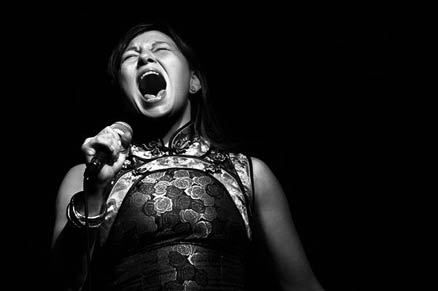
"So how was it?" asked a friend. "Orgasmic," I replied. Then I toned down my description. "Or primitive."

The truth is that Tagaq's performance reminded me of child birth. When an Inuit woman is on her hands and knees violently sucking air in with her throat and howling like a wolf, then the delivery room comes to mind. I should know, I have been there twice.

At the same time, fellows tend to lose their lunch at any reference to child birth or even the female body. But during the concert, a woman seated beside me whispered in my ear, see on nii erootiline! So my arrow did not miss its mark.

Tagaq is a solo performance artist who specializes in Inuit throat singing. She is unique in that she has married a folk tradition with a new means of expression -- throat singers typically sing in pairs, she sings alone; and with modern technology -- she was accompanied by a percussionist (Kenton Loewen) and a "DJ," that is, to say, a guy (Michael Edwards) standing in front of a laptop.

She performed two dates in Estonia over the weekend: the first at the MTÜ Eesti Pärimusmuusika Keskus in Viljandi and the second at the Kumu Art Museum in Tallinn. I chose to see her in Viljandi because it's closer and I had a feeling the audience would be a bit more down to Earth. I mean, who wants to sit next to Edgar Savisaar at a throat-singing concert?

Tagaq is small but fiery. When she began to warm up, I wondered if I could stomach an hour plus of throat singing. There were no words I could understand, except when she knelt in the spotlight like a demon and began grunting, "aitäh, aitäh, aitäh." Interestingly, her two releases have Estonian names. The first, Sinaa (2004), means "the edge" in Inuktitut, but could mean "you" in some Estonian dialect. The second, Auk (2008), means "hole" in Estonian, but "blood" in Inuktitut.

Which leads us to a big question: what the heck was Tagaq doing in Viljandi on a Friday night saying "aitäh" to people? My Estonian companions assured me it was because of Viljandi's place in the pantheon of folk music centers, but I proposed a more personal hypothesis.

Simply put, Tagaq worked with Björk on Medulla (2004). Björk worked with Michael 'Arvopoeg' Pärt, born in Tallinn, on Volta (2007). Arvo Pärt, born in Paide, is respected in all avant-garde circles and is a "friend" on the pages of many a MySpace musician. Estonia thus is one of the places where cool people who dig throat singing might hang out. Case closed.

"I'm not sure," said my friend. "I mean, I don't even like Arvo Pärt." She caught herself saying it and cupped her hand over her mouth. "I'm sorry," she blushed. "You're not allowed to say that in Estonia."

"It's not just his music," I said. "He looks awesome. He looks like a mad monk or a science fiction character. People want to come and play in the country of his birth, hoping that his essence will rub off on them."

And so our conversation drifted into the night fed by glasses of wine. But Tagaq? She was a no show at the performance center cafe. She had probably gone home to rest her throat.

reede, veebruar 20, 2009

judenfrei

The Holocaust is still an extremely sensitive topic in Eastern Europe. In Estonia, which was under Nazi Soviet occupation from June 1941 to September 1944, it is also sensitive, though perhaps less discussed than in Poland or Lithuania.

Estonia was the only country designated as "judenfrei" -- free of Jews -- at the Wannsee Conference in 1942, a terrible category to be put in, indeed, and one that continues to haunt the country in the discussion of its past.

At the same time, it is perhaps worth noting that by the time the Germans arrived in Estonia in 1941, Estonia's prewar Jewish community, which numbered around 4,500, had been reduced to around 1,000 persons, thanks to Soviet deportations, executions, and Red Army mobilization. In comparison, there were around 34,000 Jews in Lithuania and up to 420,000 in occupied Poland at the time.

So the "final solution" was carried out in Estonia even before Wannsee, indeed even before Hitler himself decided to eliminate the rest of the European Jewry. Some interesting things I learned in my class on WWII and Stalinism in the Baltic States this week about this nauseating chapter in Estonian history:

* The Germans staged the Holocaust on the Eastern Front as a mass, spontaneous pogrom carried out by locals. This is why so much photographic "evidence" exists of Baltic partisans taking part in atrocities: that's how the German propaganda masters wanted it. They did not want to take responsibility for it themselves.

* The Soviet authorities later used this photographic "evidence" of Baltic war crimes to discredit Baltic emigre leaders in the West who opposed the Soviet occupation and annexation of Estonia, Latvia, and Lithuania. In this way, they recycled Nazi propaganda for their own purposes.

* It was not the Estonian and Latvian SS Divisions that were central to Nazi war crimes in the occupied Baltic region. The German-led operation instead used local police battalions to guard the camps and, at times, carry out the mass executions. Sadly, many of the local police battalions were comprised of Estonian or Latvian Russians who were considered too much of a security threat to send to the front.

* Incentives to join a killing squad? Believe it or not, they were voluntary. Members of killing squads got better pay and considered it a dirty job that would advance their careers after the war. It was also safer than being sent to the front. Finally, most of the executioners were inebriated while doing their "work." Alcohol was consumed prior to mass executions.

* There were no gas chambers in Estonia. Mass executions were carried out by police battalions and killing squads using shooting as a means to accomplish their hideous task.

* According to German documents, the Estonians in German civil administration were not considered anti-Semitic enough. The local population did not support Nazi racial theories and it was difficult for the Nazis to enlist locals in their efforts.

* The Germans and Estonians were more culturally similar. They had seen the same Western films and knew the same popular songs. In comparison, the Soviet troops had lived under socialism already for 20 years. This is one of the reasons why German rule was seen as milder by many Estonians, and the Soviets were seen as alien.

* Most Estonian men who served in the German and Soviet armies were conscripted during a military occupation. The conscription of men from an occupied territory is considered a war crime in itself.

* After the war, Western military intelligence integrated existing German networks into their own. German military methods were also studied as the conquered army was still considered to be a well-run and efficient operation. Hence, many officers and officials connected to war crimes were never prosecuted and some continue to live on in the West without threat of prosecution.


And so concludes our history lesson. While I admit the topic is intense and, at times, quite sickening, I felt that these new nuggets of knowledge needed to be shared.

neljapäev, veebruar 19, 2009

eestlane ei karda tööd

I spent two hours yesterday in the presence of Marju Lauristin, and I am still tired from the experience. This is a human being who, even in her late 60s, is tireless and engaging.

At times, as she paced in front of the desk, her arms waving about as she explained the differences between the Popular Front and the Congress of Estonia in the late 1980s, I began to wonder if she really was an Estonian. Estonians don't move their arms around like that, do they? Estonians aren't charismatic, are they? Estonians aren't ... friendly?

It seems that some Estonian thought leaders -- be they academics, politicians, or in betweens -- have some special gravitational pull that makes you believe everything they are saying. I have noticed this with regards to people who have encountered Mart Laar. At first, they might seem skeptical, but once exposed to Laar's unique charisma, they turn into Laarbots. I am almost afraid to meet him for fear that it might happen to me too.

I asked a Laar supporter once if they thought it might be time for the current generation of Estonian leaders to pass the torch to a younger brigade, perhaps less shaped by the collapse of the USSR. "Could you imagine," I said, "that we take a time machine to the year 2030, and Laar is prime minister for the sixth time?!" The supporter smiled and said that she would be very happy with that result, as Papa Mart knows what's best for Eestimaa.

Almost all of my professors are down on the current Estonian government. There are a number of Danes who have infiltrated the halls of Tartu Ülikool along with some Germans (yes, they're baaack) and they can't figure out why the government is cutting away at the public sector, reducing their salaries to a point that even regular Estonians start to cry.

In Denmark, a significant percentage of the population of the country feeds in one way or another on the teat of the state. This is the Scandinavian welfare model: the people work for the state and, typically, vote for parties who will increase their benefits and paychecks, or at least won't reduce them. From their perspective, the public sector must be protected, as it is the backbone of civil society.

If the Danish government started making public employees cry, there would be hell to pay, I am told. In Estonia, they'll shut up and take it for the sake of liberalism. The speck of light at the end of the tunnel is a pot of shiny coins, the leaders tell the maarahvas, and in that pot the money is in the European currency. The Gods in Estonia are not teachers or nurses or trade unionists, you see; they are foreign entrepreneurs. And forget about the poor drunks living in shanties in the Estonian global south. They might not be dead yet, but they will be soon enough!

Ai, ai ai. Estonian politics. It's everywhere; in the classroom, at the bus station, even in my sister-in-law's place where Laar and Lauri Vahtre's most recent works fill the bookcase. Now, with the European parliamentary elections coming up, I even got a free Eesti Eest! newspaper in this morning's Postimees. IRL has some good candidates: Tunne Kelam (the wiseman), Marko Mihkelson (the bold loyalist), and Karoli Hindriks (the slick choice of a new generation).

I can't wait to see who the other parties put forward. Really.

teisipäev, veebruar 17, 2009

suur-pakri

The Estonian government appears to be in support of building a nuclear power plant somewhere on the territory of Eestimaa.

A decision in principle is soon expected, though a definitive parliamentary decision could be five years off, and the power plant itself is unlikely to become functional before 2025.

A representative for Eesti Energia with the unfortunate name of Andres Tropp told Helsingin Sanomat that the government is already in the fields and bays of north Estonia scouting up locations. Its favorite site is Suur-Pakri, an island near Paldiski.

Suur-Pakri is known as Stora Rå in Swedish and is one of the few locations in Estonia that is officially labeled in my Estonian road atlas in a language other than Estonian. These coastal islands were inhabited by the Estonian Swedes prior to the Second World War. During reprivatization, many of the former owners reclaimed their property, though only a handful returned to live there. I am unsure of what kind of conflict the erection of a nuclear power plant there would create with the local landowners.

More likely, the idea to place the plant close to Paldiski, which is now home to a farm of wind turbines, made sense to the government. The area could become a small power generating corridor within the country, far away from the troublesome border with Russia, where several hydroelectric plants are already located.

As for the option of connecting the Estonian grid to the future replacement for Ignalina in Lithuania, here is a demonstration of Baltic unity for you in a nutshell:

Originally the Baltic States were planning to set up a joint nuclear power station in Lithuania. Estonia and Latvia, however, grew weary after Lithuania decided to include Poland in the project the year before last. The project has advanced sluggishly.

pühapäev, veebruar 15, 2009

kristjan jaak

And so our Estonian Literature class turned its attention to the curious case of Kristjan Jaak Peterson, an Estonian born in Riga in 1801 who, by virtue of his linguistic genius and well-kept journals and homespun poetry, made a lasting contribution to Estonian national consciousness before his untimely, TB-caused death in 1822.

During his student days in Tartu, Kristjan Jaak would parade around in Estonian folk costume much to the consternation of his more conservative friends. Indeed, Kristjan Jaak was ahead of his time; a hip gentleman who would have been more at home in the Estonian national awakening of the 1860s than the tsarist winter of the Napoleonic era.

And there is something else you should know about Kristjan Jaak: he dedicated much of his work to some person or thing named 'Alo.' Alo is a male Estonian name -- a derivative of Aleksander. The fact that the flamboyant dresser and poet was pouring his heart out to some guy named Alo raised eyebrows in our class. Could Kristjan Jaak have ... been playing for the other team?!

"No, no, no!" says the Estonian Lit teacher. As tempting as it is to expand gay iconography to include any possible historical hint of same-sex affection, we have no evidence of kreeka armastus on Kristjan Jaak's part.

Besides, guys back then loved nothing more than writing letters laced with erudite homoeroticism. The correspondence of many well-known men from the 18th and 19th centuries could be used to subtitle foreign softcore pornography films these days, argue the experts. And isn't President Ilves another foreign-born Estonian who likes to parade around Eesti in folk costume? He seems pretty straightlaced. Why, I even saw him kiss Proua Evelin on TV.

All too quickly, our ultramodern mosaic of Kristjan Jaak the gay icon falls to pieces. Just as Queen Christina of Sweden had her ladies in waiting, she had her Cardinal Azzolino. Sure, David Bowie dithered with Lou Reed, but he also dallied with Iman. Human sexuality, like humans themselves, is a complex thing. I am sure Alo would agree.

reede, veebruar 13, 2009

vastuvõtt

Much has been made of Estonian customer service skills or lack thereof. My encounter with the receptionist at the polyclinic the other day could be seen as a typical one of my daily adventures.

To set the stage, I am a bit of an odd bird. I am a foreigner who is mostly functional in the Estonian language. That doesn't mean I understand every word tossed in my direction; it means that I understand about 80 percent of what people are talking about, depending on the speaker.

So I made it up the five flights of stairs to the office of my doctor to be informed that my chart, which is typically ordered to the office from a lower reception and archival area when an appointment is made, was not there. I would have to go get it myself.

I bounced down the five flights of stairs again, took my number, and waited patiently for #527 to be called. I was a bit mentally tired when they finally called my number but, fortunately, you can be aloof in Estonia and nobody cares.

"My chart, please," I said, pushing my identity card through the window.

"Why do you need you chart?" the woman behind the desk responded.

"Because I have an appointment with my doctor," I answered.

"What doctor?"

"Kõrvits."

She typed furiously at her PC with her manicured fingernails. I noticed that parts of her hair were dyed purple. She was a very fashionable receptionist, in my opinion.

"But you have no appointment with Dr. Kõrvits today," she said.

"Yes, I do," I responded. "I just came back from the office." I stuttered when I said the word for office. The receptionists eyes lit up, understanding that I was not a native Estonian speaker.

"But the computer says that you don't." She clicked a few more times with her long fingernails.

"But I just came from the doctor's office and his assistant said that I should get my chart from here."

She looked at me as if I was crazy.

"If you have an appointment, then how come it is not in the system?"

"I don't know," I answered.

"So, you don't know," the receptionist sighed. She did not like this answer. I guess I was supposed to know why I wasn't in the system.

"Look, I made the appointment yesterday," I said. "Maybe the system hasn't been updated."

After this she decided to discuss the matter with her colleague in the next booth. The two of them went back and forth as our purple-haired, well-manicured receptionist explained the conundrum: some weird guy wants his chart, but his appointment isn't in the system. Following this lengthy discussion, a solution was found. She would call Kõrvits' assistant and ask her if I had an appointment!

"Yes, yes, certainly, certainly," she said on the phone. She asked them why I wasn't in the system and received a satisfactory answer. Finally, the receptionist stood up, walked ten feet away, pulled my chart from the wall, and pushed it under the window to me. She said nothing.

"Thank you," I said, holding my chart. The receptionist quickly sucked air in and said a breezy "jah" at the same time. I then turned to bound up the five flights of stairs to see my doctor.

esmaspäev, veebruar 09, 2009

belated obit

Samuel Huntington, the highly influential thinker who authored The Clash of Civilizations and the Remaking of World Order, died on Dec. 24 on Martha's Vineyard -- of all places, not a bad place to go.

One of the first books I read about Estonia was Marju Lauristin and Peeter Vihalemm's Return to the Western World: Cultural and Political Perspectives on the Estonian Post-Communist Transition (1997).

Return to the West lays out Estonia's historical narrative for inclusion in the nordic and European community. The book heavily references Huntington's theory, and the authors are quite pleased to reprint his map with a thick border running through the middle of Lake Peipsi separating Orthodox Russia from Western Estonia. The differences are not merely about interpretations of history; these two countries sit on different civilizational tectonic plates.

Is this just smart geopolitical repositioning? Partially. Estonia's political leaders at that time passionately used such civilizational rhetoric. To President Lennart Meri, for example, Estonia was not "FSU" but "FSE" -- former Swedish empire. But even in the Soviet era, Estonia was a different kind of Soviet country. Magazine articles from the 1950s and 60s talk of a similar kind of limboland, where Soviet power was apparent but eastern civilization was not.

The genius of Huntington's work, like the best theories, was that it confirmed something we already intrinsically knew. What is interesting is how it continues to drive Western policies. At the Lennart Meri Conference in Tallinn last year, I listened late at night as an older British diplomat explained his country's support for Baltic EU and NATO inclusion. "Tallinn could be Copenhagen," he said. "Riga could be Lübeck, Vilnius could be Krakow. This is the West!"

But Kiev? Tbilisi? The Western thinkers know not what to do. The strength of their convictions atrophies in the civilizational confusion that ensues whenever big questions over the future of Ukraine and Georgia are raised. As Peter Millar wrote in the Times in August. "For [David] Cameron to equate Estonia and Ukraine, as he did last week, is stupidity. Estonia’s history, language and culture are markedly separate."

That was a civilizational argument underpinning a contemporary foreign policy. And here you can begin to see why Huntington is still controversial and his theory is not loved in certain quarters.

pühapäev, veebruar 08, 2009

palmisaarel - 5. osa

Before Vello Vedelik began to wander the Earth, he became skilled in animal husbandry, with an area of concentration in fish breeding. He is said to know how to pair the right animals to produce a new generation of fish that is better than its predecessor generation.

Vedelik believes that Epp has strong genes. In 1999, when young men would flock to Vedelik's booth to chat up his lovely assistant Epp, Vedelik would tell her to pay them no mind on account of their average genetic potential. They were not worthy of her time. Vedelik knows fish; he seems to know humans too, as the Persian episode demonstrated.

But the last night on the island, Epp asked Vello for his expert opinion on me as a breeding specimen. Since we have two children, it's after the fact but, still, when you are in the presence of an expert who can identify a person's ancestral lineage by eye, you take advantage of your opportunities.

Vedelik pointed out that the fact that our two daughters are lighter than I am confirms his original assessment of Epp's strong genetic make-up. However, because they are incredibly cute and talented -- Anna, aged 1.5, has started saying "Hola" -- it indicates that I am no slouch myself.

"He seems intelligent and well balanced," Vedelik affirms. "He is definitely above average." I feel embarrassed and at the same time proud. There is nothing like having your genetic constitution judged by a fish breeder.

Vedelik also knows that we have been writing about him on the Internet. He does not use the Internet, but one of his accomplices has sent him telepathic messages about it. "You have been writing about me and you haven't even asked my permission," he accosted us.

"It's ok," Epp said, soothing him. 'I was just trying to find my bag, and Giustino? Well, he calls you 'Vedelik.'" "Vedelik?!" he smiles, approving of the strange moniker. "Well, you can write what you want about my theories," he said, "but, whatever you do, don't give away my trade secrets." He is afraid that other Estonians will copy him and try to capitalize on his ideas.

We left Vedelik at the bus station. We all waved to him from the bus windows as it pulled away into the night. He shook my hand, looked me in the eye, and said, väga meeldiv. He even smiled. I began to suspect that he might like me as a person. I saw him once more from the bus window, standing below a lamp on a street corner. A small halo hovered above his gray hair. Then he was gone.

Poor Manuel meantime had tried to link up with us on the last day, but, in true Spaniard style, did not call before hand. While we were on our bus, he and his old pal Gallo stopped by to see "Epah" one last time. He left us a present instead at the front desk. I thought it could be the bag, but it was the idola de tara -- a statue of the Canarian God who shares her name with Estonia's Taara.

At 4 am, we huddled to board our buses. The Finns were on their flight back to Vaasa. Marta hugged Jennifer, and I wished them hyvää matkaa, to which they replied jo and nii and kiitos -- all three of their favorite words. I loaded our overstuffed bag, now filled with t-shirts and bags of gofio and a little idola de tara, and helped my family on board. Our bus then slowly stole away into the early morning. Our vacation was over.

neljapäev, veebruar 05, 2009

palmisaarel - 4. osa

Nude beaches and regular beaches in Gran Canaria are ruled by their own, unspoken codes of conduct.

In the Zona Nudista, nakedness is normal. You are surprised to learn that all of those masses of similarly clothed people you pass on the street day after day also look homogenous without their bathing suits on, give or take stages of sun tan, extra pounds, and gray hairs.

When a clothed person walks by, they look hilarious in their baggy shorts, polo shirts, and caps. They also seem foreign and a bit rude. "Where is your nakedness?" The nude sun bathers glare. "What are you doing on our beach?!"

On the regular beach, it is the opposite. The sight of a topless sunbather draws similar stares. Couples look at each other, wondering whether or not the woman in question knows she has strayed from the Zona Nudista. No male dare remove his trunks on the regular beach, lest he be hauled away by the police for scaring little children. Here, it is the nudists who are unwelcome and suspicious.

The most interesting place is where the two beaches meet, the brackish water between the salty clothed bathers and the fresh-water nudists. Here the two tribes mix freely, quietly acknowledging that their borders are porous. In this No Man’s Land, bathers of both stripes tolerate the others’ differences.

I lay here in the golden dune sands oppressed by visions of the past. They swoop down on me like vultures, plucking at me. What are these sandstorms of feelings that harass me? Do they have names? Alienation? Vulnerability? I ask Epp, and she says that it's normal to feel vulnerable when thinking about one's past.

Our trip to recollect Epp’s bag from 1999 has dredged up the memories of a past that, on its face, seems more freewheeling and carefree. At the same time, some kind of melancholia lurks behind the nostalgic glow of not so distant history. It has been 10 years since Epp left the island. There are reasons for these things.

Part of the reason for this onset of Canarian blues is that Epp is such a good story teller. The characters – their names, faces, and situations -- come alive. People I have never met and will likely never meet become characters with whom it is easy to empathize. I can see the different sets and watch the actors block their scenes. The zestful yet absent minded young traveler. The sea captain turned supermercado padrone. The Estonian prophet. Many others. Why, it’s as if I am there, except I was not, nor am I.

Who are these people? What are their stories? If only we had Epp's journal, I could tell you more clearly. She tells me she can't recall one line of it. Such is the conundrum of our lost youth. If only Henry Miller were here to fill the rest in.

Last night, Vedelik indulged us one last time in his theories of the connection between the Estonian and Canarian peoples. “The Estonians worship Taara,“ he pointed out, “while the Guanche Canarian idol was called Tara.” Vedelik believes that Estonia is a juhtriik, like ancient Greece or Rome that all countries will eventually follow. “It would be better for Russia,” he argues, “if they readopt their lost Finno-Ugric languages and reconnect with their kin peoples in Suomi and Eesti.

"Forget about Ukraine," advises Vedelik. Once these latent Finno-Ugrics reconnect with their past, the cultural confusion that has driven their country through the preceeding neverending chaos will cease. At that moment, all will be one. Om.

On Gran Canaria, the promenades are home to slick marketers trying to sell naive tourists time shares. "Just come to our beach," they smile. "It's the best beach on the island." They always start hitting on you by asking where you come from. The time share sellers in Maspalomas are quite talented in this regard: I have heard them switch freely from Spanish to English to ... Swedish.

They asked us where we lived. "Estonia?" the Spanish time seller announced from behind his cool dark shades. He then began speaking to us in Russian. "Nyet!" I protested. "But didn't you learn it as a little boy in school?" he said. "Nyet!" I said again. Finally, Epp decided to tell them that we already had a place on the island.

Yesterday, we took a glass-bottomed boat from Mogan to Puerto Rico. No, it was not a nude, glass bottomed boat. I was waiting for Jaws to rear its great white head in the underwater window, but we only saw a few small schools of hungry fish. Over head, a plane flew by advertising a Boney M concert on the island.

Boney M’s disco-pop career peaked in the late 1970s, probably around the time that most of Gran Canaria’s middle-aged tourists were enjoying the swinging, single life. In our hotel restaurant, they indulged us in Boney M’s greatest hits, including “Rasputin.”

'There lived a certain man in Russia long ago
He was big and strong, in his eyes a flaming glow
Most people looked at him with terror and with fear
But to Moscow chicks he was such a lovely dear'


One of the only things I really look forward to, as we headed back from this sandy paradise to Eesti Vabariik, where the temperature is -5 C today, is that I will get these Boney M songs out of my head.

teisipäev, veebruar 03, 2009

palmisaarel - 3. osa

My high school girlfriend's father was a man of the 1970s. This meant that he could stroll around town wearing platform shoes without fear of having his masculinity questioned. It also meant that he imbibed various substances during many long, lost weekends.

One of his maxims was "when it doubt, it is best to puke." I thought about this as I circled our WC and regurgitated the several bowls full of gofio and lechera I had consumed only hours before.

The cause of this sudden illness? Perhaps the gray weather that set in on Sunday, or, even more compelling, our family's visit to the Faro Maspalomas shopping center where we were treated to the overcommercialized underbelly of Gran Canaria tourist civilization. If you are in Spain and they are advertising bratwurst mit sempf, you may find yourself stricken with nausea.

All Sunday night I floated on a sea of post-vomitory relief as my aching stomach soothed itself. My children have also been afflicted. We actually think it's the local water, consumed accidentally while brushing teeth, that is the culprit. Why is it that wherever Spanish is spoken the local water gives outsiders the shits?

Monday was better. The glowing orb of the sun returned, prompting expeditions to Arguineguin and Puerto Rico. In Arguineguin, a salty port dominated by a mix of locals and Norwegian pensioners, the captain Manuel returned to talk with Epp. I let them reminisce by themselves as I scarfed down my first post-gofio meal, spaghetti aglio e oglio. According to Manuel, he really gave the bag and its prized journal to Vello, who is refered to by Spaniards as "Vejo". Epp returned with a look of confusion on her face: who to believe, the Canarian sea captain or the Estonian prophet?

We walked the promenade and bathed in the salty, clear ocean waters. Here too, I was surrounded by the occassionaly nude bather and bratwurst peddler, but I retained my constitution. I began to secretly hope that my illness had passed.

Later, we returned to Rico to find Vello. Again, I let Epp conduct her interrogations without me near. Vello insists that Manuel offered the bag to him, but he said no, and that Manuel threw it away. Epp is even more confused. I began to wish that the bag had a secret tracking devices sewn into its seams. Who knows where it is? Lost in Vello's secret Puerto Rico stash? Buried in Manuel's basement? Degrading in the local dump?

After market hours, we sat with Vedelik as he expounded on possible solutions for the crisis in the Middle East. Vedelik is a strong supporter of Israel and is irritated about how Hamas fighters fire rockets into Israel and then take refuge among the civilian population of Gaza. I asked him for his opinion of Prime Minister Andrus Ansip, but he said he had none. "Ma ei tea mitte midagi eestist!" he said, pushing the thoughts away. "Mitte midagi!"

Vedelik then launched into his theories about how the ancient Estonians were kin to the Etruscans and local Guanche people who settled the Canary Islands. He supposedly is able to tell the tribal origin of a person merely by looking at their face. "But what about him?" said Epp, gesturing at me. "What does he look like?" Vedelik paused to think. "This is a hard one," he said, studying me. Finally, it came to him. "Jah, jah, nüüd ma tean!" Vedelik exclaimed. "Tema on pärslane!"

"Pärslane?" I said to Epp. I had never heard the term. "He said you look Persian," she said. "I do?" I said, trying to imagine Mahmoud Ahmadinejad as a relative. "Well, he has been to Iran," shrugged Epp. "So maybe he knows what he's talking about."

pühapäev, veebruar 01, 2009

palmisaarel - 2. osa

I had never before intended to see the bare breasts of a 70-year-old Swedish woman, but on the beaches of Gran Canaria, such occasions are inevitable.

The atmosphere here is eclectic, to say the least. Frightening cliffside roads stretch down into hotel-marred coves and tourist-thronged playas. We ate churros with our coffee in the coastal town of Puerto Rico and contemplated our search for Epp's distant past.

We were in Puerto Rico to find Vello Vedelik. Epp described him as an old hippie who never cut his hair or beard, and after strolling past a few kiosks, I saw an old man in Indonesian attire seated in a chair. Epp walked up to him, peaked under his broad hat, and in a few minutes I had come face to face with the man with no phone and no e-mail address.

"Kott? Kott? Mis kott?" he said, when asked of the missing bag. Vello spoke in clean, crisp Estonian. This was not a man from Mulgimaa. I watched Vello's body language for evidence of lying, but could find none. According to Vello, Manuel the hotel owner did indeed offer him the bag, but Vello said no, and Manuel threw it all away. It seemed unbelievable, but Epp looked Vello in the eye and said, ma usun sind -- I believe you.

Then somehow Vello went off on a diatribe about how Russians are not really Slavs but are Finno-Ugric peoples who have adopted a Slavic language and about how the economic crisis is bringing the world to the edge of catastrophe and how one of the few safe places in Estonia is Suure-Jaani and how he came up with all the ideas for Star Wars. And I believed him, because he is very believable.

Well, good old Manuel decided to face the music and came down into Puerto Rico to acknowledge that, yes, after waiting for Epp to return for seven years the bag went in the trash when he renovated his supermarket. Epp forgave him, and he said he would drive us home. He then loaded us into his jeep and we made for the Canarian hills. Manuel used to be a captain of a ship and lived in Gambia for awhile. He's a native Canario, and he owns multiple properties and seems to have many relatives on the island.

The interior of Gran Canaria resembles the American Southwest, at least to me, a person who has never visited the American Southwest. Ranches overlook huge canyons; dogs chase each other on the floors of endless, treeless ravines. The natives dislike visiting the touristed parts of the island, and, if Manuel is exemplary, they have no time to do so, because they are always driving around, visiting their friends, visiting their cousin, stopping the car in the middle of a road to chat with a friend in another car. Such is Spanish life.

For example, Manuel took us to visit the ranch of a friend he called "Gordo" -- fatso. Gordo also is known to Manuel as "maricón." Gordo acts as a local sherrif and drinks too much whiskey. He grows pigeons that he sells to local Cuban migrant workers for use in shamanistic sacrifices. My children were very impressed with the animals. Anna said "owf owf" many times in response to the tough looking guard dog. Gordo was sober, and I still don't know his real name, even though we shook hands. He said that beer is for poor people; whiskey is the only real drink.

We may see both Vello and Manuel before we leave. Vello has no new fangled communication devices (he says he uses telepathy to communicate), but he said that he can be found in that one spot, always in that one spot, until April when he heads east. Though Epp has lost her journal for good, life is at least repaying her with new tales to tell.

reede, jaanuar 30, 2009

palmisaarel

Marta, our daughter, was watching Pippi Longstocking one day and pleaded with us to go to Africa, like Pippi and her friends Tommi and Annika.

Epp picked up on this riff and located a relatively inexpensive package to Gran Canaria which, being off the coast of Morocco and West Sahara, can easily pass as "Africa" for 5-year-old dreamers.

But the real rationale behind our expedition to Gran Canaria was to retrace the steps of my spouse a decade prior. Back in 1999, a younger, more idealistic Epp worked in a local market here with fellow Estonian hippies selling trinkets and sleeping in the mountains. Epp also kept a journal: a journal she left behind in a bag at her friend Manuel's hotel.

I had no idea what to expect of these Canary Islands. I had read next to nothing about them, and I have only picked at the Estonian and English language guidebooks that have been among our possessions for the past few days. Our plane was filled with Estonians, but the flight attendants spoke Spanish and Russian.

Maspalomas, where we are staying, is brimming with pasty northern Europeans, who like bratwurst vendors and Irish pubs so much they brought them along on the plane. The local Supermercado peddles in Finnish Koskenkorva vodka but is fresh out of the local Canarian gofio bread because foreigners "have no idea what gofio is," according to the sales clerk. As I walked home from the Supermercado, I was serenaded by a Peruvian pan flute version of the Moody Blues' "Nights in White Satin."

Marta, meanwhile, has befriended a half-Finnish, half-Russian girl named Jennifer to whom she speaks in English. I managed to say "Terve", "Privet", and "Hello" to Jennifer and tried to figure out how to convert Estonian words to Finnish ones. Would "vanha äiti" pass as "vanaema"? Apparently not.

Manuel's hotel was in Arguineguin, a smaller, less touristy place than Maspalomas. Maspalomas is an urban jungle of hotels packed with foreigners; Arguineguin is a sleepy Atlantic Spanish town. Epp found her way from the bus stop to the supermercado where she used to hang out and recognized the clerk, Rene, who was still working there. Rene at first did not recognize the woman standing before him, but then realized that the carefree "Epah" of 1999 had returned with her husband and two daughters ten years later.

The hotel, however, was no longer there, and neither was the bag. It turned out that one day a year or two ago, one of the other Estonian hippies stopped by this very supermercado and chatted with Manuel, who mentioned that "Epah" hadn't picked up her bag. The Estonian hippie agreed to take it off his hands, and so now we are trying to track down a mysterious guru named Vello Vedelik who is somewhere on this island together with a horde of trinkets and beads and Epp's travel journal from 1999.

Of course his name is Vello. If you want to make your child a recluse, then by merely blessing him with this name you will have done the trick. If you want your child to be a president, then something formal like Lennart Georg or Toomas Hendrik will do. If you fancy an entertainer, then Marko or Lenna will suffice. But if it is the kind of human being that cannot be contacted by phone or e-mail in 2009, then chances are it's a Vello you are after. And so we are.

Tomorrow we will go to the Maspalomas weekend market to see if Vello Vedelik shows up in his Jesus Christ Superstar-inspired attire to sell to the crowds of Swedes and Brits and Deutschlanders. Then we will see if he's got the lost journal stashed somewhere in his mountain getaway. Our adventure has only just begun.

esmaspäev, jaanuar 26, 2009

haarde day's night

In the Icelandic capital of Reykjavik this week a government fell. Last week, Prime Minister Geir Haarde gave up Commerce Minister Bjorgvin Sigurdsson to satiate the blood lust of the Christmas-tree burning masses. Now Haarde has handed in his own resignation.

The forecast? Possible leadership under a 10-year-old party called the "Social Democratic Alliance" together with its icky-sounding partners, the "Left-Green Movement" (not to be confused with the party "Icelandic Movement - Living Land" [splitters!]). Elections in May (they had been scheduled for 2011) to follow.

While Estland is not Iceland, the political squabbling that undermined its government is similar. In Iceland, you had a 'grand coalition' of liberals and social democrats. In Estland, the coalition includes the Social Democrats, who are willing yet ideologically dissimilar partners for a center-right government. Such coalitions are typically formed for political expediency, though ideology is known to rear its head.

As Haarde's liberal Independence Party heads into opposition, questions arise as to how a center-left government in a small, northern European country that is grappling with an economic crisis will rule. As I have written about previously, we still do not know what this coming renaissance of social democracy may bring. The labor movements of the 1930s have long faded from public memory, and the halcyon 1960s were experienced by today's political leaders only as children. There has been no reformulation of social democratic policies. The red symbols of these parties are cute, yet anachronistic.

In Estonia, the position of the center-left parties, including SDE and the Center Party, is more dubious. In the nordic countries, even outliers like Iceland, social democrats have some electoral track record. In Estonia, SDE is in the government and shows no interest in working with the leadership of KERA, while KERA is in opposition and is hoping to woo SDE. What haunts both parties is that there hasn't been a popularly elected left-wing government in Estonia since 1929! Should Estonia undergo a similar political shift, we will be heading into uncharted waters. In the meantime, we can watch Iceland for clues.

reede, jaanuar 23, 2009

christmas trees on fire

Politics is a dirty business. Politicians are perhaps attracted to it both by their patriotic idealism and earnest hope to serve their communities as well as the lifestyle of catered lunches, expensive rides, and ability to expedite favorable real estate deals.

In Estonia, Minister of Social Affairs Maret Maripuu has announced her decision to resign. She is the first minister of Ansip's 2007 government to leave office under pressure.

A pretty basic DPA Article* about the resignation highlights some of Estonia's identity issues towards the end of this Age of Globalization. "It is absolutely unfitting that in a country seeking world renown as an e-state, attempts have been made to block the transition to the payment of pensions via bank accounts, which is absolutely the norm in the Nordic countries," Maripuu is quoted as saying.

The same article goes on to discuss "Eurobarometer survey showing Estonians trust their government much more than is the case in the other Baltic states of Latvia and Lithuania, despite the social security payments mess and an economy that has been in recession for months. At 48 per cent, the Estonian government's trust rating remains well above the EU average of 34 per cent and three times higher than Latvia and Lithuania's figures."

Despite these differences, most international English-language news coverage of the recent riots in Latvia and Lithuania has shocked me by the lack of basic knowledge about Estonia. There is a general meme descending in the pages of usually reliable media that the economic crisis is going to undermine political stability in basically any formerly communist country you can name drop in an article.

Bulgaria? Hungary? Estonia? Romania? Stankonia? -- They're all the same boat, whoever they are. Except old Europeans Iceland and Greece have also been rocked by protests and pepper spray too. Icelanders even burned a Christmas tree this week as they attempted to storm their parliament building. Could it be the end of times?

While Iceland becomes the next Latvia, Estonia is still grasping for its inner nord to find its way through the hard times. Experts like Andres Kasekamp and Marko Mihkelson inform us that Estonians are much more practical and restrained; not given to bouts of domestic unrest. Let's hope that Estonia's committment to the ideals of the Swedish absolutists and their Finnic abhorence of standing in close proximity to other individuals will keep them off the slopes of Toompea for the time being.

*An earlier version of this post erroneously attributed the article to Reuters.

reede, jaanuar 16, 2009

knives out

If 2007 was the year of the unruly Tallinn adolescent, and 2008 was the year of the suddenly unemployed construction worker, 2009 may very well prove to be the year of the disgruntled pensioner in Estonia.

As previously mentioned, this is a year of two elections: the elections for European Parliament in June, followed by municipal elections in October.

Soon after the new year had been celebrated with caution from the Estonian President, Estonia's political parties were jockeying to draw first blood.

The scandal of the month belongs to the activities of Minister of Social Affairs Maret Maripuu from the Reform Party who has been criticized for her inability to fix an IT glitch that deprived state support to pensioners for months.

The Center Party is leading an effort to force Maripuu to step down, while the Social Democrats, who have also criticized Maripuu's performance in the past but are part of the ruling government, have taken a 'wait and see' approach. Prime Minister Andrus Ansip has defended Maripuu, but said it will take some time to sort out the ministry. Perhaps he thinks that Maripuu's departure would be a trial run for his own.

This of course takes us back to the March 2007 parliamentary elections, in which Ansip's Reform Party scored a very narrow victory over Edgar Savisaar's Center Party. Reform won 31 seats in the 101-member body, while Center took 29 seats. The conservatives, IRL, won 19 seats, SDE took 10, and the Greens and agrarian People's Union took 6 seats apiece.

Reform had been in the ruling government with the Center Party since April 2005, when Ansip took over as PM. After the '07 elections it was believed among the Keskerakondlased that Ansip would flirt with the more ideologically similar IRL party, with whom it has always had a fractious relationship, but ultimately choose to partner with Kesk because it already was in the government and it would be easier to manage a two party "grand coalition" than a menage a trois of conservatives, liberals, and social democrats.

When Ansip deprived IRL leader Mart Laar of the coveted foreign ministry, the Keskid assumed that this would end the negotiations with Reform and that Ansip would come runnin' back to his old pal Savisaar. That didn't happen. Instead, Urmas Paet kept his post as FM, and Laar instead took no position in the government, deciding to play the role of party elder instead. The Center Party suddenly found itself in opposition -- and they were actually favored to win the '07 election.

Ever since that moment, the Keskid have been laying the ground for their return in the '09 election season. With most analysts predicting that economic growth will return to Estonia sometime in early 2010, the time would be ripe to seize power by September in order to take credit for the expected uptick in '10, riding that to electoral success in the 2011 parliamentary elections.

What is Keskerakond's strategy? Lay the economic crisis at the feet of IRL and Reform. It's their die-hard idelogical subservience to liberalism that has gotten Estonia in this predicament, and only Edgar Savisaar with his common sense and empathy for the common man can steer Estonia out this crisis.

Savisaar's opening salvo was a high-tech Christmas card where one could pick their name from a list and watch a paternal, pre-recorded Savisaar standing beside a bonfire in the forest say something like, "Saamuel, be a good person and take some hay to the animals, and remember to give Christmas presents to the children this year."

That was Savisaar showing his solidarity for the common man. Now comes the attack on Reform and IRL to paint them as out-of-touch liberal elitists (with an entirely different meaning from the 'limosine liberals' of American political discourse) who are too busy giving the people bread and circus of the erection and removal of monuments than to even pay the poor pensioners (most of whom live within a cat's whisker of abject poverty) on time.

In Tallinn, nearly every bus stop shows a large green poster blaming Reform and IRL for the souring of the Estonian economy. There is also a website advertised for those increasing numbers of discontented voters, www.protest2009.eu.

Politically, it is interesting that Kesk has decided not to blame SDE. Perhaps they harbor fantasies of forming a ruling center-left coalition with Finance Minister Ivari Padar's party. The only problem is that SDE has said that they would not be willing to partner with Kesk if Savisaar is the PM. And even if Kesk, SDE, the Greens, and the People's Union pool their votes, they'd still only have 51 seats in the Riigikogu -- not exactly the 60 seat majority that the current coalition has.

I can only guess is that Center intends to play hard and drive Reform's poll numbers into the gutter, delegitimizing Ansip's '07 win. It's already working. 35 percent of those interviewed in a December poll favored Center, compared to 29 percent for the ruling Reform party.

Those who ridicule the Center Party as the party of the marginalized Russophones might have a hard time explaining those numbers. Non-ethnic Estonians make up only 30 percent of the population in total, and a third of them hold foreign passports. No, there are plenty of Estonians who support Härra Savisaar's party -- among them the disgruntled pensioners who are increasingly featured on the covers of local newspapers, but also ... prepare to be shocked ... the local business community.

In the past, the business community -- a good deal of it controlled by Swedish or Finnish capital -- approved of Estonia's devotion to liberal economic policies. Having grown up under the thumb of nordic social democracy, these entrepreneurs welcomed Estonia into the fold and lobbied for its EU membership -- perhaps hoping to export Estonia's policies back into Finland or Sweden one day. These days, though, you can see them lining up behind former PM and businessman Tiit Vähi, whose critiques of the Ansip government are regularly published in the Swedish-owned business daily Äripäev.

And so it could be that an odd coalition of disgruntled pensioners and angry businessmen may eventually bring about a change of administration in Stenbock House in 2009. I am not sure how to prepare myself for a possible Savisaar administration, but I am starting to think I should brush up on my knowledge of life of another wily patrician from the center: Urho Kekkonen.

laupäev, jaanuar 10, 2009

mods, rockers, hippies, and ... skinheads?

I recently received a letter from the University of Tartu alerting me that the Regional Security Officer at the American Embassy in Tallinn would be in town to discuss an "event" that occurred involving an American student; an American student of African heritage.

Of course I didn't go and meet the officer. I had wood to load into the ahi and ice to remove from my windshield. I had a bad feeling though that another student of non-European descent had fallen prey to the skinheads of Tartu.

I have heard several second-hand stories of black or Asian students accosted late at night by purposefully bald-headed gentlemen who feel it is their personal duty to ward off such undesirable persons from their City of Good Thoughts. Usually, nobody gets hurt. The message, though, is clear. You may recall how the efforts of the purposefully bald allegedly caused the Dutch ambassador and his Cubano* male partner to leave Tallinn three years ago.

What to do? In these situations I pity law enforcement. You can't really arrest people for being purposefully bald or listening to message-driven heavy metal music or having tattoos. If you choose to decorate your living room with swastikas, that's your prerogative. The politsei have real business to attend to, like stopping crazy drivers on the Tartu-Tallinn road.

And besides, how do you know the purposefully bald gentleman in question might be a threat to society? He could just be a Hare Krishna. And if you try to track down a perpetrator, who has perhaps fled to the secret lair of the bald, how could you identify him? "What color eyes did he have?" "Blue." "What color hair?" "Skin."

But then students from outside Estonia come to visit the land of free wireless and online voting and they get harassed by some genuinely scary dudes. I once was held up for cash by a very intimidating purposefully bald man dressed in leather in Tallinn. He explained to me in Estonian, then Russian, then Finnish, and finally English (I was too amazed by the tattoo on his face to respond) that I should loan him some money. I obliged him; he seemed threatening, even though our ancestors both come from Europe.

Another time a pack of prematurely bald young men passed me on the street, one gave me the evil eye, to which I answered back a boisterous "tere päevast!" I secretly ponder what is the position of the baldheaded on persons of Mediterranean background. Did we spend too much time in the kiln of the creator or were we baked just right? In any case, we are probably low on the list: I mean, who has time for pestering paesans when there might be an unsuspecting Indian student on the next block?

I really have no idea what the solution is here, and I am not sure the Regional Security Officer at the American Embassy would know either. Without a crime, even a hate crime, there is no criminal. And even if you haul the perpetrator before the court, it's only one person, not an entire way of thought, that is on trial. As a resident of this city, I genuinely empathize for those people who are darker than blue. At the same time, I feel powerless when it comes to finding solutions.

esmaspäev, jaanuar 05, 2009

if the glove does not fit

I promised that I would not post on the trial of the four Bronze Soldier "defenders" until there was a verdict in the case, and today there was a verdict: not guilty.

The four -- Dmitri Klenski, Mark Sirõk, Maksim Reva, and Dmitri Linter -- had been charged with conspiring to foment the two nights of unrest in Tallinn in April 2007 in response to the removal of that statue to a military cemetery.

While some Estonians may have authoritarian impulses, the truth is that this country is as permissive as its nordic neighbors, and the BS riots were no exception.

The government didn't rip the statue out of the ground and dump it in the Narva river in indignation at the execution of almost all their predecessors by the Soviet state in the 1940s. No, they invited Lutheran and Orthodox clergymen to purify the ground and did DNA testing on the soldiers' remains to return them to their families.

The stone platform for Mr. Bronze was carefully assembled brick by brick in his new home at the military cemetery, only lacking the hammer and sickle halo that adorned the monument at Tõnismägi. "Careful with those bricks," Minister of Defense Jaak Aaviksoo perhaps muttered to his subordinates during the removal. "We want to make Härra Pronks' new surroundings as comfortable as possible."

The violence and alcohol-fueled looting that followed the removal has inspired many fingers to be pointed in a variety of directions. Some blamed the stubborn Prime Minister Andrus Ansip and his eager helpers Rein Lang and Jüri Pihl for stirring Tallinn's beastly youth to burn flags and steal Sprite.

Others blamed the nauseating 24-hour coverage by state-owned Russian TV news programs for creating an intense atmosphere of unease where any hiccup or sneeze near the monument was repackaged into propaganda and broadcast to the hungry masses.

I personally blamed demographics. The more Estonian Tallinn gets (55 percent of Tallinn residents identify as Estonian today), the less the city's residents wanted to deal with a May 9 celebration in the town center for eternity. They didn't necessarily want to remove the statue, but they also didn't necessarily care if it was gone either.

The state prosecutor's office, though, blamed Sirõk, Linter, Klenski, and Reva for organizing what was an extremely unorganized event. They had to put someone on trial, didn't they? They couldn't put themselves, ITAR-TASS, or the Estonian Statistical Office on trial. The four activists' path to the court room was clear.

If anything, they could have tried them for poor decision making or lack of organizational skills. But, in the end, the effort to tie recorded phone conversations and e-mails with urban anarchy didn't wash with the judge. In some ways, I am pleased that Estonia has demonstrated that it has a functional judicial system, where a citizen put on trial, even one as disliked as Klenski, can walk out of the court room with a big, clown-like smile on his face.

I am also pleased that this event/circumstance/situation, barring any appeals, has run its course. Sirõk can go back to school; Klenski can go back on ETV to crow in his overdone Estonian; and Linter and Reva can go back to doing whatever it is they did before. Your 15 minutes are up for now fellas, but don't worry, if Deep Purple can still get gigs in Tallinn, so can you!

laupäev, jaanuar 03, 2009

an encounter with the godfather

Wintertime is the time to be in Lõuna Eesti. Tallinn may have the medieval flavor, kitschy bars, and money-leaking tourists, but Tartu and environs have the winter sports, attractive Olympic gold-winning athletes, and somewhat less-attractive wannabe athletes as well.

Tartu also has the ice and snow, and the strange appearance of the sun during the past few days has meant that young fathers like myself who wish to spend quality time with their daughters have ventured forth, sled in hand, child in tow, to the Tartu Spordipark for some rigorous kelgutamine -- sledding.

All would be well, except yesterday my naine and lapsed had an encounter with Priit Pullerits, the godfather of Estonian journalism, a Postimees editor and columnist who provides his fellow maarahvas with crucial insights into winter sports and integration.

Pullerits, as you may recall, in 2007 raised the important question of why gay rights groups choose to parade down main thoroughfares, rather than gather beside lakes. But yesterday, he had something else on his mind: why were all these abominable tykes on sleds crowding up his cross-country skiing trails!

You see, the Tartu Maraton is just weeks away, and the Tartu Spordipark is the ideal place to train for the marathon, a 63-kilometer test of endurance. Kiddies on sleds may be useful inspiration for those journalists who wish to encourage Estonian population growth or stress the importance of exercise for today's Internet-loving slothful youth, but when the Estonian godfather of journalism straps on his suusad [skis], he means business and y'all better get the hell out of the way.

Fortunately, I wasn't there to witness Pullerits scold the children for interrupting his marathon training, but I did quiz our friend Mart, who was present for the scolding, about it. "So did you fight him?" I asked Mart, a calm man of Seto extraction who teaches nature restoration. "I beg your pardon?" he replied politely. "Did you fight Pullerits when he told you your kids couldn't sled on the course?" I asked again. Mart smiled to himself and responded in the negative.

Today we went back to Tartu Spordipark and were pleased to see that no one had heeded Pullerits' advice to stay completely clear of the cross-country skiing tracks. On the other hand, there were now so many skiiers that the kids and their sleds had migrated to a lone hill unfrequented by would-be Marathon participants. Besides, what responsible parent would let their kid sled in front of a Marathon man like Pullerits anyway? That would be a recipe for disaster.

And though the problem appeared to have been solved -- kids and sleds get their one hill, Pullerits and other ski-heads get the rest of the park -- someone had posted a large red and black sign at the entrance to the Spordipark that proclaimed that sledding on trails designated for skiers was strictly forbidden. "Ah," our friend Helen pointed out when she saw the sign. "I can see that our friend Pullerits has been here."

teisipäev, detsember 23, 2008

here's €1.7 billion, next time be more careful

Just two days shy of Christmas, jõuluvana, also known as the International Monetary Fund, decided to present Estonia's southern neighbor Latvia with a gift worth €1.7 billion.

The aid is part of a broader €7.5 billion package for the lätlased, which includes financing from the EU, all the nordic countries except Iceland, the Czech Republic, Poland, and the World Bank.

Despite horrible Eurovision entry after horrible Eurovision entry, jõuluvana has taken pity on poor Latvia, and the country will continue to peg its currency to the Euro. In explanation of its gift, the IMF attributed Latvia's problems to "years of unsustainably high growth and large current account deficits" that have "coalesced into a financial and balance-of-payments crisis."

Hmm. That sounds vaguely like the scribblings of that open-faced sandwich-loving analyst from Danske Bank, Lars Christensen. Poor Lars. So many people said he was wrong, but he was actually right, though the ability to forecast economic upheaval is hardly a skill that wins one friends.

In Estonia though, unlike in Latvia, there is moderate faith in the government. The Ansip malaise has morphed into the Ansip apathy. It is not that the people are apathetic about what is going on around them. I think instead they are resigned to the leadership that fate has dealt them. If not the stubborn liberal Ansip, the ardent patriot Laar, and the pig-farming social democrat Padar, then who? Savisaar?

The Mayor of Tallinn himself has been active as of late. He even sent me a Christmas card. It is hard to make sense of Härra Savisaar. Once in awhile he says something relatively cognizant, but most of the time, I have no idea what he is talking about. From my foreign perspective, he appears to be desperately throwing ideas at the wall, hoping one will stick. But Savisaar was last prime minister in 1992, and he wasn't even elected to that position. He's about as shiny and new as Color Me Badd.

President Ilves meanwhile has cautioned against the rise of economic populism while reassuring us that Estonia has seen worse in its history. Next year will see two elections in Estonia, with European parliamentary elections in June and municipal elections in October. If anyone were to play power politics in Estonia, some time before either of those elections would suffice. True, true, and indeed.

And so we sit eating sauerkraut and gingerbread, patiently awaiting what 2009 will bring us, a year for which nobody, including Lars Christensen, has forecast good news. For the rest of 2008, I am looking forward to more tasty küüslaugujuust and the final episode of the historical drama Tuulepealne Maa. How about you?