kolmapäev, mai 21, 2008

kolmas arnold

On Voice of America he's an "ex-officer." On Russia Today he's a "war hero." And on the BBC, he's a "Soviet war figure."

The trial of Arnold Meri, an 88-year-old cousin of former President Lennart Meri, began in Kärdla yesterday. The state prosecutors office is charging him with genocide for aiding in the deportation of 251 hiidlased to Siberia in 1949, 43 of whom died either en route or in Soviet concentration camps.

Despite helping to deport women and children, Meri is somewhat hilariously the head of the "Estonian Anti-Fascist Committee." He claims the case is political, I would agree it is. Meri did not organize the deportations. He collaborated in them, which I will leave it up to you to determine his guilt or innocence. The term 'genocide' itself is a hot potato. But if they don't try Kolmas Arnold (former president Rüütel being esimene, boy genius Oksmaa being teine) then the youth of Estonia might get the impression that you can help send your neighbors to their doom and get away with it. And nobody wants that.

This case is a new field day for the Russian media, which declined to cover the successful Teeme Ära campaign with the same ferocity in which it inspects old war memorials for scratches or graffiti. But that's just the Russian-Estonian relationship these days, isn't it? There is only the past to talk about. Only the past, because the two countries are on entirely different trajectories. The Estonians want to be small, tough, efficient, and fabulously wealthy. The Russians lust after status.

Perhaps it is good that the Icelandic foreign minister is in town. The Estonians will have some one with whom they can commiserate about economic crises and talk EU politics. Some are hinting that the next round of enlargement may be northward, rather than to the east. Maybe Estonia and Iceland can adopt the euro at the same time, after being bailed out by the Scandinavian banks, of course.

esmaspäev, mai 19, 2008

the road ahead

There's a funny sort of consensus being reached among Estonians these days, and that is that when it comes to the termination of the current ruling coalition, the question is not if, but when, and perhaps also, how.

It's hard to put ones figure on when this malaise set in. It could have been lurking even prior to parliamentary elections in March 2007. The removal of the Bronze Soldier and the ensuing rioting {and gray sanctions and cyber warfare} brought about some sort of solidarity with the government. But now, a year plus later, that solidarity is starting to wear off, and the widely advertised fact that the Estonian economy grew by 0.4 percent in the first quarter has people spooked.

Prime Minister Andrus Ansip's liberal Reform Party still enjoys the most support of the public. But at the same time the coalition of conservatives and social democrats is looking more pre-election than post. Finance Minister Ivari Padar (SDE) is staking out next year's anticipated budget shortfall as an issue where the sotsid can look like the pragmatists. Meantime, Mart Laar continues to brandish his foreign policy credentials, making some perhaps regret he was not made foreign minister last year.

The transit sector is, as you can imagine, the most sour on the government. Former PM Tiit Vähi has in several articles called for Ansip to step down. Interestingly, when asked who should lead a new, more technocratic government, he rattled off the names of Laar, Padar, and Juhan Parts.

However, the thing is that, with the economy slowing and several outstanding issues -- Russian relations among them -- yet to be solved, nobody wants to take over right now. They'd probably prefer to let it marinate for as long as possible, maybe until there are signs of improvement for which they can take credit.

I still think, though, that the current government could accomplish something before its number is up. Regional reform, for example, is an issue that requires bravery and a willingness to act. There is talk of reducing Estonia's 15 counties to four regions, and its 227 municipalities to between 60 and 80 parishes. While such reform would take years to accomplish, it might make some sense to push the issue. What does the current government have to lose?

* the photo was taken outside of Kunda last weekend.

neljapäev, mai 15, 2008

inno ja irja

For those of you interested in the very permeable boundary between journalism and blogging, you are in for a treat. The famous and infamous -- which as Steve Martin once said, means "more than famous" -- bloggers Inno and Irja are now writing in English.

The Inno ja Irjasphere is wide ranging. Sometimes they are discussing what they had for dinner, other times it's their interpretation of history, and still other times they are providing insight to the media system in Estonia. A recent piece dealt with some of the Reform Party's dirty laundry.

I was actually subjected to some discussion on their blog, where visitors were asked to rank my wife's former associates and colleagues according to "sexiness." The septuagenarian naturalist Fred Jüssi beat me hands down. And I understand why. What's not sexy about recording birds in the woods?

Anyway, go there, read, write, frolic.

estonian air

Estonian Air. That about sums it up, doesn't it? Can all your expectations and all your disappointments in a country be gleaned from an airline? Perhaps.

The branding of Estonian Air, its color scheme, its outrageously blond flight attendants, the cool northern air that wrestles with your clothing all lead you to believe you are flying Finnair junior. And in some ways, you are. The food is semi-decent. The staff is accommodating, yet slightly clinical. The flight to our destination was smooth and on time.

But it was that troubled flight back that changed my impressions. The flight was scheduled for 4 pm, but then it was moved to around 7 pm, then 9 pm, and finally, we were told, it would be arriving at half past midnight. We were not alone, I might add. A group of statuesque blond females were similarly inquiring at the information booth about their flight to Oslo.

Could it be that when air carriers from northern Europe had to pick up travelers from southern Europe, they did it at a nice, relaxed southern European pace? We got vouchers for lunch and dinner, but all the chorizo sandwiches in Spain could not take away the pain of a delayed flight.

When they did arrive, I was just glad that the plane made it and still had two wings. There seemed to be an enormous grouping of Russophone males ahead of us, who I later learned belonged to Estonia's hockey team. We were seated in the back with them, although an Estophone member of the team let us know that we could have seats up front, if we wanted. we were too tired to move seats, so we stayed with the hockey guys.

Russophones have this funny idea that everyone, or at least everyone on an Estonian Air flight, is capable of speaking their language. Several times, conversations were started with me to which I just looked to Epp to translate. Russian is not like Spanish or French. There are fewer familiar-sounding words to work with. When Epp was a little girl, one of her best friends was of Ukrainian background. So Epp actually was exposed to Ukrainian before Russian, and her early Russian language teachers in school had to correct her "Ukrainian accent".

I have no idea how terrible my Russian accent is. But I tried out my few words. "Skaska," I said, pointing to my book. "Mujina", I said pointing at the very loud gentleman seated in front of us. There seemed to be some Estonian language comprehension on their part. When a young mother began yelling "tasa!" (shut up) at them, they got the point.

At one point there was a heated bilingual conversation between the flight attendant and my beer-supplier where she scolded him in Estonian and he answered back in Russian that the airline should refund our tickets for making us wait eight hours. For Estonians, such bilingual conversations are a part of life. It has happened to me too that I have had conversations where I spoke only in Estonian and the other person only in English.

Some guy violently sneezed three times. I decided that 'terviseks' would be the best thing to say, since I doubt he felt like being blessed by God in English or in German. "Pivo", I then said, pointing at the beer they had smuggled on board. "Do you want some," the guy next to me said in English. He assumed I was Spanish and started querying my Spanish vocabulary ("How do you say beautiful in Spanish?") until I let it known that I was from New York and my abikassa was from eesti. Another guy turned to me and gave me the thumbs up, a sign of his approval. Our conversations then proceeded in English.

I had a terrible flight back from the US last time and the associated bumpiness of flying over the Alps was making me tense. I drank two cups of beer. Then he brought out the whiskey. At that moment, I was really glad they sat us next to the Estonian hockey team. I downed a full cup of that stuff, while an Estonian father looked curiously at me from the seat ahead, as if I had broken one of the rules of fatherhood. Maybe our daughters would now grow up to drink whiskey with hockey players. And they could only say, "I learned it from watching you, issi!"

Anyway, the whiskey was great, and it allowed me to sleep all the way to Tallinn. It also allowed me to rid myself of any harsh feelings towards Estonian Air. The flight attendants were nice, and I got some free sandwiches and whiskey out of my dilemma.

While I was in Spain, I suffered from one might interpret as the common questions about Estonia's European identity. ICDS' Maria Mälksoo published a very insightful and readable article on this in February. Even though Estonians look like Europeans and call the Evangelical Lutheran church theirs, they still don't feel themselves to be as European as the French or the Spanish. "Where are the supermercados staffed by Turkish immigrants?" they ponder. "How come nobody knows who we are?" they opine. And, my absolute favorite, "How come our politicians are corrupt?"

Europe, after all, feels safe, right? Europe doesn't continuously fight over the past! Europe doesn't have recessions! Spend some time in Spain and try to figure out the inheritance of the Spanish Civil War, though, and I believe, you may begin to think you're back in Estonia. There are similar characters -- partisans, nationalists, communists, fascists. There are similar icky feelings that people would prefer you not dredge up. And there are similar instances of blatantly self-serving interpretations of history. It seems that Europe is actually quite complicated. And Estonia is definitely part of that Europe.

esmaspäev, mai 12, 2008

villa lituania

Here in Barcelona, we wandered one day into the Museum of Contemporary Art.

Ironically, I had to come all the way to Spain to experience an exhibition known as the Villa Lituania, which combines pigeon races, Soviet artyfacts, and angst over the non-return of Lithuania's swanky pre-war embassy in Rome, still occupied by the diplomats of the Russian Federation.

A funny thing happened that I thought I had left the exhibition and entered one on Spanish post-war culture. Here were old movies of dark-haired women singing songs in some deeply Indo-European language. Was it Spanish? No. More like Portuguese, but, not quite. Hmm. Perhaps it was this mysterious Catalan they keep taking about, even though most people here say "gra>th<ias" instead of "si us plau". Then it dawned on me. They weren't Catalan. They were Lithuanian.

It must be a Catholic thing.

reede, mai 09, 2008

the top of europe

During last year's "events" I found it somewhat amusing that major news outlets, like The New York Times, sent their Moscow correspondents to cover the situation in Tallinn.

To me, this seemed like an ass-backward approach to reporting on Estonia, let alone even conceptualizing Estonia. Wouldn't it make sense to send someone from Stockholm, considering most of Estonia's financial sector is seamlessly integrated with Scandinavia? Or even to send a journalist from Berlin, seeing that the kroon has been, for 16 years now, pegged to first the mark and then the euro? How about Brussels? EU member. NATO member. Anyone? Anyone?

There's a real conceptual problem out there, mostly born by an older, lazier, less-globalized cadre of thinkers, who still think in terms of Cold War-era school maps covered in expanding seas of nauseous red.

Estonia is "post-Soviet", sure. But the thing is that there are degrees of post-Soviet. And when 'post-Soviet' is defined by countries like Belarus and Uzbekistan, then a country where the parliamentary parties are boringly divided between the liberals, conservatives, populists, social democrats, greens, and agrarians, looks rather unfamiliar to those standing in Moscow, but rather similar to those standing in Berlin or Stockholm.

In the post-Cold War era, northern Europe was divided by those seas of red. But today, the great Nordic community project that peaked in the early 1970s has been replaced by the great European community. I myself felt astonished this past week when, after having my bag scanned at the Tallinna Lennujaam, I walked right into the rest of the airport without having to produce my passport. Schengen has a significant psychological impact on pan-European consciousness. The 1960s post-war 'nation state' suddenly seems about as kitschy as an old 45 record. It's cute, but, what do you do with it?

So the question is, therefore, whither the nordicbalticpostsoviet jabberwocky? A recent concept floated by the Baltic Development Forum has been to 'rebrand' the region. While older concepts, the sleek Scandinavians, the technical-savvy Nordics, the ballsy Baltics, will still float, a new conceptualization should ring that will allow even the blokes at the New York Times to know what's up.

One idea is that Estonia is part of the "top of Europe", or, in the words of Tina Turner, simply the best, better than all the rest. The best universities. The best technology. The best living standards. The best haircuts. Feel like dumping $2.6 billion on an Estonian technology company? Look no further. You've come to the top of Europe. I am not sure if this regional branding thing will work out in the end. Maybe it's just another European money pit. But I do feel that the BDF is onto something.

laupäev, mai 03, 2008

teeme ära

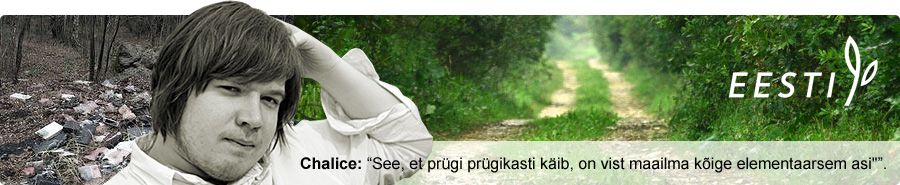
Today I took part in the Estonian garbage clean-up campaign called Teeme Ära which means something like "get it done". To be completely honest, I have no idea who organized the campaign, although I am fairly sure that the Tartu rapper Chalice had something to do with it (see advertisement above).

As an Estonian resident the campaign reached me via online media, radio, television, newspaper, and word of mouth. I had heard stories that the mysterious organizers behind Teeme Ära, including perhaps Chalice, had used high resolution satellite imaging to pinpoint every last empty bottle of Laua Viin in the forests of Eestimaa.

Maps were organized with larger dump sites. The Teeme Ära supply chain was activated, so that sometime around 9.45 am this morning we rolled into the village of Koosa northeast of Tartu to meet up with local organizers who would direct us to the trash and give us the correct bags to put it in. In our car were Ilona and Leena. Ilona is the same age as me and a mother of two. Leena's age could not be guessed, but seeing as she was introduced as being somebody's grandmother, in Estonia that would make her around 35 or older.

Maybe I was tired, but for whatever reason I just couldn't understand what Ilona was saying in Estonian. This happens sometimes. I understand the woman on the radio. I understand the contents of the article. I can read the ingredients on the cereal box. But some people I just can't follow. They speak too quickly or they slur their words. So Ilona, instead, practiced her English on me.

The road to Koosa is surrounded by a mix of leafy forests and farm lands. The tilled earth of the farms is black and pungent. For weeks now the days have been sun-kissed and today was no exception. When we reached our destination there were two guys there, neither of whom I could understand well, who haggled with Ilona about bags and directions.

It must have been a bad day for my language skills. I tried focusing on their lips, but all I heard were vowels tumbling out. Infrequent consonants, which might have acted as linguistic signposts to let me know that this word starts with 'k' or that one starts with 't', were given the once over. Instead, it seemed like 90 percent of what they were saying was either Õ or Ö.

We were sent, along with a caravan of other people bedecked in old, paint-marked clothing that said "I'm here to clean some shit up", to a place called Keressaare, where it turned out there was no garbage. Then, we turned around and went back to the gas station at Aovere, which was a few kilometers back. You see, the map had said there would be a gas station in Koosa, but it was closed. The map also said that there was a gas station in the neighboring village of Vara, but according to the clerk at the store I stopped in -- who I understood perfectly -- it wasn't there anymore.

On the way back, we started to get restless. It seems pathetic, but I could tell my passengers, Leena in particular, were dreaming about being directed to a huge, smelly, unhygienic mound of garbage. They didn't come all the way out to Koosa to eat a sandwich and visit a gas station. No, they came to "get it done." This, in a way, is a very Estonian thing. The British have the joy of sex. The Estonians have the joy of manual labor.

After yearning for heaps of bottles and dirty diapers our prayers were answered by a site halfway between Vara and Koosa at Sookalduse. Here Leena and Ilona were put to work clearing bottles and glass while I was called on to haul old tractor tires out of the marshy woods. At last, my hands were dirty. We were getting what we had come for. And then ... it was finished. That's it? I thought to myself, as I ate another pastry my wife had bought for me the night before.

Ilona instead directed our prügikonvoi to another site, this time in Peipseääre vald, which, with 981 residents, is mostly forest and field. The road in Peipsiääre vald was unpaved, and traffic by larger vehicles had left a hump in its middle littered with larger rocks that unpleasantly scraped the bottoms of our cars. One member of our caravan had their car breakdown because of this, but with a little mechanical prowess he was able to get it back on the road.

Teeme ära had been here too. Someone had already cleared this garbage site. In fact, you may be surprised to learn that we greeted the lack of garbage in Tartumaa with some sadness. We had come to haul car batteries and old couches, and all we had to show for it were some broken bottles and tractor tires. There simply was not enough garbage to sustain our enthusiasm. Discouraged, we drove back to Koosa.

In the parking lot, Ilona again haggled with those who were supposed to know things, while Leena, her thirst for garbage picking unquenched, proceeded to pick up small pieces of broken glass from the adjacent lawn.

By this point my head was hurting because I had mostly been immersed in a real Estonian language environment for several hours and my brain was getting tired of breaking down verbs and looking up meanings from my internal sõnaraamat. "Could you imagine speaking Estonian all the time?" I thought to myself. "Could you imagine if the word tõenäoliselt (probably) set you apart in the world?" It seemed the more words I learned, the less fluent -- in my own mind -- I became. The goal posts were forever moved. I would never be able to say the word pärast (after) the correct way.

I remembered how our friend David told us that when he first moved to Estonia and began working in Estonian, and often in Russian as well, that he felt like icing his head after a day at the office, the way football players ice their limbs after a brutal game. After several hours submerged in eesti keel my brain needed a little Bengay too.

We finally found a place to contribute to Teeme Ära several kilometers west of Koosa. There were already others there, gradually cleansing the roadside of bottles and cans and old bags of chips. We parked and joined them. Somebody had a radio on in their car that was playing swinging Estonian country music. In between the songs, the announcers gave updates on how many tons of garbage had been collected and how to sort the garbage you found.

I thought at first that it was a worthless job and that the place had already been picked clean. But then I noticed a bottle. Then another one. Then a can. Then a shoe. It seemed I couldn't walk ten feet without finding more garbage. I couldn't figure out where it all came from. Did people just launch their empty bottles of vodka from the car as they sped through here at night? Who dumped all those used Libero diapers near a creek? How did a pair of flip-flops wind up this deep in the woods? Were all of Estonia's forests like this? Did every pristine forest floor really conceal the discarded plastics and rubbers of our disposable civilization?

While the stretch of roadside we cleaned today is certainly looking better, I couldn't help but think that we could keep going on like that, from Koosa to Tartu and from Tartu to Viljandi and from Viljandi to Pärnu, picking up trash from the side of the road. It was a sobering thought.

reede, mai 02, 2008

island people

One of my chief concerns about moving to Tartu was its lack of sea. Tartu has water, a silty, slithering river known as the emajõgi, but there were no major geographic boundaries from which I could get my bearings.

As a child, I always lived by the sea. I always knew it was there, often minutes or less from our door. Even if I didn't go out of my way to see it everyday, I sensed it. I smelled its air. I could feel the dark humidity before a thunderstorm. It helped keep me, in some ways, sane.

It was my fear that by moving to Tartu, I would be somehow stuck in the Missouri of Estonia. My own internal bias was that all landlocked people eventually went mad. I didn't want to go mad and, as you can see, I haven't gone quite mad yet.

That is due to two reasons. First, Estonians themselves have an island mentality, even if one "coast" is a marshy border with Latvia. So no matter where you are in Estonia, you are still delineated by the Baltic and Peipsi. Second, Tartu itself is an island community that just happens to be surrounded by farms instead of sea. Going anywhere -- to Põlva or Otepää or Lake Peipsi -- takes some adjustment. When you are lost in Tartu, the outside world might as well not exist.

In Tartu, you forget that the rest of Estonia doesn't voluntarily wear 19th century university corporation fashion accessories to the supermarket. The rest of Estonia isn't brimming with people who call themselves "poets" by profession. In Tartu, thrill-seeking Americans gather together to ... drink beer and carve pumpkins.

The bevy of nighttime entertainment leaves you breathing room to roam from the cavernous püsirohukelder to the crowded Zavood, to the old-timey Vilde's. If you want Georgian, there's the Gruusia Saatkond. Italian? La Dolce Vita. Libraries? We've already lost count of those.

Why would one ever leave Tartu island when everything you need is right here?

teisipäev, aprill 29, 2008

a simpler estonia?

A recent trend in the Nordic countries is municipal reform. Denmark took the lead in 2007 by reducing Denmark's 13 counties to 5 regions.

Not to be outdone, Sweden also plans on reducing their counties system in favor of larger regions by 2015. As typical in the Nordic countries, Iceland has ignored the developments in Denmark while Finland hasn't even heard of them yet.

I find it a bit amusing that when the Estonians restored their state, they didn't restore their old county system. The current Estonian state has 15 counties, whereas the state in the 1920s and 1930s had 11 counties, one of which, Petserimaa, has since been stolen/annexed/ceded to Russia.

Does it really make sense to have a Lääne and Ida Virumaa county? How about just one "Virumaa", as it is still called by Estonians. Does Jõgevamaa serve any purpose? Shouldn't we just add some of the smaller bits to the larger ones and give the regions more power in implementing governmental reforms?

I'd like to think that Estonia was capable of pulling off such a reform if it so desired. But don't count on it. Estonian politicians would prefer to argue over the ostentatious võidusamba instead.

laupäev, aprill 26, 2008

the ansip malaise

It's springtime in Estonia. The birds and the bees are buzzing in the trees. No longer burdened by lousy weather and darkness, youth congregate on benches, drink in one hand, laptop in the other, to soak in the endless sunlight.

I spent the afternoon at our friends' daughters' fourth birthday party. The backyard was thick with children. There was the birthday girl, Liisa, but also Helena, Marta, Anna, Marta, Krõõt, Minna, Uku, and Kaarel. One young mother of two even had a third on the way. Happy times, and yet a certain unsteadiness hangs in the air.

It's been twenty years since the Singing Revolution, remarked Ott, who was then only 17, but is now 37 with slightly graying temples. As he stood before these happiest of times, he also managed in his infinite wisdom to identify the missing ingredient. The will to act.

This is what is lacking from Estonia right now. The will to identify problems, of which there are a few, host an honest and open debate, and come to some consensus about how to solve those problems. There is a feeling that there is still more to be done, but that no one is willing to do it, and that the political leadership is incapable of acting without self-destructing in the process. The people are getting anxious. Society feels a bit irregular, in the digestive sense.

Minu kallis naine accurately pointed out that the current leadership needs to marinate a little more before its thrown on the grill. I agree.

reede, aprill 25, 2008

the truth is out there

It's that time of the year. Bronze Soldier removal anniversary time. A time to replay clips of violent youths overturning cars and lighting flags on fire. A time to engage in word battles on YouTube supported by random facts pulled from the KGB archives. A time to lecture Estonia about integration. Yes, it is that time of the year.

A German student in one of my classes said recently that she was surprised how her Estonian interview subjects tended to view the integration dilemma as a foreign construct, a plaything for foreign students and foreign journalists, but something that actually matters little in day to day life.

I privately wonder when I stopped giving a shit. A Swedish friend in Tartu once had to deal with an old Russophone neighbor who one day went crazy in the apartment house corridor shouting obscenities about "Estonians" and his terrible lot in life to live in the City of Good Thoughts. The Swede seemed to conclude that the subject was crazy. In New York we step over people who talk to themselves all the time.

The problem with all of these interpretations of Estonia and what is to be done in this country, is that the "Estonians" the Swede's angry neighbor was railing against are treated as one unified block. The actions of one political party, like Isamaa, can be attributed to all Estonians, because the state is wrongly seen as ethnocentric. But when we revisit the facts, we see, for example, that the vote to remove the odious Soviet statue last winter only passed by two votes.

The reality on the ground is that, when it comes to politics, it's rather hard to pin anything on the "Estonians." In a country where you are 70 percent of the population, it's sort of hard not to vote along ethnic lines. Instead you vote for other reasons. Some people in Tartu are disenchanted with the ruling Reform Party. In Tallinn they opine about Keskerakond. The concerns of everyday life -- day care and housing and zoning issues and roads and sanitation -- take precedence over historical blood feuds and naive suggestions about integration policies.

And so, one year on, I find myself reading the "foreign" English-language press and scratching my head. "There's Soviet baggage in Estonia." Well, what do you expect? "The citizenship processes could be liberalized." Easier said than done, my friend. "Maybe you should take another official language." And maybe you should privatize the British National Health Service.

This country is complicated, but attempts to explain it to the outside world often fail. People fumble for remedies to problems they themselves misdiagnose. It's like 18th century medicine -- they create a host of other conditions for you by trying to solve one unrelated problem. Got the flu? How about some leaches and blood-letting? That's sure to do the trick!

Estonia is closer than you think to solving the Rubik's Cube of the Soviet legacy. Let them work it out by themselves.

neljapäev, aprill 24, 2008

porihing

So I have been reading Andrus Kivirähk's Ivan Orava mälestused või helesinised mäed -- a faux memoir of a fictional elder Estonian who remembers the day when young lovers would gather at the home of President Konstantin Päts to play billiards and celebrate their honeymoons.

Even though my Estonian skills aren't up to the task, I bought a handy dictionary to help guide the way. I figured that it would be an excellent opportunity to build my vocabulary while enjoying Kivirähk's absurd humor. So, of course I was the idiot on the Tallinn-Tartu bus trying to contain my laughter as I read about Johannes Lauristin and his golden egg-laying dog. I almost wanted to turn to the button-down Estonian student beside me, her face buried in her mobile phone, and say "hey, this Kivirähk is some funny shit."

At the Lennart Meri Conference I saw Andrus' older brother, Juhan, who is something of political analyst sans absurd humor. I wanted to grab him by the arm too and talk about the tallalakkuja (bootlicking) Leopold Pakt, the imaginary third cosignatory to the infamous Molotov-Ribbentrop-Pakt, but I had a feeling if there was one made-up historical figure he did not wish to discuss, it was the lipitseja (brown-noser) Leopold Pakt.

Tallalakkuja and lipitseja are indeed useful words, but some of the other ingredients in this modern-day Tammsaare's vocabulary are less useful. One such word was 'porihing.' I consulted my dictionary and even the excellent aare.pri.ee dictionary, but there was no definition. Finally, minu kallis naine informed me that it was a made-up fusion of 'pori' (dirt) and 'hing' (soul). Literally, dirtsoul.

I am unsure of what I will do with this potent Kivirähkism for the time being. But rest assured, I will make good use of porihing before the month is out!

kolmapäev, aprill 23, 2008

the foreign minister for finland and estonia

"The European Union is 15 times richer than Russia, its population is three times larger, and it spends seven times as much on the national defence. Strong Europe is in the interests of both Estonia and Finland.''

-- Finnish Foreign Minister Alexander Stubb in Tallinn today.

(Estonia seriously needs to hire this guy)

esmaspäev, aprill 21, 2008

with whom to sauna?

Recently I was teased by laughing, joking, drinking night game-playing Andrei Petserimaa about my "pinko", "Commie", "lefty" leanings. "Ew," I shuddered to myself, "am I really on the left?"

It indeed seemed gross because these days I don't know where I am on the ideological spectrum. Kriistina Ojuland recently decided to confine "sotsiaalistid-marksistid" to the garbage bin of history. But I don't worship at the altar of St. Milton Friedman, nor have I any use for St. Marx or even St. Thorning-Schmidt. I have no saints. My geopolitical world view has no partisan bedrock.

And it is hard to exactly see where one party begins and the other ends. The current government, with its promises of pension increases and support for the ever popular mother's salary, seems to have borrowed some ideas from the social welfare Shangri-Las across the Baltic Sea. And it isn't it odd that when the government held out an incentive, people started making babies? Could it be that the gospel of liberalism does not apply to procreation?

But left wing? That sounds dirty. Trotsky was charismatic, but "permanent revolution"? It sounds like something Thomas Jefferson might have dreamed up in the sauna high on absinthe. What's a well meaning pinko to do?

In Estonia I tend to subliminally support the Social Democrats, because to me they seem the most normal. Perhaps it has come down to who you'd prefer to sauna with most, just as in the US, they ask themselves "with whom would I like to share a beer?"

Saunaing with Isamaa would be interesting, but after awhile I would get sick of hearing every little detail about the battles of 1944. Enough already with the 1944! Give me some 2008, or 2009 even! Saunaing with Reformierakond seems out of my league. You know that they only have the most expensive saunas, and I don't think I am wealthy enough to use theirs. As for Keskerakond, well, I don't think I could fit into a sauna with Savisaar.

But the Social Democrats? They'd probably have a regular sauna and a mixed one as well. And they'd keep the temperature just right, neither too scalding nor too warm. Given the aforementioned options, I'd have to choose Finance Minister Ivari Padar's sauna. And we could all get together and complain about how bad the second Estonia has it, and how integration is really working, I swear.

Ah, to be among my fellow useful idiots. There would be nothing finer. As for Petserimaa, well, I think he'd be welcome in the Isamaa sauna. They could take a break from discussing Sinimäe and tackle the 1967 war instead.

pühapäev, aprill 20, 2008

kolmapäev, aprill 16, 2008

a conversation with flasher t

There's a funny thing about Estonian blogger Flasher T, author of the lively Antyx. Everyone knows his real name is Andrei, yet they prefer to call him "Flasher."

I recently sat down with "Flasher" to do a non-blog related interview but decided to share the contents with you because Flasher is so damn articulate. Enjoy:

Where were you born?
Tallinn

What is your family background?

My mother’s family comes from Irboska [part of Estonia before WWII, now part of Russia]. My father’s side is Yiddish, and comes from the eastern part of Germany via Riga, Latvia.

How often do you go to Latvia?

Approximately once or maybe twice a year for last few years. I usually visit Riga and the surroundings.

Have you ever been to Lithuania?

No.

Have you ever been to Russia?

Yes. I have been there twice in my life, twelve years apart. The same place as well, St. Petersburg.

How would you describe the relationship between Russia and the Baltic States at the moment?:

Tumultuous. You have to differentiate between Russia as a nation and Russia as a state. As a state, Russia has a useful target in that Estonia won’t get particularly offended because it has the sense of security offered by EU and NATO membership. On the other hand, Estonia doesn’t have the immediate means to retaliate, so Russia has a tool to use in its internal politics almost without any fear of consequences.

I think by default, it likes Lithuania more because Lithuania never had a problem with citizenship, but I think Russian internal propaganda against the Baltics impacts all three countries equally and the average Russian who knows little about Estonia has the same attitude towards Estonia and Lithuania.

As a nation, it has a vague idea of the Baltics as something unspecifically hostile. Statistically, there's a percentage of Russians that are so dissatisfied with state that they will do things because the state tells them not to. And there's a percentage of Russians who are so politically apathetic that they don’t care. Those two percentages are where the bulk of Russian tourism in Estonia comes from.

How would you describe the relationship between Russia and the Baltic States ten or twenty years ago?

It’s always been there because Estonia has always had the combination of nationalism and practical superiority, superiority on an everyday level of creature comforts. On the one hand, Russians are provoked by Estonians’ dislike for them, and on the other hand Russians are practically offended by the fact that even in the Soviet days, life in Estonia was a lot better.

The Russian writer Mihhail Veller tells about how he came to Tallinn and came to work at a newspaper during the Soviet era. He recalls how he was drinking cognac in the lobby of the press house and he remembers seeing the bartender tell one of the regulars that there was a call for him and handed him the phone over the bar. He was stunned by this because it seemed like such a Western thing. In Estonia these things seemed so natural, but in St. Petersburg it wouldn't have happened that way.

That was the Soviet time. Now we have the issue that Estonia has evolved so much more efficiently than Russia. So average Russians are probably offended by the fact that Estonia did not need Russia and that Russia in fact held them back.

But why is your opinion different from the average Russians'?

My viewpoints are not representative of general Russian population. I don’t have a deep Russian identity. I don’t identify myself as a Russian. I speak Russian because that is the language my parents spoke, but my roots are in Estonia, I was born here and I grew up here. I have had no cause to significantly distrust or dislike the Estonian state, and from about the time when I started to develop my own judgment I have been significantly annoyed by Russian propaganda, and not just central propaganda as it applies to Estonia, but just Russian propaganda and the unseemly aspects of the Russian mentality that have been shaped by that propaganda.

How do you think the relationship with Russia will develop in the next couple of years?

I am hoping it will stabilize. Logic dictates that at least for the next 3-7 years, Russian officialdom will not have a desperate need for a scapegoat and at the same time Estonia has shown itself willing and capable to actively fight for mindshare in European politics. I think Russia will probably consider that it will be simpler to look for scapegoats somewhere else, such as Ukraine, Georgia, or the Balkans.

How would you describe the relationship between the Baltic States themselves at the moment?

I think they slightly resent being lumped together but see the logic in it and don’t significantly mind.

How would you describe the relationship between the Baltic States themselves ten/twenty years ago?

In 1988 we had a common enemy. In 1998 we had a common goal. At this point I think the Baltic states are more than ever before in a position to establish their identities independently, not just as Baltic states.

A substantial part of that is that Estonia associates with Finland and Sweden, and Lithuania associates itself with Poland. I think a cute example of Baltic relations is Tallink, which invested massive amounts of money into a new fleet to do the Tallinn-Helsinki and Tallinn-Stockholm route, but has also bought the Riga-Stockholm route and uses its old dilapidated ferries there.

What are the causes for the change in this relationship?

There isn't a significant need to stick together. Before it was us three against the world. Now it is us 27 against the world. And us 27 have a lot more at stake. The overriding necessity has diminished so the three countries have an opportunity to create their identity which they would have always been happy to do had the need not been there. Because they don’t have that much in common, other than that they are all in the same spot and they are all rather small.

How do you think the relationship will develop in the next couple of years?

I don’t think there will be any cosmic shift. There might be a few misunderstanding between Estonia and Latvia because Latvia has decided on a course of appeasement towards Russia, where as Estonia is still pissed and not to let Russia get away with anything. Lithuania is content to keep its head down and figure out its own problems for awhile.

Can you explain where the Baltic States differ from each other?

It comes down to influence. Lithuania and Latvia are quite close, Estonia is ethnically different. Latvia has a stronger German heritage than Estonia. But Estonia has this concept of the good, old Swedish times. Estonia wants itself to be thought of as part of Scandinavia. I think Latvia understands that they can’t pull that off. Lithuania has its two religions, Catholicism and basketball. Even if it doesn't wish to be, Lithuania inevitably turns out to be a client state of Poland in the same way that Estonia is a client state of the Nordic Council.

Do the identities of the native Russians differ from the identities of the native Baltic people?

The difference is in taking responsibility. The key significant between proper locals is that they have a sense that this is their country and they are responsible for how things work in it, whereas local Russians, their biggest difference and the source of their problems is that they don’t feel in charge here. They don’t feel like it’s up to then to change things or that they could change things.

Would you say that the Baltic States can be seen as a region where the people have the same identity?

No, of course not.

Can you explain where the Baltic States and Russia differ in terms of identity of the people?

On the more general level, Russians perceive the space relevant to them as far greater. Estonians are essentially interested in their own farm and maybe their own country. Most Russians aren’t even interested that much in their city. They are primarily interested in their country and its place in the world.

On any level that is really important, Estonians don’t care whether anybody likes or fears Estonia in the world, as long as their pigs are healthy. This goes a long way to explaining differences between Estonia and Russia – levels of street cleanliness, levels of corruption, relations with authorities. This does come from Soviet propaganda, but it was also there historically. Russians have a sense of if they don’t do it, somebody else will. Estonians have a sense of if they don’t do it, it’s not going to get done.

What are the main areas where Estonia, Latvia, and Lithuania should cooperate?

Lobbying of common interests in EU internal politics. The rest of it we can handle, but EU internal politics is a place where interests are similar to a large extent and we could benefit from acting as united front.

kolmapäev, aprill 09, 2008

puhkusel

Wow, this is my 500th post. Anyway, I have decided to take a little break from the blog. Not for too long, but the remainder of April is going to be very busy on the home front. In the meantime, the gateways to the northern dimension are always to your right if you need a little early morning discussion or late night entertainment.

pühapäev, aprill 06, 2008

tanking in tallinn

Explain this for me:
Support for the ruling Estonian Reform Party (ER) has declined over the past month, according to a poll by TNS Emor. 30 per cent of respondents would vote for the ER in the next legislative election, down five points since January.

The Estonian Centre Party (KESK) is second with 27 per cent—up four points in two months—followed by the Union of Fatherland and Res Publica (IRPL) with 16 per cent, the Social Democratic Party (SDE) with 12 per cent, the Estonian Greens (EER) with eight per cent, and the Estonian People’s Union (ERL) with four per cent.

Reform Party has gone from enjoying a post-Bronze Soldier crisis high of 43 percent support in July 2007, to just barely topping KESK in this recent poll. Why? Perhaps call it the 'Ansip malaise' -- no euro adoption, higher inflation, a cooling real estate market, and, in general, no big plans for, uh, reform.

Meanwhile, government investments in research and development, education, and health care aren't really matching Estonia's neighbors', and so human development also lags behind. The average Estonian man lives to the age of 66. His Finnish counterpart lives to 79. For all the new, shiny commercial buildings in Tallinn, maybe the average Andres hasn't been feeling enough love from Stenbock House. What's your take?

neljapäev, aprill 03, 2008

nägemist, ilkka

One has to wonder at what point between Finnish Foreign Minister Ilkka Kanerva's departure from Ljubljana, Slovenia, his arrival in Tallinn, his dinner buffet at Kadriorg, and then his no-show at the Lennart Meri Conference session on Baltic and Nordic cooperation the following morning, did he get a text message from Kokoomus leader Jyrki Katainen telling him that he was out and Alexander Stubb was in.

I had a feeling that the endless global media coverage about Kanerva's textcapades with an adult entertainer 30 years his junior may have been getting to Katainen, who perhaps fretted about what impact this would have on the marketability of Kokoomus' conservative chic. But I also wondered who knew what and when. Did all the politicos at the conference know Kanerva's fate before we did. And how long is the delay between official knowledge and public knowledge?

In someways it reminds me of the NATO Bucharest summit. President Bush went on tour in Kiev publicly backing membership action plans for Ukraine and Georgia. And yet it has been widely known for weeks that Germany would oppose MAPs for these two countries. So did Bush utter those words in Kiev just for show and to encourage further reform in these two countries, knowing all along that no matter how hard the US promised to fight in Romania, their fates were decided before the summit? Maybe. But who knew what and when, and how did that influence the show we see on TV? I think a lot of people ought to be asking themselves that question.

pühapäev, märts 30, 2008

whither social democracy?

Moral cowardice. Greed. Stupidity. Those are the reasons that the current German leadership lacks the political will to send favorable signals to Ukraine and Georgia about future NATO and EU membership, according to one foreign policy thinker.

This hesitance does influence other wobbly policies in adjacent Western European countries like France and Spain, and yet the trail of breadcrumbs seems to lead us back to Berlin's grand coalition of Angela Merkel and Frank-Walter Steinmeier. Aye, the stench of the German Social Democratic Party is in the air on the eve of the NATO Bucharest Summit.

This weekend's Lennart Meri Conference was in someways a coming together of the European center-right. The representatives of former German Chancellor Gerhard Schroeder were not to be found. And while Lennart's soul is kept alive with anecdotes about a chain smoking Estonian intellectual with a whimsical love of history and a way with quick oneliners, I felt that the real soul of the conference was Mart Laar, who during his turn on the panel sat with his laptop open, presumably keeping abreast of world events while the other interviewees tried to explain European integration with metaphors about love making.

"Is he it?" I thought to myself. "The new, living embodiment of Estonia -- absorbed by the questions of the day and distracted by his beloved technology?" Laar strikes a nice balance between the Estonian Ambassador to NATO Jüri Luik, who seems a quiet and tough patriot, and President Toomas Hendrik Ilves, who without notice might color his arguments by referencing Wittgensteinian philosophers, the 1970s Philadelphia city government, and IKEA.

And Laar is from the parempool -- the right wing. My inner journalist cries out for some social democrats to counter the onslaught this union of right forces, maybe former Finnish PM Paavo Lipponen, or Schroeder himself. Please, come, make them mad so we can have a good show. But the truth is that they probably weren't invited because of their association with moral cowardice, greed, and stupidity.

It's as one Finnish analyst put it during a morning session. He said the Finnish NATO debate was being defined as a conflict between 'Nokia' Finns, who wish to integrate completely with Western institutions, and 'Muumin' Finns, the idealists who question the need for such a common security arrangement with the majority of their neighbors. I mean collective security, who needs it?!

Finnish FM Ilkka Kanerva was supposed to attend a session this morning, but he supposedly had to return prematurely to Helsinki to face up to the text message scandal. When I asked a Finn if he would like to see the personable social democrat Erkki Tuomioja back in the FM's seat should Kanerva step down, he told me that he liked Erkki's style, but he hoped that the Finnish Social Democrats would stay in political opposition in the Eduskunta for a long, long time

From the Estonian perspective these 'Muumin' Finns and Norwegians and Swedes and Germans are seen as untrustworthy. They were the ones who pleaded with the Baltic independence movements to not rock Gorbachev's boat back in the late 1980s. They were apparently very wrong, and their silence and sweetheart, sauna diplomacy since has soiled the legacy of social democracy. Those of us who grew up in awe of the capability of these dynamic northern countries to educate and care for their masses are now turned off by the morphing of social democracy into Schrödocracy, a self-interested coziness with illiberalism and little else.

It's the reason why there are so few Western European social democrats involved in the important debates of today. They have become stale and irrelevant. As someone pointed out over lunch, "Why would you even bother to invite the European left to a place like this when they have nothing to say?"

Nothing to say, and yet, Estonia could learn something from the Muumin welfare vikings from across the Baltic Sea. Estonia wants to transition from a low-cost, low-skill economy of tourism, transport, and manufacture, to a high-skill, high-pay economy of technological innovation -- the kind of society embodied by Laar and his laptop.

Yet do the Estonians really get the kind of state support that their northern brethren do in Finland and Sweden? People travel from all over the world to study at the Karolinska Institute or the University of Helsinki. And they go on to found university spin-outs that make the Nordic countries among the most competitive economies in the world. Much fewer are those who take the bus to Tartu, Estonia instead.

I would like to believe that the reason for these small, relatively remote countries success has less to do with them being of superior genetic stock, as one disgruntled German World War I veteran put it, and more to do with the fact that their governments invest heavily in their people and the investment tends to pay off. And so, despite its moral cowardice, greed, and stupidity, European social democracy has had some benefits.

Driving through the streets of Tallinn last night, I got an earful from an Estonian taxi driver named Vladimir. As we zoomed through Telliskivi, the taxi drove into a deep puddle, and you could feel the frame of the car scrape the ruined asphalt beneath as the car pulled its way out.

"Now that we are in the EU, we have EU prices," he opined in accented Estonian. "We don't have European roads, or European salaries, or European service. But we do have European prices." I pointed out that EU structural funds were being spent on renovations on the Tallinn-Tartu road. "They are going to have to renovate more than road around the airport," Vladimir said. "These roads are destroying our cabs, and who pays for the repairs? We do."

He's right. European integration has brought economic miracles to downtown Tallinn. But drive a little bit deeper into the residential neighborhoods and you'll wonder when the invisible hand of the marketplace will manage to make their sidewalks walkable and streets navigable. As for those poor dopes in the countryside, well, they'll have to wait especially long for the invisible hand to reach them. Most probably think that it will never come at all.

It would seem like these day-to-day issues would be a boon to proponents of social democracy. Fix the city roads; fix the city plumbing. Fund the universities; bring in the talent; reorient the economy. Demonstrate the capability of government to positively impact the average Vladimir's life. But no, Europe's social democrats are probably too busy cutting gas deals with Gazprom and smiling for the camera to take advantage of such opportunities. It makes me really mad.

The only thing that could distract my political malaise was people watching in Old Town. As I turned down a narrow medieval street after a deeply moving performance of Arvo Pärt's music at the Niguliste Kirik, I was stopped by a British youth in front of Olde Hansa, the living embodiment of Estonia's tourism industry.

'Pardon me, mate, but are you from around here?' he asked.

'Uh ... sort of,' I replied.

'Do you know where I can get some cocaine?' he smiled.

'Cocaine, huh?' I said. 'Well, you could try the McDonalds down the street for a hamburger instead.'

He looked at me a bit weird and then said in a perplexed voice, 'a hamburger?' I walked off, leaving him to the lights of the Raekoja Plats.