reede, september 12, 2008

halonen

I am not sure if you paid attention to this most recent scandal in Finnish-Estonian bilateral relations, but, in summary, it comes down to some comments attributed to President Tarja Halonen.

Halonen told YLE, in regards to Finland's position on the Georgian conflict in the context of Baltic foreign policies, the following:

"It is to the benefit of the European Union as well to have countries that are free of those sort of post-traumatic situations and a country that is relatively cool-headed, matter-of-fact and constructive.


I concur with the assessments saying that Finland positioned itself on the middle ground and perhaps slightly closer to Russia. Finland is not the northernmost Baltic country but the easternmost Nordic country."


It would be justifiable to accuse the Finnish president of a strategy of appeasement towards its large, wealthy, violence-prone eastern neighbor, the Russian Federation. But there is truth in the words of this social democrat, who is decades older than many Estonian policy makers; truth that most people would prefer not to discuss in Estonian political circles.

One truth is that Estonia absolutely does have post-Soviet baggage. How could it not? The second truth is that Finland is looking out for Finland. That is what, as president of Finland, Halonen is charged to do.

There is also a larger truth in Halonen's words. That truth is that Finland creates security for Estonia. The presence of Finnish banks, Finnish industry, Finnish tourists and, overall, Finnish investment, gives the Estonians a sense of security that they might not have otherwise. And so Estonian parliamentarians can raise all the hell they want in relations with Russia, because the blanket of Nordic normalcy keeps Estonia warm and dry.

A lot of people were on edge when riots broke out in Tallinn last year. Some predicted the end of times for the Estonian republic. But I didn't. Why? It wasn't just because of those two NATO planes flying overhead. It was because there is so much Nordic capital here that it would be politically impossible to impose a Soviet-style military occupation on this country again, especially over that controversy.

That hasn't even been an option in Georgia, at least for the moment. Russia's goal was to have a loyal stooge in power in its neighboring country. That is why the Russian objective for Estonia is to create a special relationship with domestic political parties that will basically adopt a Halonen-style policy towards Moscow. In other words, Kekkoslovakia redux.

People might criticize the Halonen line, but Finland is a well-ordered, wealthy country with a diversified economy. Lip service may cost the Finns some pride, but that pride is made up for in capital which, in the end, benefits the Finnish people. The Finns, though, believe they are different, and here is the contrast with the Estonians, who do not see their future through the lens of Nordic exceptionalism. Finns looked at Georgians and saw "them." Estonians looked at "them" and saw "us."

One untruth, though, maybe in Halonen's description of Finland as the "eastern most Nordic country" with regards to its Russia policies. That doesn't jive with the position of fellow Nordic country Sweden on the conflict in Georgia, does it? Wasn't Sweden also pushing for a hard European line? Isn't Denmark similarly friendly to Ukraine and Georgia's NATO aspirations? Finland's stance seems more isolationist than "Nordic." If "Nordic" means being pro-Moscow, then perhaps Finland is not only the easternmost Nordic country, but the only Nordic country, period.

kolmapäev, september 10, 2008

toimii kuin junan vessa

"Toimii kuin junan vessa" -- it works like a train toilet. This is supposedly a compliment in Finland, a land where everything presumably works.

But when I heard this saying today in Helsinki, I couldn't help but think of that train toilet I once came face to face with in Italy that was caked with the abominable stench of humanity. If Finns are thinking of functional train toilets, they certainly aren't thinking of that one!

Like a greenhorn in the big city, going from Tallinn to Helsinki takes your breath away. Tallinn only has some big buildings; Helsinki is mostly made of big buildings. Tallinn is built like an inflatable Scandinavian tourist getaway; Helsinki is built to last. In Tallinn, a sizable percentage of everyone you meet knows someone you know; in Helsinki, you are but a small speck on the impeccably functioning toilet called Finland.

The Finnish and Estonian languages are similar enough that I am tempted to speak Estonian at every juncture. But even trying to speak Finnish can get you in trouble. For example, the Finnish word for "eight" is written as "kahdeksan." The Estonian word for "eight" is "kaheksa." But when I said "kahdeksan" to my taxi driver, who said he spoke "little English," he gave me a weird look and said, "kaheksa?" back at me. I am told that the Finnish spoken around Helsinki is quite similar to Estonian in some respects.

And nobody says "terve" or "näkemiin" -- both of which I use because I equate them with "tere" and "nägemist." In Finland, it's "moi" this and "moi moi" that. "Terve" is for old farts. "Moi" is what the guys from Lordi say to each other when they show up for band rehearsal. In Estonia, a "harbor" is called a "sadam," but in Finland it's a "satama." The tabloids look almost identical, the only difference being the longer, screwier looking headlines in the Finnish editions. I walk into a supermarket and the products are nearly identical; even the bakery sells rice "pirukaat." The open air markets offer up heaps of mushrooms and berries.

Estonia and Finland also share a lot of brands. Estonia is in some ways an extension of the Finnish market; an extra 15 counties, if you will. Finns and Estonians both have R-Kiosk and Anttila and K-Rautakesko and Seppälä and, most importantly, Stockmann. This common commercial environment leads one to feel as if they are still in the same country; just a slightly different part of it.

Finland, though, seems more uniform. The street signs in a city like Turku are all the same. In some Estonian cities, though, including Tallinn, you'll find all different sizes and shapes of street signs, some still bilingual, some not. It's just a mess, and it's a mess that is reflected in the eclectic mishmash of architectural styles that are erected not to serve some greater purpose of Estonianness, but because the developer could save money that way.

If there's one thing that irks my inner pinko, it is the rejection of society, period, in some veins of Estonian thought. It's just mina, mina, mina -- my suvila, my BMW, my shopping center. I'll make my snail tower as ugly as I like it, because it's all about my vision -- screw the city skyline of Tartu! If there's one take home message from this country for Estonia, it's that a little more meie can help make things better for the entire country, which ultimately trickles down to sina ja mina. In other words, the train toilet should work for all of us.

Oh well, forgive me my moment of preachy indiscretion. Maybe 48 hours in Finland is a little too much for someone like me.

esmaspäev, september 08, 2008

sillamäel

"As a strange inheritance from the Soviet era, Ida Virumaa sometimes seems to be an alien in its own land."

These words from Indrek Rohtmets' A Cultural Guide to Estonia rang in my head as our car passed the sign marking our passage into Ida Viru county last Friday. I was looking for signs of something different, because, to most Estonians Ida Virumaa is both so faraway and so close.

The main differentiator in the Estonian mindset, is the ethno-linguistic difference. Only about one-fifth of Ida Virumaa's population of 174,000 belongs to the exclusive category known as "ethnic Estonians."

Needless to say, when I asked a relative in March 2007 why he voted for the right-wing Isamaa-Res Publica party, he said it was to "cancel out" the votes of the Russophone, Center Party-backers in Ida Virumaa. So, enough Russians to set your mind afire with Russophobia is expectation number one.

Expectation number two is that the "industrial northeast" is a post-Soviet petri dish of pathologies; of heroin junkies siphoning bathtub gin across the River Narva; of overworked miners coughing up black and red; of stateless pensioners cleaning their rifles for the day when the red ship returns; of the shocking reality of the Soviet collapse.

But driving through the countryside, I couldn't help but wonder if we had taken a wrong turn near Kunda and wound up in Ireland. Surely, the Clancy Brothers must be somewhere amongst those cottages turning up gentle smoke, whiskey in hand, green on the land, ready to pluck another tune out on the banjo.

Oh, whiskey, you're the devil, you're leadin' me astray
Over rocks and mountains, and to Amerikay!

Along the placid highway, packed with commuters going to places like Sillamäe, Jõhvi, Kohtla-Järve, and even Narva, I was disappointed to find that Ida Virumaa looked a lot like Lääne Virumaa, and, essentially, had the same creature comforts of Selver and Maxima shopping centers and Statoil and Lukoil gas stations as every other place.

As we passed Aseri, the road wound past a wind farm, one of several in Estonia. Several large propellers turned, while others sat silent. The key word of European, nay, global discourse today is energy. Some Estonian entrepreneurs have it in mind to turn Estonia into the next Denmark, using the winds of the Gulf of Finland to take care of the country's energy needs and then some. From what I understand, there have been technical and political obstacles, but, unlike a lot of plans in Estonia, this one has actually been realized. There are wind turbines in the ground; the questions are now how to support their output and where to direct it.

Estonians are gradually coming to the realization that, save some help from Finland, they are mostly on their own when it comes to energy. Talks about building a new nuclear reactor at Ignalina have hit the typical snag in Baltic rim relations -- bickering between Poland and Lithuania. The Finns might throw Estonia an extra connection or two, but if Estonia gets a nuclear power plant, chances are it will be somewhere out in Ida Virumaa.


After about 45 minutes driving along the coast, we finally came to the municipality of Sillamäe, which means "bridge hill," a bit of a contrived name if you ask me; about as believable as a road called Vikerkaar (rainbow) street in Tartu that, you guessed it, is shaped like a rainbow. Such appellations are indicative of the nutty postwar fetish for "modernity."

Sillamäe was though, in its heart and soul, a product of this era. Before 1945, the area was home to a small, Swedish-owned company. After the war, up to 20,000 people were imported to live in a closed city where fuel rods were manufactured for use as energy and weaponry. Today the population is around 15,000 and boasts such streets as "Yuri Gagarin Boulevard."

My expectations of Sillamäe basically coincided with your average Estonians' impressions of the northeast. It would be dirty; there would be flamboyant, bow-legged wimmin' soliciting money for sex; and maybe a couple heroin junkies trying to siphon some bootleg vodka from Russian territorial waters. And everything would be in that scary, extraterrestrial-looking language they call Русский -- the one where the number 3 makes a 'z' sound. When Russians dream, they don't go 'zzzzz', they go '33333.'

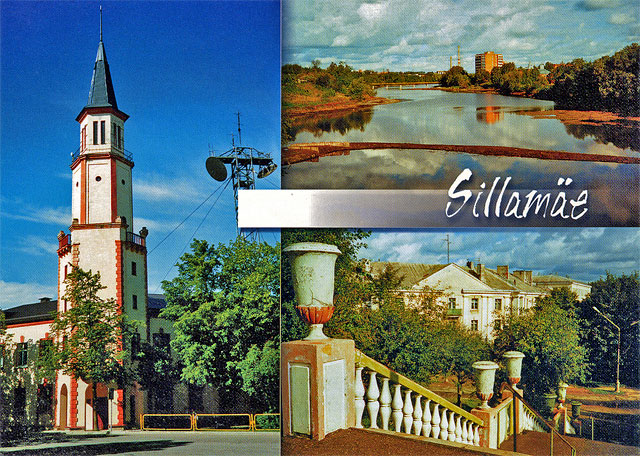
These expectations were not to be met. Sillamäe is in decent shape, if you compare it to some other struggling Estonian towns which I hesitate to name {this means you, Jõgeva}. The whole city is a triumph of what is called "Stalinist architecture" -- which sounds like the buildings must be made of hazardous chemicals and corpses. But it's actually quite grand. The buildings are painted a creamy yellow with white trim, the streets are lined with trees, and there's even a 'church' -- actually a townhall -- to top it off.

Used to rambling montages of Scandinavian glass boxes, 19th century wooden ghettos and Khrushchev-era apartment blocks in cities like Viljandi and Rakvere, Sillamäe's uniformity gave it the ambiance of an open-air mental institution, where everything in life, even a walk through the park, had been planned for you by some superior power in advance.

I was told by my guide that, in the late 1990s, Sillamäe really had been the shithole of my expectations, but then a fellow named Ain Kiviorg was elected mayor and cleaned the place up, putting those imagined junkies and prostitutes {in reality, just local people down on their luck} to good work picking up litter and fixing up the joint.

Around the same time, a joint group of Estonians and Scandinavians worked together to cap the local uranium dumping site, conveniently located next to the harbor, with enough clay to prevent further seepage. You see, while the Russians took much of the local industrial equipment back with them in 1994, they deemed themselves to be not responsible for the environmental negligence of "the Soviets."


The port of Sillamäe, nearby, is open for business and business could be good. However, political relations between the current Estonian government and the current Russian one are not, directly affecting not only the transit trade, but every business tangentially related to the transit trade. You'll notice that former prime minister Tiit Vähi, who built the port, has been one of the leading critics of the Ansip government. He's probably slightly annoyed with how his investment has turned out so far, but, barring wars, ports tend to outlast prime ministers, even self-appointed Russian ones.

Well, like any good local boy, Mayor Ain Kiviorg was having lunch at the Cafe Randevuu when we rolled in. The amicable woman behind the counter began the conversation with Estonian niceties and took our order. My guide rustled us up a delicious lõunasöök of chicken schnitzels and french fries, downed with a great beer on tap. For dessert we feasted on vareenikud with jam. As my buzz gained traction, I really began to fall in love with Sillamäe.

"Everyone who visits Estonia should visit this place," I hiccuped to myself. "It's just too unique to pass up."

The streets of Sillamäe were trampled underfoot by throngs of pedestrians. Old ladies, young kids, even those confined to wheel chairs made their rounds. To where they were headed, I had no idea. There are shopping centers fairly close to the center. There's a Hansapank in town. There's even a nice hotel called "Krunk", which is a pretty stereotypically Estonian hotel name for a closed city built during the days of cosmonaut and Hero of the Soviet Union Yuri Gagarin.

"The thing about Russians is they love to walk and be outside," said my guide. "You should see what this place looks like in the first weeks of spring. There are people everywhere."

Despite being surprised by this city of good feelings, though, I began to feel a bit like a sardine trapped in a tin. There were no houses in Sillamäe; only apartment blocks. And there was apparently little privacy to be found in a city of extroverts. You had an outrageous view of the Gulf of Finland, but ... so did everybody else.

I was relieved later when we got to Toila, a city that lays directly west from Sillamäe, yet looks completely different, after a few minutes of driving. The local fish canning factory, despite some wear, looked like it had been airlifted from Reykjavik. "Thank God," I thought to myself. "I'm back in eesti."

In Toila there were few apartment blocks, but plenty of neatly painted private homes, and, at the head of the village, a pristine sanatorium where you could relax in the sauna or ease your aches and pains in the swimming pool. There the sinine-must-valge Estonian flag flapped proudly in the wind.

Most of all, there was no one around. Not a soul, except for the shadows glanced through the windows of the sanatorium or a couple of guys working near the port. "Where is everybody?" I asked my guide. "They're probably all at work," he shrugged.

In Toila, I felt like I had returned to Estonia, but I wasn't quite sure where I had been. Sillamäe, with its Hansapank office and Hotel Krunk, was definitely Estonia, but an Estonia with a very different dynamic. It was, in some ways, like most of this country; a relic of another age given an appealing face lift to meet the needs of the day.

reede, september 05, 2008

fearmongering

If there's one thing I despise, it's journalists lecturing other journalists. But what can I say when so many news outlets have begun irresponsibly reinterpreting the Russian-Georgian conflict through the prism of potential ethnic strife in Estonia.

Among the latest events in the annals of stupidity, a gang of
supposedly ethnic Estonians in northeastern Estonia banded together to declare an "Estonian Soviet Socialist Republic" on the territory of their two farms and request recognition from the Russian Federation. A reporter from Russian state-owned news portal RIA Novosti generously reported the "news."

And the "news" went from RIA Novosti's lips to your ears. Postimees made it the top story on their website. Not only the Denver Post and The Olympian of Washington State in the US reprinted the story, but others followed suit.

"Rumors are circulating, for instance, that two groups of Russians in Estonia will soon try to secede," warns Investors Business Daily.

"The veracity of the report is dubious — 'bourgeois' is not exactly common vernacular beyond the world of Soviet propaganda — but that is not the point. Roughly one-third of the Estonian population is either ethnically Russian or linguistically Russophone," cautioned the Financial, a Georgian paper.

Except that the leader of the "Estonian Soviet Socialist Republic" quoted in the RIA Novosti piece was named Andres Tamm, about the most Estonian name a person can have. How we got from kooky Estonian agrarian communist PR stunt to ethnic revolt in Ida Virumaa, is hard to guess.

The only answer is that somebody took a few pieces of information from an untrustworthy source -- Estonia, Soviet, northeast -- and decided to disseminate news of their own creation. Supposedly, the media has gate keepers. Yet, in this case, the editors were asleep at the wheel. RIA Novosti's mental sewage was released untreated into the rivers of communication.

The new penchant for predicting problems for Estonia based on what happened in Georgia -- which, I remind you, is as far from Tallinn as Barcelona -- has been adopted by some more mainstream media sources though. In several of its recent articles, The Economist has interpreted Russia's actions in Georgia as having ramifications for Estonia's Russian minority.

"NATO needs to reassure all its members, including places like Estonia and Latvia with large Russian minorities, that they are protected by the alliance’s mutual defence guarantees," it writes in a recent editorial. "An alienated minority of stateless people, and tens of thousands who carry Russian passports, are a potential nightmare for the Baltic states and their friends," it writes in another.

Except the Abkhazians and the South Ossetians aren't ethnic Russians, nor do they claim to be. How we got from these Caucasian separatists to "Estonia is next" is almost understandable. 6.9 percent of Estonian residents hold Russian passports. The stateless -- many of them deep in middle age -- certainly have a license to gripe. But one must have a will to separate, plus a separatist movement, before one can embark on the perils of triggering World War III in Europe.

Yet, without so much as lifting a finger, let alone an AK-47, Estonian Russians have been rendered suspected enemy number one in the EU and NATO by English-language media merely by what language they choose to speak to their children.

It's not only disingenuous to infer that they are ready to shatter the sleepy landscapes of eastern Estonia for some yet-to-be articulated, hypothetical, and, in my opinion, meaningless goal. It's also a great disservice to them. The more they are demonized by irresponsible writers, the less possibilities exist for integration measures in this country. Who really wants to be friends with someone from a group that's allegedly out to stab them in the back?

I really don't know. I went to Sillamäe and other places in Ida Virumaa today, and I didn't exactly get the sense of looming conflict over anything except maybe a parking spot in front of the local Selver shopping center. The 'city' of Sillamäe is looking better; it certainly did not live up to the ominous reputation of the Russophone cities of Estonia's northeast. People go to the bank; they go to the store; they go to the park; they go to work. To steal a few words from Dirty Harry, they get up and they put their pants on.

Words to live by.

kolmapäev, september 03, 2008

sarko at the crossroads

Considering all the out of control spin that has come out of the Russia-Georgia crisis, including the bizarre and conflicting statements from the Russian foreign ministry, I figured that one more helping of pure BS wouldn't hurt.

And here is my take on the results of this week's EU summit. French President Nicolas Sarkozy is not happy with his Russian colleagues.

It's not just that Russia set up Georgia for in invasion in August; it's not just that it has illegally recognized Abkhazia and South Ossetia; it's not even because more hawkish Europeans are comparing the man who called Parisian rioters "scum" to long-dead British Prime Minister Neville Chamberlain. {"Peace in our time," they taunt Sarkozy. "Peace in our time!"}

No, Sarkozy is not pleased with Mr. Putin and Mr. Medvedev because Sarkozy lives in Paris with his chanteuse Carla Bruni-Sarkozy and doesn't take it lightly when his summer vacation is interrupted by a crisis on the non-EU side of the Black Sea.

He probably didn't appreciate it that he had to fly all the way to Moscow and then all the way to Tbilisi and negotiate with gangs of hotheaded politicians with highly unreasonable demands until they signed a six-point ceasefire. And now those unscrupulous Russians have the nerve to have wasted all of his time? They have the nerve to make him fly all the way back to Moscow on Sept. 8 so he can tell them to abide by the agreement they signed just weeks before?!?

People try to make the Russians out to be masters of this game. But there is a strong whiff of improvisation coming out of Moscow. After the EU announced it would suspend talks on a new partnership agreement, the Russians first criticized the decision. Then they praised it. At least they didn't agree on sanctions, the Russian spindoctors said. Putin praised his little lemmings for making a "responsible decision." {Of course they didn't authorize them -- sanctions are a last resort before turning off ones own gas supply in protest.}

Putin may be vain and arrogant, but Nicolas Sarkozy may be as well. And my gut tells me that, deep inside, Monsieur President is more than slightly annoyed. It's not just about international law. It's not just about disproportionate use of force. It's the fact that he has been inconvenienced by Vladimir and Dmitri. We spoke earlier of the Estonians sticking out their feet to trip the Russians on the way to the front of the class. I wouldn't be surprised if, in the future, a few more countries, including France, do the same.

esmaspäev, september 01, 2008

the thin ice

British journalists often come packaged not only with their file of clippings but with individual, ideological worldviews that inevitably bring them into conflict with their fellow countrymen who practice the same trade.

That's why I hesitate to quote two of them in the same blog post, for fear of being avalanched by Anglo negativity. But two journalists, one named Peter Millar, the other Ambrose Evans-Pritchard, both of whom no doubt have loyal readers and mortal enemies, have chosen to view the EU-Russia conflict through the civilizational, rather than values lens.

In yesterday's Daily Telegraph, Evans-Pritchard writes:

The credible Nato line in Eastern Europe runs along the borders of the European Union, from the Baltics to Romania. This pits Russia against a unified bloc of 505m people. Any attempt by Moscow to peel off Estonia or Latvia by stirring up Sudeten-style irredentism among their Russian minorities would be deemed a mortal challenge by the EU's elites.


This is not to criticise David Miliband's impassioned plea in Kiev ... But Nato membership for Ukraine is playing with fire. Some 30pc of the population are native-Russian speakers. The Donetsk and Luhansk oblasts are uprisings-in-waiting along Russia's border.


In the Times, Peter Millar makes an even more overt civilizational argument:

For [David] Cameron to equate Estonia and Ukraine, as he did last week, is stupidity. Estonia’s history, language and culture are markedly separate. Forced into the Soviet Union in the second world war, it has also over the centuries been part of Sweden, and ruled by the Teutonic knights. Its language is related to Finnish.


Ukraine is another matter. Its name comes from Old Slavonicu kraju, meaning “on the edge” – in other words, borderlands. We stopped saying “the Ukraine” to make it sound more like any other country. To Russians it doesn’t.


By posting these snippets from these no doubt controversial authors, I do not necessarily endorse them. However, I find it interesting that both employ civilizational rhetoric to support Estonia's membership in the West, rather than values language. There's no reference to democracy or rule of law. Instead, NATO and the EU are conceptualized as civilizational projects.

It's kind of interesting to know what our British friends are reading.

laupäev, august 30, 2008

dialoog velloga

The other day I sat with a reclusive Estonian writer named Vello at the Cafe Plus 7, formerly the Nurgakohvik, in what could be described as 'midtown' Tartu.

Just back from a job moonlighting as an international man of mystery in Moscow, I thought Vello could enlighten me about the gigantic land to our east which stretches across seven timezones.

The Plus 7 was the perfect spot to talk about Russian relations because it appears to be Estonian-Russian owned. The menu featured the "Sochi 2014 Special," and Vello ordered the "Druzhba snitzel" from his Russian-language menu. I had the "Sõpruse šnitsel" from my Estonian-language menu instead.

"Why do the Russians dislike the Estonians so much?" I began.

"Well, for starters, they think the Estonians are arrogant," he said. "I hear this in St. Petersburg all the time. 'Those Estonians think they're better than us.'"

On the wall, a large flat-screen television played a series of music videos, that could have been American, save for the fact that they were in the Russian language, and all the extras in the videos were white.

Vello and I continued our discussion.

"Another thing about the Estonians," he said, "is that they fight like peasants."

"How so?" I asked.

"The Estonians' idea of getting even is, 'Let's wait until the master is asleep, and then we'll kill him,' or 'Let's get the master really drunk and stab him when he's not looking.'"

The music videos continued to play on the Plus 7 's TV. There was a pop diva, then some kind of hip hop group riding around on the metro. At some point, a woman who looked a bit like Anne Veski came on and began singing a disco-infused tune, the chorus to which was "pussy, pussy, pussy."

"You know," I said to Vello. "Estonians are sort of like that kid at the front of the class who sticks his foot out when the class bully goes to do an exercise on the blackboard."

An image of Juhan Parts taking the Estonian-Russian border treaty, blowing his nose in it, and handing it back to his Russian colleague saying "sign this," flashed in my head.

"Exactly," he said. We were then joined by our female counterparts, Liina and Epp.

"So what have you been talking about?" asked Epp.

"We've been talking about how Estonians are arrogant and think they are better than everyone else," I said.

"That's true," she laughed.

"And what about you, Liina," I said. "Do you think that Estonians are like the kid at the front of the class that always makes sure to trip up the Russians?"

"Of course," she said. "And they deserve it."

neljapäev, august 28, 2008

merkel tallinnas

It is kind of ironic, given Estonian history, that when the chancellor of Germany arrives to visit Tallinn, the local politicians line up to shake her hand and bask in her presence.

It's also sort of ironic, again given Estonian history, that in reaction to Russia's invasion of Georgia, some Estonian politicians are openly welcoming the possible stationing of NATO troops on their soil. Where will these troops come from? I am not sure. But I wouldn't be surprised if they happened to be compatriots of Dr. Merkel's.

The mutual rapport between the German and Estonian leadership, though, illuminates some of the fundamental dilemmas for the EU given the Georgian crisis. Tallinn, you see, was once Reval. Its Lutheran spires are testament to its Europeanness; its Low German-inspired vocabulary connects Estland to Deutschland in a way that the average Dietrich or Tiidrik might not understand, but the elites certainly do.

But when the German elite looks at Georgia, they perhaps know not what to do. When the EU expanded eastward in 1995 and again in 2004 and 2007, Stockholm became the regional capital of northern Europe and Berlin the heart of the union. Austrians and Slovenians could rub elbows and share mountain climbing tips; Swedes and Estonians could swap Baltic Sea sailing stories.

The predicament with Georgia is that its invasion by Russia and the apparent attempt to unseat its government bring European values, rather than cultural heritage, to the fore. It's no longer a civilizational question, it's a values question, and, in this case, it is much trickier territory for a European elite that is trying to carve out some kind of coexistence with the bloodthirsty capitalists next door in Moscow.

The crisis in that country continues to unfold and, perhaps, will revert to a new kind of frozen conflict. I think, though, that the Georgian crisis has acutely raised the "civilizational project versus values-driven project" question for the European Union. Is it one or the other or both? As of today, there is still no answer.

teisipäev, august 26, 2008

setomaal


Estonia is allegedly a small country, but our life has been spent between three points: Tallinn, Tartu, and Karksi-Nuia. I have been to Kuressaare and Kärdla and Pärnu and Paide and Rakvere. But never to the big "cities" of Ida-Virumaa county, and never to the swath of land from Paide to Haapsalu.

I'd also, until this past week, never been to the southeastern most corner of Estonia, the home of the Orthodox, Finno-Ugric Setu people, save a road trip last summer. I am not sure how long a person has to be in a place to understand it or even claim to have been there. I once spent a night in a Warsaw airport hotel. I ate dumplings and drank black current juice and learned how to say dzien kuje, but I never try to pass it off as having visited Poland. This time, though, I think I can finally say that I have visited Setomaa, as it is called.

Our friends Mart and Helen have a summer place there, and after attending an ökofestival in Põlva, we traveled down to the hamlet of Obinitsa, just a few clicks from the Russian border. Borders are interesting things. Some are natural. The Pyrenees cleave Spain from France. More locally, the Narva river delineates Estonia from Russia. But in the southeastern part of this country, rivers and streams and bogs and thick forests abound. Where to draw the line? At orthodoxy? At tongue? At travel artery?

**

Estonian place names are everywhere. Every little clump of houses set between the knolls and fields of south Estonia has a name. You can literally walk from one tiny settlement to the other and claimed to have visited with in 20 minutes Hilana, Miku, Vasla, and Talka, Estonia. I am not quite sure where in relation to the real Obinitsa Mart and Helen's summer house was located, but it was up a dirt road from many of these places.

There is no sea in Setomaa, but the endless fields act as a sea; one can stand on the edge of a field and feel as if they were standing on a beach, watching waves of oat shimmy in the wind. Mart and Helen's home sat adjacent to these fields. It's a wooden house, built perhaps early in the 20th century or even before that.

The Orthodox religion is one of the main differentiators between Estonia proper and Setomaa. Helen explained that Seto homes always have an ikooninulk -- a corner where Orthodox icons of the virgin and child are hung, typically framed by a Seto cloth embroidered with folk patterns.

Mart is the family member with the links to Setomaa. Mart is both a typical and atypical Estonian man. He's typical in that he is calm, peaceful, deliberate in his movements, mostly quiet, and knowledgeable about the inner mechanics of the ahi and the smoke sauna.

He is atypical in that he teaches conservation biology, and he taught me a new word that I should know by now -- taimed [plants]. And despite the ease with which he moves around, he was also very friendly and untroubled by the mess of having visitors with a curious child in tow. Some Estonians are just not there; totally inaccessible. Mart was there. He even gave me some homemade rye vodka, which hit my nerves with the force of a giant exclamation point ! after I swallowed the shot.

"You're not driving home tonight," he said. "This is 50 percent alcohol."*

Mart's family story is indicative of the collective Seto angst. When all other Estonians celebrated the restoration of independence by getting back their pre-war properties that had been confiscated by the Soviet state, Mart's inheritance sat several kilometers away in Petseri, a decently sized country town that was Estonian from 1920 to 1940 and part of Russia since Stalin lifted it from the freshly re-occupied Estonian SSR in 1944.

Being so close to the border, the unfairness of having to obtain a visa to visit what still is a very important cultural center for Seto people is tangible. Seto live on both sides of the border, and Seto traditions requires that they visit their relatives' graves, partake in singing festivals, et cetera. Most Estonians have probably come to grips with the loss of Petseri. The border agreement ratified by the Estonian state with Russia in 2005 abandoned claims to the city. But the Estonians are not happy about it. Perhaps it is similar to Russia's feelings towards the Crimea, only on a much tinier, Estonian scale.

If Mart is the one with the Seto roots, then Helen is the Seto enthusiast. She is actually from Tallinn, but got sucked into south Estonian cultural life while at Tartu University. Setos have the interesting habit of putting their family name first, even in writing. Estonians do this as well, but it's strictly colloquial. Someone might refer to a neighbor in Estonia proper as "Mustkivi Piret" to differentiate her from Pirets belonging to other families, but at the bank she's "Piret Mustkivi." In Seto magazines, though, an article attributed to Ms. Mustkivi would have "Mustkivi Piret" as the byline.

Helen explained these nuances and more as her children played on the wooden floor of their Obinitsa home. "Suvila" -- summer cottage -- actually seems like the wrong word in this situation. It denotes comfort. But the Obinitsa house is more like roughing it. There's no running water, which means you go outside to visit the outhouse or to bring in a bucket of well water for morning coffee.

Our breakfast of tangupuder was warmed in the heat of the vene ahi -- the "Russian furnace" -- different from typical Estonian furnaces in that there were brick steps behind it that led to a nook where a cold Seto couple could curl up on top of the warm furnace in wintertime and presumably conceive more Setos, if the need arose.

***

As previously mentioned, the fact that Petseri is not in Estonia leads to some complications. A main, possibly well-paved road led straight from Obinitsa through Petseri up to Värska, our Sunday destination. Instead, we had to take some side roads to make our way to Värska without encountering the Russian border police.

We went to Värska because it's interesting, because it's the last real town before the Russian border, because wonderful mineral water is bottled there, and because it's where my wife Epp's grandfather Karl was born and baptized into the Orthodox faith.

I think Värska is an aesthetically pleasing place. It straddles a bay -- the Värska laht -- and most of the homes along the road are in good shape. Epp phoned her grandfather, a former veterinarian, who gave her an overview of his itinerant childhood. He was born in Värska in 1928, and his father owned an apteek across from the Värska Orthodox church. However, at some point, they relocated to Saatse down the road, literally the last Estonian settlement before Russia in the far southeastern nook of the country.

To get from Värska to Saatse, you have to travel down a stretch of dirt road called the Saatse saabas or "Saatse boot" where you literally cross a sliver of Russian territory for eight or so minutes before rejoining Estonian territory. There's no border check, but you are advised not to exit your car. We looked for a sign along the road that said "Welcome to the Russian Federation" with maybe a big billboard of Dmitri Medvedev and Vladimir Putin giving passersby the thumbs up, but instead we saw border posts painted red and green with odd combinations of Cyrillic lettering and numbers on top.

I was half expecting the Russian border police to come zooming out the woods with machine guns fixed. "Are you the one," they would demand in broken English, "who inferred that Foreign Minister Lavrov refers to Prime Minister Putin as 'honey'?!" Instead I saw people who pretty much looked like Estonians picking berries in the woods towards the end of the boot. Maybe Russia isn't so different after all.

In Saatse we approached the house where grandpa Karl lived as a boy in the 1930s and his traveling father Alexander kept a store. It was across from an Orthodox church, and I could hear music coming from inside its onion domes. Believe it or not, I had never been to an Orthodox cemetery before. At least not one like the one in Saatse. From hundreds of different tombstones the black and white portraits of the deceased stared back at me. Unsurprisingly, none of the dead were smiling.

We went inside the church, smoky and dark with the golds and reds of Orthodox art reflecting the glare of the service candles. A group of people stood around a bearded priest who chanted forth incantations in Estonian. Yes, even here, despite the onion-domes and Cyrillic tombstones and portraits of the dead, we were still in Estonia. Epp blessed herself and insisted that I do it too. But we then noticed people looking at us, and we left. She told me later that she should have had her head covered before entering the church.

When we rolled out of Saatse, I think we both felt that we were returning from one of the ends of the earth, or at least meie väike eesti maa.

* He said 'kraadi', which I originally translated as 'proof.'

esmaspäev, august 25, 2008

eile nägin ma eestimaad

I was asked a funny question recently, "Do you have any Estonian friends?" And I wasn't sure how to answer.

My wife has friends, who are by extension my acquaintances. They, in turn, have husbands, who are glad to help and chat when in proximity. But actual sõbrad? I am not so sure.

My "Estonian" friends are typically other foreigners in Estonia, or, oddly enough, eestimaalased, like our friend Flasher T. But if you check my mobile phone, you'll find few Priits or Reins or Urmases. For some reason, Estonian friends have avoided me. That's not to say that Estonians are not capable of having passionate relationships. Just look at Ruja.

I went to see this "rock opera" last week having no idea what to expect. I even thought it was a legitimate rock opera in the vein of Tommy, authored by a band and committed to vinyl. Instead it was a dramatization of the career of Estonia's best known progressive rock group set to their music.

It was solidly enjoyable, and I say this as someone who has experienced all kinds of east coast theater -- Broadway, Off Broadway, Dirty Basement on the Lower East Side. I've even been in musicals before. And this one, Ruja, was good.

Good how so? First of all, superb acting. It literally took several scenes for the naine and I to recognize Priit Võigemast behind his spacey and music conductor-like rendition of principal songwriter and organist Rein Rannap. Then there was Sergo Vares, known to me from his role on Kodu Keset Linna, as mustachioed lead singer Urmas Alender. For me, it's a great thrill when I do not recognize an actor on stage. Also, the cameo of Tõnis Mägi as a rock-singing, stairwell drunk was welcome. And to think I just saw him at the öölaulupidu. Härra Mägi gets around.

Second, in addition to great lighting, costumes, and stage design, Ruja benefited from great camera work. The geniuses behind Ruja decided that not everyone would be able to pick up on the interplay between the actors on stage. Instead, a large screen was centered between the lights that allowed intricate camera work to bring out the action in the script, so when guitarist Jaanus Nõgisto is practicing in the toilet while a drunk Alender urinates, you can actually see the stream; or when Alender falls in love during a duet with the väga andekas Evelin Pang, you can watch him slice off a piece of vorst and share it with her.

Third, Ruja has an honest script. How many performances have you seen with bogus finales? Ruja is not one of those kind of, er, rock operas. Instead you get a genuine look at an Estonian rock band battling with Soviet censors; with the internal disagreements within the band; and with their effort to become big in Moscow that ultimately leads to a decline in the quality of their material and the group's disintegration. A mix of musical performances, chaotic scenes, and actual footage of the band help tie the show together.

And the thing about the total Ruja package is that the fellows in the band, as well as on stage, seemed not only to get along, but to get along passionately. They, despite their bickering, were at least sometimes friends. In this way, Ruja taught me that friendship with Estonians is possible, even if observed second hand.

kolmapäev, august 20, 2008

on jälle aeg

For someone who spends a lot of time in Estonia writing about Estonians, you may find it hard to believe that until last night I had never attended a song festival. For many outside Estonia, and within it as well, it is these mass singing events that define the country's nationalism.

Last evening's öölaulupidu -- night song festival -- served various functions. Ostensibly, it was a celebration of the 20th anniversary of the major events of the Singing Revolution. But it was also a celebration of independence on the eve of the 17th anniversary of the restoration of independence, as well as a show of solidarity in light of the ongoing conflict between Russia and Georgia.

Let's face it, for the past few weeks the news has been pretty bad. Yet things suddenly looked up yesterday when Gerd Kanter won the gold medal in discus. You see, as an American, I sort of take it for granted that we will produce swimmers who win eight gold medals. We're 300 million people of endless ethnic origins -- we're bound to produce some magnificent athletes. But for a country of 1.3 million to produce an Olympic gold medalist is a feat of which to be immensely proud.

And so, as we headed to hail a cab, passing people of all different backgrounds holding Estonian flags, the sour mood in the air dissipated, and a positive one took hold. We shared a cab with an Estonian family who was also on the way to the lauluväljak -- the song festival grounds. Along the way, parades of people marched towards the grounds, as cars stuck in traffic blared Estonian pop music.

For the first time in a really long time, I felt the culture shock of being submerged in Estonianness, where everyone around me spoke that one language, dressed in a different way than I did, shared a common national discourse. It felt as if I was in the capital city of a foreign country. I wanted to bring nearly everyone I knew and show them what I was seeing with my own eyes. If they were only here at this one moment, sitting next to those guys blasting some Jaagup Kreem song, they could easily figure out what this whole "Estonia" thing is all about.

Inside the grounds, the feeling of being engulfed by Estonians was realized. From one side of the song festival grounds to the other were thousands (hundreds of thousands?) of people, most of them waving blue, black, and white flags. We bought a larger one too, for 90 Estonian kroons (about $9 US).

Being surrounded by festive Estonians was a bit of a shocker too. You see, I have been cautioned in this country that strangers don't start conversations; relatives don't usually hug; money is deposited in the plastic dish at the store, not exchanged hand to hand. And so, to have some random stranger forcibly grab my hand and lift it up to the sky to coincide with the lyric of a song that refers to the moon, was a bit disarming.

The woman next to me was quite literally going nuts. I wondered if she had consumed some kind of chemical prior to the event, but her eyes were lucid. During some of the "harder" songs -- which were softened up by a cheerful glockenspiel -- I saw blond, orderly Estonian teenage girls twisting their bodies into strange, impossible positions, overcome by the music they know so well.

The songs are mostly good. Konstantin Päts spoke of Estonia as being a "peasant democracy." And there is something quite accessible about a song festival. The grandeur and pomposity of a national event is not there. People sing songs from films. And they know all the words. I was one of the few losers who had to consult his Märkamisaeg song book for the lyrics to "Põgene, vaba laps!" But as little as I understood, I found it easy to sing along, and everyone was singing.

Somewhere along the line, Ilves showed up. He was taken to the hospital in morning, so people applauded his arrival. I think they really like their president. A lot of American political rallies are staged, so it takes guts to go out in front of hundreds of thousands of people who just might hate your guts and give a speech.

I was also afraid that politics would sidetrack the event. People came to sing, not to be lectured. But he managed to get in a few words about defending ones freedom and appreciate it, and got in some choice references to Prague in 1968 and Georgia today. And his message was positive, which reinforced the feeling of the event. Trust me, the people were quite aware of the luxury of freedom last night!

The peak of the festival was undoubtedly Tõnis Mägi singing "Koit."He sang it once, and then was called out by the audience to sing it again. Each time Mägi sang, there was so much emotion in his face, that I was afraid his chest might explode if he reached too far for an elusive note.

There were other good songs as well. Villu Tamme, who bears such an uncanny resemblance to media mogul Hans Hansapoeg Luik that they may indeed be the same person, sang "Tere Perestroika." Tõnu Trubtesky sang "Insener Garini hüperboloid."

My favorite of the bunch is "Ei ole üksi, ükski maa." This is an Alo Mattiisen song, with a touch of "We are the world" about it. Mattiisen wrote a sizable chunk of the ärkamisaeg song book. I have no idea how he came out with so many good songs, but it reminds me of a story I heard about Peter Frampton, who woke up one morning in the mid-70s, wrote "Show Me the Way," and "Baby, I Love Your Way" on his guitar and went back to sleep.

I imagine that Mattiisen ate some sort of magic verivorst one night and stayed up late sculpting songs like "Ei ole üksi, ukski maa" and "Isamaa ilu hoieldes" which sounds more like it should be the soundtrack to the St. George's Night Uprising, than the Singing Revolution.

At the end, a Georgian male choir came out to close the conference. Again, I was afraid the event would diverge into angry words, but their eastern-inflected performance was peaceful and you couldn't help but feel the anguish they must feel about the future of their country. The ants then marched back out of the festival grounds and into the Kadriorg night. By the time we got home, it was past 3 am.

teisipäev, august 19, 2008

the 1989 census

Almost 20 years later, the 1989 census is still going strong, despite the precision and timeliness of the Estonian Statistical Office.

Consider this factoid from a piece in the Irish Business News:

In Georgia the issue is Ossetia and Abkhazia, but here in the Baltic the issue is the 40 per cent of the Estonian population who consider themselves Russian.

At first I thought the author David McWilliams was talking about Tallinn, but then I realized that these were the population numbers he was providing for all of Estonia.

He's not alone. Last year one of my own professors used similarly old statistics to criticize the Estonian government, and said that Tallinn was "half Russian and half Estonian." Colleagues and friends of mine too rely on this out-of-date information.

The 1989 census was an extremely politicized census. Showing native Estonians as 61.5 percent of the population, its circulation fueled the narrative of being colonized to extinction by Russophone settlers from the east. The frightening juxtaposition of the 1934 census, where Estonians were 88 percent of the population, with the 1989 census, was enough to make anyone ill. It was these numbers that justified a slough of Estonian policies, from language laws to citizenship requirements.

But the reality is that the 1989 census is as different from the 2008 figures as it was from the 1979 or 1968 figures. Demography is always in flux, and if someone had managed to provide the 2008 figures to Mr. McWilliams, he would have painted a slightly different picture of Estonia.

For starters, in 1990 there were 1.57 million people in Estonia. In 2008, there are 1.34 million. In 1990, ethnic Estonians were 61 percent of the population. In 2008, they are 69 percent -- which I guess would make McWilliams' statement erroneous, unless 110 percent equals a whole.

There are ~340,000 ethnic Russians in Estonia today, or 25 percent of the total population. Tallinn is 55.4 percent ethnic Estonian, whereas 36.7 percent of its residents identify as Russians. Of course, we must factor in the Ukrainians, Belorussians, Finns, Jews, Tatars, Latvians, Lithuanians, Germans, Azerbaijanis, and Swedes, but let's not make this post too complicated.

The Estonian Statistical Office updates this information about population, along with sex, age, administrative unit, type of settlement, and place of residence, every year. And yet, for whatever reason, people still think it's 1989. Why is that? Why aren't the most accurate, up to date stats available at McWilliams' finger tips?

esmaspäev, august 18, 2008

kekkoslovakia

There's much gloom and doom in the Estonia media recently when it comes to talk of the future.

One Finnish writer predicted that Estonian independence will last only another decade or so, using last year's "events" to forge some kind of forward-looking statement.

Others look at ominous financial forecasts plus Russia's recent intervention in Georgia on behalf of its "citizens" and can only muster up a prediction that we must be headed for 1940 redux. First will come a bases pact, then an Orzel-like event that spurs the full occupation of the country, followed by deportations and the decapitation of Estonia's statehood.

This kind of talk really annoys me, not only because I obviously don't want to predict a future where friends and relatives are raped and killed by marauding Russian conscripts, but because it's so unimaginative.

Is this the only history lesson they teach in schools? Sometimes, I think so. You'll notice that when it comes to Estonian chronology, whole centuries are often given a few sentences, whereas paragraphs are devoted to months in the years 1939 and 1940.

But, in reality, this lack of creative thinking is an injustice to all. Over the past few years Russia has been busy sealing border deals not only with Latvia, but also with Norway and China, because it is actively trying to build the state. In most cases, save South Ossetia and Abkhazia, it is not looking to acquire territory, but to strongly define its borders. And while the Russian Federation may not be a nation-state per se, it is a state led by Russian nationalists for whom Stalin was a Georgian, Dzerzhinsky a Pole, and Trotsky a Jew.

Only 79 percent of Russian Federation citizens identify as ethnic Russians, and according to most reports I have read, that proportion is dropping. The aim of this nationally-minded federation, therefore, is not to acquire more uppity minorities, like the Georgians or the Estonians or whomever, but to continue to build a Moscow-centered Russia for the Russians.

Crafting some kind of "Soviet people" ideology to squeeze the annexation of Estonia into that agenda not only does not make sense, it goes against the principles of the post-1991 Russian state-building project. And besides, an Estonia placated by "Olympic Games"-like nationalism, where sovereignty is defined by song festivals and winning gold medals in skiing, that is party to the decision-making organs of both the EU and NATO, is inherently more valuable.

That is why, at least for several years, Russia's man in Estonia has been Tallinn Mayor Edgar Savisaar. The Russians were deeply disappointed when Andrus Ansip's Reform Party routed Keskerakond in last year's parliamentary elections, and even more disappointed when the Keskid went into opposition. Hence, at the first opportunity following the "events," the Duma mission to Estonia voiced its support for the dissolution of the Ansip-headed government.

The kind of relationship Russia would like to have with Estonia is predicated on the relationship it had with former Finnish President Urho Kekkonen. And if Savisaar, or one of his surrogates, takes power on Toompea, Estonia will be forced into the ambiguous position of trying to appease both European and Russian interests at the same time.

It could be done, both to Savisaar's benefit. If Estonia was to adopt some generic minority legislation, like the European Charter for Regional or Minority Languages, it would look like a good, little EU country -- although it already implements most of the provisions of the charter. And if Estonia were to wave more requirements for citizenship of stateless persons, it would only create more voters -- for Savisaar. The minority issue is just one issue that comes up, but it shows you how it could be used by a potential Estonian leader to reinforce his own domestic support while placating the interests of external parties.

Furthermore, it's naive to think that the right-wing parties will continue to dominate Estonian politics until the end of time. Calvin Coolidge's roaring '20s Republican party gave way to FDR's New Deal. Harold Wilson left office in Britain in 1976, three years before the rise of Margaret Thatcher. If one thing is certain, it is that in democracies, the political pendulum tends to swing from time to time. And that's another question for you to contemplate. If not Ansip or Laar or Parts, then who?

But for all of those predicting the death and dismemberment of this country on the basis of 1940, I would say, if you want to talk worst-case scenarios, take a look at our neighbor to the north, where one man ruled as president for 26 long years; where he used his hyvä veli network of good old boys to implement policies, and where the Moscow card was always used to secure domestic legitimacy.

It's time to rid ourselves of this World War II lobotomy, and think more critically about what growing, unchecked Russian power could really mean for Estonia. It's time to think less about the restoration of Eesti NSV, and more about the potential threat of Finlandization.

kolmapäev, august 13, 2008

becoming europeans

The conflict in Georgia has had its impact on the Estonian political debate.

While the situation has prompted Isamaaliit-hosted, pro-Georgian rallies, like the ones this week in Tallinn and Tartu, it has also allowed some other political players, like former prime ministers Edgar Savisaar and Tiit Vähi, to urge a quieter approach.

The ambiguity in the real Estonian position was driven home by Saakashvili himself, who, whether it be for pure marketing purposes or not, described Georgia in an interview as the "only former-Soviet country" that has embraced Western liberal democracy to such an extent. He was of course thinking about Georgia in relation to Kazakhstan or Armenia. But I couldn't help but wonder that, in Saakashvili's mind at least, not only was Georgia eclipsing Ukraine in its orientation, but that Estonia didn't even register.

Could it be that Estonia is no longer a "former-Soviet republic"? In some ways, yes. I tend to see the discourse in this country as that of a country stuck in the halfway house between two empires. On one side, Estonian nationality is strongly based on identification with the Swedish empire of the 17th century. I know most people see the Swedish influence as minimal, but hear me out.

More recent ideological framing, like Samuel Huntington's thesis, is based on an older juxtaposition of absolutist protestantism versus absolutist orthodoxy that reached its heights during the 17th century. That's why this country is happy to have monuments to Gustav Adolph and Karl XII, but not to Peeter Hirmus. In this way, identification with the nordic countries and Europe in general is not about choosing one civilization over the other, it's about choosing civilization, period. The fact that 70 percent of FDI comes from Stockholm and Helsinki is seen as the way it should be.

On the other hand, a lot of Estonians feel that what happens in Tbilisi, as far away from Tallinn as Barcelona, matters for their future. They feel that they sit on the same formerly tsarist tectonic plate, and whatever happens to Georgia will eventually happen to them. They still, in some corner of their minds, feel they are subjects of the tsar.

Yesterday our niece asked when the Russians are coming. This concept is burned in every Estonian's psyche. That one day, they and their mistreated conscript army will rain rape and disaster on the pastoral spirit of Eestimaa. But what if they never come? What if this is it? What if, from here on out, the future is not predicated on what happens in Tbilisi, but on the fact that this crisis interrupted President Ilves' summer French immersion course?

The somewhat awkward diplomatic situation the country found itself in underscores this shift. On one hand, Estonia had to show unequivocal support for Georgia. If Russia's plans for Tbilisi -- regime change -- had been realized, it would have been a disaster for reform efforts in that country, let alone the larger ideological and security implications.

When I think of Georgia, I don't think of Mikheil Saakashvili. I think of all the Georgian students I have met who base their entire future on securing some kind of Western-oriented career. To replace Saakashvili with an illegitimate client of Moscow would be a blow for their future. Those Georgians who packed the square in Tbilisi needed to be shown that they were supported, and that the West would not sit idly by while their country was swallowed by a larger neighbor.

On the other hand, the deal brokers were not Estonians. Instead it was the French EU presidency and the Finnish presidency of the OSCE that led the European mission to end this war. And that is the catch. Even as this country becomes more and more European, to the extent that gets hard to imagine troops at a check point outside of the SAS Radisson, it is also hard to imagine some Estonian politicians going to Tbilisi and then flying to Moscow to secure a peace agreement.

Is this country ever going to get to that point? Or is it playing the role it should play? The Finns negotiate the ceasefires, the Estonians make the international condemnations? What's a new European to do?

esmaspäev, august 11, 2008

to die for danzig?

Beyond failing to make a payment on the family BMW or watching the smoke sauna go up in smoke, every Estonian's worst fear is to be invaded from the east.

This fear goes back to the Livonian Wars of the 16th century, the Great Northern War of the 18th century, and the Second World War of the 20th century.

In each case, Estonians found their communities physically destroyed; their people subject to the cruelty of a conscripted army that had been treated so poorly by its commanders that it took out its hostility on the civilian population.

Couple that with exposure to virulent strains of Russian nationalism, which question the right of neighboring peoples -- Chechens, Georgians, Estonians -- to even exist, let alone be free, and you have an utter contempt for Russian military intervention in its "near abroad" -- which also technically includes Japan, the United States, and Norway, if you drag out your atlases.

It is not only for these reasons, however, that Estonian national opinion is overwhelmingly on the Georgian side. As in the rest of the West, in Estonia there is of course sympathy for the civilians killed in Russia's air raids on Poti and Gori in Georgia.*

Against the background of apartment blocks burning, Russia's claim to "bring peace" only to the conflict zones looks hollow. What's more, the country has squandered it's pre-Kosovo "respect the territorial integrity of sovereign nations" stance, putting its international position in question once this conflict is resolved.

And how it is resolved is really the key. President Saakashvili may throw out as many World War II metaphors he likes, but this is not Czechoslovakia and it is not 1938, nor is it Schleswig-Holstein in 1864. The fact that the West has its knickers in a bunch over a place like South Ossetia shows you how far we've really advanced during the past 17 years. In reality, this is Georgia in 2008, and what happens next will come to effect the security of all Eurasia.

If Russia is allowed to follow through on a doctrine of issuing passports to residents of an adjacent country, aiding the secessionists in their provocation of that country, intervening on their behalf, destroying the military infrastructure of that country, annexing those territories, and achieving regime change in the subject country, and getting away with it, well -- those are some terrible precedents for all who live on its borders to deal with.

This is exactly the outcome the West is trying to avoid. Despite the finger pointing over who started it, the West has to finish it, or else it will empower Russia to undertake similar endeavors elsewhere.
--

*Georgia's actions in Tskhinvali -- which Russian Foreign Minister Sergei Lavrov tried to paint as "ethnic cleansing" -- remain unknown in the West, because of Russia's closed, state-owned communication infrastructure. In addition, because the Russian media so blatantly serves a propaganda role ("our troops bring peace and life!"), their interpretation of events is generally ignored in Western media.

That means that people who consume Russian-based media and people who consume Western media in this country are being given two wholly different versions of events as they unfold. One sees the ruins of Tskhinvali and blames Georgia; the other sees the ruins of Gori and blames Russia. That's something else to think about.

reede, august 08, 2008

eesti leegion

Yesterday morning, I stopped in Rahva Raamat in Tallinn's Old Town to kill some time. I didn't really know what I was looking for, but like all males, I was instantly drawn to the books about war: ah, yes, war -- the most dramatic theater of international relations.

The book is called Eesti Leegion, and it is about Estonian soldiers who fought in the service of the Third Reich during the Second World War. Its main author is former prime minister Mart Laar, who last week published an op-ed in the Wall Street Journal condemning both Stalinism and Nazism.

Having read more than I would have liked to on the topic, I agree mostly with Laar's interpretation of history, and I think we in the West do, too. In the Western narrative, like in Estonia, the war begins in 1939 with the partitioning of Poland, not in 1941, as it does in the Russian Federation, with the Nazi invasion, for instance.

Eesti Leegion is a collection of never-before-seen photographs of both those drafted into service in 1944 as well as the batches of volunteers who joined the German Army of their own accord to fight the Soviets in the years 1941-43. Most of new recruits are kids -- probably 18, 19, 20-years-old, typically smiling in the photographs, a natural reaction of any person to the sight of a camera.

The book on several occasions describes the volunteers and draftees as heroes who fought for their country's independence. "A country that does not fight for its freedom does not deserve to be free," the book states. But were these fellows really fighting for "freedom," or were they fighting for local stooge Dr. Hjalmar Mäe -- a portly former Vaps with a mustache who makes sure to heil the fuhrer in many a photo? Were they fighting for their kodumaa, as the recruitment posters attest, or were they fighting for Heinrich Himmler, who makes a cameo in a photo in the book?

Used and Abused

After carefully viewing each sharp, black and white photo, I came away from Eesti Leegion with a profound feeling of sadness. Most of these kids were neither heroes nor villains; they were cannon fodder for sinister men with sinister plans. They were young men, like my brother-in-law, aged 20, and his friends. Today, when they gather, they are accused of glorifying the goals of 1940s Berlin. But is that really the case? I doubt it.

I also felt sad to see the Estonian flag, the sinine must valge, which seems like the most harmless expression of a person's love for their homeland, cynically exploited by the German commanders. It was a smart move from a propaganda standpoint to dress up draftees in nationally themed uniforms and give them the feeling that they were fighting for their own country, rather than on behalf of the Reich. However, for Estonia, the experience tarnished its own nationalism, confusing it with an ideology that is far removed from what this country is about.

Indeed, the photos of Dr. Mäe with his arm outstretched in salute are for Estonians at least as embarrassing as the photos of Johannes Lauristin laying a wreath at Lenin's Tomb in August 1940 on behalf of Eesti NSV. When anyone ever mentions Estonians as "enthusiastic collaborators", it should always be mentioned that there were Estonian "enthusiastic collaborators" on all sides. I am glad that the book puts it all out there for everyone to see and make their own judgments. In this way, it is quite bold.

The larger point that depresses me, though, is that it further convinced me that images and selective history can be made to serve any purpose. In Estonia, old veterans can easily become props with meanings beyond their mortal condition. Arnold Meri is a prop; the Eesti Leegion vets are props. It's like they were used in their youth, and now they are being used in old age. The violence they endured and created is considered to be a profound expression of something, and that something is usually malleable and defined by the storyteller.

New Narrative

One new narrative that has emerged recently is that Estonians in all armies during the Second World War were fighting for the same thing: the restoration of independence. The Finnish boys -- the most politically correct of the lot -- were fighting for "Finland's freedom and Estonia's honor." The German and Red Army vets cancel each other out: one fought against Bolshevist terror, the other against fascism, but all had one dream: to return to the country they knew before 1939.

This is a meme that has surfaced several times in recent weeks and has paired the unlikely sorts of IRL Defense Minister Jaak Aaviksoo and Estonian Social Democratic Party-founder Marju Lauristin with back to back statements reinforcing the narrative.

"Estonia and its men fought on both sides of the front line not for communism or fascism, but against both of them," Aaviksoo was quoted as saying in the Baltic Times. «Selles mõttes need mehed ei olnud nii väga erinevad [in this regards the men weren't so different],» Lauristin told ERR.

«Seda peab vaatama kui meie rahvuslikku tragöödiat, meie rahvuslikku ajalugu ja sellest tõesti õppima» [We should see this as our national tragedy, our national history, and really learn from this], she said.

I have to say, I like this new narrative. It's also simplistic enough, for those of you tired of arguing about history in all its boring detail, that it could catch on.

neljapäev, august 07, 2008

tallinna vaim

People often ponder about the so-called carefree spirit of Tartu (Tartu vaim) that will embolden people to do wild and crazy things like wear second-hand t-shirts, write poetry, or have children out of wedlock in that university city.

But what of the Tallinna vaim, the spirit of the capital? I felt it as soon as I began walking down its avenues today. Suddenly, I realized that I was dressed like a complete slob.

My shirt wasn't tucked in, my comfortable trousers too loose. And how come I wasn't wearing a scarf? Wait a second, why were all these blond mehed and naised wearing scarves in August? It wasn't that cold, was it? Ei, those fellows were wearing scarves out of their own volition for fashion. I was in trendy Tallinn, where people are supposed to look good.

The truth is that in Tartu it has gotten to the point that I could go to the grocery store in my pajamas and few would bat an eye. I'd be standing next to the PhD, brown with muck from the archaeological dig; the wizened alcoholic buying a new brandy; the local mechanic with grease on his overalls. Everyone is into their own thing; that is the Tartu vaim.

But in Tallinn I feel like I stick out like an extra from Easy Rider. Next time I'll make sure to hit the local Monton before I dare to tread across Tammsaare Park.

kolmapäev, august 06, 2008

savisaar

If Estonia had to have a prime minister named Savisaar in the future, I'd take Vilja over Edgar.

Would you?

esmaspäev, august 04, 2008

dog days of august

My attention in recent hours has been on the warming up of the frozen conflict in the Georgian breakaway province of South Ossetia.

My only thoughts are that, if somebody wants to resolve that issue violently, then now is the time. In only a few days the summer Olympics will begin in Beijing and presumably capture more global attention than some renegade province in the Caucuses ever will.

The leaders of the "West" -- as the EU and North America are commonly known -- are also likely to be distracted. The European priority is still finding a solution to the Lisbon treaty drama; plus most good Europeans are likely to be away sailing the Aegean or hiking the Alps at this time of year. In the US, the presidential race will get hotter, with vice presidential picks dominating the news cycles, followed by the actual political convention coverage that will take us through the first of September.

In this environment, it would make sense for those who wish to settle their scores to unleash their bags of dirty tricks. It brings to mind one eventful June in the year 1940, when, as Hitler's troops marched into Paris -- a city far better known to the world than Tallinn, Estonia -- the government of Estonia suddenly found itself blockaded by Soviet military on land, sea, and air, and directed at gunpoint to abandon its sovereignty.

Some carriers of news took notice at the time, but who could be bothered to pay attention to some former-tsarist province when German troops were goose stepping down the avenues of the French capital.

Update: Vladimir Socor has an interesting post up about this.

laupäev, august 02, 2008

joodik

Today we took a trip out to visit Epp's great uncle Leo, who is approaching his 79th birthday, and despite stagnant living standards and chronic illness, is still taking care of his business and is probably in better mental shape than some of his offspring.

Leo was actually born Leonid and christened in an Orthodox church in Värska. His father was an ex-White Army soldier from Vjatka in the foothills of the Ural mountains; his mom was a local girl from south Estonia. To add to the cultural palette, Leo married an Ingrian Finnish woman who has since passed on.

Leo's generation in Estonia has gotten consistently screwed at nearly every stage of life, it seems. As children they suffered through the economic and political crises of the 1930s, only to spend their teens living in fear of a war that ravaged every community in this country. The post-war "peace" meant that nearly any man with a brain and a pulse quickly found himself arrested and sent to Siberia, and Leo's father was gone for nearly a decade.

After the war, the young men of Leo's generation had to quietly stomach years of Stalinist intrusion into almost every part of their lives, baptizing their kids in secrecy, watching their children going to school with a little hammer and sickle on their lapels to ensure that they knew who was boss.

It is for these reasons, perhaps, that older Estonians seem to be defiantly apolitical: even if they scrape by on a pension and live in impoverished conditions, they say little as their representatives glide around Tallinn in shiny, black cars. They just want to be left alone; they have no interest in ideology. They also have no money and no power, so no one listens to them.

After a lifetime of serving Eesti NSV, the rebirth of the Estonian Republic caught guys like Leo when they were just nearing retirement. Their savings were suddenly worth nothing, and their assets -- typically a worn down apartment or farmhouse in the countryside -- were worth little as well. I am told that when another side of the family received compensation for the property lost following the Soviet takeover, they spent the proceeds on car parts. Today, alas, the same property would be worth much more.

Things could be worse, and they are. Leo has two sons. One has a steady job and is a family man. He does what he can to help out and it good that he does because the other son is a joodik -- a drunk. When I asked Leo what his sons do, he informed me that one works in forestry and the other is a drunk -- he stated it plainly, as if being a drunk was a full-time job. maybe it is. It amazes me, though, that given the steady stream of bad news about Estonia, including its oft-exaggerated ethnic and economic problems, people seem to leave out the social ill that plagues nearly every family I know -- booze.

Apparently, the joodik has passed on his love of the bottle to at least one of his children, who was allegedly conceived with another joodik. Other children, one of whom we met, are fine, but typically these "normal" relatives spend their time compensating for the lifestyle of the more afflicted members of their family.

Another uncle -- the first cousin of the previously described joodik, is a joodik as well and he's never getting better. He could handle daily intoxication for a few decades, but now he's pushing 50 and making routine visits to the hospital. You can imagine the stress it puts on his octogenarian parents, with whom he still lives.

This paucity of responsible, middle-aged adults in these families means that there is no one around to fix up the sagging ceilings or the nightmare electrical work that has been done on these homes to give them some semblance of modernity. There is no money and so life just keeps drifting on in a sea of tattered decay. A few improvements are made, here and there, but one can paper over the cracks only so many times.

Leo, though, doesn't seem to complain much, and I don't blame him. How do you really complain about things that you have come to accept as your reality? That's just how it is and it really isn't that different from family to family. Some Estonian cities -- like Tallinn, Pärnu, or Tartu -- are awash in reconstruction and if you are young and you have a good head on your shoulders, you can graduate to a decent living standard.

But while society infatuates itself with monuments and arguments about the past, fellows like Leo and the alcohol-infused villages of south Estonia are typically relegated to the obituaries section of the newspaper. It's going to take a long time for any economic morsels to find their way to his door, and I doubt that a last ditch effort to give him state-supplied laptop and turn him into a day trader will have a positive outcome.

I wish a campaign to lessen these troubles would find their way onto some social agenda, but I am not holding my breath.

reede, august 01, 2008

tüüpiline päev

My readjustment to Estonian life after over a month on North American soil happened around 7.30 pm yesterday when I went to pick up our delayed baggage from the CargoBus depot behind the MacDonald's in Tartu.

I walked right in, and in my wide-mouthed Long Islandese began to ask something in English before I remembered that, oh shit, I was back in Estonia, where people speak Estonian. So, I switched gears, and slowly became comfortable again with using Estonian as a public language.

It's always fun to hear Estonians say my last name, pronouncing every letter to the fullest. I think they even like saying it; it's a respite from saying Tamm and Orav {and Dvinjaninov}. The clerk said it aloud three times. "Yeah, that's me," I thought, chuffed at the thought that Sylvester Stallone would be known in Estland as "Stallon-EH."

Today was more of a typical day in Eestimaa. I did some interviews in the morning {with a guy from Karksi-Nuia, Epp's hometown}, then drove through town to meet up with my better half at the home of my sister-in-law. Sometimes explaining things to my in-laws is a bitch, because I can never keep it simple, and what I try to say gets lost in translation as I mangle verb endings and use awkwardly constructed sentences. That's just how it is, I guess.

My niece came outside and proclaimed that today there would be a päikesevarjutus. I understood the word päike (sun) and vari (shadow) and figured out she was talking about, as Seymour Krelborn would say, a total eclipse of the sun. She confirmed this by telling me it was a "solar eclipse" in English. She's only 10.

We all piled into the automobile and headed for the turg -- the outdoor market between the bus station and the river where we like to stock up on plums and potatoes and mushrooms, but never, ever, meat products. The turg is supposedly a artifact from simpler times, before the sleek nordic shopping centers and their off-kilter color schemes moved in and took over. I like the turg, though, because I like to watch people, and not only shapely female people.

Forget Olde Hansa, the turg people are positively medieval. The deeply lined faces, the unfashionable, round-headed haircuts, the bad teeth -- it's all there. The turg is also quite multicultural. It is one of the epicenters of Russian-speaking Tartu residents in this city. The truth is that most sellers are bilingual, so the concept of being Russian-speaking or Estonian-speaking seems a bit half-baked at the market. There are also Germans and Italians and Americans -- it's surprising how international a little market in a place like Tartu can be.

We wound up hauling several large bags of produce back to our car, whose parking fee was conveniently paid for with my mobile phone. I really like that you can pay by phone here. I hate searching around for spare change just so I can go buy some potatoes. Bless you, E-stonia.

Later, we went to our friends' place in Karlova, where they are selling everything they own to pay for a relocation to Miami. While mu kallis naine sized up their furniture, I took to conversing with the two girls present, both about 6 or 7 years old, Hanna and Janne. They both sat beside each other with an open book singing songs about animals and other wholesome things. I envied them. I wish I still had some naivety and could sit around and serenade the squirrels without a hint of self consciousness.

"Do you know that Janne is actually a boy's name in Finland?" I said to the girls. They squealed with laughter. "Can you imagine," one said to the other. "A boy named ... Janne!" They squealed some more. Later, after playing on the swings in the yard, they came inside and begged Hanna's mother for ice cream. She took two out of the freezer, and noticed that this was not brand X ice cream, this was Vanilla Ninja ice cream, the real friggin' deal.

Vanilla Ninja are a popular "girl band", and Estlandish law strictly mandates that all pre-pubescent females must own their CDs, decorate their walls with posters of the trio (sometimes a quartet), and praise them whenever mentioned. And eat their Vanilla Ninja-themed food products.

"That's Vanilla Ninja ice cream," I said to Janne. "I know," she responded. "It's the best ice cream. And they are my favorite band." The Estonian word for favorite is lemmik, and when someone uses it, you know that they really, really like it a lot.