neljapäev, mai 15, 2008

estonian air

Estonian Air. That about sums it up, doesn't it? Can all your expectations and all your disappointments in a country be gleaned from an airline? Perhaps.

The branding of Estonian Air, its color scheme, its outrageously blond flight attendants, the cool northern air that wrestles with your clothing all lead you to believe you are flying Finnair junior. And in some ways, you are. The food is semi-decent. The staff is accommodating, yet slightly clinical. The flight to our destination was smooth and on time.

But it was that troubled flight back that changed my impressions. The flight was scheduled for 4 pm, but then it was moved to around 7 pm, then 9 pm, and finally, we were told, it would be arriving at half past midnight. We were not alone, I might add. A group of statuesque blond females were similarly inquiring at the information booth about their flight to Oslo.

Could it be that when air carriers from northern Europe had to pick up travelers from southern Europe, they did it at a nice, relaxed southern European pace? We got vouchers for lunch and dinner, but all the chorizo sandwiches in Spain could not take away the pain of a delayed flight.

When they did arrive, I was just glad that the plane made it and still had two wings. There seemed to be an enormous grouping of Russophone males ahead of us, who I later learned belonged to Estonia's hockey team. We were seated in the back with them, although an Estophone member of the team let us know that we could have seats up front, if we wanted. we were too tired to move seats, so we stayed with the hockey guys.

Russophones have this funny idea that everyone, or at least everyone on an Estonian Air flight, is capable of speaking their language. Several times, conversations were started with me to which I just looked to Epp to translate. Russian is not like Spanish or French. There are fewer familiar-sounding words to work with. When Epp was a little girl, one of her best friends was of Ukrainian background. So Epp actually was exposed to Ukrainian before Russian, and her early Russian language teachers in school had to correct her "Ukrainian accent".

I have no idea how terrible my Russian accent is. But I tried out my few words. "Skaska," I said, pointing to my book. "Mujina", I said pointing at the very loud gentleman seated in front of us. There seemed to be some Estonian language comprehension on their part. When a young mother began yelling "tasa!" (shut up) at them, they got the point.

At one point there was a heated bilingual conversation between the flight attendant and my beer-supplier where she scolded him in Estonian and he answered back in Russian that the airline should refund our tickets for making us wait eight hours. For Estonians, such bilingual conversations are a part of life. It has happened to me too that I have had conversations where I spoke only in Estonian and the other person only in English.

Some guy violently sneezed three times. I decided that 'terviseks' would be the best thing to say, since I doubt he felt like being blessed by God in English or in German. "Pivo", I then said, pointing at the beer they had smuggled on board. "Do you want some," the guy next to me said in English. He assumed I was Spanish and started querying my Spanish vocabulary ("How do you say beautiful in Spanish?") until I let it known that I was from New York and my abikassa was from eesti. Another guy turned to me and gave me the thumbs up, a sign of his approval. Our conversations then proceeded in English.

I had a terrible flight back from the US last time and the associated bumpiness of flying over the Alps was making me tense. I drank two cups of beer. Then he brought out the whiskey. At that moment, I was really glad they sat us next to the Estonian hockey team. I downed a full cup of that stuff, while an Estonian father looked curiously at me from the seat ahead, as if I had broken one of the rules of fatherhood. Maybe our daughters would now grow up to drink whiskey with hockey players. And they could only say, "I learned it from watching you, issi!"

Anyway, the whiskey was great, and it allowed me to sleep all the way to Tallinn. It also allowed me to rid myself of any harsh feelings towards Estonian Air. The flight attendants were nice, and I got some free sandwiches and whiskey out of my dilemma.

While I was in Spain, I suffered from one might interpret as the common questions about Estonia's European identity. ICDS' Maria Mälksoo published a very insightful and readable article on this in February. Even though Estonians look like Europeans and call the Evangelical Lutheran church theirs, they still don't feel themselves to be as European as the French or the Spanish. "Where are the supermercados staffed by Turkish immigrants?" they ponder. "How come nobody knows who we are?" they opine. And, my absolute favorite, "How come our politicians are corrupt?"

Europe, after all, feels safe, right? Europe doesn't continuously fight over the past! Europe doesn't have recessions! Spend some time in Spain and try to figure out the inheritance of the Spanish Civil War, though, and I believe, you may begin to think you're back in Estonia. There are similar characters -- partisans, nationalists, communists, fascists. There are similar icky feelings that people would prefer you not dredge up. And there are similar instances of blatantly self-serving interpretations of history. It seems that Europe is actually quite complicated. And Estonia is definitely part of that Europe.

esmaspäev, mai 12, 2008

villa lituania

Here in Barcelona, we wandered one day into the Museum of Contemporary Art.

Ironically, I had to come all the way to Spain to experience an exhibition known as the Villa Lituania, which combines pigeon races, Soviet artyfacts, and angst over the non-return of Lithuania's swanky pre-war embassy in Rome, still occupied by the diplomats of the Russian Federation.

A funny thing happened that I thought I had left the exhibition and entered one on Spanish post-war culture. Here were old movies of dark-haired women singing songs in some deeply Indo-European language. Was it Spanish? No. More like Portuguese, but, not quite. Hmm. Perhaps it was this mysterious Catalan they keep taking about, even though most people here say "gra>th<ias" instead of "si us plau". Then it dawned on me. They weren't Catalan. They were Lithuanian.

It must be a Catholic thing.

reede, mai 09, 2008

the top of europe

During last year's "events" I found it somewhat amusing that major news outlets, like The New York Times, sent their Moscow correspondents to cover the situation in Tallinn.

To me, this seemed like an ass-backward approach to reporting on Estonia, let alone even conceptualizing Estonia. Wouldn't it make sense to send someone from Stockholm, considering most of Estonia's financial sector is seamlessly integrated with Scandinavia? Or even to send a journalist from Berlin, seeing that the kroon has been, for 16 years now, pegged to first the mark and then the euro? How about Brussels? EU member. NATO member. Anyone? Anyone?

There's a real conceptual problem out there, mostly born by an older, lazier, less-globalized cadre of thinkers, who still think in terms of Cold War-era school maps covered in expanding seas of nauseous red.

Estonia is "post-Soviet", sure. But the thing is that there are degrees of post-Soviet. And when 'post-Soviet' is defined by countries like Belarus and Uzbekistan, then a country where the parliamentary parties are boringly divided between the liberals, conservatives, populists, social democrats, greens, and agrarians, looks rather unfamiliar to those standing in Moscow, but rather similar to those standing in Berlin or Stockholm.

In the post-Cold War era, northern Europe was divided by those seas of red. But today, the great Nordic community project that peaked in the early 1970s has been replaced by the great European community. I myself felt astonished this past week when, after having my bag scanned at the Tallinna Lennujaam, I walked right into the rest of the airport without having to produce my passport. Schengen has a significant psychological impact on pan-European consciousness. The 1960s post-war 'nation state' suddenly seems about as kitschy as an old 45 record. It's cute, but, what do you do with it?

So the question is, therefore, whither the nordicbalticpostsoviet jabberwocky? A recent concept floated by the Baltic Development Forum has been to 'rebrand' the region. While older concepts, the sleek Scandinavians, the technical-savvy Nordics, the ballsy Baltics, will still float, a new conceptualization should ring that will allow even the blokes at the New York Times to know what's up.

One idea is that Estonia is part of the "top of Europe", or, in the words of Tina Turner, simply the best, better than all the rest. The best universities. The best technology. The best living standards. The best haircuts. Feel like dumping $2.6 billion on an Estonian technology company? Look no further. You've come to the top of Europe. I am not sure if this regional branding thing will work out in the end. Maybe it's just another European money pit. But I do feel that the BDF is onto something.

laupäev, mai 03, 2008

teeme ära

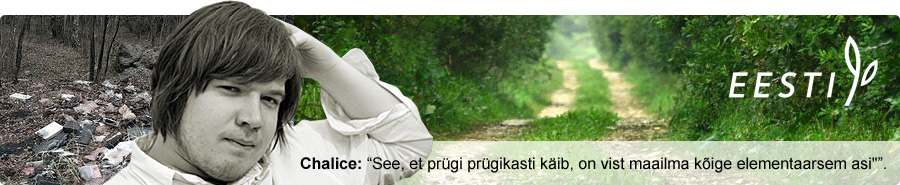
Today I took part in the Estonian garbage clean-up campaign called Teeme Ära which means something like "get it done". To be completely honest, I have no idea who organized the campaign, although I am fairly sure that the Tartu rapper Chalice had something to do with it (see advertisement above).

As an Estonian resident the campaign reached me via online media, radio, television, newspaper, and word of mouth. I had heard stories that the mysterious organizers behind Teeme Ära, including perhaps Chalice, had used high resolution satellite imaging to pinpoint every last empty bottle of Laua Viin in the forests of Eestimaa.

Maps were organized with larger dump sites. The Teeme Ära supply chain was activated, so that sometime around 9.45 am this morning we rolled into the village of Koosa northeast of Tartu to meet up with local organizers who would direct us to the trash and give us the correct bags to put it in. In our car were Ilona and Leena. Ilona is the same age as me and a mother of two. Leena's age could not be guessed, but seeing as she was introduced as being somebody's grandmother, in Estonia that would make her around 35 or older.

Maybe I was tired, but for whatever reason I just couldn't understand what Ilona was saying in Estonian. This happens sometimes. I understand the woman on the radio. I understand the contents of the article. I can read the ingredients on the cereal box. But some people I just can't follow. They speak too quickly or they slur their words. So Ilona, instead, practiced her English on me.

The road to Koosa is surrounded by a mix of leafy forests and farm lands. The tilled earth of the farms is black and pungent. For weeks now the days have been sun-kissed and today was no exception. When we reached our destination there were two guys there, neither of whom I could understand well, who haggled with Ilona about bags and directions.

It must have been a bad day for my language skills. I tried focusing on their lips, but all I heard were vowels tumbling out. Infrequent consonants, which might have acted as linguistic signposts to let me know that this word starts with 'k' or that one starts with 't', were given the once over. Instead, it seemed like 90 percent of what they were saying was either Õ or Ö.

We were sent, along with a caravan of other people bedecked in old, paint-marked clothing that said "I'm here to clean some shit up", to a place called Keressaare, where it turned out there was no garbage. Then, we turned around and went back to the gas station at Aovere, which was a few kilometers back. You see, the map had said there would be a gas station in Koosa, but it was closed. The map also said that there was a gas station in the neighboring village of Vara, but according to the clerk at the store I stopped in -- who I understood perfectly -- it wasn't there anymore.

On the way back, we started to get restless. It seems pathetic, but I could tell my passengers, Leena in particular, were dreaming about being directed to a huge, smelly, unhygienic mound of garbage. They didn't come all the way out to Koosa to eat a sandwich and visit a gas station. No, they came to "get it done." This, in a way, is a very Estonian thing. The British have the joy of sex. The Estonians have the joy of manual labor.

After yearning for heaps of bottles and dirty diapers our prayers were answered by a site halfway between Vara and Koosa at Sookalduse. Here Leena and Ilona were put to work clearing bottles and glass while I was called on to haul old tractor tires out of the marshy woods. At last, my hands were dirty. We were getting what we had come for. And then ... it was finished. That's it? I thought to myself, as I ate another pastry my wife had bought for me the night before.

Ilona instead directed our prügikonvoi to another site, this time in Peipseääre vald, which, with 981 residents, is mostly forest and field. The road in Peipsiääre vald was unpaved, and traffic by larger vehicles had left a hump in its middle littered with larger rocks that unpleasantly scraped the bottoms of our cars. One member of our caravan had their car breakdown because of this, but with a little mechanical prowess he was able to get it back on the road.

Teeme ära had been here too. Someone had already cleared this garbage site. In fact, you may be surprised to learn that we greeted the lack of garbage in Tartumaa with some sadness. We had come to haul car batteries and old couches, and all we had to show for it were some broken bottles and tractor tires. There simply was not enough garbage to sustain our enthusiasm. Discouraged, we drove back to Koosa.

In the parking lot, Ilona again haggled with those who were supposed to know things, while Leena, her thirst for garbage picking unquenched, proceeded to pick up small pieces of broken glass from the adjacent lawn.

By this point my head was hurting because I had mostly been immersed in a real Estonian language environment for several hours and my brain was getting tired of breaking down verbs and looking up meanings from my internal sõnaraamat. "Could you imagine speaking Estonian all the time?" I thought to myself. "Could you imagine if the word tõenäoliselt (probably) set you apart in the world?" It seemed the more words I learned, the less fluent -- in my own mind -- I became. The goal posts were forever moved. I would never be able to say the word pärast (after) the correct way.

I remembered how our friend David told us that when he first moved to Estonia and began working in Estonian, and often in Russian as well, that he felt like icing his head after a day at the office, the way football players ice their limbs after a brutal game. After several hours submerged in eesti keel my brain needed a little Bengay too.

We finally found a place to contribute to Teeme Ära several kilometers west of Koosa. There were already others there, gradually cleansing the roadside of bottles and cans and old bags of chips. We parked and joined them. Somebody had a radio on in their car that was playing swinging Estonian country music. In between the songs, the announcers gave updates on how many tons of garbage had been collected and how to sort the garbage you found.

I thought at first that it was a worthless job and that the place had already been picked clean. But then I noticed a bottle. Then another one. Then a can. Then a shoe. It seemed I couldn't walk ten feet without finding more garbage. I couldn't figure out where it all came from. Did people just launch their empty bottles of vodka from the car as they sped through here at night? Who dumped all those used Libero diapers near a creek? How did a pair of flip-flops wind up this deep in the woods? Were all of Estonia's forests like this? Did every pristine forest floor really conceal the discarded plastics and rubbers of our disposable civilization?

While the stretch of roadside we cleaned today is certainly looking better, I couldn't help but think that we could keep going on like that, from Koosa to Tartu and from Tartu to Viljandi and from Viljandi to Pärnu, picking up trash from the side of the road. It was a sobering thought.

reede, mai 02, 2008

island people

One of my chief concerns about moving to Tartu was its lack of sea. Tartu has water, a silty, slithering river known as the emajõgi, but there were no major geographic boundaries from which I could get my bearings.

As a child, I always lived by the sea. I always knew it was there, often minutes or less from our door. Even if I didn't go out of my way to see it everyday, I sensed it. I smelled its air. I could feel the dark humidity before a thunderstorm. It helped keep me, in some ways, sane.

It was my fear that by moving to Tartu, I would be somehow stuck in the Missouri of Estonia. My own internal bias was that all landlocked people eventually went mad. I didn't want to go mad and, as you can see, I haven't gone quite mad yet.

That is due to two reasons. First, Estonians themselves have an island mentality, even if one "coast" is a marshy border with Latvia. So no matter where you are in Estonia, you are still delineated by the Baltic and Peipsi. Second, Tartu itself is an island community that just happens to be surrounded by farms instead of sea. Going anywhere -- to Põlva or Otepää or Lake Peipsi -- takes some adjustment. When you are lost in Tartu, the outside world might as well not exist.

In Tartu, you forget that the rest of Estonia doesn't voluntarily wear 19th century university corporation fashion accessories to the supermarket. The rest of Estonia isn't brimming with people who call themselves "poets" by profession. In Tartu, thrill-seeking Americans gather together to ... drink beer and carve pumpkins.

The bevy of nighttime entertainment leaves you breathing room to roam from the cavernous püsirohukelder to the crowded Zavood, to the old-timey Vilde's. If you want Georgian, there's the Gruusia Saatkond. Italian? La Dolce Vita. Libraries? We've already lost count of those.

Why would one ever leave Tartu island when everything you need is right here?

teisipäev, aprill 29, 2008

a simpler estonia?

A recent trend in the Nordic countries is municipal reform. Denmark took the lead in 2007 by reducing Denmark's 13 counties to 5 regions.

Not to be outdone, Sweden also plans on reducing their counties system in favor of larger regions by 2015. As typical in the Nordic countries, Iceland has ignored the developments in Denmark while Finland hasn't even heard of them yet.

I find it a bit amusing that when the Estonians restored their state, they didn't restore their old county system. The current Estonian state has 15 counties, whereas the state in the 1920s and 1930s had 11 counties, one of which, Petserimaa, has since been stolen/annexed/ceded to Russia.

Does it really make sense to have a Lääne and Ida Virumaa county? How about just one "Virumaa", as it is still called by Estonians. Does Jõgevamaa serve any purpose? Shouldn't we just add some of the smaller bits to the larger ones and give the regions more power in implementing governmental reforms?

I'd like to think that Estonia was capable of pulling off such a reform if it so desired. But don't count on it. Estonian politicians would prefer to argue over the ostentatious võidusamba instead.

laupäev, aprill 26, 2008

the ansip malaise

It's springtime in Estonia. The birds and the bees are buzzing in the trees. No longer burdened by lousy weather and darkness, youth congregate on benches, drink in one hand, laptop in the other, to soak in the endless sunlight.

I spent the afternoon at our friends' daughters' fourth birthday party. The backyard was thick with children. There was the birthday girl, Liisa, but also Helena, Marta, Anna, Marta, Krõõt, Minna, Uku, and Kaarel. One young mother of two even had a third on the way. Happy times, and yet a certain unsteadiness hangs in the air.

It's been twenty years since the Singing Revolution, remarked Ott, who was then only 17, but is now 37 with slightly graying temples. As he stood before these happiest of times, he also managed in his infinite wisdom to identify the missing ingredient. The will to act.

This is what is lacking from Estonia right now. The will to identify problems, of which there are a few, host an honest and open debate, and come to some consensus about how to solve those problems. There is a feeling that there is still more to be done, but that no one is willing to do it, and that the political leadership is incapable of acting without self-destructing in the process. The people are getting anxious. Society feels a bit irregular, in the digestive sense.

Minu kallis naine accurately pointed out that the current leadership needs to marinate a little more before its thrown on the grill. I agree.

reede, aprill 25, 2008

the truth is out there

It's that time of the year. Bronze Soldier removal anniversary time. A time to replay clips of violent youths overturning cars and lighting flags on fire. A time to engage in word battles on YouTube supported by random facts pulled from the KGB archives. A time to lecture Estonia about integration. Yes, it is that time of the year.

A German student in one of my classes said recently that she was surprised how her Estonian interview subjects tended to view the integration dilemma as a foreign construct, a plaything for foreign students and foreign journalists, but something that actually matters little in day to day life.

I privately wonder when I stopped giving a shit. A Swedish friend in Tartu once had to deal with an old Russophone neighbor who one day went crazy in the apartment house corridor shouting obscenities about "Estonians" and his terrible lot in life to live in the City of Good Thoughts. The Swede seemed to conclude that the subject was crazy. In New York we step over people who talk to themselves all the time.

The problem with all of these interpretations of Estonia and what is to be done in this country, is that the "Estonians" the Swede's angry neighbor was railing against are treated as one unified block. The actions of one political party, like Isamaa, can be attributed to all Estonians, because the state is wrongly seen as ethnocentric. But when we revisit the facts, we see, for example, that the vote to remove the odious Soviet statue last winter only passed by two votes.

The reality on the ground is that, when it comes to politics, it's rather hard to pin anything on the "Estonians." In a country where you are 70 percent of the population, it's sort of hard not to vote along ethnic lines. Instead you vote for other reasons. Some people in Tartu are disenchanted with the ruling Reform Party. In Tallinn they opine about Keskerakond. The concerns of everyday life -- day care and housing and zoning issues and roads and sanitation -- take precedence over historical blood feuds and naive suggestions about integration policies.

And so, one year on, I find myself reading the "foreign" English-language press and scratching my head. "There's Soviet baggage in Estonia." Well, what do you expect? "The citizenship processes could be liberalized." Easier said than done, my friend. "Maybe you should take another official language." And maybe you should privatize the British National Health Service.

This country is complicated, but attempts to explain it to the outside world often fail. People fumble for remedies to problems they themselves misdiagnose. It's like 18th century medicine -- they create a host of other conditions for you by trying to solve one unrelated problem. Got the flu? How about some leaches and blood-letting? That's sure to do the trick!

Estonia is closer than you think to solving the Rubik's Cube of the Soviet legacy. Let them work it out by themselves.

neljapäev, aprill 24, 2008

porihing

So I have been reading Andrus Kivirähk's Ivan Orava mälestused või helesinised mäed -- a faux memoir of a fictional elder Estonian who remembers the day when young lovers would gather at the home of President Konstantin Päts to play billiards and celebrate their honeymoons.

Even though my Estonian skills aren't up to the task, I bought a handy dictionary to help guide the way. I figured that it would be an excellent opportunity to build my vocabulary while enjoying Kivirähk's absurd humor. So, of course I was the idiot on the Tallinn-Tartu bus trying to contain my laughter as I read about Johannes Lauristin and his golden egg-laying dog. I almost wanted to turn to the button-down Estonian student beside me, her face buried in her mobile phone, and say "hey, this Kivirähk is some funny shit."

At the Lennart Meri Conference I saw Andrus' older brother, Juhan, who is something of political analyst sans absurd humor. I wanted to grab him by the arm too and talk about the tallalakkuja (bootlicking) Leopold Pakt, the imaginary third cosignatory to the infamous Molotov-Ribbentrop-Pakt, but I had a feeling if there was one made-up historical figure he did not wish to discuss, it was the lipitseja (brown-noser) Leopold Pakt.

Tallalakkuja and lipitseja are indeed useful words, but some of the other ingredients in this modern-day Tammsaare's vocabulary are less useful. One such word was 'porihing.' I consulted my dictionary and even the excellent aare.pri.ee dictionary, but there was no definition. Finally, minu kallis naine informed me that it was a made-up fusion of 'pori' (dirt) and 'hing' (soul). Literally, dirtsoul.

I am unsure of what I will do with this potent Kivirähkism for the time being. But rest assured, I will make good use of porihing before the month is out!

kolmapäev, aprill 23, 2008

the foreign minister for finland and estonia

"The European Union is 15 times richer than Russia, its population is three times larger, and it spends seven times as much on the national defence. Strong Europe is in the interests of both Estonia and Finland.''

-- Finnish Foreign Minister Alexander Stubb in Tallinn today.

(Estonia seriously needs to hire this guy)

esmaspäev, aprill 21, 2008

with whom to sauna?

Recently I was teased by laughing, joking, drinking night game-playing Andrei Petserimaa about my "pinko", "Commie", "lefty" leanings. "Ew," I shuddered to myself, "am I really on the left?"

It indeed seemed gross because these days I don't know where I am on the ideological spectrum. Kriistina Ojuland recently decided to confine "sotsiaalistid-marksistid" to the garbage bin of history. But I don't worship at the altar of St. Milton Friedman, nor have I any use for St. Marx or even St. Thorning-Schmidt. I have no saints. My geopolitical world view has no partisan bedrock.

And it is hard to exactly see where one party begins and the other ends. The current government, with its promises of pension increases and support for the ever popular mother's salary, seems to have borrowed some ideas from the social welfare Shangri-Las across the Baltic Sea. And it isn't it odd that when the government held out an incentive, people started making babies? Could it be that the gospel of liberalism does not apply to procreation?

But left wing? That sounds dirty. Trotsky was charismatic, but "permanent revolution"? It sounds like something Thomas Jefferson might have dreamed up in the sauna high on absinthe. What's a well meaning pinko to do?

In Estonia I tend to subliminally support the Social Democrats, because to me they seem the most normal. Perhaps it has come down to who you'd prefer to sauna with most, just as in the US, they ask themselves "with whom would I like to share a beer?"

Saunaing with Isamaa would be interesting, but after awhile I would get sick of hearing every little detail about the battles of 1944. Enough already with the 1944! Give me some 2008, or 2009 even! Saunaing with Reformierakond seems out of my league. You know that they only have the most expensive saunas, and I don't think I am wealthy enough to use theirs. As for Keskerakond, well, I don't think I could fit into a sauna with Savisaar.

But the Social Democrats? They'd probably have a regular sauna and a mixed one as well. And they'd keep the temperature just right, neither too scalding nor too warm. Given the aforementioned options, I'd have to choose Finance Minister Ivari Padar's sauna. And we could all get together and complain about how bad the second Estonia has it, and how integration is really working, I swear.

Ah, to be among my fellow useful idiots. There would be nothing finer. As for Petserimaa, well, I think he'd be welcome in the Isamaa sauna. They could take a break from discussing Sinimäe and tackle the 1967 war instead.

pühapäev, aprill 20, 2008

kolmapäev, aprill 16, 2008

a conversation with flasher t

There's a funny thing about Estonian blogger Flasher T, author of the lively Antyx. Everyone knows his real name is Andrei, yet they prefer to call him "Flasher."

I recently sat down with "Flasher" to do a non-blog related interview but decided to share the contents with you because Flasher is so damn articulate. Enjoy:

Where were you born?
Tallinn

What is your family background?

My mother’s family comes from Irboska [part of Estonia before WWII, now part of Russia]. My father’s side is Yiddish, and comes from the eastern part of Germany via Riga, Latvia.

How often do you go to Latvia?

Approximately once or maybe twice a year for last few years. I usually visit Riga and the surroundings.

Have you ever been to Lithuania?

No.

Have you ever been to Russia?

Yes. I have been there twice in my life, twelve years apart. The same place as well, St. Petersburg.

How would you describe the relationship between Russia and the Baltic States at the moment?:

Tumultuous. You have to differentiate between Russia as a nation and Russia as a state. As a state, Russia has a useful target in that Estonia won’t get particularly offended because it has the sense of security offered by EU and NATO membership. On the other hand, Estonia doesn’t have the immediate means to retaliate, so Russia has a tool to use in its internal politics almost without any fear of consequences.

I think by default, it likes Lithuania more because Lithuania never had a problem with citizenship, but I think Russian internal propaganda against the Baltics impacts all three countries equally and the average Russian who knows little about Estonia has the same attitude towards Estonia and Lithuania.

As a nation, it has a vague idea of the Baltics as something unspecifically hostile. Statistically, there's a percentage of Russians that are so dissatisfied with state that they will do things because the state tells them not to. And there's a percentage of Russians who are so politically apathetic that they don’t care. Those two percentages are where the bulk of Russian tourism in Estonia comes from.

How would you describe the relationship between Russia and the Baltic States ten or twenty years ago?

It’s always been there because Estonia has always had the combination of nationalism and practical superiority, superiority on an everyday level of creature comforts. On the one hand, Russians are provoked by Estonians’ dislike for them, and on the other hand Russians are practically offended by the fact that even in the Soviet days, life in Estonia was a lot better.

The Russian writer Mihhail Veller tells about how he came to Tallinn and came to work at a newspaper during the Soviet era. He recalls how he was drinking cognac in the lobby of the press house and he remembers seeing the bartender tell one of the regulars that there was a call for him and handed him the phone over the bar. He was stunned by this because it seemed like such a Western thing. In Estonia these things seemed so natural, but in St. Petersburg it wouldn't have happened that way.

That was the Soviet time. Now we have the issue that Estonia has evolved so much more efficiently than Russia. So average Russians are probably offended by the fact that Estonia did not need Russia and that Russia in fact held them back.

But why is your opinion different from the average Russians'?

My viewpoints are not representative of general Russian population. I don’t have a deep Russian identity. I don’t identify myself as a Russian. I speak Russian because that is the language my parents spoke, but my roots are in Estonia, I was born here and I grew up here. I have had no cause to significantly distrust or dislike the Estonian state, and from about the time when I started to develop my own judgment I have been significantly annoyed by Russian propaganda, and not just central propaganda as it applies to Estonia, but just Russian propaganda and the unseemly aspects of the Russian mentality that have been shaped by that propaganda.

How do you think the relationship with Russia will develop in the next couple of years?

I am hoping it will stabilize. Logic dictates that at least for the next 3-7 years, Russian officialdom will not have a desperate need for a scapegoat and at the same time Estonia has shown itself willing and capable to actively fight for mindshare in European politics. I think Russia will probably consider that it will be simpler to look for scapegoats somewhere else, such as Ukraine, Georgia, or the Balkans.

How would you describe the relationship between the Baltic States themselves at the moment?

I think they slightly resent being lumped together but see the logic in it and don’t significantly mind.

How would you describe the relationship between the Baltic States themselves ten/twenty years ago?

In 1988 we had a common enemy. In 1998 we had a common goal. At this point I think the Baltic states are more than ever before in a position to establish their identities independently, not just as Baltic states.

A substantial part of that is that Estonia associates with Finland and Sweden, and Lithuania associates itself with Poland. I think a cute example of Baltic relations is Tallink, which invested massive amounts of money into a new fleet to do the Tallinn-Helsinki and Tallinn-Stockholm route, but has also bought the Riga-Stockholm route and uses its old dilapidated ferries there.

What are the causes for the change in this relationship?

There isn't a significant need to stick together. Before it was us three against the world. Now it is us 27 against the world. And us 27 have a lot more at stake. The overriding necessity has diminished so the three countries have an opportunity to create their identity which they would have always been happy to do had the need not been there. Because they don’t have that much in common, other than that they are all in the same spot and they are all rather small.

How do you think the relationship will develop in the next couple of years?

I don’t think there will be any cosmic shift. There might be a few misunderstanding between Estonia and Latvia because Latvia has decided on a course of appeasement towards Russia, where as Estonia is still pissed and not to let Russia get away with anything. Lithuania is content to keep its head down and figure out its own problems for awhile.

Can you explain where the Baltic States differ from each other?

It comes down to influence. Lithuania and Latvia are quite close, Estonia is ethnically different. Latvia has a stronger German heritage than Estonia. But Estonia has this concept of the good, old Swedish times. Estonia wants itself to be thought of as part of Scandinavia. I think Latvia understands that they can’t pull that off. Lithuania has its two religions, Catholicism and basketball. Even if it doesn't wish to be, Lithuania inevitably turns out to be a client state of Poland in the same way that Estonia is a client state of the Nordic Council.

Do the identities of the native Russians differ from the identities of the native Baltic people?

The difference is in taking responsibility. The key significant between proper locals is that they have a sense that this is their country and they are responsible for how things work in it, whereas local Russians, their biggest difference and the source of their problems is that they don’t feel in charge here. They don’t feel like it’s up to then to change things or that they could change things.

Would you say that the Baltic States can be seen as a region where the people have the same identity?

No, of course not.

Can you explain where the Baltic States and Russia differ in terms of identity of the people?

On the more general level, Russians perceive the space relevant to them as far greater. Estonians are essentially interested in their own farm and maybe their own country. Most Russians aren’t even interested that much in their city. They are primarily interested in their country and its place in the world.

On any level that is really important, Estonians don’t care whether anybody likes or fears Estonia in the world, as long as their pigs are healthy. This goes a long way to explaining differences between Estonia and Russia – levels of street cleanliness, levels of corruption, relations with authorities. This does come from Soviet propaganda, but it was also there historically. Russians have a sense of if they don’t do it, somebody else will. Estonians have a sense of if they don’t do it, it’s not going to get done.

What are the main areas where Estonia, Latvia, and Lithuania should cooperate?

Lobbying of common interests in EU internal politics. The rest of it we can handle, but EU internal politics is a place where interests are similar to a large extent and we could benefit from acting as united front.

kolmapäev, aprill 09, 2008

puhkusel

Wow, this is my 500th post. Anyway, I have decided to take a little break from the blog. Not for too long, but the remainder of April is going to be very busy on the home front. In the meantime, the gateways to the northern dimension are always to your right if you need a little early morning discussion or late night entertainment.

pühapäev, aprill 06, 2008

tanking in tallinn

Explain this for me:
Support for the ruling Estonian Reform Party (ER) has declined over the past month, according to a poll by TNS Emor. 30 per cent of respondents would vote for the ER in the next legislative election, down five points since January.

The Estonian Centre Party (KESK) is second with 27 per cent—up four points in two months—followed by the Union of Fatherland and Res Publica (IRPL) with 16 per cent, the Social Democratic Party (SDE) with 12 per cent, the Estonian Greens (EER) with eight per cent, and the Estonian People’s Union (ERL) with four per cent.

Reform Party has gone from enjoying a post-Bronze Soldier crisis high of 43 percent support in July 2007, to just barely topping KESK in this recent poll. Why? Perhaps call it the 'Ansip malaise' -- no euro adoption, higher inflation, a cooling real estate market, and, in general, no big plans for, uh, reform.

Meanwhile, government investments in research and development, education, and health care aren't really matching Estonia's neighbors', and so human development also lags behind. The average Estonian man lives to the age of 66. His Finnish counterpart lives to 79. For all the new, shiny commercial buildings in Tallinn, maybe the average Andres hasn't been feeling enough love from Stenbock House. What's your take?

neljapäev, aprill 03, 2008

nägemist, ilkka

One has to wonder at what point between Finnish Foreign Minister Ilkka Kanerva's departure from Ljubljana, Slovenia, his arrival in Tallinn, his dinner buffet at Kadriorg, and then his no-show at the Lennart Meri Conference session on Baltic and Nordic cooperation the following morning, did he get a text message from Kokoomus leader Jyrki Katainen telling him that he was out and Alexander Stubb was in.

I had a feeling that the endless global media coverage about Kanerva's textcapades with an adult entertainer 30 years his junior may have been getting to Katainen, who perhaps fretted about what impact this would have on the marketability of Kokoomus' conservative chic. But I also wondered who knew what and when. Did all the politicos at the conference know Kanerva's fate before we did. And how long is the delay between official knowledge and public knowledge?

In someways it reminds me of the NATO Bucharest summit. President Bush went on tour in Kiev publicly backing membership action plans for Ukraine and Georgia. And yet it has been widely known for weeks that Germany would oppose MAPs for these two countries. So did Bush utter those words in Kiev just for show and to encourage further reform in these two countries, knowing all along that no matter how hard the US promised to fight in Romania, their fates were decided before the summit? Maybe. But who knew what and when, and how did that influence the show we see on TV? I think a lot of people ought to be asking themselves that question.

pühapäev, märts 30, 2008

whither social democracy?

Moral cowardice. Greed. Stupidity. Those are the reasons that the current German leadership lacks the political will to send favorable signals to Ukraine and Georgia about future NATO and EU membership, according to one foreign policy thinker.

This hesitance does influence other wobbly policies in adjacent Western European countries like France and Spain, and yet the trail of breadcrumbs seems to lead us back to Berlin's grand coalition of Angela Merkel and Frank-Walter Steinmeier. Aye, the stench of the German Social Democratic Party is in the air on the eve of the NATO Bucharest Summit.

This weekend's Lennart Meri Conference was in someways a coming together of the European center-right. The representatives of former German Chancellor Gerhard Schroeder were not to be found. And while Lennart's soul is kept alive with anecdotes about a chain smoking Estonian intellectual with a whimsical love of history and a way with quick oneliners, I felt that the real soul of the conference was Mart Laar, who during his turn on the panel sat with his laptop open, presumably keeping abreast of world events while the other interviewees tried to explain European integration with metaphors about love making.

"Is he it?" I thought to myself. "The new, living embodiment of Estonia -- absorbed by the questions of the day and distracted by his beloved technology?" Laar strikes a nice balance between the Estonian Ambassador to NATO Jüri Luik, who seems a quiet and tough patriot, and President Toomas Hendrik Ilves, who without notice might color his arguments by referencing Wittgensteinian philosophers, the 1970s Philadelphia city government, and IKEA.

And Laar is from the parempool -- the right wing. My inner journalist cries out for some social democrats to counter the onslaught this union of right forces, maybe former Finnish PM Paavo Lipponen, or Schroeder himself. Please, come, make them mad so we can have a good show. But the truth is that they probably weren't invited because of their association with moral cowardice, greed, and stupidity.

It's as one Finnish analyst put it during a morning session. He said the Finnish NATO debate was being defined as a conflict between 'Nokia' Finns, who wish to integrate completely with Western institutions, and 'Muumin' Finns, the idealists who question the need for such a common security arrangement with the majority of their neighbors. I mean collective security, who needs it?!

Finnish FM Ilkka Kanerva was supposed to attend a session this morning, but he supposedly had to return prematurely to Helsinki to face up to the text message scandal. When I asked a Finn if he would like to see the personable social democrat Erkki Tuomioja back in the FM's seat should Kanerva step down, he told me that he liked Erkki's style, but he hoped that the Finnish Social Democrats would stay in political opposition in the Eduskunta for a long, long time

From the Estonian perspective these 'Muumin' Finns and Norwegians and Swedes and Germans are seen as untrustworthy. They were the ones who pleaded with the Baltic independence movements to not rock Gorbachev's boat back in the late 1980s. They were apparently very wrong, and their silence and sweetheart, sauna diplomacy since has soiled the legacy of social democracy. Those of us who grew up in awe of the capability of these dynamic northern countries to educate and care for their masses are now turned off by the morphing of social democracy into Schrödocracy, a self-interested coziness with illiberalism and little else.

It's the reason why there are so few Western European social democrats involved in the important debates of today. They have become stale and irrelevant. As someone pointed out over lunch, "Why would you even bother to invite the European left to a place like this when they have nothing to say?"

Nothing to say, and yet, Estonia could learn something from the Muumin welfare vikings from across the Baltic Sea. Estonia wants to transition from a low-cost, low-skill economy of tourism, transport, and manufacture, to a high-skill, high-pay economy of technological innovation -- the kind of society embodied by Laar and his laptop.

Yet do the Estonians really get the kind of state support that their northern brethren do in Finland and Sweden? People travel from all over the world to study at the Karolinska Institute or the University of Helsinki. And they go on to found university spin-outs that make the Nordic countries among the most competitive economies in the world. Much fewer are those who take the bus to Tartu, Estonia instead.

I would like to believe that the reason for these small, relatively remote countries success has less to do with them being of superior genetic stock, as one disgruntled German World War I veteran put it, and more to do with the fact that their governments invest heavily in their people and the investment tends to pay off. And so, despite its moral cowardice, greed, and stupidity, European social democracy has had some benefits.

Driving through the streets of Tallinn last night, I got an earful from an Estonian taxi driver named Vladimir. As we zoomed through Telliskivi, the taxi drove into a deep puddle, and you could feel the frame of the car scrape the ruined asphalt beneath as the car pulled its way out.

"Now that we are in the EU, we have EU prices," he opined in accented Estonian. "We don't have European roads, or European salaries, or European service. But we do have European prices." I pointed out that EU structural funds were being spent on renovations on the Tallinn-Tartu road. "They are going to have to renovate more than road around the airport," Vladimir said. "These roads are destroying our cabs, and who pays for the repairs? We do."

He's right. European integration has brought economic miracles to downtown Tallinn. But drive a little bit deeper into the residential neighborhoods and you'll wonder when the invisible hand of the marketplace will manage to make their sidewalks walkable and streets navigable. As for those poor dopes in the countryside, well, they'll have to wait especially long for the invisible hand to reach them. Most probably think that it will never come at all.

It would seem like these day-to-day issues would be a boon to proponents of social democracy. Fix the city roads; fix the city plumbing. Fund the universities; bring in the talent; reorient the economy. Demonstrate the capability of government to positively impact the average Vladimir's life. But no, Europe's social democrats are probably too busy cutting gas deals with Gazprom and smiling for the camera to take advantage of such opportunities. It makes me really mad.

The only thing that could distract my political malaise was people watching in Old Town. As I turned down a narrow medieval street after a deeply moving performance of Arvo Pärt's music at the Niguliste Kirik, I was stopped by a British youth in front of Olde Hansa, the living embodiment of Estonia's tourism industry.

'Pardon me, mate, but are you from around here?' he asked.

'Uh ... sort of,' I replied.

'Do you know where I can get some cocaine?' he smiled.

'Cocaine, huh?' I said. 'Well, you could try the McDonalds down the street for a hamburger instead.'

He looked at me a bit weird and then said in a perplexed voice, 'a hamburger?' I walked off, leaving him to the lights of the Raekoja Plats.

laupäev, märts 29, 2008

soul limbo

So I am here in Tallinn, city of Danish expansionism. Tallinn does not feel like the Estonia I know, the Estonia I try to write about. This city is not crisscrossed by the bumpy, unpaved roads of Viljandimaa. Instead, its well-heeled pedestrians enjoy the cosmopolitan life.

That means eating a lunch like the one I just ate -- of delicious, peeled pears covered in sweet whipped cream, satisfying pasta salads, medallions of mouthwatering beef. Where are the potatoes, pork, sauerkraut, and tordid? They don't sell food like this in Selver.

This is the fare served up at the Second Annual Lennart Meri Memorial Conference, held this week. The conference, organized more in line with Meri's interests than his cult of personality -- as it should be -- draws together the Estonian policy community, representatives from think-tanks across Europe, foreign ministers, prime ministers, ambassadors, high representatives -- people whose opinion should count. And also the media.

I have to say the mood of this conference strikes me as different from last year's. There seems to be greater resignation in the air about "the West" and its ability to influence events in adjacent countries. The soft and hard support mechanisms that influenced, say, the "color revolutions" in Georgia and Ukraine seem tired by the reality of how hard it actually is to make Abkhazia make up with T'bilisi, or how realistic it is that Ukraine would under go complete reorientation, or how much energy it will take to produce meaningful reform in Belarus. At the same time its clear that "we" still care about "them." This isn't all just for fun and territorial bragging rights.

Still the speakers, including riigijuhid Mart Laar and Toomas Hendrik Ilves, argue that we should worry less about changing the debate within, say, the Russian Federation, and instead focus more on making sure our own countries are corruption-free. The best offense is a good defense. Wear a condom. That sort of thing.

That's a tall order even in lily white Estonia -- held out as a model for other transition countries -- where the domestic political debate simmers over crooked real estate deals. Is it really like the old grannies of Viljandimaa will tell you? Is it true, vanaema, that all politicians are crooks, even Estonian ones?

György Schöpflin, a European MP from Hungary, argued yesterday that we are entering a bust after a long boom -- one that I assume dates back to the end of the George H.W. Bush recession in the early 1990s and drove us from the Spice Girls debut, through their break up, their solo albums, and to their eventual reunion. We had a boom, now prepare for bust. That's a hell of a weight to have on your chest when Edward Lucas is telling you to strap on your protective gear for The New Cold War.

I am not sure how this stew will turn out, and I am not sure this conference will answer it. The discourse ranges from highbrow debates over "Western values" and "imitation democracy" to more concrete discussions about the Middle East. But I do believe that these kinds of discussions will help guide the policies of the future. Such concentrated talent can only lead to some kind of result.

As an aside, I am surprised by how enormous so many Estonian politicos are. Defense Minister Jaak Aaviksoo must be taller than I am. MP Marko Mihkelson must be as well. With a few less savory Tallinn luncheons, and a little practice, Estonia could have one hell of a Riigikogu basketball team. They should challenge Putin and Medvedev to a match.

teisipäev, märts 25, 2008

mälupulk

Why is my life filled of tiny dramas like this one? Yesterday, at Euronics, I set about trying to find a 'memory stick' so that I can transport handy things like PowerPoint presentations from place to place.

The trouble was that I couldn't find it, and I was terrified to ask the müüja (seller) because I couldn't remember the words for 'memory stick' in Estonian. Memory is mälu, but the only word I know for 'stick' is kepp.

Kepp is a very troublesome word because it can also be used as a euphemism for sex, that is to say kui Tõnu kepib Triinu, he's really 'stickin' it' to her. Kepp is simply not for polite talk, and I was afraid that if I asked for a mälu kepp, the müüja might get some unwholesome ideas.

Fortunately, at that point, I spied the memory sticks on the other side of the store. And there it was written mälupulk. Ah, yes, pulk -- the word Estonians use to denote a 'stick' without any inappropriate innuendo. Pulk as in pulgakomm (lollipop), huulepulk (lipstick), and soolapulk (pretzel). Sometimes it takes a while to learn a new word. Consider pulk to be part of my vocabulary.

esmaspäev, märts 24, 2008

keskid

When Reformierakond won two seats more in the Estonian parliament than its closest competitor and former coalition partner Keskerakond, the prevailing sense among the Keskid was that Reform would flirt with Isamaa-Res Publica Liit, then return to form the new election coalition with Keskerakond.

Unfortunately, for Keskerakond, that didn't happen. The major stumbling block to a coalition agreement with IRL -- the appointment of Mart Laar to the post of foreign minister, which was rejected by PM Andrus Ansip -- was set aside and the coalition was formed with the Social Democrats. Keskerakond went into opposition.

This morning I caught an interesting interview with Kadri Must on ETV, the head representative of Keskerakond and an Estonian MP. Keskerakond has been trying to woo/insult Eestimaa Rahvaliit and SDE into consultations, though SDE has made it clear that as long as Tallinn Mayor Edgar Savisaar is leading Keskerakond, it will be unwilling to partner with that party.

This is a smart bluff from SDE. In reality, the kinds of voters that SDE is looking for are the same ones that attract Keskerakond's support. Savisaar is Kesk's most charismatic candidate. If Savisaar were out of the picture, presumably SDE's support would grow. And since he's unlikely to be out of the picture, well, SDE can just sit right where it is -- in the ruling coalition. They shouldn't rule out consultations though. With a dependable 10 percent of the electorate behind them, they very well could wind up being the party that is never out of power.

The idea of Savisaar remaining as mayor of Tallinn and a newer prime ministerial candidate being put forward by Keskerakond was evinced from Must during the interview. The ETV interviewer mentioned the fact that, by Estonian political standards at least, Savisaar is getting kind of old (He will be 61 in 2011, the year of the next parliamentary elections). He was also at the top of their list in 2003 and 2007, and didn't manage to win, even though polls indicated the odds were in the party's favor.

Must responded that the party leadership is certainly weighing putting someone younger forward in 2011, perhaps former Minister of Social Affairs Jaak Aab (pictured), or former Minister of the Interior Kalle Laanet. Both Aab and Laanet hail from the countryside -- Aab is from Helme Parish in Valgamaa, Laanet is from Saaremaa -- and they definitely carry less baggage than Savisaar. But it remains to be seen whether this idea is genuine or just morning television BS.

Another concept floated was that 2009 -- the year of European Parliamentary elections and municipal elections in Estonia -- will be a trying one for the ruling coalition because of their conflicting platforms. I have some suspicion that Keskerakond has already hatched a sinister plan to play the current coalition partners off one another and ride their way all the way back to Stenbock House. We'll see.

pühapäev, märts 23, 2008

põlvkonnad

I recently read through the Estonian Human Development Report for 2007, and the section on integrating non-Estonians -- one of the four main sections, which gives you an idea of how important this topic is in Estonia and abroad -- gave me a new insight into the dynamics of Estonian integration policies and current politics.

The most helpful figure was a breakdown of Estonian residents by age group and ethnic identity. You may be surprised to know that the 25 percent of Estonia that is ethnic Russian is not equally distributed along the age groups. Instead the Estonian side of the graph resembles an hour glass. Ethnic Estonians are about 75-80 percent of the over 60 and under 45 set. But for the middle aged generation, the split is actually 60 percent ethnic Estonian, 40 percent ethnic Russian.

Why is that important? Step into my time machine, and let's revisit the lifespan of the generation of Andrus Ansip (age 50) and Mart Laar (age 47). They were born post-Stalin, so they have no memories of brutal deportations or wars in the woods. Instead, they were raised by the broken survivors of the Second World War, entering adolescence during the Brezhnev stagnation, and becoming young men during the Russification campaigns of the late 1970s and early 1980s.

They must have also noticed that 40 percent of their peers were not ethnic Estonians. And as members of a Soviet society, it was they who were expected to adapt to the majority, Russophone culture, not the other way around. They may have pondered sometime during the tenure of Karl Vaino, the ethnic Estonian Russophone head of Eesti NSV, that if their generation was split 60-40 with Estonians on top, would the next generation have the same split, except with the ethnicities reversed? Were they all just Karl Vainos in waiting?

So you could say that this generation is deeply concerned (not paranoid) about Russian influence in Estonian society. They are the ones that gave you the language law and the law on aliens. They are the ones who form the core of the right-wing leadership. Most importantly, it is this age group that will remain in power for some time to come. The Human Development Report states that it is this age group that is most likely to oppose any liberalization of the current laws. I wonder why.

That's one generation, but how about another? Of those aged 15-19, 78 percent are ethnic Estonian. To give you an idea of what kind of majority that is, it might help to recall that 79 percent of the Russian Federation identifies as Russian. Around the same number of Lithuanian residents identify as Lithuanian. So it's not a simple majority. We're talking nation state.

It's also a majority reinforced by a state culture that favors it, a mass media culture that produces the majority of its products for their consumption. This is an Estonia absent of the bold, Slavic touches of the USSR, and instead covered by the cute, clinical, and nordic. This Estonian majority has grown up with almost no living memory of the USSR. Rather than feeling threatened by the onslaught of Soviet population transfer, they instead feel confident about the future. According to the report, because of this security, they are more 'integration friendly' than their parents' generation. But what of their ethnic Russian peers?

It is their peers who ironically find themselves in a situation not unlike the rising generation of Estonians found themselves in during the late 1970s. Instead of feeling confident, they feel weak. As pointed out previously, their numbers are smaller. In cities like Tartu, Pärnu, and Tallinn, where sizable ethnic Russian minorities have existed since the 1950s, their proportion of the population is shrinking. Instead of coming to Estonia to rebuild it, confident in the mechanics of the Soviet state, as their grandparents did 50 years ago, they instead have grown up poorer than the rest, living in shadow of the collapse of the USSR.

Some may have been intimidated by those who were out in the streets last April smashing windows and burning flags. But the sad reality is for all that damage, there were only a few thousand young people willing to 'go to war' over the Bronze Soldier in Tallinn. Instead of the anger, what one might have seen is the desperation. Because they have no power and their world is determined by a bunch of middle-aged ethnic Estonian men. And, as we have discussed, they have their own phobias and agendas.

Despite this, the report left me hopeful. If the younger half of Estonia really does look like a nation state, and they are less encumbered by the baggage of the Soviet era, then they may be more amenable to an 'open and inclusive debate' about its domestic policies. What I came away thinking after reading the report, was not that Estonia needs any more suggestions from traveling bureaucrats or prodding from Brussels or Moscow. Instead, this country just needs more time to work out its issues by itself. I find that conclusion not only convincing, but also relieving.

laupäev, märts 22, 2008

regilaul

I recently burned myself a copy of Hedningarna's 1999 album, Karelia Visa. It is a modern exploration of Karelian folk music. I am pretty pleased with it, and it serves as good background music during a ride through the countryside.

It's also fun to match the Karelian words up with the Estonian ones. the first track 'Veli' means 'Vend' (brother) in Estonian. The second track "Mitä Minä (Laulan)" is "Mis mina laulan" (what I sing) in eesti keel.

When I visited Lapland about five and a half years ago I remember that there seemed to be an abundance of folk music available for purchase. The most famous folk form in Finland is, of course, the Sami joik. I became well acquainted with 'joiking' during that trip.

In Estonia though I am unaware of where I can find decent recordings of Estonian folk music. I am familiar with the works of Jaan Tätte and Erkki-Sven Tüür, but I am thinking more along the lines of people from rural areas singing the traditional runo song or regilaul. That is why I am putting up this post: I am fishing for some new music. My daughter requests music performed by other girls, so if there are female singers, it's an added bonus. I welcome your suggestions.

kolmapäev, märts 19, 2008

naughty poika

Is Finnish Foreign Minister Ilkka Kanerva smiling in this photo because he just received a naughty text message? Could be.

According to the Helsingin Sanomat, the 60-year-old Lokalahti native sent about 200 text messages from his Nokia mobile phone to Johanna Tukiainen, 29, one of which asked what she was wearing under her tight dress.

In another message suggested an arrangement with Miss Tukiainen and her sister, Julia, who has worked in adult industry (see photo below).

Kanerva confirmed earlier this month that he had sent text messages to the dancer. "Messages have been sent, but not in the sense of any deep drama of human relationships", he said in Brussels following a European Union foreign ministers' meeting.

This week Kanerva revealed that he has received death threats, presumably from the Tukiainens' father, while Tuija Nurmi, an MP from his own Kokoomus party, has called for his resignation.

But Kanerva need not worry, because Prime Minister Matti Vanhanen has got his back. Vanhanen, let's not forget, recently lost a court battle over a kiss-and-tell book written by his former lover, Susan Ruusunen, in which she detailed how he loved to sauna before sex and eat potatoes and beef afterwards.

He also has used his handy Nokia to organize his personal life. According to the Daily Telegraph, Vanhanen dumped Ruusunen with a text message: "It's over."

Let's just hope Kanerva doesn't start text messaging Vanhanen any time soon.

teisipäev, märts 18, 2008

püksid - byxor

In New York -- where I spent most of the last week -- the front pages of newspapers teem with fun headlines about former Governor Eliot Spitzer's appetite for call girls. In Estonia, on today's front page of Postimees is a debate over whether or not integration is an enemy of the Estonian language.

Urmas Sutrop, director of the Estonian Language Institute, made headlines last week when he said that integration was a threat to the Estonian language. Sutrop clarified his position today, explaining that by bringing 300,000+ speakers of Russian and Ukrainian into the estophone world, the language will inherit their grammatical errors and loan words from their native tongues, thus diluting the riigikeel (state language).

Rein Raud, rector of Tallinn University, writes in response that Estonian has already borrowed heavily from foreign tongues and sees no threat in borrowing some more. He gives several examples of common Estonian words of foreign origin in his piece. So, as I drank my morning coffee, I was able to learn that the Estonian word for trousers -- püksid -- comes from the Swedish word 'byxor'. I did not know that. See, that's what Estonian newspapers are for.

reede, märts 14, 2008

smug city

I wouldn't hold up Estonia as a model because I think they have been quite smug. Their particular problem is the Estonian Russians -- their integration has not gone as fast as it should have done in the past few years.

The Bronze Soldier riot was a wake-up call to them. They're not getting the solid allegiance of a new generation of Baltic Russians. Fifteen years ago no one would have dreamed that Russian teenagers would be rioting in the streets of Tallinn shouting 'USSR forever!'

--
Economist correspondent Edward Lucas in an interview with Alfa.lt last week.

The thing about this comment is that it is true. Yes, some Estonian politicians might strike an outsider as smug and self-satisfied. They suffer from 'Tallinn syndrome' -- where the country girl or boy from Haapsalu or Paide suddenly finds themselves surrounded by buildings that are taller than three stories and the international political jet set and are too absorbed in the euphoric moment of "I've finally made it, baby" to think about what comes next. Integrating Estonian Russians? That's the last thing on the list of things to do for a person afflicted with Tallinn syndrome. They are more concerned in skirting zoning laws.

Yet, on the flipside, the 'Western' European outlook on 'Eastern' European countries seems smug in itself. Hey, Estonia, you need to work on integration. Easier said than done. What is the solution? Feel good, useless legislation? National campaigns to get ethnic Estonians to view their Russian-speaking neighbors as 'equals'. That would be great, if ethnic Estonians actually liked their ethnic Estonian neighbors. Instead, Estonians tend to treat each other as competition. As someone once famously pointed out, the only authority an Estonian might be willing to salute is themselves in the mirror. But please, integrate those Russian-Estonian/Estonian-Russians, kohe!

So Lucas is right, but is the very expectation of what Estonia is capable of doing in itself wrong? Is it that Estonian syndrome, Flasher was talking about: the presumption of competence. I personally believe that, either by the basis of civilizational outlook or constant self-delusion, Estonia has become a quasi-Western European country. One may worry about the security implications of some teenagers burning an Estonian flag or chanting 'USSR Forever', but, shit, how about the security implications of publishing some drawings of the Prophet Mohammed in Denmark?

I mean first it was just the insult to Islam. Then it was the way society reacted to the insult to Islam. Then it was the way the police put extra pressure on those who may be insulted by the Danish cartoonists' insult to Islam. And then it was those anarchist lovers of multiculturalism who turned over cars and set fire to buildings to let ordinary Danes know that they are in solidarity with their friends who may have been insulted by the Danish police or the sinister cartoonists they protect. So, please, Denmark, integrate your Muslims and anarchists. Pass a law, build a new joint ungdomshuset-mosque, and stop selling flags to the Iranians to burn. Please, anything to make the uncomfortable reality of violent, idiotic youth go away.

Perhaps my world view has been too informed by the musings of lost existencialistas. Perhaps I too suffer from Tallinn syndrome. I have had my sõõrikud, drunk my coffee, rubbed elbows with people who know people. But I have heard the same conversation in the dormitories of Copenhagen that I have heard in the living rooms of Tallinn. People don't want to live their lives in fear and they do believe in integration. Yet beyond that, they know not what to do. What can an individual really do, other than work, eat, sleep, and occasionally reproduce? In the meantime, our hapless northern individualists find themselves hijacked by 'fascists' -- as a Danish colleague referred to the anarchists, Muslim extremists, and Bronze Soldier 'defenders' -- for whom they have little or no respect.

It appears that there are no easy answers. There are no laws to pass. There is no governmental interference that can make it all go away. We'll just have to cling to the life preserver of rote pragmatism and stomach it. To borrow a line from Braveheart: they can burn our R-Kiosks, but they can never take our freedom.

neljapäev, märts 13, 2008

järgmine peatus: 'the new cold war'

One of the reasons I routinely attempt to connect Estonia to other northern European countries for readers used to seeing it portrayed as just another piece of the geopolitical puzzle, is that Estonia is blessed with a quality one might find in Bergen, Reykjavik, Umeå, or Oulu: isolation.

On any map, Estonia is connected both to the central European landmass and is a stepping stone to the St. Petersburg region and Eurasia beyond. Yet on three sides Estonia is surrounded by water. To the south are the avenues of Riga and Europe, and to get there you must get on a bus or plane. This is not Benelux where happy backpackers can zoom from country to country by high-speed train, drinking all the way. Even within Estonia, travel is encumbered by unpaved roads, ferry connections, and aggressive drivers.

If a person wakes up in Kärdla, Hiiumaa, how long would it take them to get to Narva at the other side of their tiny Baltic nation? And for the residents of Võrumaa, how genuine were events like last year’s riots in Tallinn? Weren’t they just like every event in the world, broadcast by radio and television? In Estonia, the outside world takes awhile to seep in.

It is in this context that I should say the premise of Edward Lucas’ book The New Cold War: How the Kremlin Menaces both Russia and the West seemed troubling. Here Estonia is portrayed as the frontline in the behind-the-scenes battle between Western liberalism and Eastern illiberalism. Banks and gas pipelines are the carriers of the disease. President-Select Dmitri Medvedev might be the poster boy for New Russians, but who knows what his heirs or handlers might do with the channels of power they inherit.

From the perspective of The New Cold War, small fishing villages such as Omedu on Lake Peipsi where they sell smoked fish and onions are the new guard posts of the West. It seems a preposterous notion. But on Omedu’s side of the lake, the politicians are derided as idle or self-interested servants, held to scrutiny, and discarded when they are no longer useful. On the opposing side of the lake, the politicians are gods massaged by the media and industries they own. They are only accountable to the man at the top, not the people at the bottom.

This is the crucial difference that makes for the conflict described by Lucas and it is all true and widely known in Estonia. While Lucas tries to rouse Rip Van Winkle-like Western Europe to the fact that the narrative of 1989, of Russians embracing Western values, listening to the Scorpions and Billy Joel, eating Big Macs, and trudging down the road to the West is long over, it is not difficult to argue that Estonia never had much faith in its eastern neighbor to begin with.

More likely the Estonian government of the 1990s and early 2000s that successfully navigated the Estonian ship of state into the ports of the European Union and the North Atlantic Treaty Organization saw Russia like any Pärnu homeowner would view the retreating of the Baltic Sea after a flood. It was time to inspect the damage, repair what could be salvaged, and build a better foundation. Moving, in Estonia’s case, has never been an option.

And because of this quiet country cynicism, a better bulwark for the West could not be imagined. During last April’s nonsense, we pondered what would happen in our home city of Tartu should the “Pskov division” be “not far off.” And it was difficult to imagine Tartlased doing much of anything other than shrugging and going about their business. Either they would stand by the invader’s tanks and mock, as they have done for centuries, or, more likely, they would hunker down inside with a stash of alcohol from the local Selver and mock some more via Internet. If the invaders were to sever Estonia’s Internet connection, well: that would only result in one thing: a fierce and bloody guerrilla war.

And that leads us to the final question. For whom is this book written if the Estonians are already aware of what lies across the River Narva? Well I bought it in Heathrow Airport, and it is written by a British author in the English language, though many editions are planned in other languages. So I suppose the main audience is the readership of The Economist itself: Britons and those who take part in corner-booth international relations chats at cafes from Santiago to Hong Kong. This is a book written partially for those in the know and partially for the English-language audience that needs to know.

Inside you will find the sinister murders of Russian journalists and dry humor in explaining how Gazprom manages to waste so much of its money on “ludicrously grand buildings, holiday resorts, yachts, and other gimmicks.” It is as if Edward Lucas’ brain were uncorked and its contents, mixed from the briefings of Vladimir Socor’s postings at The Eurasian Daily Monitor, the behind-closed-doors musings of NATO officials, the paranoia of Lithuanian energy heads, and the rare moments of honesty on the part of Kremlin apparatchiks, were poured into nine chapters that somehow manage to tie the mess of the Putin years into a coherent framework. A book, if you will.

This is no easy task. Lucas’ final chapter: ‘How to Win the New Cold War, Why the West Must Believe in Itself’, could be a book on its own right. But rather than ponder where there could be more and where there could be less, readers should instead just read it. Some might read its title as a call to arms. But, rather, I see it as a very long letter written by a correspondent who has so much to tell you that he cannot squeeze into an article in The Daily Mail or The Economist. It’s a letter from the correspondent to you. In this way, the book is for everybody: the traveling journalist in Heathrow, the London commuter, the corner-booth conspiracy theorists in Santiago, Chile, and maybe even the citizens of small Estonian villages who wearily watch Russia from the other side of the lake.

esmaspäev, märts 10, 2008

naistepäevast

March 8 was International Women's Day, or naistepäev. In Estonia it is known as an old Soviet holiday, but when I crossed over into Helsinki yesterday I saw that they still celebrate the holiday in the 16th republic, too, at least on paper.

As an American, I was unsure how much attention I should pay to this holiday. I mean we already celebrate Valentine's Day and Mother's Day, so why exactly was there a need for International Women's Day?

But the problem is that all the other Estonian women in our lives are married to Estonian guys who indulge them with sweets and flowers on naistepäev. And once you give women another holiday, can you really take it away? So the adult woman in my life got a new book and some flowers, while the smaller ladies in my life -- one aged 4 years, the other 8 months -- got a fairy sticker book and a box of baby teething cookies, respectively.

Another dilemma is that even though I know that naistepäev is a holiday and I participated in it, I still in my heart don't believe it is a real holiday. It's as if I told Epp that June 1 is 'St. Justin's Day' -- which it is -- and that I deserve a little something extra because, well, it would be against the spirit of St. Justin's Day not to buy me something in appreciation of all the hard work I put into being fair and just. She might even take me up on it, but it still would be lacking in the credibility department.

laupäev, märts 08, 2008

'terve', i mean 'tere'

Estonia is considering hiring 300 unemployed Finnish police officers to handle its internal shortage of police. However, Finnish authorities have their reservations, namely lower salaries, variations in levels of police authority between the two countries, and the fact that Estonia might have to change some laws to make it all work:
Implementing the move would require a change in Estonian legislation, which currently requires that police officers be Estonian citizens.
I wonder how they'll clear that one up. Perhaps tweak the laws to require police officers be Estonian or Finnish citizens? It's been 15 years since the Riigikogu passed its Law on Aliens, forcing all Estonia loyalists into awkward acts of contortion to explain de jure legal continuity to the rest of the global village. But, may I dare say that some of the ramifications of those acts keep coming back to bite the government in the ass, such as in this case.

Another obstacle of turning poliisi into politsei is the language issue. This strikes close to home because just yesterday I was in Tartu Kaubamaja listening to some shoppers talk to a employee handing out free samples in the toidumaailm in a very, well, messy Estonian dialect. "Their Estonian is really bad," I thought to myself, before realizing that they were speaking Finnish.

I am not sure how deep Finnish-Estonian interoperability goes, but it seems as if some Estonians can quite easily communicate with Finnish speakers, while others cannot. This woman at the toidumaailm seemed to be doing fine, while I am not so sure someone speeding in Hiiumaa would understand if they were stopped by the poliisi. However, Estonia could use some more traffic police, so by all means, put Pekka out on the Tallinn-Tartu highway and give him some heat-seeking missiles. Please. Pyydän. Palun.

kolmapäev, märts 05, 2008

otepää

Estonia is the kind of country that looks small on a map, but when you get inside it you discover it is huge. It is for this reason that the Estonian winter capital of Otepää has eluded me to this day, even if I have visited all the neighboring towns and villages -- Tõrva, Võru, Põlva, Elva. I even got gas in Rõngu one time. But I never had a reason to go to Otepää. Until today.

Otepää is mostly famous for its cross-country skiing. The town has a skiing museum and has hosted the FIS World Cup in cross country skiing in the past. Most of Estonia's well-known skiers also live in Otepää. You can imagine what happens when Jaak Mäe bumps into Andrus Veerpalu at the grocery store. "So what are you doing today?" "Skiing"

I didn't get to do any skiing, but I did do some sledding, and my car got stuck in a snow bank, forcing me to do some Markko Märtin-inspired driving to get our family-sized vehicle to safety.

The day's weather just called for a quick day trip, to spend time doing real things away from an e-life that is sometimes more demanding than an actual baby. Everything is there for you on the screen -- online communities, online banking, telecommuting, online shopping. They might as well arrange deliveries of organic food to our house so I never have to peel my eyes away from the hypnotic allure of the Internet. Oh wait, we already get those deliveries.

But Otepää had been calling me. All day yesterday I felt it tugging at my insides, like the force of the moon directing the tides. And that's the other secret of Otepää. It is a holy place that sits overlooking Pühajarv (holy lake). It has an energiasammas (energy monument) that directs unassuming foreigners like me to come visit, eat pikkpoiss (meat loaf) at Edgari Trahter, and take photos of the knoll-laden Valgamaa countryside from the perspective of the vaadetorn (lookout tower).

Otepää truly is Estonia's pearl. Visiting was a rewarding experience and we will be back. You should go there sometime too.

teisipäev, märts 04, 2008

jesus medvedev

"I'm congratulating all my Russian friends on yesterday's choice, and not only because against the backdrop of rival candidates Gennady Zyuganov and Vladimir Zhirinovsky, Medvedev indeed looked like dear Jesus on the hill of Golgotha."

---- Jaak Allik, parliamentarian belonging to Rahvaliit, on the selection of Dmitri Medvedev.